2014 HYUNDAI IX35 sensor
[x] Cancel search: sensorPage 858 of 1534

What to do in an emergency
30
6
Checking the tire inflation pres- sure
1.After driving approximately 7~10
km (4~6 miles or about 10 min),
stop at a safety location.
2.Connect connection hose (9) of the compressor directly to the tire
valve.
3.Plug the compressor power cord into the vehicle power outlet.
4.Adjust the tire inflation pressure to the recomended tire inflation.
With the ignition swithched on, pro-
ceed as follows.
- To increase the inflation pres-sure : Switch on the compressor,
position I. To check the current
inflation pressure setting, briefly
switch off the compressor.✽✽ NOTICE
The pressure gauge may show high-
er than actual reading when the
compressor is running. To get an
accurate tire reading, the compres-
sor needs to be turned off.
- To reduce the inflation pres- sure: Press the button 8 on the
compressor.
CAUTION - Tire pressure
sensor
The sealant on the tire pressure
sensor and wheel should beremoved when you replace the tire with a new one and inspectthe tire pressure sensors inauthorized dealer.
WARNING
Do not let the compressor run
for more than 10 minutes, other-
wise the device will overheat
and may be damaged.
CAUTION
If the inflation pressure is not maintained, drive the vehicle asecond time, refer to Distributing the sealant. Thenrepeat steps 1 to 4.
Use of the TMK may be ineffec-tual for tire damage larger thanapproximately 4 mm (0.16 in).
We recommend that you contactan authorized HYUNDAI dealerif the tire cannot be made road-worthy with the Tire Mobility Kit.
WARNING
The tire inflation pressure must
be at least 220 kPa (32 psi). If it
is not, do not continue driving.
Call for road side service or
towing.
EL(FL) Eng 6.QXP 7/11/2013 10:53 AM Page 30
Page 925 of 1534
Maintenance
60
7
Replace the filter according to the
Maintenance Schedule.
If the vehicle is operated in extremely
dusty or sandy areas, replace the ele-ment more often than the usual recom-
mended intervals. (Refer to “Maintenance under severe usage conditions” in thissection.)
CAUTION
Do not drive with the air cleaner removed; this will result in exces-
sive engine wear.
When removing the air cleaner fil- ter, be careful that dust or dirtdoes not enter the air intake, or
damage may result.
We recommend that you use parts for replacement from anauthorized HYUNDAI dealer.Improper parts could damage the
air flow sensor, turbocharger or engine.
EL(FL) Eng 7.QXP 10/7/2013 9:30 AM Page 60
Page 951 of 1534
Maintenance
86
7
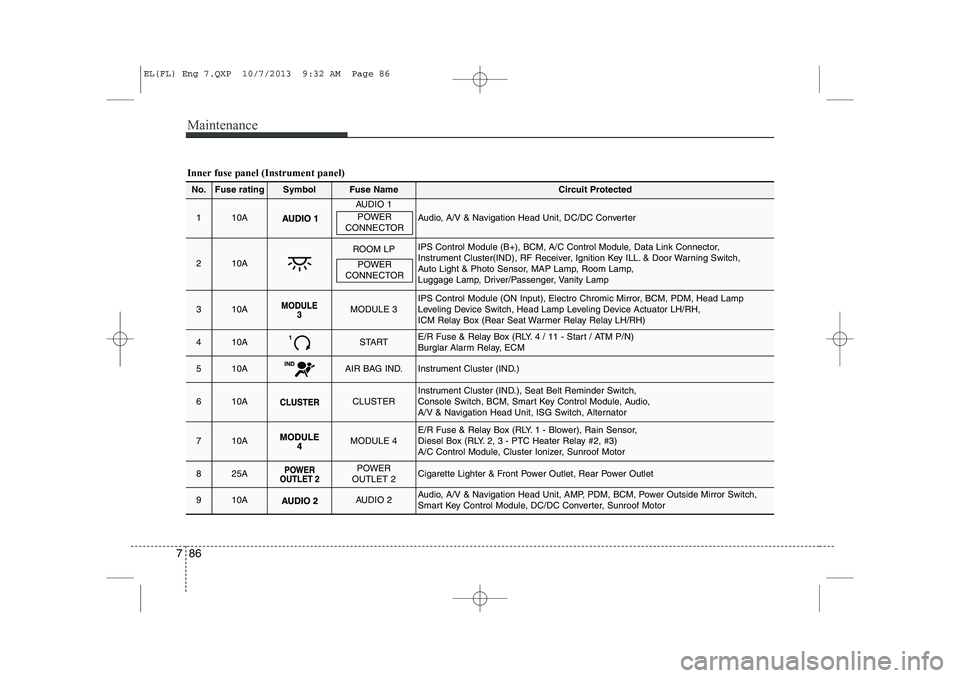
Inner fuse panel (Instrument panel)
No.Fuse ratingSymbolFuse NameCircuit Protected
110A
AUDIO 1
Audio, A/V & Navigation Head Unit, DC/DC Converter
210A
ROOM LPIPS Control Module (B+), BCM, A/C Control Module, Data Link Connector,
Instrument Cluster(IND), RF Receiver, Ignition Key ILL. & Door Warning Switch,
Auto Light & Photo Sensor, MAP Lamp, Room Lamp,
Luggage Lamp, Driver/Passenger, Vanity Lamp
310AMODULE 3IPS Control Module (ON Input), Electro Chromic Mirror, BCM, PDM, Head Lamp
Leveling Device Switch, Head Lamp Leveling Device Actuator LH/RH,
ICM Relay Box (Rear Seat Warmer Relay Relay LH/RH)
410ASTARTE/R Fuse & Relay Box (RLY. 4 / 11 - Start / ATM P/N)
Burglar Alarm Relay, ECM
510AAIR BAG IND.Instrument Cluster (IND.)
610ACLUSTERInstrument Cluster (IND.), Seat Belt Reminder Switch,
Console Switch, BCM, Smart Key Control Module, Audio,
A/V & Navigation Head Unit, ISG Switch, Alternator
710AMODULE 4E/R Fuse & Relay Box (RLY. 1 - Blower), Rain Sensor,
Diesel Box (RLY. 2, 3 - PTC Heater Relay #2, #3)
A/C Control Module, Cluster Ionizer, Sunroof Motor
825APOWER
OUTLET 2Cigarette Lighter & Front Power Outlet, Rear Power Outlet
910AAUDIO 2Audio, A/V & Navigation Head Unit, AMP, PDM, BCM, Power Outside Mirror Switch,
Smart Key Control Module, DC/DC Converter, Sunroof Motor
POWER
CONNECTOR
POWER
CONNECTOR
EL(FL) Eng 7.QXP 10/7/2013 9:32 AM Page 86
Page 952 of 1534
787
Maintenance
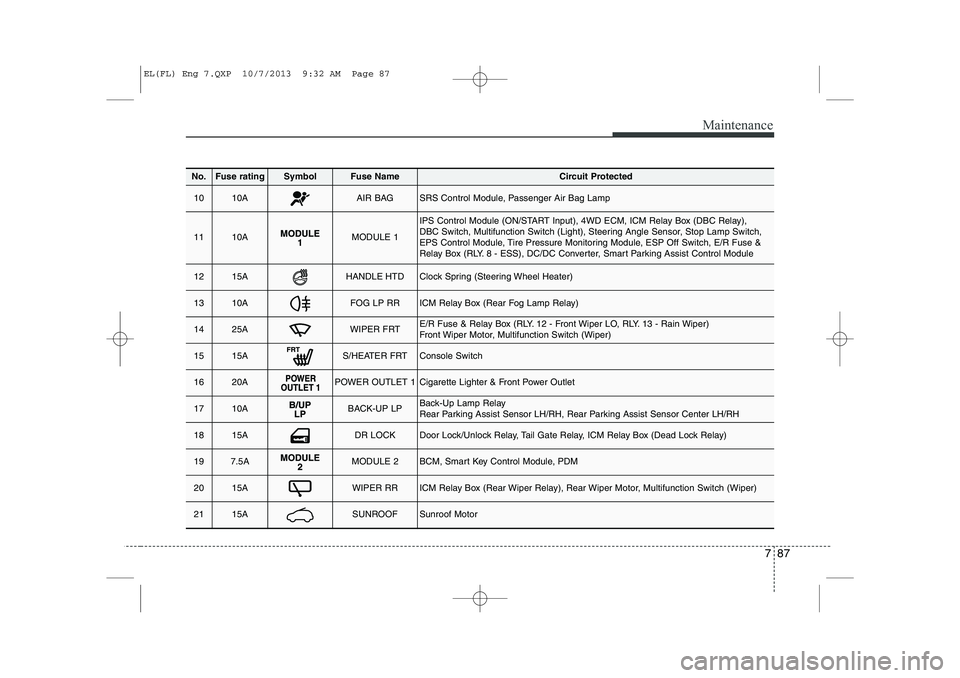
No.Fuse ratingSymbolFuse NameCircuit Protected
1010AAIR BAGSRS Control Module, Passenger Air Bag Lamp
1110AMODULE 1
IPS Control Module (ON/START Input), 4WD ECM, ICM Relay Box (DBC Relay),
DBC Switch, Multifunction Switch (Light), Steering Angle Sensor, Stop Lamp Switch,
EPS Control Module, Tire Pressure Monitoring Module, ESP Off Switch, E/R Fuse &
Relay Box (RLY. 8 - ESS), DC/DC Converter, Smart Parking Assist Control Module
1215AHANDLE HTDClock Spring (Steering Wheel Heater)
1310AFOG LP RRICM Relay Box (Rear Fog Lamp Relay)
1425AWIPER FRTE/R Fuse & Relay Box (RLY. 12 - Front Wiper LO, RLY. 13 - Rain Wiper)
Front Wiper Motor, Multifunction Switch (Wiper)
1515AS/HEATER FRTConsole Switch
1620APOWER OUTLET 1Cigarette Lighter & Front Power Outlet
1710ABACK-UP LPBack-Up Lamp Relay
Rear Parking Assist Sensor LH/RH, Rear Parking Assist Sensor Center LH/RH
1815ADR LOCKDoor Lock/Unlock Relay, Tail Gate Relay, ICM Relay Box (Dead Lock Relay)
197.5AMODULE 2BCM, Smart Key Control Module, PDM
2015AWIPER RRICM Relay Box (Rear Wiper Relay), Rear Wiper Motor, Multifunction Switch (Wiper)
2115ASUNROOFSunroof Motor
EL(FL) Eng 7.QXP 10/7/2013 9:32 AM Page 87
Page 955 of 1534
Maintenance
90
7
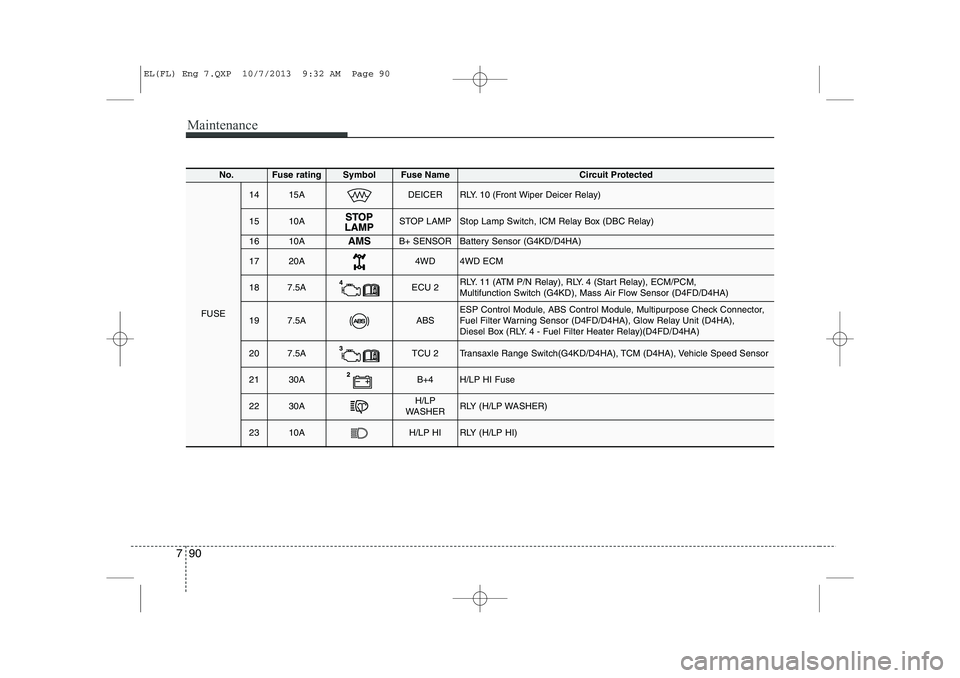
No.Fuse ratingSymbolFuse Name Circuit Protected
FUSE
1415ADEICERRLY. 10 (Front Wiper Deicer Relay)
1510ASTOP LAMPStop Lamp Switch, ICM Relay Box (DBC Relay)
1610AAMSB+ SENSORBattery Sensor (G4KD/D4HA)
1720A4WD4WD ECM
187.5AECU 2RLY. 11 (ATM P/N Relay), RLY. 4 (Start Relay), ECM/PCM,
Multifunction Switch (G4KD), Mass Air Flow Sensor (D4FD/D4HA)
197.5AABSESP Control Module, ABS Control Module, Multipurpose Check Connector,
Fuel Filter Warning Sensor (D4FD/D4HA), Glow Relay Unit (D4HA),
Diesel Box (RLY. 4 - Fuel Filter Heater Relay)(D4FD/D4HA)
207.5ATCU 2Transaxle Range Switch(G4KD/D4HA), TCM (D4HA), Vehicle Speed Sensor
2130AB+4H/LP HI Fuse
2230AH/LP
WASHERRLY (H/LP WASHER)
2310AH/LP HIRLY (H/LP HI)
EL(FL) Eng 7.QXP 10/7/2013 9:32 AM Page 90
Page 994 of 1534

Introduction
2
1
This Owners Manual is designed to help
vehicle users derive the greatest possi-
ble amount of enjoyment and satisfaction
from driving the HYUNDAI vehicle. It isstrongly recommended that the entire
manual is read in order that all of the fea-
tures, safety systems and maintenancerequirements are understood.
To minimise the RISK of death or injury,
the "WARNING" and "CAUTION" state-
ments must be read and understood
before operating the vehicle.
Illustrations are used throughout the
manual to complement written descrip-
tions intended to best explain how to
enjoy using the vehicle.
Reading this manual will assist the vehi-
cle user to learn about and understand
the features, important safety informa-
tion, and driving recommendations.
The general layout of the manual is pro-
vided in the Table of Contents. The index
has an alphabetical listing of all the infor-
mation contained in the manual. The
manual has eight sections plus an index.
Each section begins with a brief list ofcontents to easily identify at a glance if
that section contains the informationbeing sought. "WARNING", "CAUTION", and "NOTICE"
information is provided to enhance the
personal safety of the vehicle user. This
information must be carefully read and
followed.
✽✽
NOTICE
A NOTICE indicates interesting or help-
ful information is being provided.
Petrol engine
Unleaded
For the optimal vehicle performance, we
recommend you to use unleaded petrol
with an octane rating of RON (Research
Octane Number) 95 /AKI (Anti Knock
Index) 91 or higher.
You may use unleaded petrol with an
octane rating of RON 91~94/AKI 87~90
but it may result in slight performance
reduction of the vehicle.
HOW TO USE THIS MANUAL FUEL REQUIREMENTS
WARNING
A WARNING indicates a situation in
which harm, serious bodily injury ordeath could result if the warning isignored.
CAUTION
A CAUTION indicates a situation in which damage to your vehicle couldresult if the caution is ignored.
CAUTION
NEVER USE LEADED FUEL. Theuse of leaded fuel is detrimental to the catalytic converter and will
damage the engine control sys- tem’s oxygen sensor and affectemission control.
Never add any fuel system cleaningagents to the fuel tank other than
what has been specified. (We rec- ommend that you consult a HYUNDAI authorised repairer fordetails.)
EL(FL) UK 1.QXP 8/5/2013 6:21 PM Page 2
Page 1049 of 1534
343
Safety features of your vehicle
How does the air bag system operate
Air bags are activated (able to inflate ifnecessary) only when the ignition
switch is turned to the ON or STARTposition.
Air bags inflate instantly in the event of serious frontal or side collision (if
equipped with side air bag or curtainair bag) in order to help protect the
occupants from serious physical injury.
There is no single speed at which the air bags will inflate.
Generally, air bags are designed to
inflate based upon the severity of a col-
lision and its direction. These two fac-
tors determine whether the sensors
produce an electronic deployment/inflation signal.
Air bag deployment depends on a number of factors including vehiclespeed, angles of impact and the densi-
ty and stiffness of the vehicles or
objects which your vehicle hits in the
collision. The determining, factors are
not limited to those mentioned above.
The front air bags will completely inflate and deflate in an instant. It is virtually impossible for you to see
the air bags inflate during an accident.
It is much more likely that you will sim-ply see the deflated air bags hanging
out of their storage compartments afterthe collision.
In order to help provide protection in a severe collision, the air bags must
inflate rapidly. The speed of air bag
inflation is a consequence of extremely
short time in which a collision occursand the need to get the air bag
between the occupant and the vehicle
structures before the occupant impacts
those structures. This speed of inflation
reduces the risk of serious or life-
threatening injuries in a severe collision
and is thus a necessary part of air bagdesign.
However, air bag inflation can also
cause injuries which can include facial
abrasions, bruises and broken bonesbecause the inflation speed also caus-
es the air bags to expand with a great
deal of force.
There are even circumstances under which contact with the steer-
ing wheel air bag can cause fatal
injuries, especially if the occupant
is positioned excessively close tothe steering wheel.
WARNING
To avoid severe personal injury or death caused by deploying air
bags in a collision, the driver
should sit as far back from the
steering wheel air bag as possible
(at least (10 inches) 250 mm
away). The front passenger should
always move their seat as far
back as possible and sit back intheir seat.
Air bag inflates instantly in an event of a collision, passengers
may be injured by the air bag
expansion force if they are not in
a proper position.
Air bag inflation may cause injuries including facial or bodily
abrasions, injuries from broken
glasses or burns.
EL(FL) UK 3.QXP 8/5/2013 6:28 PM Page 43
Page 1053 of 1534
347
Safety features of your vehicle
SRS components and functions
The SRS consists of the following com- ponents:
1. Driver's front air bag module*
2. Front impact sensors*
3. Passenger's front air bag module*
4. Retractor pre-tensioner assemblies*
5. Side impact sensors*
6. Curtain air bag modules*
7. Side air bag modules*
8. SRS control module (SRSCM)
9. Air bag warning light
10. Anchor pre-tensioner assembly* (driver side)
11. Passenger’s front air bag ON/OFF switch*
12. Passenger’s front air bag ON/OFF indicator*
*: if equipped The SRSCM continually monitors all ele-
ments whilst the ignition switch is ON to
determine if a frontal, near-frontal impact
or side impact is severe enough to
require air bag deployment or pre-ten-
sioner seat belt deployment.
The SRS air bag warning light on the
instrument panel will illuminate for about
6 seconds after the ignition switch is
turned to the ON position, after which the
air bag warning light should go out.
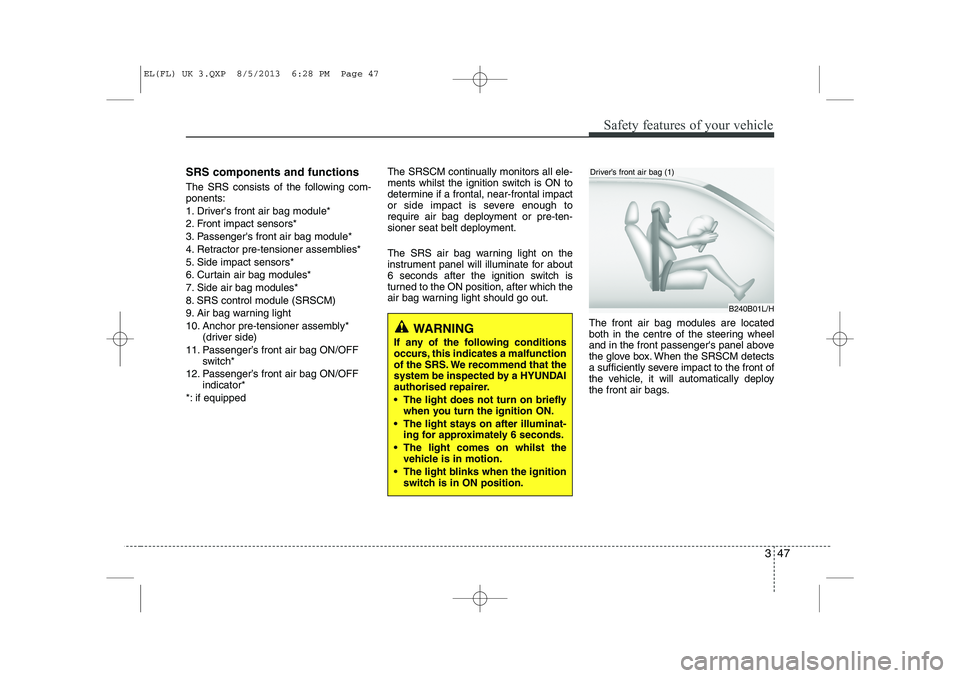
The front air bag modules are located
both in the centre of the steering wheel
and in the front passenger's panel above
the glove box. When the SRSCM detects
a sufficiently severe impact to the front of
the vehicle, it will automatically deploy
the front air bags.
WARNING
If any of the following conditions
occurs, this indicates a malfunction
of the SRS. We recommend that the
system be inspected by a HYUNDAI
authorised repairer.
The light does not turn on briefly when you turn the ignition ON.
The light stays on after illuminat- ing for approximately 6 seconds.
The light comes on whilst the vehicle is in motion.
The light blinks when the ignition switch is in ON position.
B240B01L/H
Driver’s front air bag (1)
EL(FL) UK 3.QXP 8/5/2013 6:28 PM Page 47