2014 HYUNDAI IX35 service
[x] Cancel search: servicePage 299 of 1534

75
Maintenance
MAINTENANCE SERVICES
You should exercise the utmost care to
prevent damage to your vehicle and
injury to yourself whenever performing
any maintenance or inspection proce-
dures.
Inadequate, incomplete or insufficient
servicing may result in operational prob-
lems with your vehicle that could lead to
vehicle damage, an accident, or person-
al injury. Owner’s responsibility
✽✽
NOTICE
Maintenance Service and Record
Retention are the owner's responsibility.
We recommend in general that you have
your vehicle serviced by an authorised
HYUNDAI dealer. You should retain doc-
uments that show proper maintenance
has been performed on your vehicle inaccordance with the scheduled mainte-
nance service charts shown on the fol-
lowing pages. You need this information
to establish your compliance with the
servicing and maintenance requirements
of your vehicle warranties. Detailed war-
ranty information is provided in your
Service Passport. Repairs and adjust-ments required as a result of improper
maintenance or a lack of required main-
tenance are not covered when your vehi-
cle is covered by warranty. Owner maintenance precautions
Improper or incomplete service may
result in problems. This section gives
instructions only for the maintenance
items that are easy to perform.✽✽
NOTICE
Improper owner maintenance during the warranty period may affect warran-
ty coverage. For details, read the sepa-
rate Service Passport provided with the
vehicle. If you're unsure about any serv-
icing or maintenance procedure, we rec-ommend that the system be serviced by
an authorised HYUNDAI dealer.
EL(FL) Aust 7.QXP 7/26/2013 2:22 PM Page 5
Page 300 of 1534

Maintenance
6
7
Engine compartment precautions (Diesel engine)
• The piezo injector operates at high
voltage (maximum 200v). Therefore,
the following accidents may occur.
- Direct contact with the injector or
injector wiring may cause electric
shock or damage your muscle or
nerve system.
- The electromagnetic wave from the operating injector may cause the arti-
ficial heart pacemaker to malfunction.
Follow the safety tips provided below, when you are checking the engine
room whilst the engine is running.
- Do not touch the injector, injector
wirings, and the engine computer
whilst the engine is running.
- Do not remove the injector connector whilst the engine is running.
- People using pacemakers must not go near the engine whilst the engine
is starting or running.
WARNING - Maintenance
work
Performing maintenance work on a vehicle can be dangerous. You
can be seriously injured whilst
performing some maintenance
procedures. If you lack sufficient
knowledge and experience or the
proper tools and equipment to do
the work, we recommend that the
system be serviced by an autho-
rised HYUNDAI dealer.
Working under the bonnet with the engine running is dangerous.
It becomes even more dangerous
when you wear jewelry or loose
clothing. These can become
entangled in moving parts and
result in injury. Therefore, if you
must run the engine whilst work-
ing under the bonnet, make cer-
tain that you remove all jewelry
(especially rings, bracelets,
watches, and necklaces) and all
neckties, scarves, and similar
loose clothing before gettingnear the engine or cooling fans.WARNING - Diesel Engine
Never work on injection system with engine running or within 30
seconds after shutting off engine.
High-pressure pump, rail, injectorsand high-pressure pipes are sub-
ject to high pressure even after the
engine stopped. The fuel jet pro-
duced by fuel leaks may cause seri-
ous injury, if it touches the body.
People using pacemakers should
not move than 30cm closer to theECU or wiring harness within the
engine room whilst engine is run-
ning, since the high currents in the
electronic engine control system
produce considerable magneticfields.
EL(FL) Aust 7.QXP 7/26/2013 2:22 PM Page 6
Page 303 of 1534
79
Maintenance
SCHEDULED MAINTENANCE SERVICE
Follow Normal Maintenance Schedule
if the vehicle is usually operated where
none of the following conditions apply. If
any of the following conditions apply, fol-
low Maintenance Under Severe Usage
Conditions.
Repeated short distance driving.
Driving in dusty conditions or sandy areas.
Extensive use of brakes.
Driving in areas where salt or other corrosive materials are being used.
Driving on rough or muddy roads.
Driving in mountainous areas.
Extended periods of idling or low speed operation.
Driving for a prolonged period in cold temperatures and/or extremely humid
climates.
More than 50% driving in heavy city traffic during hot weather above 32°C(90°F).
If your vehicle is operated under the
above conditions, you should inspect, replace or refill more frequently than thefollowing Normal Maintenance Schedule.
After the periods or distance shown inthe chart, continue to follow the pre- scribed maintenance intervals.
EL(FL) Aust 7.QXP 7/26/2013 2:22 PM Page 9
Page 304 of 1534

Maintenance
10
7
NORMAL MAINTENANCE SCHEDULE
The following maintenance services must be performed to ensure good emission control and performance. Keep receipts for all
vehicle emission services to protect your warranty. Where both mileage and time are shown, the frequency of service is deter-
mined by whichever occurs first. * 1
: Check the engine oil level and leak every 500 km or before
starting a long trip.
* 2
: The engine oil level should be checked regularly and main-
tained properly. Operating with an insufficient amount oil
can damage the engine, and such damage is not covered
by warranty.
* 3
: Inspect and if necessary correct or replace. Inspect drive
belt tensioner, idler and alternator, pulley and if necessary
correct or replace.
* 4
: The fuel filter is considered to be maintenance free but peri-
odic inspection is recommended for this maintenance
schedule depends on fuel quality. If there are some impor-
tant matters like fuel flow restriction, surging, loss of power,
hard starting problem etc, replace the fuel filter immediately
regardless of maintenance schedule. We recommend that
you consult an authorised HYUNDAI dealer for details.
* 5
: This maintenance schedule depends on fuel quality. It is
applicable only when using a qualified fuel <"EN590 or
equivalent">. If the diesel fuel specifications don't meet the
EN590, it must be replaced more frequently. HYUNDAI rec-
ommends "every 7,500km inspection, every 15,000kmreplacement". If there are some important safety matters like fuel flow
restriction, surging, loss of power, hard starting problemetc., replace the fuel filter immediately regardless of main-
tenance schedule. We recommend that you consult an
authorised HYUNDAI dealer for details.
* 6
: Manual transaxle fluid, transfer case oil and rear differential
oil should be changed anytime they have been submerged
in water.
* 7
: When adding coolant, use only deionized water or soft
water for your vehicle and never mix hard water in the
coolant filled at the factory. An improper coolant mixture can
result in serious malfunction or engine damage.
* 8
: For your convenience, it can be replaced prior to it's interval
when you do maintenance of other items.
* 9
: If good quality petrols meet Europe Fuel standards (EN228)
or equivalents including fuel additives is not available, one
bottle of additive is recommended. Additives are available
from your authorised HYUNDAI dealer along with informa-
tion on how to use them. Do not mix other additives.
EL(FL) Aust 7.QXP 7/26/2013 2:22 PM Page 10
Page 310 of 1534

Maintenance
16
7
NORMAL MAINTENANCE SCHEDULE (CONT.)
120,000 km or 96 months
❑ Inspect air cleaner filter
❑ Inspect air conditioner refrigerant/compressor (if equipped)
❑ Inspect battery condition
❑ Inspect brake lines, hoses and connections
❑ Inspect cooling system
(At first, inspect 60,000 km or 48 months
after that, inspect every 30,000 km or 24 months)
❑ Inspect disc brakes and pads
❑ Inspect drive belt (Petrol) * 3
❑ Inspect drive belt (Diesel) * 3
(At first, inspect 90,000 km or 48 months
after that, inspect every 30,000 km or 24 months)
❑ Inspect drive shafts and boots
❑ Inspect exhaust system
❑ Inspect front suspension ball joints
❑ Inspect fuel lines, fuel hoses and connections (Diesel)
❑ Inspect fuel lines, fuel hoses and connections (Petrol)
❑ Inspect manual transaxle fluid (if equipped) * 6
❑ Inspect parking brake
❑ Inspect propeller shaft (4WD) (if equipped)
❑ Inspect rear differential oil (4WD) * 6
(Continued)
(Continued)
❑
Inspect steering gear rack, linkage and boots
❑ Inspect tyre (pressure & tread wear)
❑ Inspect transfer case oil (4WD) * 6
❑ Inspect vapour hose and fuel filler cap
❑ Replace brake/clutch(if equipped) fluid
❑ Replace climate control air filter (if equipped)
❑ Replace coolant * 7
(At first 210,000 km or 120 months,
after every 30,000 km or 24 months) * 8
❑ Replace engine oil and filter * 1
*2
❑ Replace fuel filter (Petrol) * 4
❑ Replace fuel filter cartridge (Diesel) * 5
❑ Replace fuel tank air filter (Petrol)
❑ Replace spark plugs (Petrol)
(Every 150,000 km or 120 months)
❑ Add fuel additives * 9
❈ Inspect : Inspect and if necessary, adjust, correct, clean or
replace.
No check, No service required
❑Automatic transaxle fluid
EL(FL) Aust 7.QXP 7/26/2013 2:22 PM Page 16
Page 311 of 1534
717
Maintenance
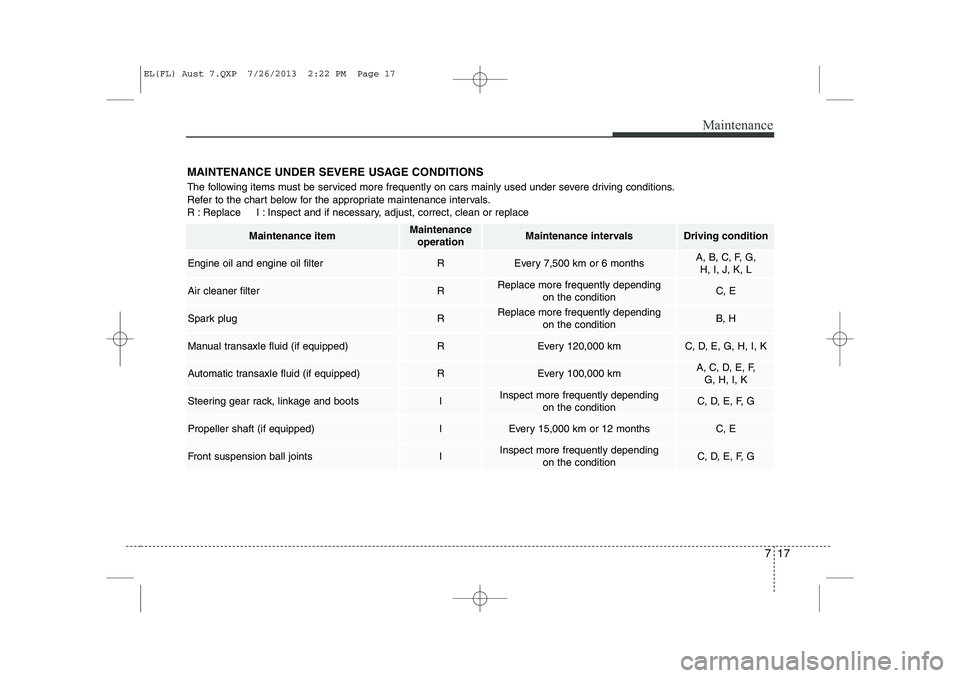
MAINTENANCE UNDER SEVERE USAGE CONDITIONS
The following items must be serviced more frequently on cars mainly used under severe driving conditions.
Refer to the chart below for the appropriate maintenance intervals.
R : Replace I : Inspect and if necessary, adjust, correct, clean or replace
Maintenance itemMaintenanceoperationMaintenance intervalsDriving condition
Engine oil and engine oil filterREvery 7,500 km or 6 monthsA, B, C, F, G, H, I, J, K, L
Air cleaner filterRReplace more frequently depending on the conditionC, E
Spark plugRReplace more frequently depending on the conditionB, H
Manual transaxle fluid (if equipped)REvery 120,000 kmC, D, E, G, H, I, K
Automatic transaxle fluid (if equipped)REvery 100,000 kmA, C, D, E, F, G, H, I, K
Steering gear rack, linkage and bootsIInspect more frequently depending
on the conditionC, D, E, F, G
Propeller shaft (if equipped) IEvery 15,000 km or 12 monthsC, E
Front suspension ball jointsIInspect more frequently depending on the conditionC, D, E, F, G
EL(FL) Aust 7.QXP 7/26/2013 2:22 PM Page 17
Page 331 of 1534
737
Maintenance
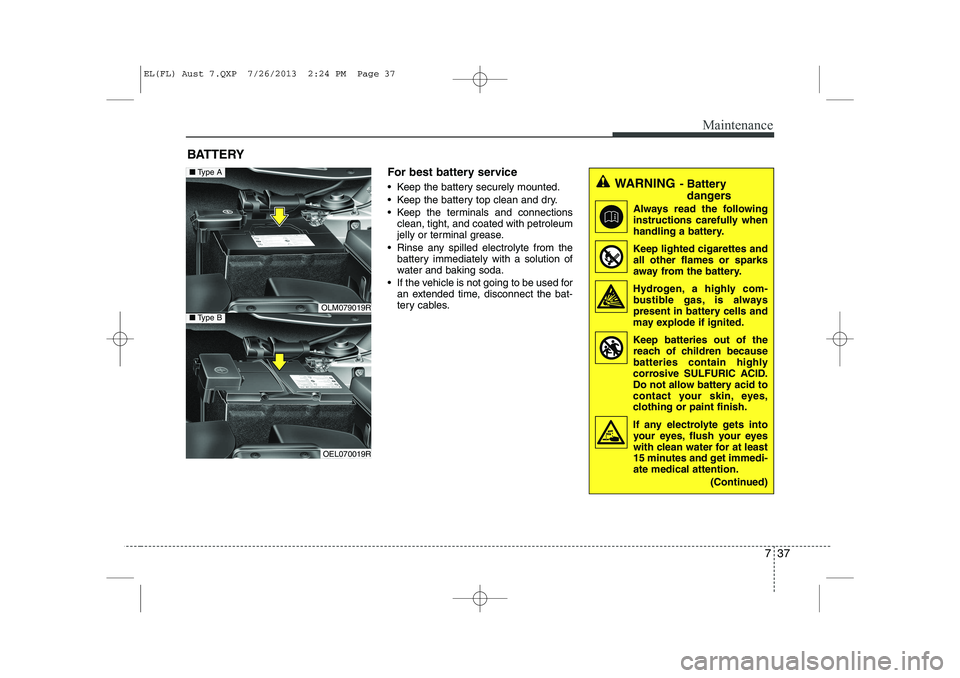
BATTERYFor best battery service
Keep the battery securely mounted.
Keep the battery top clean and dry.
Keep the terminals and connectionsclean, tight, and coated with petroleum
jelly or terminal grease.
Rinse any spilled electrolyte from the battery immediately with a solution of
water and baking soda.
If the vehicle is not going to be used for an extended time, disconnect the bat-
tery cables.
WARNING - Battery
dangers
Always read the following
instructions carefully when
handling a battery.
Keep lighted cigarettes and all other flames or sparks
away from the battery.
Hydrogen, a highly com- bustible gas, is always
present in battery cells and
may explode if ignited.
Keep batteries out of the reach of children because
batteries contain highly
corrosive SULFURIC ACID.
Do not allow battery acid to
contact your skin, eyes,
clothing or paint finish.
If any electrolyte gets into your eyes, flush your eyes
with clean water for at least
15 minutes and get immedi-ate medical attention.
(Continued)
OLM079019R
OEL070019R
■Type A
■Type B
EL(FL) Aust 7.QXP 7/26/2013 2:24 PM Page 37
Page 342 of 1534

Maintenance
48
7
4. Tyre ply composition and material
The number of layers or plies of rub-
ber-coated fabric are in the tyre. Tyre
manufacturers also must indicate the
materials in the tyre, which include
steel, nylon, polyester, and others.
The letter "R" means radial ply con-
struction; the letter "D" means diago-
nal or bias ply construction; and theletter "B" means belted-bias ply con-
struction.
5. Maximum permissible inflation
pressure
This number is the greatest amount of air pressure that should be put in
the tyre. Do not exceed the maximum
permissible inflation pressure. Refer
to the Tyre and Loading Information
label for recommended inflation
pressure.
6. Maximum load rating
This number indicates the maximum
load in kilograms and pounds that
can be carried by the tyre. When
replacing the tyres on the vehicle,
always use a tyre that has the same
load rating as the factory installed
tyre.
7. Uniform tyre quality grading
Quality grades can be found where
applicable on the tyre sidewall
between tread shoulder and maxi-
mum section width.
For example:
TREADWEAR 200
TRACTION AA
TEMPERATURE A Tread wear
The tread wear grade is a compara-
tive rating based on the wear rate ofthe tyre when tested under controlled
conditions on a specified govern-
ment test course. For example, a tyre
graded 150 would wear one-and-a-
half times (1½) as well on the gov-
ernment course as a tyre graded100.
The relative performance of tyres depends upon the actual conditions
of their use, however, and may
depart significantly from the norm
because of variations in driving
habits, service practices and differ-
ences in road characteristics and cli-
mate.
These grades are molded on the
side-walls of passenger vehicle
tyres. The tyres available as standard
or optional equipment on your vehi-
cles may vary with respect to grade.
WARNING - Tyre age
Tyres degrade over time, even
when they are not being used.
Regardless of the remaining
tread, it is recommended that
tyres generally be replaced
after six (6) years of normal
service. Heat caused by hot cli-mates or frequent high loadingconditions can accelerate the
aging process. Failure to follow
this Warning can result in sud-
den tyre failure, which could
lead to a loss of control and an
accident involving serious
injury or death.
EL(FL) Aust 7.QXP 7/26/2013 2:24 PM Page 48