2014 HYUNDAI IX35 trailer
[x] Cancel search: trailerPage 407 of 1534

Stowing the rear seat belt ................................................3-23
Sun visor ........................................................................4-127
Sunglass holder ..............................................................4-124
Sunroof, see panorama sunroof ......................................4-30
Tachometer ......................................................................4-48
Tailgate ............................................................................4-19
Tether anchor system ......................................................3-34
Theft-alarm system ..........................................................4-13
Tilt steering ......................................................................4-35
Towing..............................................................................6-14
Trailer towing ..................................................................5-61
TransaxleAutomatic transaxle....................................................5-18
Manual transaxle ........................................................5-15
Transaxle Shift Indicator..................................................4-52
Trip A/B ..........................................................................4-64
Trip computer ..................................................................4-63 Fuel Economy ............................................................4-65
Trip A/B ......................................................................4-64
TSA (Trailer stability assist) ............................................5-43
Turn signals ......................................................................4-91
Tyre chains ......................................................................5-58
Tyre rotation ....................................................................7-43
Tyre specification and pressure label ..............................8-10
Tyres and wheels ......................................................7-40, 8-4 Checking tyre inflation pressure ................................7-42
Compact spare tyre replacement ................................7-45
Recommended cold tyre inflation pressures ..............7-43
Tyre care ....................................................................7-43
Tyre maintenance ......................................................7-46
Tyre replacement ........................................................7-44
Tyre rotation ..............................................................7-43
Tyre sidewall labeling ................................................7-46
Tyre traction ..............................................................7-46
Wheel alignment and tyre balance ............................7-44
Wheel replacement ....................................................7-45
User Settings Mode ..........................................................4-55
Vanity mirror lamp ........................................................4-100
Vehicle run-in process ........................................................1-6
Vehicle certification label ..................................................8-9
Vehicle handling instructions ............................................1-6
Vehicle identification number (VIN) ................................8-9
Vehicle stability management ..........................................5-39
Vehicle weight..................................................................5-71
I 10
Index
V
T
U
EL(FL) Aust Index.qxp 7/26/2013 2:14 PM Page 10
Page 414 of 1534
Introduction
6
1
As with other vehicles of this type, failure
to operate this vehicle correctly mayresult in loss of control, an accident or
vehicle rollover.
Specific design characteristics (higher
ground clearance, track, etc.) give this
vehicle a higher center of gravity than
other types of vehicles. In other words
they are not designed for cornering at the
same speeds as conventional 2-wheel
drive vehicles. Avoid sharp turns or
abrupt maneuvers. Again, failure to oper-
ate this vehicle correctly may result in
loss of control, an accident or vehicle
rollover. Be sure to read the “Reducing
the risk of a rollover” driving guide-
lines, in section 5 of this manual. No special break-in period is needed. By
following a few simple precautions for the
first 1,000 km (600 miles) you may add to
the performance, economy and life of
your vehicle.
Do not race the engine.
While driving, keep your engine speed
(rpm, or revolutions per minute)
between 2,000 rpm and 4,000 rpm.
Do not maintain a single speed for long
periods of time, either fast or slow.
Varying engine speed is needed to
properly break-in the engine.
Avoid hard stops, except in emergen- cies, to allow the brakes to seat prop-
erly.
Don't let the engine idle longer than 3
minutes at one time.
Don't tow a trailer during the first 2,000 km (1,200 miles) of operation.
VEHICLE BREAK-IN PROCESS
VEHICLE HANDLING
INSTRUCTIONS
EL(FL) Eng 1.QXP 8/8/2013 6:52 PM Page 6
Page 573 of 1534

483
Features of your vehicle
Non-operational conditions
The rear parking assist system may not
operate properly when:
1. Moisture is frozen to the sensor. (It willoperate normally when the moisture has been cleared.)
2. The sensor is covered with foreign matter, such as snow or water, or the
sensor cover is blocked. (It will operate
normally when the material is removed
or the sensor is no longer blocked.)
3. Driving on uneven road surfaces. (unpaved roads, gravel, bumps, gradi-ent)
4. Objects generating excessive noise (vehicle horns, loud motorcycle
engines, or truck air brakes) are within
range of the sensor.
5. Heavy rain or water spray exists.
6. Wireless transmitters or mobile phones are within range of the sensor.
7. The sensor is covered with snow.
8. Trailer towing.
9. The place light the fluorescent lamp. The detecting range may decrease when:
1. The sensor is stained with foreign mat-
ter such as snow or water. (The sens-
ing range will return to normal when
removed.)
2. Outside air temperature is extremely hot or cold.
The following objects may not be recog-
nized by the sensor:
1. Sharp or slim objects such as ropes, chains or small poles.
2. Objects which tend to absorb the sen- sor frequency such as clothes, spongy
material or snow.
3. Undetectable objects smaller than 1 m (40 in.) in height and narrower than 14
cm (6 in.) in diameter.
Rear parking assist system precau-
tions
The rear parking assist system may not sound sequentially depending on the speed and shapes of the objectsdetected.
The rear parking assist system may malfunction if the vehicle bumperheight or sensor installation has been
modified or damaged. Any non-factory
installed equipment or accessories
may also interfere with the sensor per-
formance.
The sensor may not recognize objects less than 30 cm (11.8 in.) from the sen-
sor, or it may sense an incorrect dis-
tance. Use caution.
When the sensor is frozen or stained with snow, dirt, or water, the sensor
may be inoperative until the stains are
removed using a soft cloth.
Do not push, scratch or strike the sen- sor. Sensor damage could occur.
EL(FL) Eng 4A.QXP 7/11/2013 11:34 AM Page 83
Page 578 of 1534
Features of your vehicle
88
4
Operating condition
Use the smart parking assist system as
follows when all conditions are satisfied.
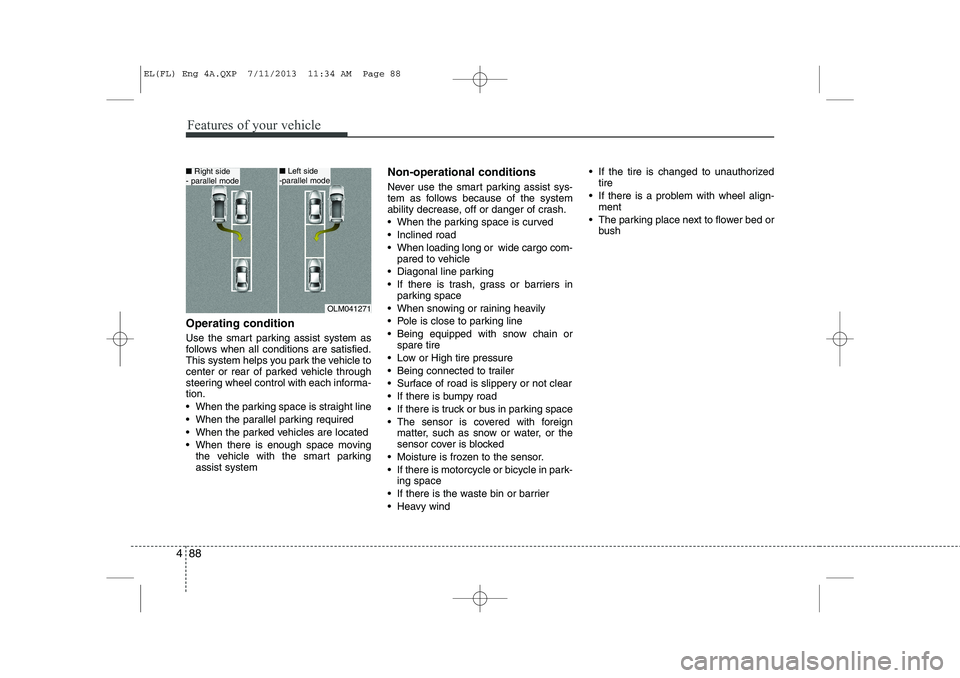
This system helps you park the vehicle to
center or rear of parked vehicle through
steering wheel control with each informa-tion.
When the parking space is straight line
When the parallel parking required
When the parked vehicles are located
When there is enough space moving
the vehicle with the smart parking assist system Non-operational conditions
Never use the smart parking assist sys-
tem as follows because of the system
ability decrease, off or danger of crash.
When the parking space is curved
Inclined road
When loading long or wide cargo com-
pared to vehicle
Diagonal line parking
If there is trash, grass or barriers in parking space
When snowing or raining heavily
Pole is close to parking line
Being equipped with snow chain or spare tire
Low or High tire pressure
Being connected to trailer
Surface of road is slippery or not clear
If there is bumpy road
If there is truck or bus in parking space
The sensor is covered with foreign matter, such as snow or water, or the
sensor cover is blocked
Moisture is frozen to the sensor.
If there is motorcycle or bicycle in park- ing space
If there is the waste bin or barrier
Heavy wind If the tire is changed to unauthorized
tire
If there is a problem with wheel align- ment
The parking place next to flower bed or bush
OLM041271
■Right side
- parallel mode■ Left side
-parallel mode
EL(FL) Eng 4A.QXP 7/11/2013 11:34 AM Page 88
Page 802 of 1534
Driving your vehicle
48
5
Trailer stability assist system continuous-
ly analyzes the vehicle and trailer insta-
bility. When the Trailer stability assist sys-
tem detects some sway, the brakes are
applied automatically to stabilize the
vehicle on the front wheel. However, if it
is not enough to stabilize, the brakes areapplied on all wheels automatically and
engine power is properly reduced. When
the vehicle is stable from swaying, trailer
stability assist system does not operate. Good braking practices
Check to be sure the parking brake is
not engaged and that the parking
brake indicator light is out before driv-
ing away.
Driving through water may get the brakes wet. They can also get wet
when the vehicle is washed. Wet
brakes can be dangerous! Your vehicle
will not stop as quickly if the brakes are
wet. Wet brakes may cause the vehicle
to pull to one side.
To dry the brakes, apply the brakes
lightly until the braking action returns to
normal, taking care to keep the vehicle
under control at all times. If the braking
action does not return to normal, stop
as soon as it is safe to do so and we
recommend that you call an authorized
HYUNDAI dealer for assistance.
Don't coast down hills with the vehicle out of gear. This is extremely haz-
ardous. Keep the vehicle in gear at all
times, use the brakes to slow down,
then shift to a lower gear so that
engine braking will help you maintain a
safe speed.
WARNING
Whenever you leave or park your vehicle, always set the parking
brake as far as possible and fully
engage the vehicle's transaxle
into the P (Park) position. If the
parking brake is not fully
engaged, the vehicle may move
inadvertently and injure yourself
and others.
All vehicles should always have the parking brake fully engaged
when parking to avoid inadver-
tent movement of the vehicle
which can injure occupants orpedestrians.
EL(FL) Eng 5.QXP 7/11/2013 11:04 AM Page 48
Page 819 of 1534
565
Driving your vehicle
If you are considering towing with your
vehicle, you should first check with your
country's Department of Motor Vehicles
to determine their legal requirements.
Since laws vary the requirements for tow-
ing trailers, cars, or other types of vehi-
cles or apparatus may differ. We recom-
mend that you ask an authorized
HYUNDAI dealer.✽✽NOTICE - For Europe
Page 820 of 1534

Driving your vehicle
66
5
Hitches
It's important to have the correct hitch
equipment. Crosswinds, large trucks
going by, and rough roads are a few rea-
sons why you’ll need the right hitch. Here
are some rules to follow:
Will you have to make any holes in the
body of your vehicle when you install a
trailer hitch? If you do, then be sure to
seal the holes later when you removethe hitch.
If you don’t seal them, deadly carbon
monoxide (CO) from your exhaust can
get into your vehicle, as well as dirt and
water.
The bumpers on your vehicle are not intended for hitches. Do not attach
rental hitches or other bumper-type
hitches to them. Use only a frame-mounted hitch that does not attach to
the bumper.
A HYUNDAI accessory trailer hitch is available at an authorized HYUNDAI
dealer. Left side
Right side
EL(FL) Eng 5.QXP 7/11/2013 11:05 AM Page 66
Page 821 of 1534

567
Driving your vehicle
Safety chains
You should always attach chains
between your vehicle and your trailer.
Cross the safety chains under the tongue
of the trailer so that the tongue will not
drop to the road if it becomes separatedfrom the hitch.
Instructions about safety chains may be
provided by the hitch manufacturer or by
the trailer manufacturer. Follow the man-
ufacturer’s recommendation for attaching
safety chains. Always leave just enough
slack so you can turn with your trailer.
And, never allow safety chains to drag on
the ground.Trailer brakes
If your trailer is equipped with a braking
system, make sure it conforms to your
country’s regulations and that it is prop-
erly installed and operating correctly.
If your trailer weight exceeds the maxi-
mum allowed weight without trailer
brakes, then the trailer will also require its
own brakes as well. Be sure to read and
follow the instructions for the trailer
brakes so you’ll be able to install, adjust
and maintain them properly.
Don’t tap into or modify your vehicle's
brake system. Driving with a trailer
Towing a trailer requires a certain
amount of experience. Before setting out
for the open road, you must get to know
your trailer. Acquaint yourself with the
feel of handling and braking with the
added weight of the trailer. And always
keep in mind that the vehicle you are
driving is now a good deal longer and not
nearly so responsive as your vehicle is
by itself.
Before you start, check the trailer hitch
and platform, safety chains, electrical
connector(s), lights, tires and mirror
adjustment. If the trailer has electric
brakes, start your vehicle and trailer mov-
ing and then apply the trailer brake con-
troller by hand to be sure the brakes are
working. This lets you check your electri-
cal connection at the same time.
During your trip, check occasionally to be
sure that the load is secure, and that the
lights and any trailer brakes are still work-ing.
WARNING
- Trailer brakes
Do not use a trailer with its own
brakes unless you are absolutely
certain that you have properly set
up the brake system. This is not a
task for amateurs. Use an experi-
enced, competent trailer shop for
this work.
EL(FL) Eng 5.QXP 7/11/2013 11:05 AM Page 67