2014 HYUNDAI IX35 service
[x] Cancel search: servicePage 978 of 1534

7 113
Maintenance
EMISSION CONTROL SYSTEM
The emission control system of your
vehicle is covered by a written limited
warranty. Please see the warranty infor-
mation contained in the Service Passport
in your vehicle.
Your vehicle is equipped with an emis- sion control system to meet all emission
regulations. There are three emission control sys-
tems which are as follows.
(1) Crankcase emission control system
(2) Evaporative emission control system(3) Exhaust emission control system In order to assure the proper function of
the emission control systems, it is rec-
ommended that you have your car
inspected and maintained by an author-
ized HYUNDAI dealer or other repairshops that use qualified technicians inaccordance with the maintenance sched-
ule in this manual. Caution for the Inspection and
Maintenance Test (With Electronic
Stability Program (ESP) system)
To prevent the vehicle from misfir-
ing during dynamometer testing,
turn the Electronic Stability
Program (ESP) system off by press-
ing the ESP switch.
After dynamometer testing is com- pleted, turn the ESP system back on
by pressing the ESP switch again.
1. Crankcase emission control system
The positive crankcase ventilation sys-
tem is employed to prevent air pollution
caused by blow-by gases being emitted
from the crankcase. This system supplies
fresh filtered air to the crankcase through
the air intake hose. Inside the crankcase,
the fresh air mixes with blow-by gases,
which then pass through the PCV valveinto the induction system. 2. Evaporative emission control
System
The Evaporative Emission Control
System is designed to prevent fuel
vapors from escaping into the atmos-
phere.
Canister
Fuel vapors generated inside the fuel tank are absorbed and stored in the
onboard canister. When the engine is
running, the fuel vapors absorbed in the
canister are drawn into the surge tank
through the purge control solenoid valve.
Purge Control Solenoid Valve (PCSV)
The purge control solenoid valve is con-
trolled by the Engine Control Module
(ECM); when the engine coolant temper-
ature is low during idling, the PCSV clos-
es so that evaporated fuel is not taken
into the engine. After the engine warms-
up during ordinary driving, the PCSV
opens to introduce evaporated fuel to the
engine.
EL(FL) Eng 7.QXP 10/7/2013 9:33 AM Page 113
Page 992 of 1534
811
Specifications & Consumer information
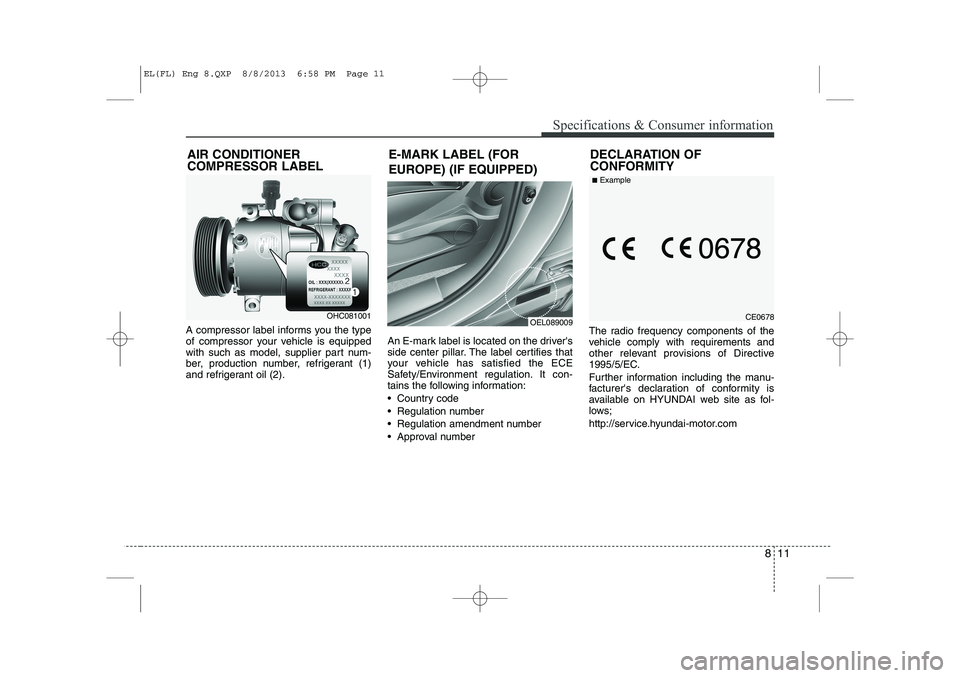
A compressor label informs you the type
of compressor your vehicle is equipped
with such as model, supplier part num-
ber, production number, refrigerant (1)
and refrigerant oil (2).An E-mark label is located on the driver's
side center pillar. The label certifies that
your vehicle has satisfied the ECE
Safety/Environment regulation. It con-
tains the following information:
Country code
Regulation number
Regulation amendment number
Approval numberThe radio frequency components of the
vehicle comply with requirements and
other relevant provisions of Directive
1995/5/EC.
Further information including the manu-
facturer's declaration of conformity is
available on HYUNDAI web site as fol-
lows;
http://service.hyundai-motor.comOEL089009
AIR CONDITIONER COMPRESSOR LABELOHC081001
E-MARK LABEL (FOR
EUROPE) (IF EQUIPPED)
DECLARATION OF CONFORMITYCE0678
■
Example
EL(FL) Eng 8.QXP 8/8/2013 6:58 PM Page 11
Page 1032 of 1534
Safety features of your vehicle
26
3
WARNING
Pre-tensioners are designed to operate only one time. After acti-
vation, pre-tensioner seat belts
must be replaced. All seat belts,
of any type, should always be
replaced after they have been
worn during a collision.
The pre-tensioner seat belt assembly mechanisms become
hot during activation. Do not
touch the pre-tensioner seat belt
assemblies for several minutes
after they have been activated.
Do not attempt to inspect or replace the pre-tensioner seat
belts yourself. We recommend
that the system be serviced by a
HYUNDAI authorised repairer.
Do not strike the pre-tensioner seat belt assemblies.
Do not attempt to service or repair the pre-tensioner seat belt
system in any manner.
(Continued)CAUTION
If the pre-tensioner seat belt is notworking properly, this warning light
will illuminate even if there is nomalfunction of the SRS air bag. Ifthe SRS air bag warning light does not illuminate when the ignition
switch is turned to ON, or if itremains illuminated after illuminat-ing for approximately 6 seconds, or
if it illuminates whilst the vehicle isbeing driven, we recommend thatthe system be inspected by aHYUNDAI authorised repairer.
(Continued)
Improper handling of the pre-ten- sioner seat belt assemblies, and failure to heed the warnings not
to strike, modify, inspect, replace,
service or repair the pre-tension-
er seat belt assemblies may lead
to improper operation or inadver-
tent activation and serious injury.
Always wear the seat belts when driving or riding in a motor vehi-
cle.
If the vehicle or pre-tensioner seat belt must be discarded, we
recommend that you contact a
HYUNDAI authorised repairer.
EL(FL) UK 3.QXP 8/5/2013 6:27 PM Page 26
Page 1061 of 1534
355
Safety features of your vehicle
• The side air bags are designed todeploy only during certain side-impact
collisions, depending on the crash
severity, angle, speed and point ofimpact.
The side air bags do not only deploy on the side of the impact but also on the
opposite side.(Continued)
• Use of seat covers could reduceor prevent the effectiveness of the system.
Do not install any accessories on the side or near the side air bag.
Do not place any objects over the air bag or between the air bag
and yourself.
Do not place any objects (an umbrella, bag, etc.) between the
front door and the front seat.
Such objects may become dan-
gerous projectiles and cause
injury if the supplemental side air
bag inflates.
To prevent unexpected deploy- ment of the side air bag that may
result in personal injury, avoidimpact to the side impact sensor
when the ignition key is on.
If seat or seat cover is damaged, we recommend that the system
be serviced by a HYUNDAI autho-
rised repairer. Inform that your
vehicle is equipped with side air
bags.WARNING
The side air bag is supplemental to the driver's and the passen-
ger's seat belt systems and is not
a substitute for them. Therefore
your seat belts must be worn at
all times whilst the vehicle is in
motion. The air bags deploy only
in certain side impact conditions
severe enough to cause signifi-
cant injury to the vehicle occu-pants.
For best protection from the side air bag system and to avoid being
injured by the deploying side air
bag, both front seat occupantsshould sit in an upright position
with the seat belt properly fas-
tened. The driver's hands shouldbe placed on the steering wheelat the 9:00 and 3:00 positions.
The passenger's arms and handsshould be placed on their laps.
Do not use any accessory seat covers.
(Continued)
WARNING
Do not allow the passengers to lean
their heads or bodies onto doors,
put their arms on the doors, stretch
their arms out of the window, or
place objects between the doors
and passengers when they areseated on seats equipped with side
and/or curtain air bags.
EL(FL) UK 3.QXP 8/5/2013 6:37 PM Page 55
Page 1063 of 1534
357
Safety features of your vehicle
(Continued)
Do not allow the passengers tolean their heads or bodies onto
doors, put their arms on the
doors, stretch their arms out of
the window, or place objects
between the doors and passen-
gers when they are seated onseats equipped with side and/or
curtain air bags.
Never try to open or repair any components of the side curtain
air bag system. We recommend
that the system be serviced by a
HYUNDAI authorised repairer.
Failure to follow the above men-tioned instructions can result in
injury or death to the vehicle occu-pants in an accident.
EL(FL) UK 3.QXP 8/5/2013 6:34 PM Page 57
Page 1065 of 1534
359
Safety features of your vehicle
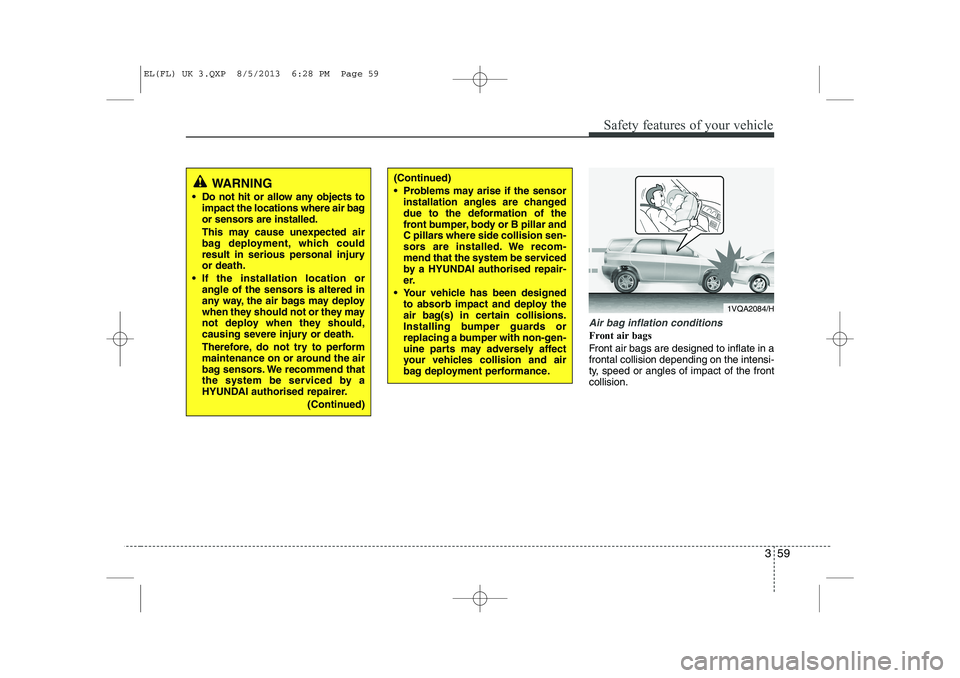
Air bag inflation conditions
Front air bags
Front air bags are designed to inflate in a frontal collision depending on the intensi-
ty, speed or angles of impact of the frontcollision.
WARNING
Do not hit or allow any objects to impact the locations where air bag
or sensors are installed.
This may cause unexpected air
bag deployment, which could
result in serious personal injuryor death.
If the installation location or angle of the sensors is altered in
any way, the air bags may deploy
when they should not or they may
not deploy when they should,
causing severe injury or death.
Therefore, do not try to perform
maintenance on or around the air
bag sensors. We recommend that
the system be serviced by a
HYUNDAI authorised repairer.
(Continued)(Continued)
Problems may arise if the sensorinstallation angles are changed
due to the deformation of the
front bumper, body or B pillar and
C pillars where side collision sen-
sors are installed. We recom-
mend that the system be serviced
by a HYUNDAI authorised repair-
er.
Your vehicle has been designed to absorb impact and deploy the
air bag(s) in certain collisions.
Installing bumper guards or
replacing a bumper with non-gen-
uine parts may adversely affect
your vehicles collision and air
bag deployment performance.
1VQA2084/H
EL(FL) UK 3.QXP 8/5/2013 6:28 PM Page 59
Page 1069 of 1534
363
Safety features of your vehicle
SRS Care
The SRS is virtually maintenance-free
and so there are no parts you can safely
service by yourself. If the SRS air bag
warning light does not illuminate, or con-
tinuously remains on, we recommend
that the system be inspected by a
HYUNDAI authorised repairer.
WARNING
Modification to SRS components or wiring, including the addition
of any kind of badges to the pad
covers or modifications to the
body structure, can adversely
affect SRS performance and lead
to possible injury.
For cleaning the air bag pad cov- ers, use only a soft, dry cloth or
one which has been moistened
with plain water. Solvents or
cleaners could adversely affect
the air bag covers and proper
deployment of the system.
No objects should be placed over or near the air bag modules on
the steering wheel, instrument
panel, and the front passenger's
panel above the glove box,
because any such object could
cause harm if the vehicle is in a
crash severe enough to cause
the air bags to inflate.
If the air bags inflate, we recom- mend that the system be
replaced by a HYUNDAI autho-
rised repairer.
(Continued)(Continued)
Do not tamper with or disconnectSRS wiring, or other components
of the SRS system. Doing so
could result in injury, due to acci-
dental inflation of the air bags or
by rendering the SRS inopera-
tive.
If components of the air bag sys- tem must be discarded, or if the
vehicle must be scrapped, certain
safety precautions must be
observed. We recommend that
you contact a HYUNDAI autho-
rised repairer for these precau-
tions and necessary information.
Failure to follow these precau-
tions and procedures could
increase the risk of personal
injury.
If your car was flooded and has soaked carpeting or water on
flooring, you shouldn't try to start
the engine; we recommend that
you contact a HYUNDAI autho-
rised repairer.
EL(FL) UK 3.QXP 8/5/2013 6:28 PM Page 63
Page 1077 of 1534
Features of your vehicle
6
4
CAUTION
The transponder in your ignition
key is an important part of the
immobiliser system. It is designedto give years of trouble-free service,however you should avoid expo- sure to moisture, static electricity
and rough handling. Immobilisersystem malfunction could occur.
CAUTION
Do not change, alter or adjust theimmobiliser system because it
could cause the immobiliser sys-tem to malfunction. We recommend that the system be serviced by aHYUNDAI authorised repairer.
Malfunctions caused by improperalterations, adjustments or modifi-cations to the immobiliser system are not covered by your vehicle
manufacturer warranty.
EL(FL) UK 4A.QXP 8/5/2013 6:38 PM Page 6