2014 HYUNDAI IX35 service
[x] Cancel search: servicePage 902 of 1534

737
Maintenance
MAINTENANCE UNDER SEVERE USAGE CONDITIONS - EXCEPT EUROPE
The following items must be serviced more frequently on cars mainly used under severe driving conditions.
Refer to the chart below for the appropriate maintenance intervals.
R : Replace I : Inspect and if necessary, adjust, correct, clean or replace
Maintenance itemMaintenanceoperationMaintenance intervalsDriving condition
Engine oil and engine oil filterGasoline
Except Middle EastREvery 7,500 km (5,000 miles) or 6 months
A, B, C, F, G, H, I, J, K, LFor Middle EastREvery 5,000 km (3,000 miles) or 6 months
DieselREvery 5,000 km (3,000 miles) or 6 months
Air cleaner filterRReplace more frequently depending on the conditionC, E
Spark plugRReplace more frequently depending on the conditionB, H
Manual transaxle fluid (if equipped)REvery 120,000 km (80,000 miles)C, D, E, G, H, I, K
Automatic transaxle fluid (if equipped)REvery 100,000 km (62,500 miles)A, C, F, G, H, I, K
Steering gear rack, linkage and bootsIInspect more frequently depending
on the conditionC, D, E, F, G
Propeller shaft (if equipped) IEvery 15,000 km (10,000 miles) or 12 monthsC, E
Front suspension ball jointsIInspect more frequently depending on the conditionC, D, E, F, G
EL(FL) Eng 7.QXP 10/7/2013 9:29 AM Page 37
Page 904 of 1534
739
Maintenance
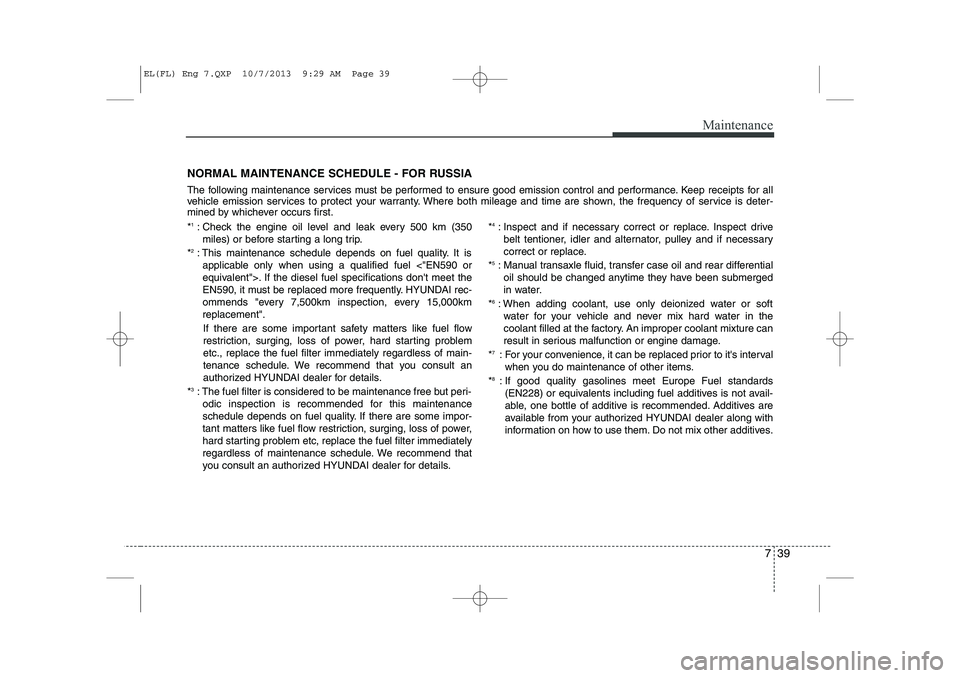
NORMAL MAINTENANCE SCHEDULE - FOR RUSSIA
The following maintenance services must be performed to ensure good emission control and performance. Keep receipts for all
vehicle emission services to protect your warranty. Where both mileage and time are shown, the frequency of service is deter-
mined by whichever occurs first. *1
: Check the engine oil level and leak every 500 km (350
miles) or before starting a long trip.
* 2
: This maintenance schedule depends on fuel quality. It is
applicable only when using a qualified fuel <"EN590 or
equivalent">. If the diesel fuel specifications don't meet the
EN590, it must be replaced more frequently. HYUNDAI rec-
ommends "every 7,500km inspection, every 15,000kmreplacement".
If there are some important safety matters like fuel flow
restriction, surging, loss of power, hard starting problemetc., replace the fuel filter immediately regardless of main-
tenance schedule. We recommend that you consult an
authorized HYUNDAI dealer for details.
* 3
: The fuel filter is considered to be maintenance free but peri-
odic inspection is recommended for this maintenance
schedule depends on fuel quality. If there are some impor-
tant matters like fuel flow restriction, surging, loss of power,
hard starting problem etc, replace the fuel filter immediately
regardless of maintenance schedule. We recommend that
you consult an authorized HYUNDAI dealer for details. *
4
: Inspect and if necessary correct or replace. Inspect drive
belt tentioner, idler and alternator, pulley and if necessary
correct or replace.
* 5
: Manual transaxle fluid, transfer case oil and rear differential
oil should be changed anytime they have been submerged
in water.
* 6
: When adding coolant, use only deionized water or soft
water for your vehicle and never mix hard water in the
coolant filled at the factory. An improper coolant mixture can
result in serious malfunction or engine damage.
* 7
: For your convenience, it can be replaced prior to it's interval
when you do maintenance of other items.
* 8
: If good quality gasolines meet Europe Fuel standards
(EN228) or equivalents including fuel additives is not avail-
able, one bottle of additive is recommended. Additives are
available from your authorized HYUNDAI dealer along with
information on how to use them. Do not mix other additives.
EL(FL) Eng 7.QXP 10/7/2013 9:29 AM Page 39
Page 910 of 1534

745
Maintenance
NORMAL MAINTENANCE SCHEDULE - FOR RUSSIA (CONT.)
No check, No service required
❑Automatic transaxle fluid
❈ Inspect : Inspect and if necessary, adjust, correct, clean or
replace.
120,000 km (80,000 miles) or 96 months
❑ Inspect air cleaner filter
❑ Inspect air conditioner refrigerant/compressor (if equipped)
❑ Inspect battery condition
❑ Inspect brake/clutch (if equipped) fluid
❑ Inspect brake lines, hoses and connections
❑ Inspect cooling system
(At first, inspect 60,000 km (40,000 miles) or 48 months
after that, inspect every 30,000 km
(20,000 miles)or 24
months)
❑ Inspect disc brakes and pads
❑ Inspect drive belt * 4
❑ Inspect drive shafts and boots
❑ Inspect exhaust system
❑ Inspect front suspension ball joints
❑ Inspect fuel lines, fuel hoses and connections (Diesel)
❑ Inspect fuel lines, fuel hoses and connections (Gasoline)
❑ Inspect manual transaxle fluid (if equipped) * 5
❑ Inspect parking brake
❑ Inspect propeller shaft (4WD) (if equipped)
❑ Inspect rear differential oil (4WD) * 5
❑ Inspect steering gear rack, linkage and boots
❑ Inspect tire (pressure & tread wear)
(Continued)
(Continued)
❑ Inspect transfer case oil (4WD) * 5
❑ Inspect vapor hose and fuel filler cap
❑ Replace climate control air filter (if equipped)
❑ Replace coolant * 6
(At first 210,000 km (120,000 miles) or 120 months,
after every 40,000 km (25,000 miles) or 24 months) * 7
❑ Replace engine oil and filter * 1
❑ Replace fuel filter (Gasoline) * 3
❑ Replace fuel filter cartridge (Diesel) * 2
❑ Replace fuel tank air filter (Gasoline)
❑ Replace spark plugs (2.0 Gasoline)
(Every 160,000 km (100,000 miles) or 120 months)
❑ Replace spark plugs (1.6 Gasoline)
(Every 150,000 km (100,000 miles) or 120 months)
❑ Add fuel additives * 8
(Every 5,000 km or 6 months)
EL(FL) Eng 7.QXP 10/7/2013 9:29 AM Page 45
Page 911 of 1534

Maintenance
46
7
MAINTENANCE UNDER SEVERE USAGE CONDITIONS - FOR RUSSIA
The following items must be serviced more frequently on cars mainly used under severe driving conditions.
Refer to the chart below for the appropriate maintenance intervals.
R : Replace I : Inspect and if necessary, adjust, correct, clean or replace
MAINTENANCE ITEMMAINTENANCE
OPERATIONMAINTENANCE INTERVALSDRIVING
CONDITION
Engine oil and engine oil filterREvery 7,500 km (5,000 miles)
or 6 monthsA, B, C, F, G, H, I, J, K, L
Air cleaner filterRReplace more frequently depending on the conditionC, E
Spark plugRReplace more frequently depending on the conditionB, H
Manual transaxle fluid (if equipped)REvery 120,000 km (80,000 miles)C, D, E, G, H, I, K
Automatic transaxle fluid (if equipped)REvery 90,000 km (60,000 miles)A, C, F, G, H, I, K
Steering gear rack, linkage and bootsIInspect more frequently depending on the conditionC, D, E, F, G
Propeller shaft (if equipped) IEvery 15,000 km (10,000 miles) or 12 monthsC, E
Front suspension ball jointsIInspect more frequently depending on the conditionC, D, E, F, G
EL(FL) Eng 7.QXP 10/7/2013 9:29 AM Page 46
Page 931 of 1534

Maintenance
66
7
BATTERY
For best battery service
Keep the battery securely mounted.
Keep the battery top clean and dry.
Keep the terminals and connectionsclean, tight, and coated with petroleum
jelly or terminal grease.
Rinse any spilled electrolyte from the battery immediately with a solution of
water and baking soda.
If the vehicle is not going to be used for an extended time, disconnect the bat-
tery cables.
WARNING - Battery
dangers
Always read the following
instructions carefully when
handling a battery.
Keep lighted cigarettes and all other flames or sparks
away from the battery.
Hydrogen, a highly com- bustible gas, is always
present in battery cells and
may explode if ignited.
Keep batteries out of the reach of children because
batteries contain highly
corrosive SULFURIC ACID.
Do not allow battery acid to
contact your skin, eyes,
clothing or paint finish.
If any electrolyte gets into your eyes, flush your eyes
with clean water for at least
15 minutes and get immedi-ate medical attention.
(Continued)
OLM079019N
OEL070019
■Type A
■Type B
EL(FL) Eng 7.QXP 10/7/2013 9:31 AM Page 66
Page 942 of 1534

777
Maintenance
4. Tire ply composition and material
The number of layers or plies of rub-
ber-coated fabric are in the tire. Tire
manufacturers also must indicate the
materials in the tire, which include
steel, nylon, polyester, and others.
The letter "R" means radial ply con-
struction; the letter "D" means diago-
nal or bias ply construction; and theletter "B" means belted-bias ply con-
struction.
5. Maximum permissible inflationpressure
This number is the greatest amount of air pressure that should be put in
the tire. Do not exceed the maximum
permissible inflation pressure. Refer
to the Tire and Loading Information
label for recommended inflation
pressure.
6. Maximum load rating
This number indicates the maximum
load in kilograms and pounds that
can be carried by the tire. When
replacing the tires on the vehicle,
always use a tire that has the same
load rating as the factory installed
tire.
7. Uniform tire quality grading
Quality grades can be found where
applicable on the tire sidewall
between tread shoulder and maxi-
mum section width.
For example:
TREADWEAR 200
TRACTION AA
TEMPERATURE A Tread wear
The tread wear grade is a compara-
tive rating based on the wear rate ofthe tire when tested under controlled
conditions on a specified govern-
ment test course. For example, a tire
graded 150 would wear one-and-a-
half times (1½) as well on the gov-
ernment course as a tire graded 100.
The relative performance of tires depends upon the actual conditions
of their use, however, and may
depart significantly from the norm
because of variations in driving
habits, service practices and differ-
ences in road characteristics and cli-
mate.
These grades are molded on the
side-walls of passenger vehicle tires.
The tires available as standard or
optional equipment on your vehicles
may vary with respect to grade.
WARNING - Tire age
Tires degrade over time, even
when they are not being used.
Regardless of the remaining
tread, it is recommended that
tires generally be replaced after
six (6) years of normal service.
Heat caused by hot climates orfrequent high loading condi-
tions can accelerate the aging
process. Failure to follow this
Warning can result in sudden
tire failure, which could lead to
a loss of control and an acci-
dent involving serious injury ordeath.
EL(FL) Eng 7.QXP 10/7/2013 9:31 AM Page 77
Page 968 of 1534

7 103
Maintenance
Outside light
1. Open the tailgate.
2. Loosen the light assembly retainingscrews with a cross-tip screwdriver.
3. Remove the rear combination light assembly from the body of the vehicle. 4. Remove the socket from the assembly
by turning the socket counterclockwise
until the tabs on the socket align with
the slots on the assembly.
5. Remove the bulb from the socket by pressing it in and rotating it counter-
clockwise until the tabs on the bulb
align with the slots in the socket. Pull
the bulb out of the socket.
6. Insert a new bulb by inserting it into the socket and rotating it until it locks
into place.
7. Install the socket in the assembly by aligning the tabs on the socket with the
slots in the assembly. Push the socket
into the assembly and turn the socket
clockwise.
8. Reinstall the light assembly to the body of the vehicle.
Inside light
1. Open the tailgate.
2. Remove the service cover using a flat- blade screwdriver.
3. Remove the socket from the assembly by turning the socket counterclockwise
until the tabs on the socket align with
the slots on the assembly.
OLM079034
OLM079035
OLM079036
OLM079047
OEL079038
EL(FL) Eng 7.QXP 10/7/2013 9:33 AM Page 103
Page 969 of 1534

Maintenance
104
7
4. Remove the bulb from the socket by
pressing it in and rotating it counter-
clockwise until the tabs on the bulb
align with the slots in the socket. Pull
the bulb out of the socket.
5. Insert a new bulb by inserting it into the socket and rotating it until it locks
into place.
6. Install the socket in the assembly by aligning the tabs on the socket with the
slots in the assembly. Push the socket
into the assembly and turn the socket
clockwise.
7. Install the service cover by putting it into the service hole.
Stop and tail light (LED type)
If the light does not operate, we recom-
mend that the system be checked by an
authorized HYUNDAI dealer. Rear fog light (if equipped)
1. Remove the socket from the assembly
by turning the socket counterclockwise
until the tabs on the socket align with
the slots on the assembly.
2. Remove the bulb from the socket by pressing it in and rotating it counter-
clockwise until the tabs on the bulb
align with the slots in the socket. Pull
the bulb out of the socket.
3. Insert a new bulb in the socket.
4. Reinstall the light assembly to the body of the vehicle. High mounted stop light bulb replacement (if equipped)
If the light does not operate, we recom-
mend that the system be checked by an
authorized HYUNDAI dealer.
OLM079039
EL(FL) Eng 7.QXP 10/7/2013 9:33 AM Page 104