Page 1462 of 1534
Maintenance
18
7
Recommended engine coolant
When adding coolant, use only deion-
ized water or soft water for your vehicle
and never mix hard water in the
coolant filled at the factory. An improp-
er coolant mixture can result in serious
malfunction or engine damage.
The engine in your vehicle has alumi
-num engine parts and must be protect-
ed by an ethylene-glycol-based coolant
to prevent corrosion and freezing.
DO NOT USE alco hol or methanol
coolant or mix them with the specifiedcoolant.
Do not use a solution that contains more than 60% antifreeze or less than
35% antifreeze, which would reduce
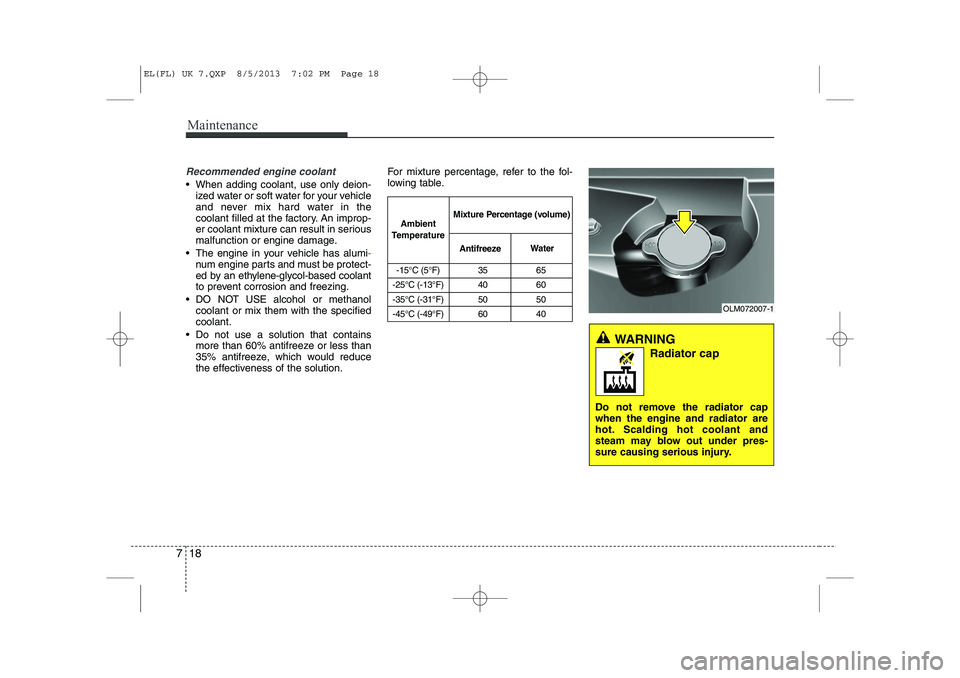
the effectiveness of the solution. For mixture percentage, refer to the fol-
lowing table.
WARNING
Radiator cap
Do not remove the radiator cap when the engine and radiator are
hot. Scalding hot coolant and
steam may blow out under pres-
sure causing serious injury.
-15°C (5°F) 35 65
-25°C (-13°F) 40 60
-35°C (-31°F) 50 50
-45°C (-49°F) 60 40
Ambient
Temperature Mixture Percentage (volume)
Antifreeze Water
OLM072007-1
EL(FL) UK 7.QXP 8/5/2013 7:02 PM Page 18
Page 1463 of 1534
719
Maintenance
Changing the coolant
We recommend that the coolant be
replaced by a HYUNDAI authorised
repairer.Checking the brake/clutch fluid
level
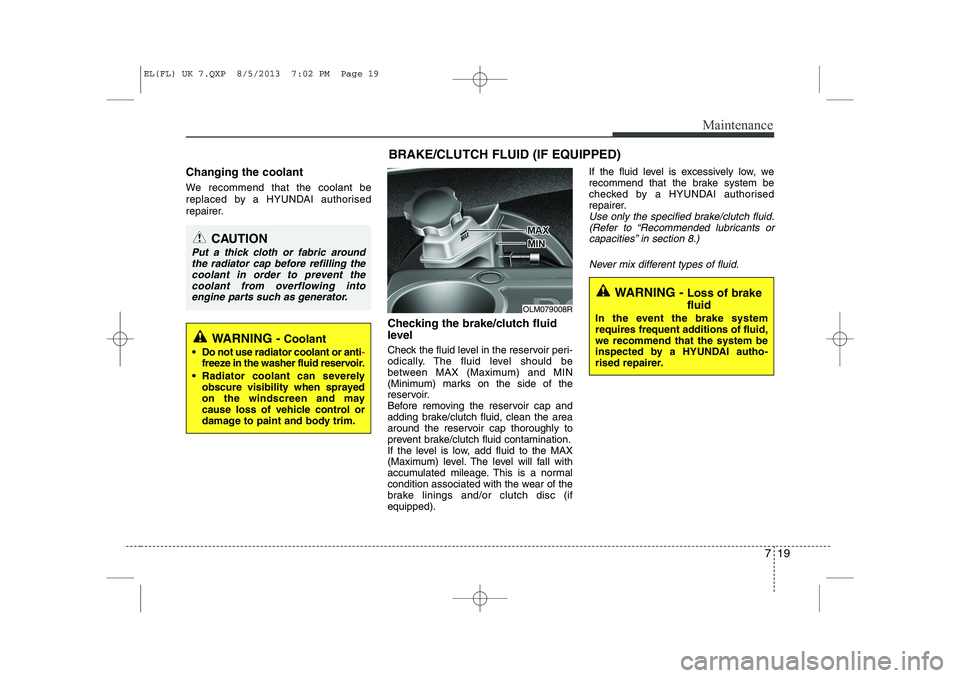
Check the fluid level in the reservoir peri-
odically. The fluid level should be
between MAX (Maximum) and MIN
(Minimum) marks on the side of the
reservoir.
Before removing the reservoir cap and
adding brake/clutch fluid, clean the area
around the reservoir cap thoroughly to
prevent brake/clutch fluid contamination.
If the level is low, add fluid to the MAX
(Maximum) level. The level will fall with
accumulated mileage. This is a normal
condition associated with the wear of the
brake linings and/or clutch disc (ifequipped).If the fluid level is excessively low, we
recommend that the brake system be
checked by a HYUNDAI authorised
repairer.
Use only the specified brake/clutch fluid.
(Refer to “Recommended lubricants orcapacities” in section 8.)
Never mix different types of fluid.
WARNING - Loss of brake fluid
In the event the brake system
requires frequent additions of fluid,we recommend that the system be
inspected by a HYUNDAI autho-
rised repairer.
OLM079008R
CAUTION
Put a thick cloth or fabric around the radiator cap before refilling thecoolant in order to prevent the
coolant from overflowing intoengine parts such as generator.
WARNING - Coolant
Do not use radiator coolant or anti
-freeze in the washer fluid reservoir.
Radiator coolant can severely obscure visibility when sprayed
on the windscreen and may
cause loss of vehicle control or
damage to paint and body trim.
BRAKE/CLUTCH FLUID (IF EQUIPPED)
EL(FL) UK 7.QXP 8/5/2013 7:02 PM Page 19
Page 1464 of 1534
Maintenance
20
7
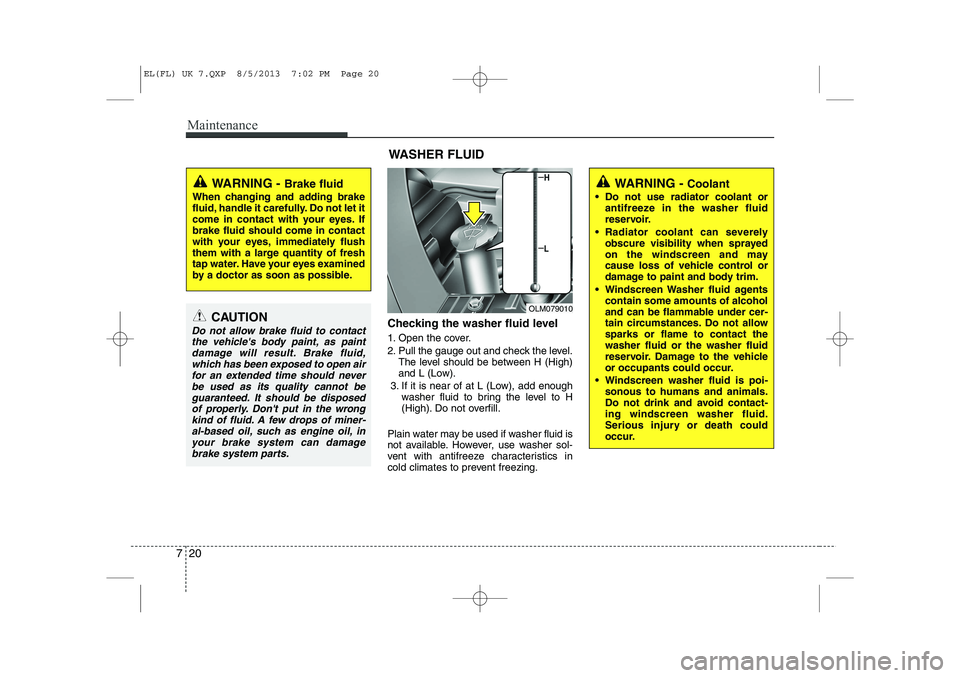
Checking the washer fluid level
1. Open the cover.
2. Pull the gauge out and check the level.
The level should be between H (High)
and L (Low).
3. If it is near of at L (Low), add enough washer fluid to bring the level to H
(High). Do not overfill.
Plain water may be used if washer fluid is
not available. However, use washer sol-
vent with antifreeze characteristics in
cold climates to prevent freezing.
OLM079010
WARNING - Coolant
Do not use radiator coolant or antifreeze in the washer fluid
reservoir.
Radiator coolant can severely obscure visibility when sprayed
on the windscreen and may
cause loss of vehicle control or
damage to paint and body trim.
Windscreen Washer fluid agents contain some amounts of alcohol
and can be flammable under cer-
tain circumstances. Do not allowsparks or flame to contact thewasher fluid or the washer fluid
reservoir. Damage to the vehicle
or occupants could occur.
Windscreen washer fluid is poi- sonous to humans and animals.
Do not drink and avoid contact-ing windscreen washer fluid.
Serious injury or death could
occur.WARNING - Brake fluid
When changing and adding brake
fluid, handle it carefully. Do not let it
come in contact with your eyes. Ifbrake fluid should come in contact
with your eyes, immediately flush
them with a large quantity of fresh
tap water. Have your eyes examined
by a doctor as soon as possible.
CAUTION
Do not allow brake fluid to contact the vehicle's body paint, as paint
damage will result. Brake fluid,which has been exposed to open air for an extended time should neverbe used as its quality cannot be
guaranteed. It should be disposed of properly. Don't put in the wrongkind of fluid. A few drops of miner-al-based oil, such as engine oil, in
your brake system can damagebrake system parts.
WASHER FLUID
EL(FL) UK 7.QXP 8/5/2013 7:02 PM Page 20
Page 1520 of 1534
Maintenance
76
7
EMISSION CONTROL SYSTEM
The emission control system of your
vehicle is covered by a written limited
warranty. Please see the warranty infor-
mation contained in the Service Passport
in your vehicle.
Your vehicle is equipped with an emis- sion control system to meet all emission
regulations. There are three emission control sys-
tems which are as follows.
(1) Crankcase emission control system
(2) Evaporative emission control system(3) Exhaust emission control system In order to assure the proper function of
the emission control systems, it is rec-
ommended that you have your car
inspected and maintained by a
HYUNDAI authorised repairer in accor-
dance with the maintenance schedule. Caution for the Inspection and
Maintenance Test (With Electronic
Stability Program (ESP) system)
To prevent the vehicle from misfir-
ing during dynamometer testing,
turn the Electronic Stability
Program (ESP) system off by press-
ing the ESP switch.
After dynamometer testing is com- pleted, turn the ESP system back on
by pressing the ESP switch again.
1. Crankcase emission control system
The positive crankcase ventilation sys-
tem is employed to prevent air pollution
caused by blow-by gases being emitted
from the crankcase. This system supplies
fresh filtered air to the crankcase through
the air intake hose. Inside the crankcase,
the fresh air mixes with blow-by gases,
which then pass through the PCV valveinto the induction system. 2. Evaporative emission control
System
The Evaporative Emission Control
System is designed to prevent fuel
vapours from escaping into the atmos-
phere.
Canister
Fuel vapours generated inside the fuel tank are absorbed and stored in the
onboard canister. When the engine is
running, the fuel vapours absorbed in the
canister are drawn into the surge tank
through the purge control solenoid valve.
Purge Control Solenoid Valve (PCSV)
The purge control solenoid valve is con-
trolled by the Engine Control Module
(ECM); when the engine coolant temper-
ature is low during idling, the PCSV clos-
es so that evaporated fuel is not taken
into the engine. After the engine warms-
up during ordinary driving, the PCSV
opens to introduce evaporated fuel to the
engine.
EL(FL) UK 7.QXP 8/5/2013 7:05 PM Page 76
Page 1530 of 1534
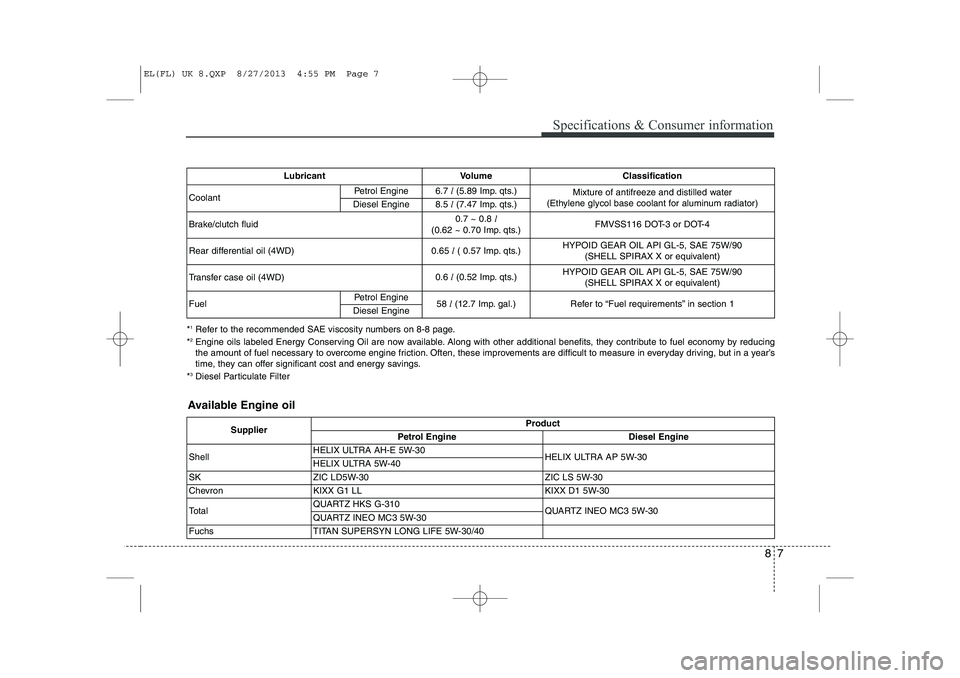
87
Specifications & Consumer information
Lubricant Volume Classification
Coolant Petrol Engine6.7 l(5.89 Imp. qts.)Mixture of antifreeze and distilled water
(Ethylene glycol base coolant for aluminum radiator)
Diesel Engine8.5 l(7.47 Imp. qts.)
Brake/clutch fluid0.7 ~ 0.8 l
(0.62 ~ 0.70 Imp. qts.)FMVSS116 DOT-3 or DOT-4
Rear differential oil (4WD) 0.65
l( 0.57 Imp. qts.) HYPOID GEAR OIL API GL-5, SAE 75W/90
(SHELL SPIRAX X or equivalent)
Transfer case oil (4WD) 0.6
l(0.52 Imp. qts.) HYPOID GEAR OIL API GL-5, SAE 75W/90
(SHELL SPIRAX X or equivalent)
Fuel Petrol Engine
58 l(12.7 Imp. gal.)
Refer to “Fuel requirements” in section 1
Diesel Engine
Available Engine oil
Supplier Product
Petrol Engine Diesel Engine
Shell HELIX ULTRA AH-E 5W-30
HELIX ULTRA AP 5W-30
HELIX ULTRA 5W-40
SK ZIC LD5W-30 ZIC LS 5W-30
Chevron KIXX G1 LL KIXX D1 5W-30
Total QUARTZ HKS G-310
QUARTZ INEO MC3 5W-30
QUARTZ INEO MC3 5W-30
Fuchs TITAN SUPERSYN LONG LIFE 5W-30/40
* 1
Refer to the recommended SAE viscosity numbers on 8-8 page.
* 2
Engine oils labeled Energy Conserving Oil are now available. Along with other additional benefits, they contribute to fuel economy by reducing
the amount of fuel necessary to overcome engine friction. Often, these improvements are difficult to measure in everyday driving, but in a year’s
time, they can offer significant cost and energy savings.
* 3
Diesel Particulate Filter
EL(FL) UK 8.QXP 8/27/2013 4:55 PM Page 7