2014 HONDA ACCORD HYBRID TPMS
[x] Cancel search: TPMSPage 321 of 561

320
uuCustomized Featuresu
Features
*1:Default Setting
*2:Refer to the Navigation System Manual for complete details.Setup
Group Customizable Features Description Selectable Settings
Vehicle
Settings TPMS Calibration
Cancels/Calibrates the TPMS. Cancel*1
/Calibrate
Driver
Assist
System
Setup *Forward Collision Warning
Distance
Changes at which distance FCW alerts, or turns
FCW on and off. Long
/Normal *1
/
Short /Off
Head-up Warning Turns the heads-up warning lights on to flash or off. On*1
/Off
ACC Pre-Running Car
Detect Beep * Causes the system to beep when the system detects a
vehicle, or when the vehicle goes out of ACC range.
On
*1
/Off
ACC Display Speed Unit *
Changes the speed unit for ACC on the multi-
information display. mph
*1
/km/h (U.S.)
miles /km *1
(Canada)
Meter
Setup Language Selection
Changes the displayed language on the multi-
information display. English
*1
/French /
Spanish
Adjust Outside Temp.
Display Adjusts the temperature reading by a few degrees.
-5°F ~ ±0°F
*1
~ +5°F (U.S.)
-3°C ~ ±0°C*1 ~ +3°C (Canada)
“Trip A” Reset TimingChanges the setting of how to reset trip meter A, average
fuel economy A, average speed A, and elapsed time A.With Refuel /IGN Off /
Manually Reset *1
“Trip B” Reset Timing
Changes the setting of how to reset trip meter B, average
fuel economy B, average speed B, and elapsed time B.With Refuel /IGN Off /
Manually Reset *1
Fuel Efficiency Backlight Turns the ambient meter feature on and off. On*1
/Off
Turn by Turn Display *2
Selects whether the turn-by-turn display comes
on during the route guidance. On
*1
/Off
* Not available on all models
Main MenuTable of Contents
Page 410 of 561
409
Driving
This chapter discusses driving, refueling, and information on items such as accessories.
Before Driving Driving Preparation .......................... 410
Maximum Load Limit........................ 413
Towing a Trailer Towing Your Vehicle ........................ 415
When Driving Turning on the Power ...................... 416
Precautions While Driving................. 419
Transmission .................................... 419
Shifting ............................................ 420
ECON Button ................................... 422
Acoustic Vehicle Alerting System ...... 423
Cruise Control *
................................ 424 Adaptive Cruise Control (ACC)
*
....... 427
Forward Collision Warning (FCW) *
.. 435
Lane Departure Warning (LDW) *
..... 439
Vehicle Stability Assist (VSA®), aka Electronic
Stability Control (ESC), System ............... 443
LaneWatchTM....................................... 445Tire Pressure Monitoring System (TPMS) ... 447Tire Pressure Monitoring System (TPMS) -
Required Federal Explanation ......... 449
High Voltage Battery ........................ 451
Braking
Brake System ................................... 452
Anti-lock Brake System (ABS) ........... 454 Brake Assist System ......................... 455
Parking Your Vehicle
When Stopped ................................ 456
Multi-View Rear Camera .................. 457
Rearview Camera ............................. 458
Refueling Fuel Information .............................. 459
How to Refuel ................................. 460
Fuel Economy Improving Fuel Economy .................. 461
Accessories and Modifications ........ 462
* Not available on all models
Main Menu
Page 448 of 561
447
uuWhen DrivinguTire Pressure Monitoring System (TPMS)
Continued
Driving
Tire Pressure Monitoring System (TPMS)
Instead of directly measuring the pressure in each tire, the TPMS on this vehicle
monitors and compares the rolling radius and rotational characteristics of each
wheel and tire while you are driving to determine if one or more tires are
significantly under-inflated. This will cause the low tire pressure/TPMS indicator to
come on and a message to appear on the multi-information display.
You must start TPMS calibration every time you: •Adjust the pressure in one or more tires.
• Rotate the tires.
• Replace one or more tires.
Before calibrating the TPMS:• Set the cold tire pressure in all four tires.
2 Checking Tires P. 493
Make sure:• The vehicle is at a complete stop.
• The shift lever is in
(P .
• The power mode is in ON.
■TPMS Calibration
1Tire Pressure Monitoring System (TPMS)
The system does not monitor the tires when driving at low speed.
Conditions such as low ambient temperature and
altitude change directly affect tire pressure and can
trigger the low tire pressure/TPMS indicator to come on.
Tire pressure checked and inflated in: •Warm weather can become under-inflated in
colder weather.
• Cold weather can become over-inflated in warmer weather.
The low tire pressure indicator will not come on as a
result of over inflation.
The TPMS may not function properly if tire type and
size are mixed. Make sure to use the same size and
type of tire. 2 Checking and Maintaining Tires P. 493
The low tire pressure/TPMS indicator may come on
with a delay or may not come on at all when:
• You rapidly accelerate, decelerate, or turn the
steering wheel.
• You drive on snowy or slippery roads.
• Snow chains are used.
The low tire pressure/TPMS indicator may come on
under the following conditions:• There is a heavier and uneven load on the tires than
the condition at calibration.
• Snow chains are used.
Main MenuTable of Contents
Page 449 of 561

uuWhen DrivinguTire Pressure Monitoring System (TPMS)
448
Driving
You can calibrate the system from the
customized features on the multi-information
display.1. Press the / button to select Vehicle
Settings , then press the SEL/RESET button.
uTPMS Calibration appears on the display.
2. Press the SEL/RESET button.
uThe display switches to the
customization setup screen, where you
can select Cancel or Calibrate .
3. Press the / button and select
Calibrate , then press the SEL/RESET button.
uCalibration Started screen appears,
then the display returns to the customization menu screen.
• If the Calibration Failed to Start message
appears, repeat steps 2-3.
• The calibration process finishes automatically.
1TPMS Calibration •The calibration process requires approximately 30
minutes of cumulative driving at speeds between
30-60 mph (48-97 km/h).
• During this period, if the power mode is set to ON
and the vehicle is not moved within 45 seconds,
you may notice the low tire pressure indicator
comes on briefly. This is normal and indicates that
the calibration process is not yet complete.
You can calibrate the system using the audio/information screen. 2 Customized Features P. 293
If the snow chains are installed, remove them before
calibrating the TPMS.
If the low tire pressure/TPMS indicator comes on even
when the properly inflated specified regular tires are
installed, have your vehicle checked by a dealer.
We recommend that the tires be replaced with the
same brand, model, and size as the originals. Ask a
dealer for details.
4
4
Main MenuTable of Contents
Page 450 of 561
449
uuWhen DrivinguTire Pressure Monitoring System (TPMS) - Required Federal Explanation
Continued
Driving
Tire Pressure Monitoring System (TPMS) - Required
Federal Explanation
Each tire, including the spare (if provided), should be checked
monthly when cold and inflated to the inflation pressure recommended by the vehicle manufacturer on the vehicle placard
or tire inflation pressure label.
(If your vehicle has tires of a different size than the size indicated
on the vehicle placard or tire inflation pressure label, you should
determine the proper tire inflation pressure for those tires.)
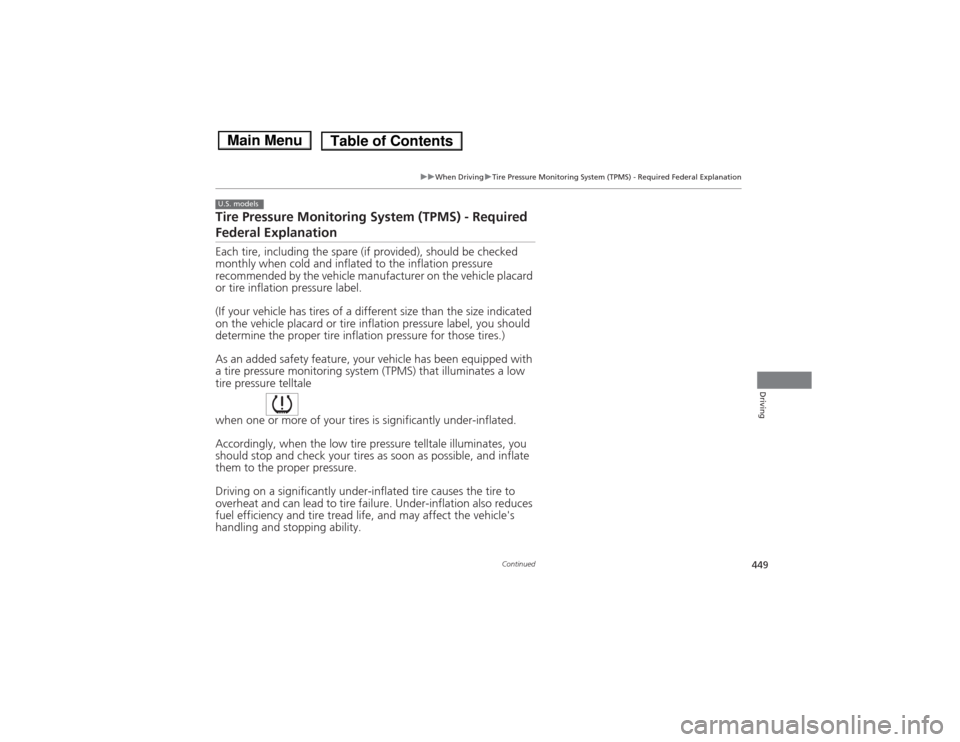
As an added safety feature, your vehicle has been equipped with a tire pressure monitoring system (TPM S) that illuminates a low
tire pressure telltale
when one or more of your tires is significantly under-inflated.
Accordingly, when the low tire pressure telltale illuminates, you
should stop and check your tires as soon as possible, and inflate them to the proper pressure.
Driving on a significantly under-inflated tire causes the tire to
overheat and can lead to tire fail ure. Under-inflation also reduces
fuel efficiency and tire tread life, and may affect the vehicle's
handling and stopping ability.
U.S. models
Main MenuTable of Contents
Page 451 of 561

450
uuWhen DrivinguTire Pressure Monitoring System (TPMS) - Required Federal Explanation
Driving
Please note that the TPMS is not a substitute for proper tire
maintenance, and it is the driver's responsibility to maintain
correct tire pressure, even if under-inflation has not reached the
level to trigger illumination of the TPMS low tire pressure telltale.
Your vehicle has also been equipped with a TPMS malfunction
indicator to indicate when the system is not operating properly.
The TPMS malfunction indicator is combined with the low tire
pressure telltale. When the system detects a malfunction, the
telltale will flash for approximately one minute and then remain continuously illuminated. This se quence will continue upon
subsequent vehicle start-ups as long as the malfunction exists.
When the malfunction indicator is illuminated, the system may
not be able to detect or signal low tire pressure as intended.
TPMS malfunctions may occur for a vari ety of reasons, including
the installation of replacement or alternate tires or wheels on the
vehicle that prevent the TPMS from functioning properly. Always check the TPMS malfunction telltale after replacing one or
more tires or wheels on your vehicle to ensure that the
replacement or alternate tires and wheels allow the TPMS to
continue to function properly.
Main MenuTable of Contents
Page 494 of 561
493
Maintenance
Checking and Maintaining Tires
Checking Tires
To safely operate your vehicle, your tires must be of the proper type and size, in
good condition with adequate tread, and properly inflated. ■Inflation guidelines
Properly inflated tires provide the best combination of handling, tread life, and comfort. Refer to the driver’s doorjamb label or sp ecification’s page for the specified pressure.
Underinflated tires wear unevenly, adversely affect handling and fuel economy, and
are more likely to fail from overheating.
Overinflated tires make your vehicle ride harshly, are more prone to road hazards, and wear unevenly.
Every day before you drive, look at each of the tires. If one looks lower than the
others, check the pressure with a tire gauge.
At least once a month or before long trips, use a gauge to measure the pressure in
all tires. Even tires in good condition can lose 1 to 2 psi (10 to 20 kPa, 0.1 to 0.2
kgf/cm 2
) per month.
■ Inspection guidelines
Every time you check inflation, also examine the tires and valve stems.
Look for: • Bumps or bulges on the side or in the tread. Replace the tire if you find any cuts,
splits, or cracks in the side of the tire. Replace it if you see fabric or cord.
• Remove any foreign objects and inspect for air leaks.
• Uneven tread wear. Have a dealer check the wheel alignment.
• Excessive tread wear.
2 Wear Indicators P. 498
• Cracks or other damage around valve stem.
1Checking Tires
Measure the air pressure when tires are cold. This
means the vehicle has been parked for at least three
hours, or driven less than 1 mile (1.6 km). If
necessary, add or release air until the specified
pressure is reached.
If checked when hot, tire pressure can be as much as
4–6 psi (30–40 kPa, 0.3–0.4 kgf/cm 2
) higher than if
checked when cold.
Whenever tire pressure is adjusted, you must
calibrate the TPMS.
2 TPMS Calibration P. 447
Have a dealer check the tires if you feel a consistent
vibration while driving. New tires and any that have
been removed and reinstalled should be properly balanced.
3WARNING
Using tires that are excessively worn or
improperly inflated can cause a crash in
which you can be seriously hurt or killed.
Follow all instruction s in this owner’s
manual regarding tire inflation and
maintenance.
Main MenuTable of Contents
Page 501 of 561

500
uuChecking and Maintaining TiresuTire Rotation
Maintenance
Tire Rotation
Rotating tires according to the maintenance messages on the multi-information
display helps to distribute wear more evenly and increase tire life. ■Tires without rotation marks
Rotate the tires as shown here.
■ Tires with rotation marks
Rotate the tires as shown here.
1Tire Rotation
Tires with directional tread patterns should only be
rotated front to back (not from one side to the other).
Directional tires should be mounted with the rotation
indication mark facing forward, as shown below.
Whenever tires are rotated, you must calibrate the
TPMS.2 TPMS Calibration P. 447
FRONT
Direction MarkFront
Front
Main MenuTable of Contents