2014 FORD SUPER DUTY ABS
[x] Cancel search: ABSPage 21 of 82
filters at the same time. Regular fuel filter
changes are an important part of engine
maintenance; failing to keep with the
scheduled maintenance could lead to
engine performance issues and fuel
injection system damage. Refer to the
scheduled maintenance information of this
supplement for more information. See
General Maintenance Information
(page 58).
Refer to Motorcraft part numbers in the
Capacities and Specifications chapter for
the fuel filter replacement part number.
See Motorcraft Parts (page 54). This part
number includes filters and seals for both
the engine-mounted and frame-mounted
filters.
Removal - Diesel Fuel Conditioner
Module filter
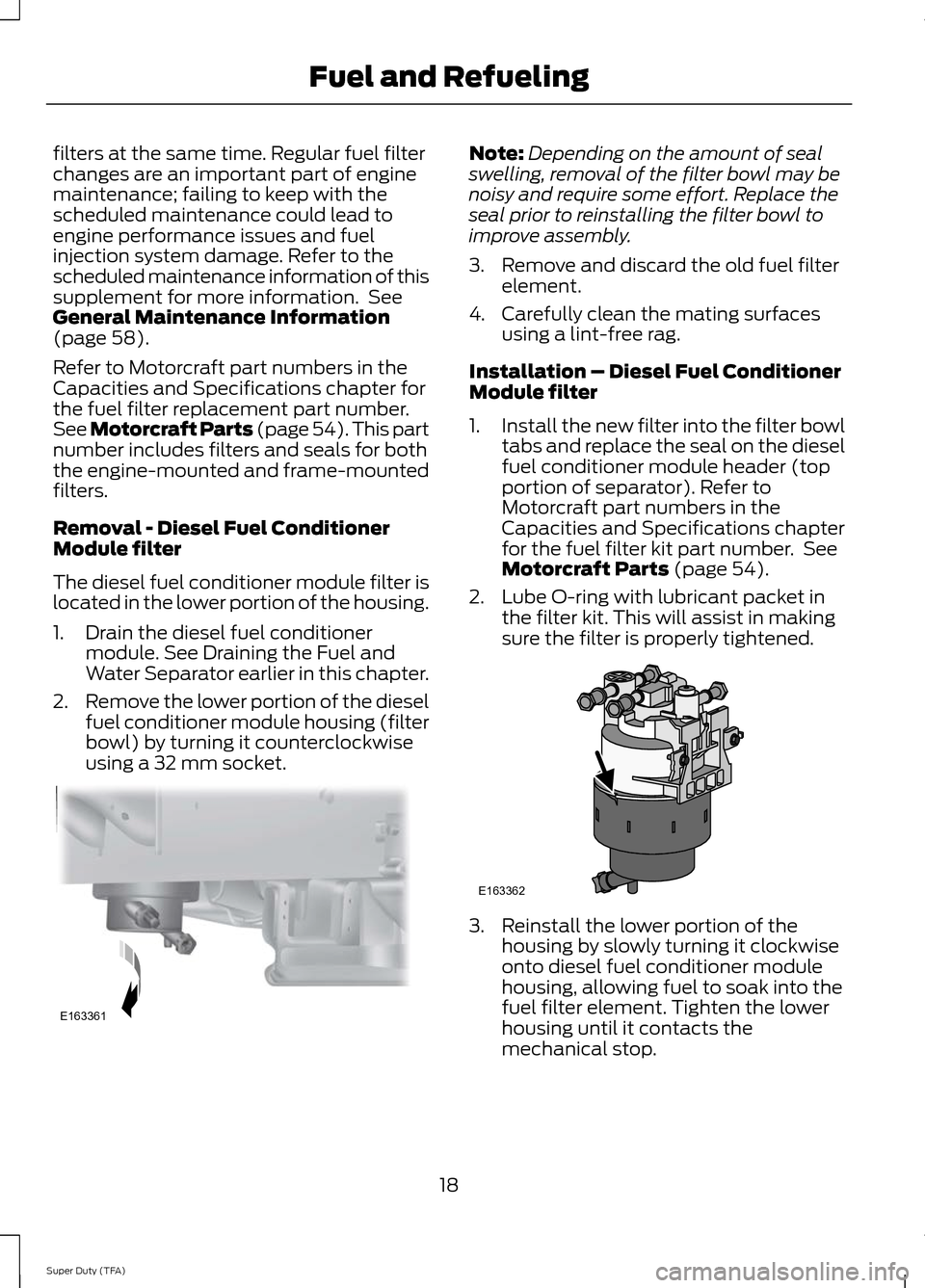
The diesel fuel conditioner module filter is
located in the lower portion of the housing.
1. Drain the diesel fuel conditioner module. See Draining the Fuel and
Water Separator earlier in this chapter.
2. Remove the lower portion of the diesel
fuel conditioner module housing (filter
bowl) by turning it counterclockwise
using a 32 mm socket. Note:
Depending on the amount of seal
swelling, removal of the filter bowl may be
noisy and require some effort. Replace the
seal prior to reinstalling the filter bowl to
improve assembly.
3. Remove and discard the old fuel filter element.
4. Carefully clean the mating surfaces using a lint-free rag.
Installation – Diesel Fuel Conditioner
Module filter
1. Install the new filter into the filter bowl
tabs and replace the seal on the diesel
fuel conditioner module header (top
portion of separator). Refer to
Motorcraft part numbers in the
Capacities and Specifications chapter
for the fuel filter kit part number. See
Motorcraft Parts
(page 54).
2. Lube O-ring with lubricant packet in the filter kit. This will assist in making
sure the filter is properly tightened. 3. Reinstall the lower portion of the
housing by slowly turning it clockwise
onto diesel fuel conditioner module
housing, allowing fuel to soak into the
fuel filter element. Tighten the lower
housing until it contacts the
mechanical stop.
18
Super Duty (TFA) Fuel and RefuelingE163361 E163362
Page 22 of 82
Note:
The engine will not run properly if you
do not install the diesel fuel conditioner
module fuel filter in the housing or if the
filter bowl is not tightened to the
mechanical stop.
Note: You will need to purge the system of
air after removal or changing of the filter.
See purging air from the fuel system later
in this chapter.
Removal - Engine-mounted fuel filter
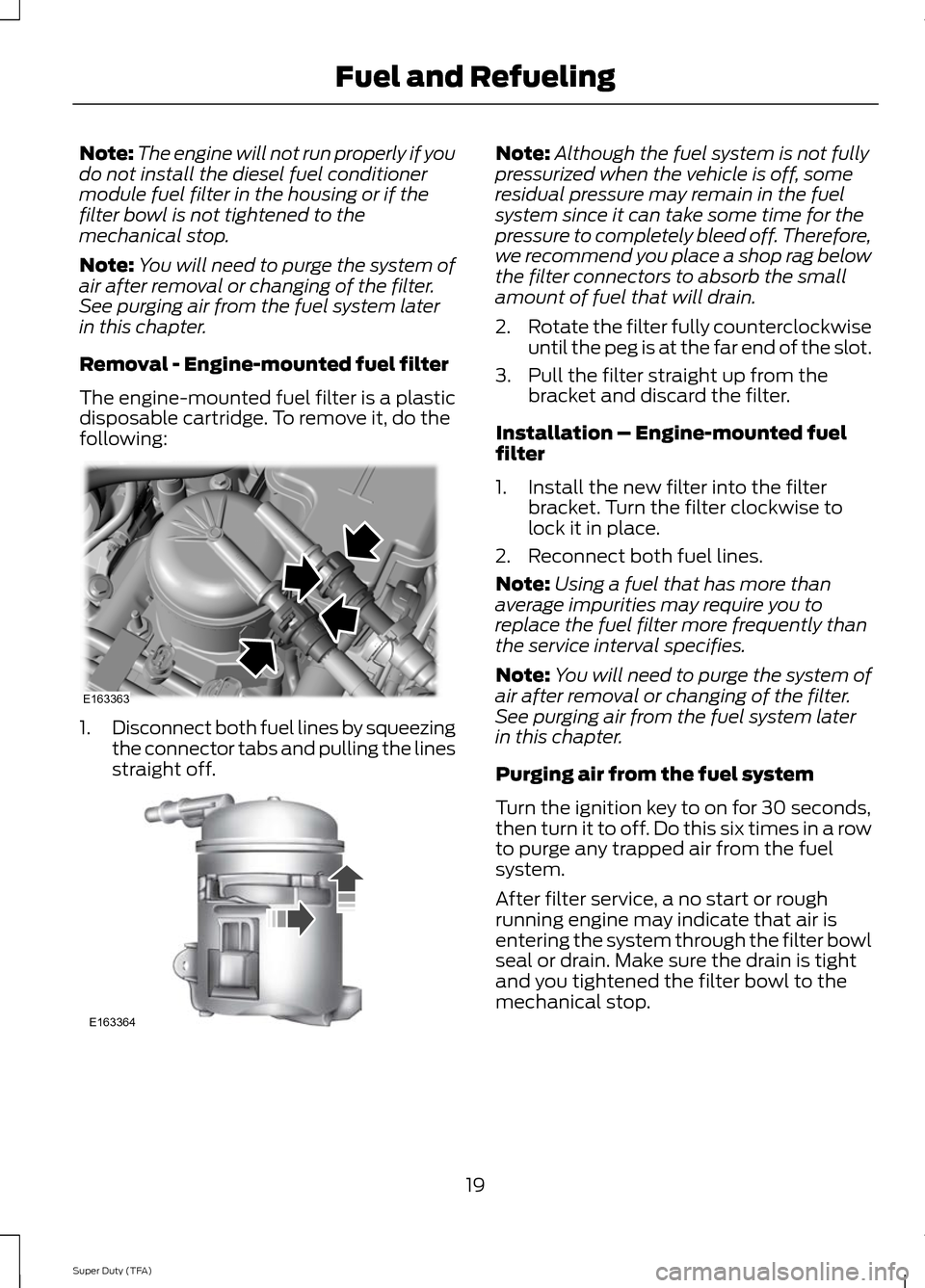
The engine-mounted fuel filter is a plastic
disposable cartridge. To remove it, do the
following: 1.
Disconnect both fuel lines by squeezing
the connector tabs and pulling the lines
straight off. Note:
Although the fuel system is not fully
pressurized when the vehicle is off, some
residual pressure may remain in the fuel
system since it can take some time for the
pressure to completely bleed off. Therefore,
we recommend you place a shop rag below
the filter connectors to absorb the small
amount of fuel that will drain.
2. Rotate the filter fully counterclockwise
until the peg is at the far end of the slot.
3. Pull the filter straight up from the bracket and discard the filter.
Installation – Engine-mounted fuel
filter
1. Install the new filter into the filter bracket. Turn the filter clockwise to
lock it in place.
2. Reconnect both fuel lines.
Note: Using a fuel that has more than
average impurities may require you to
replace the fuel filter more frequently than
the service interval specifies.
Note: You will need to purge the system of
air after removal or changing of the filter.
See purging air from the fuel system later
in this chapter.
Purging air from the fuel system
Turn the ignition key to on for 30 seconds,
then turn it to off. Do this six times in a row
to purge any trapped air from the fuel
system.
After filter service, a no start or rough
running engine may indicate that air is
entering the system through the filter bowl
seal or drain. Make sure the drain is tight
and you tightened the filter bowl to the
mechanical stop.
19
Super Duty (TFA) Fuel and RefuelingE163363 E163364
Page 32 of 82
Diesel fuel dispensing nozzle fill rate
Your truck is equipped with a fuel fill pipe
that is able to accept fuel up to 20 gallons
per minute from an 11⁄8 fuel-dispensing
nozzle. Pumping fuel at greater flow rates
may result in premature nozzle shut-off or
spit back.
Fuel filler cap
WARNINGS
The fuel system may be under
pressure. If the fuel filler cap is
venting vapor or if you hear a hissing
sound, wait until it stops before completely
removing the fuel filler cap. Otherwise, fuel
may spray out and injure you or others. If you do not use the proper fuel filler
cap, excessive pressure or vacuum
in the fuel tank may damage the fuel
system or cause the fuel cap to disengage
in a collision, which may result in possible
personal injury. Note:
If you must replace the fuel filler cap,
replace it with a fuel filler cap designed for
your vehicle. The vehicle warranty may be
void for any damage to the fuel tank or fuel
system if the correct genuine Ford or
Motorcraft® fuel filler cap is not used.
Your fuel tank filler cap has an indexed
design with a 1/4 turn on/off feature.
When fueling your vehicle:
1. Turn the engine off.
2. Carefully turn the filler cap counterclockwise until it spins off.
3. Pull to remove the cap from the fuel filler pipe.
4. To install the cap, align the tabs on the
cap with the notches on the filler pipe.
5. Turn the filler cap clockwise 1/4 of a turn until it clicks at least once. EMISSION CONTROL SYSTEM
Diesel Exhaust System: Oxidation
Catalyst And Diesel Particulate
Filter System (If Equipped)
Your vehicle is equipped with a diesel
particulate filter. The diesel particulate
filter is an inline filter in the exhaust system
that reduces carbon emissions by trapping
exhaust particles before they reach the
tailpipe. The diesel particulate filter looks
similar to a traditional exhaust catalyst,
except larger, and is part of the exhaust
system under the vehicle. The filter couples
to a diesel oxidation catalyst that reduces
the amount of harmful exhaust emitted
from the tailpipe. As soot gathers in the
system, it begins to restrict the filter. You
need to periodically clean the soot that
gathers inside the. You can clean the soot
in two different ways, passive regeneration
and active regeneration. Both methods
occur automatically and require no actions
from the driver. During either one of these
regeneration methods, you may notice a
change in exhaust tone. At certain times,
the information display will display various
messages related to the diesel particulate
filter. See the Information Displays chapter
in the Owner Guide for more information.
Passive regeneration
In passive regeneration, the high
temperature of the exhaust system
automatically cleans the filter, or reduces
the soot level, by burning (oxidizing) the
soot. This high exhaust temperature occurs
naturally because of normal engine
operating conditions (at varying levels, due
to driving patterns.
29
Super Duty (TFA) Fuel and Refueling
Page 37 of 82
Emission Control System(s) Laws
WARNING
Do not remove or alter the original
equipment floor covering or
insulation between it and the metal
floor of the vehicle. The floor covering and
insulation protect occupants of the vehicle
from the engine and exhaust system heat
and noise. On vehicles with no original
equipment floor covering insulation, do not
carry passengers in a manner that permits
prolonged skin contact with the metal
floor. Provide adequate insulation. Failure
to follow these instructions may result in
fire or personal injury. In the U.S. federal law and certain state
laws prohibit removing or rendering
inoperative emission control system(s).
Similar federal or provincial laws may
apply in Canada. Ford recommends
against any vehicle modification without
determining applicable law.
Tampering with emissions
control systems (including
related sensors and the diesel
exhaust fluid injection system) can result
in reduced engine power and the
illumination of the service engine soon
light.
Tampering with a Noise Control
System
Federal law prohibits the following acts or
the causing thereof: (1) The removal or
rendering inoperative by any person other
than for purposes of maintenance, repair
or replacement of any device or element
of design incorporated into any new vehicle
for the purpose of noise control prior to its
sale or delivery to the ultimate purchaser
or while it is in use, or (2) the use of the
vehicle after such device or element of
design has been removed or rendered
inoperative by any person. Among those acts, which the U.S.
Environmental Protection Agency may
presume to constitute tampering are the
acts listed below:
•
Removal of hood blanket, fender apron
absorbers, fender apron barriers,
underbody noise shields or acoustically
absorptive material.
• Tampering or rendering inoperative the
engine speed governor, to allow engine
speed to exceed manufacturer ’s
specifications.
The complexity of the diesel engine makes
it so the owner is discouraged from
attempting to perform maintenance other
than the services described in this
supplement.
If you experience difficult starting the
engine, rough idling, excessive exhaust
smoke, a decrease in engine performance
or excess fuel consumption, perform the
following checks:
• A plugged or disconnected air inlet
system or engine air filter element
• Water in the fuel filter and water
separator
• A clogged fuel filter
• Contaminated fuel
• Air in the fuel system, due to loose
connections
• An open or pinched sensor hose
• Check engine oil level
• Wrong fuel or oil viscosity for climactic
conditions
If these checks do not help you correct the
engine performance problem you are
experiencing, consult an authorized dealer.
34
Super Duty (TFA) Fuel and Refueling
Page 38 of 82
Noise Emissions Warranty, Prohibited
Tampering Acts and Maintenance
On January 1, 1978, Federal regulation
became effective governing the noise
emission on trucks over 10,000 lbs. (4,536
kg) GVWR (Gross Vehicle Weight Rating).
The preceding statements concerning
prohibited tampering acts and
maintenance, and the noise warranty
found in the Warranty Guide, are
applicable to complete chassis cabs over
10,000 lbs. (4,536 kg) GVWR.
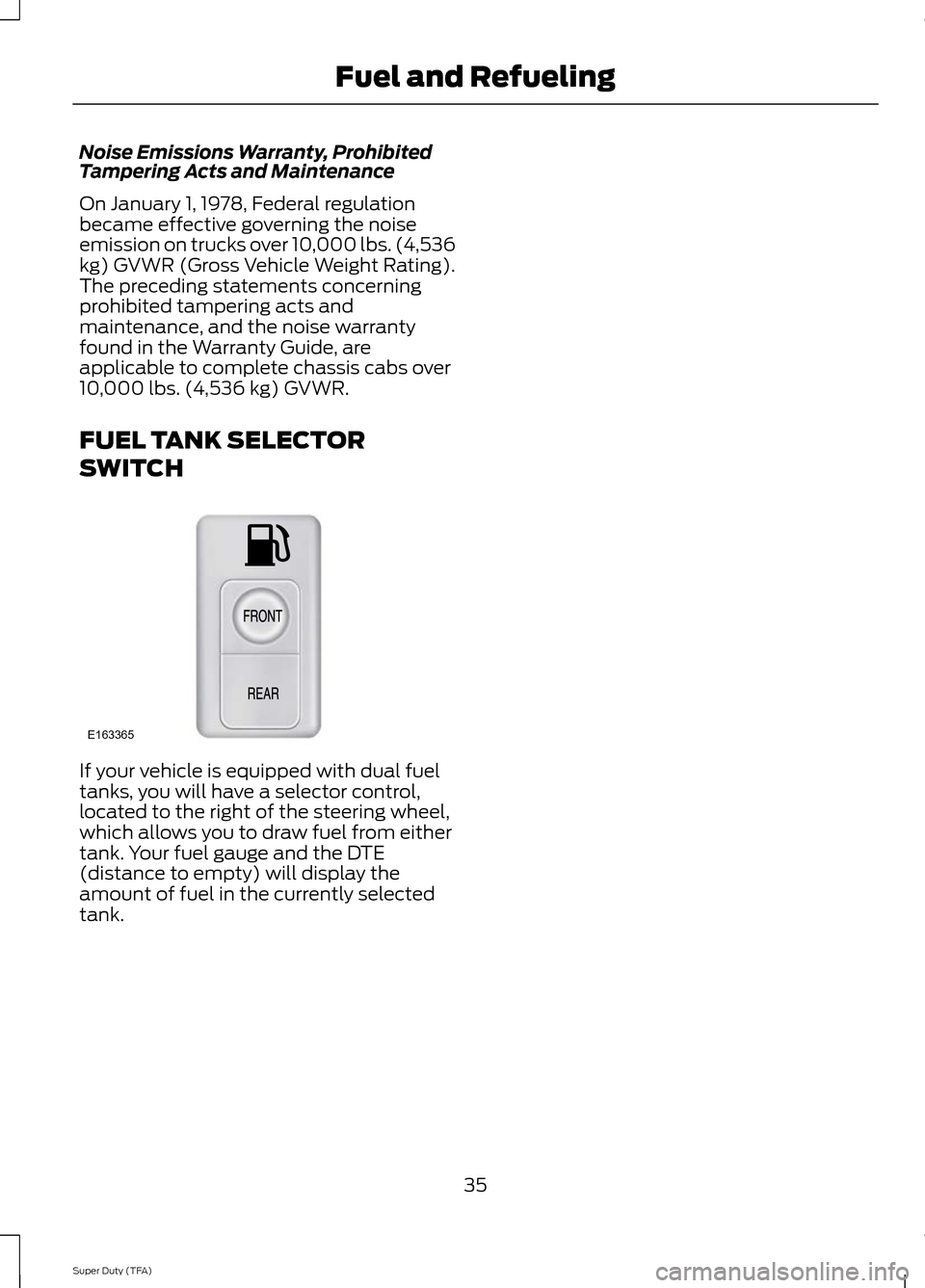
FUEL TANK SELECTOR
SWITCH
If your vehicle is equipped with dual fuel
tanks, you will have a selector control,
located to the right of the steering wheel,
which allows you to draw fuel from either
tank. Your fuel gauge and the DTE
(distance to empty) will display the
amount of fuel in the currently selected
tank.
35
Super Duty (TFA) Fuel and RefuelingE163365
Page 55 of 82
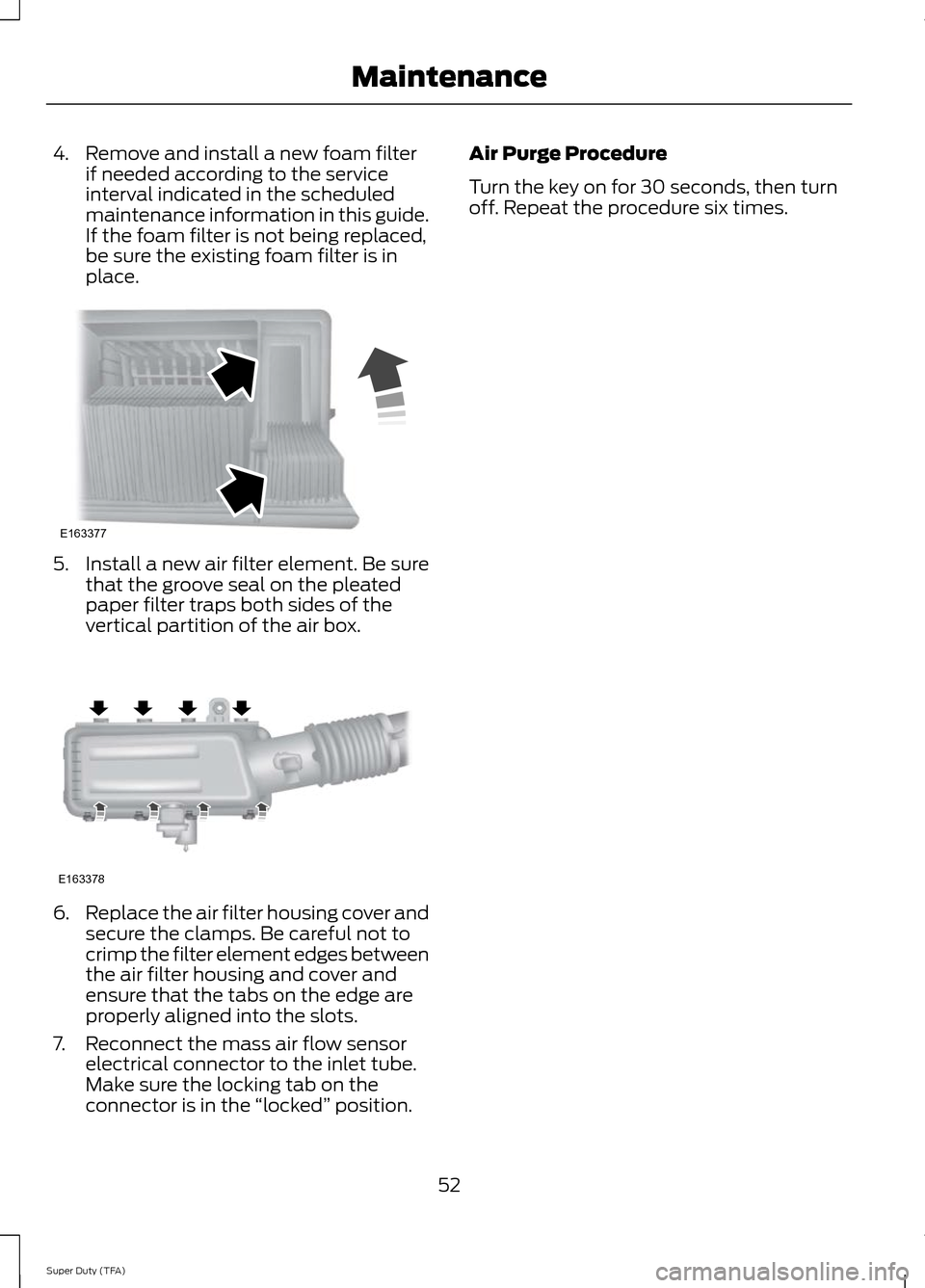
4. Remove and install a new foam filter
if needed according to the service
interval indicated in the scheduled
maintenance information in this guide.
If the foam filter is not being replaced,
be sure the existing foam filter is in
place. 5. Install a new air filter element. Be sure
that the groove seal on the pleated
paper filter traps both sides of the
vertical partition of the air box. 6.
Replace the air filter housing cover and
secure the clamps. Be careful not to
crimp the filter element edges between
the air filter housing and cover and
ensure that the tabs on the edge are
properly aligned into the slots.
7. Reconnect the mass air flow sensor electrical connector to the inlet tube.
Make sure the locking tab on the
connector is in the “locked ” position. Air Purge Procedure
Turn the key on for 30 seconds, then turn
off. Repeat the procedure six times.
52
Super Duty (TFA) MaintenanceE163377 E163378
Page 80 of 82
A
About This Supplement.................................3
Breaking-In Your Vehicle...................................... 3
Diesel Engine Information................................... 3
Minor Troubleshooting Guide............................. 5
Warnings.................................................................... 3
ABS See: Brakes............................................................. 36
B
Brakes.................................................................36 General Information............................................ 36
C
Capacities and Specifications..................54 Technical Specifications................................... 56
Changing the Engine Air Filter
...................49
Air Filter Replacement....................................... 50
Air Filter Restriction Gauge............................... 49
Cleaning the Engine......................................53
Cleaning the Exhaust
....................................53
Coolant Check See: Engine Coolant Check.............................. 44
E
Emission Control System............................29 Diesel Exhaust System: Oxidation Catalyst
And Diesel Particulate Filter System
........................................................................\
........ 29
Engine Block Heater.......................................13 Rapid Heat Supplemental Heating
System.................................................................. 13
Engine Coolant Check..................................44 Adding Engine Coolant...................................... 44
Checking Coolant Corrosion Inhibitor Additive Strength ............................................ 47
Checking the Engine Coolant.......................... 44
Coolant Change.................................................... 49
Engine and Secondary Cooling System Refill Procedure............................................... 46
Engine-driven Cooling Fan (Fan Clutch)................................................................ 49
Recycled Engine Coolant................................... 47
Severe Climates.................................................... 47Engine Idle Shutdown....................................12
Engine Oil Check.............................................42
Changing the Engine Oil and Oil Filter.........43
Engine Oil Specifications.................................. 42
Engine Specifications
...................................54
Drivebelt Routing................................................. 54
F
Fuel and Refueling
..........................................14
Fuel Quality.......................................................14
Biodiesel................................................................... 15
Diesel Fuel Additives ........................................... 16
Fuel And Water Separator ................................ 16
Fuel Requirements - Choosing The Right Fuel: Vehicles Operated Where Ultra Low
Sulfur Diesel Fuel Is Not Required ............14
Fuel Requirements - Choosing The Right Fuel: Vehicles Operated Where Ultra Low
Sulfur Diesel Fuel Is Required (United
States/Canada/Puerto Rico/U.S. Virgin
Islands And Other Locales) ......................... 14
Fuel Shutoff
.....................................................38
Running Out Of DEF (Diesel Exhaust
Fluid).................................................................... 38
Fuel Tank Selector Switch..........................35
G
Gauges..................................................................7 Engine Boost Gauge............................................... 7
General Maintenance Information..........58 Multi-point Inspection....................................... 60
Owner Checks and Services............................ 59
Protecting Your Investment............................. 58
Why Maintain Your Vehicle?............................ 58
Why Maintain Your Vehicle at Your Dealership?....................................................... 58
I
Instrument Cluster
............................................7
Introduction........................................................3
77
Super Duty (TFA) Index