2014 FORD MONDEO brake
[x] Cancel search: brakePage 204 of 446
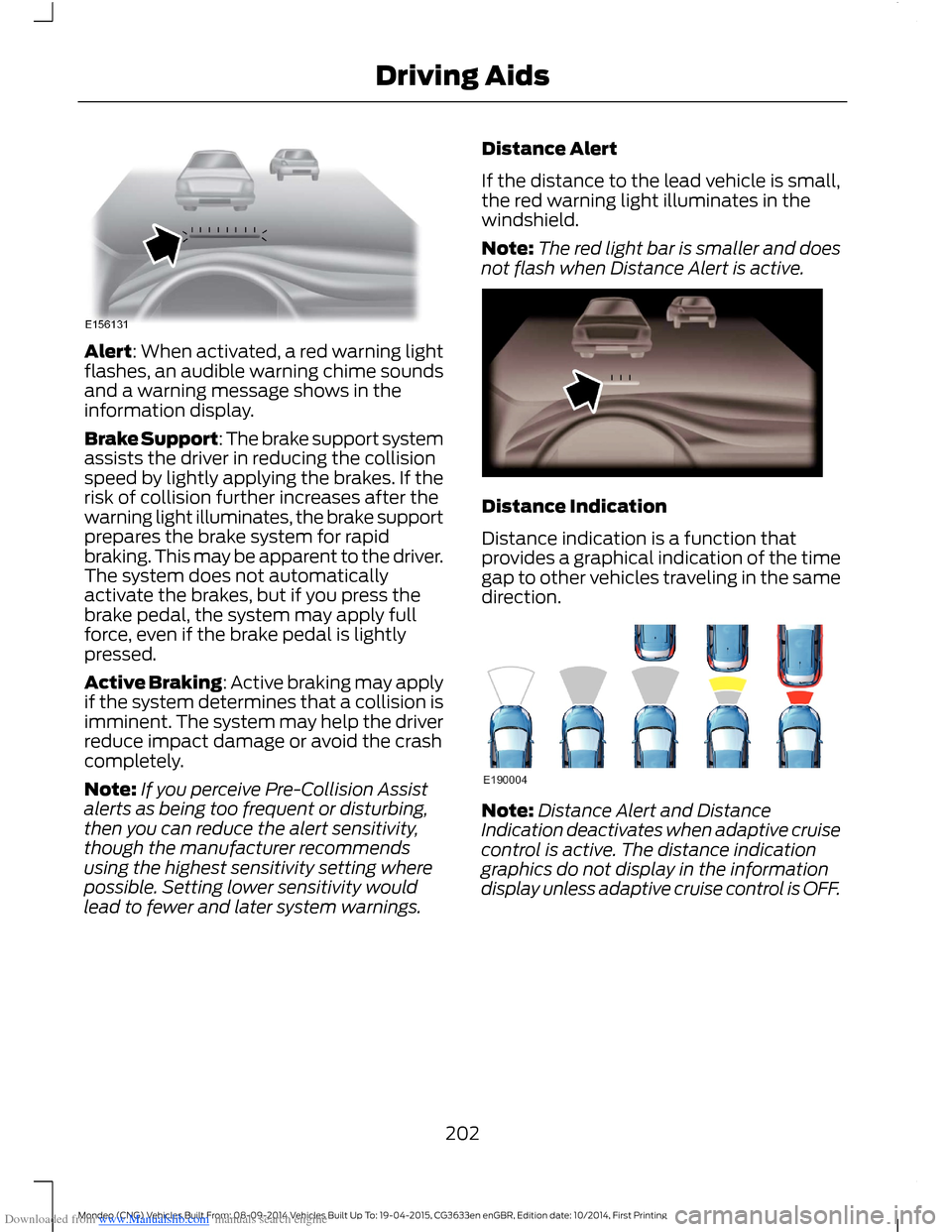
Downloaded from www.Manualslib.com manuals search engine Alert: When activated, a red warning lightflashes, an audible warning chime soundsand a warning message shows in theinformation display.
Brake Support: The brake support systemassists the driver in reducing the collisionspeed by lightly applying the brakes. If therisk of collision further increases after thewarning light illuminates, the brake supportprepares the brake system for rapidbraking. This may be apparent to the driver.The system does not automaticallyactivate the brakes, but if you press thebrake pedal, the system may apply fullforce, even if the brake pedal is lightlypressed.
Active Braking: Active braking may applyif the system determines that a collision isimminent. The system may help the driverreduce impact damage or avoid the crashcompletely.
Note:If you perceive Pre-Collision Assistalerts as being too frequent or disturbing,then you can reduce the alert sensitivity,though the manufacturer recommendsusing the highest sensitivity setting wherepossible. Setting lower sensitivity wouldlead to fewer and later system warnings.
Distance Alert
If the distance to the lead vehicle is small,the red warning light illuminates in thewindshield.
Note:The red light bar is smaller and doesnot flash when Distance Alert is active.
Distance Indication
Distance indication is a function thatprovides a graphical indication of the timegap to other vehicles traveling in the samedirection.
Note:Distance Alert and DistanceIndication deactivates when adaptive cruisecontrol is active. The distance indicationgraphics do not display in the informationdisplay unless adaptive cruise control is OFF.
202Mondeo (CNG) Vehicles Built From: 08-09-2014 Vehicles Built Up To: 19-04-2015, CG3633en enGBR, Edition date: 10/2014, First PrintingDriving Aids
Page 217 of 446
Downloaded from www.Manualslib.com manuals search engine TOWING A TRAILER
WARNINGS
Do not exceed 60 mph (100 km/h).This could result in the loss of vehiclecontrol, serious personal injury ordeath.
The rear tire pressures must beincreased by 3 psi (0.2 bar) abovespecification. Do not exceed themaximum pressure stated on the tiresidewall. This could cause serious personalinjury. See Wheels and Tires (page 260).
Do not exceed the maximum grosstrain weight stated on your vehicleidentification plate. This could resultin the loss of vehicle control, seriouspersonal injury or death. See VehicleIdentification Plate (page 280).
Do not exceed the maximumpermissible trailer nose weight(vertical weight on the tow ball) asstated in the vehicle specification chart.This could result in the loss of vehiclecontrol, serious personal injury or death.See Capacities and Specifications(page 277).
The anti-lock braking system doesnot control the overrun brake on thetrailer. This could result in the loss ofvehicle control, serious personal injury ordeath.
When towing a trailer:
•Obey country specific regulations fortowing a trailer.
•Do not exceed 60 mph (100 km/h)even if a country allows higher speedsunder certain conditions.
•Place loads as low as possible andcentral to the axle of your trailer. If youare towing with an unladen vehicle,place the load in your trailer toward thenose, within the maximum nose load,as this gives the best stability. SeeCapacities and Specifications (page277).
•The trailer nose weight (vertical weighton the tow ball), is essential for thedriving stability of your vehicle andtrailer.
•The vertical weight on the tow ballshould be at least 4% of the trailerweight and not exceed the maximumpermissable weight. See Capacitiesand Specifications (page 277).
•Reduce speed immediately if the trailershows any sign of swaying. See TrailerSway Control (page 216).
•Use a low gear when descending asteep downhill gradient.
Note:The maximum permissible trailernose weight on the trailer identificationplate is the trailer manufacturer’s testingvalue. The vehicle maximum permissibletrailer nose weight may be lower.
The stability of your vehicle to trailercombination is very much dependent onthe quality of the trailer.
Towing a trailer changes the vehiclehandling characteristics and increasesstopping distances. Adapt your speed anddriving behavior to the load of the trailer.
The gross train weight stated on thevehicle identification plate applies for roadgradients up to 12% and altitudes up to3280 ft (1,000 m) when towing a trailer.In mountainous regions, the engineperformance decreases due to lower airdensity with increasing altitude. In highaltitude regions above 3280 ft (1,000 m),you must reduce the stipulated maximumpermitted gross train weight by 10% forevery extra 3280 ft (1,000 m).
215Mondeo (CNG) Vehicles Built From: 08-09-2014 Vehicles Built Up To: 19-04-2015, CG3633en enGBR, Edition date: 10/2014, First PrintingTowing
Page 218 of 446

Downloaded from www.Manualslib.com manuals search engine Note:Not all vehicles are suitable orapproved to have tow bars fitted. See anauthorized dealer for further information.
TRAILER SWAY CONTROL
If the trailer begins to sway, the stabilitycontrol warning lamp flashes and amessage appears in the informationdisplay. The system applies the brakes tothe individual wheels and reduces enginetorque to aid vehicle stability.
Stop your vehicle as soon as it is safe todo so. Check the vertical weight on the towball and trailer load distribution. SeeCapacities and Specifications (page277). See Load Carrying (page 207).
Note:This feature does not prevent trailersway, but reduces it once it begins.
Note:This feature cannot stop all trailersfrom swaying.
Note:In some cases, if your vehicle speedis too high, the system may turn on multipletimes, gradually reducing your vehicle speed.
TOW BALL
WARNINGS
An audible warning tone soundswhen the tow ball arm is not in thefully stowed position or in propertowing position. If the audible warning tonedoes not sound when the tow ball armmoves or when the system switches on,do not use the tow bar. See an authorizeddealer.
Do not touch the tow ball arm whenit is moving.
Make sure there are no obstaclespreventing the tow ball arm frommoving.
Note:We recommend keeping the tow ballarm in the stowed position when you arenot using it. In addition, consider localregulations and insurance terms.
Tow ball arm.A
13-pin trailer socket.B
Swiveling the Tow Ball Arm
Note:Do not attach any plug to the 13-pintrailer socket.
Note:Make sure the vehicle battery has afull charge.
Note:The vehicle has to be stationary forthe tow ball arm to operate.
Note:If something is blocking the tow ballarm during its swivel process, the systemtries to reverse. If the tow ball arm stopsbefore it is fully in towing position or stowedposition, restart the swivel process bypressing the button twice.
Swiveling the Tow Ball Arm Out
Note:If the tow ball arm does not operate,but you hear an audible double tone (lowpitch followed by a high pitch), switch onthe ignition for 10 seconds, and then pressthe brake pedal and try operating the towball arm again.
216Mondeo (CNG) Vehicles Built From: 08-09-2014 Vehicles Built Up To: 19-04-2015, CG3633en enGBR, Edition date: 10/2014, First PrintingTowing
Page 221 of 446
Downloaded from www.Manualslib.com manuals search engine TOWING THE VEHICLE ON
FOUR WHEELS - MANUAL
TRANSMISSION
WARNINGS
You must switch the ignition on whenyour vehicle is being towed. Failureto follow this warning could seriouslyincrease the risk of injury or death.
The brake and steering assistancewill not operate unless the engine isrunning. Press the brake pedal harderand allow for increased stopping distancesand heavier steering. Failure to take caremay lead to a crash or personal injury.
If your vehicle has a steering wheellock, make sure the ignition is in theaccessory or on position when beingtowed.
Too much tension on a tow ropecould cause damage to your vehicleor the vehicle that is towing.
When towing your vehicle you mustselect neutral. Failure to follow thiswarning could damage thetransmission and may lead to a crash orinjury.
Drive off slowly and smoothly withoutjerking the vehicle that is being towed.
You must only use the towing eye that wasdelivered with your vehicle. See TowingPoints (page 217).
Tow ropes or rigid towing bars must beplaced on the same side. For example; righthand rear towing point to right hand fronttowing point.
You must use a tow rope or rigid towingbar that is of the correct strength for theweight of the towing vehicle and thevehicle that is being towed.
The weight of the vehicle that is beingtowed must not exceed the weight of thetowing vehicle.
Do not exceed 30 mph (50 km/h). SeeTowing the Vehicle on Four Wheels(page 219).
TOWING THE VEHICLE ON
FOUR WHEELS - AUTOMATIC
TRANSMISSION
WARNINGS
You must switch the ignition on whenyour vehicle is being towed. Failureto follow this warning could seriouslyincrease the risk of injury or death.
You must make sure thetransmission selector lever is placedin position N. Failure to follow thiswarning could damage the transmissionand may lead to a crash or injury.
The brake and steering assistancewill not operate unless the engine isrunning. Press the brake pedal harderand allow for increased stopping distancesand heavier steering. Failure to take caremay lead to a crash or personal injury.
Too much tension on a tow ropecould cause damage to your vehicleor the vehicle that is towing.
219Mondeo (CNG) Vehicles Built From: 08-09-2014 Vehicles Built Up To: 19-04-2015, CG3633en enGBR, Edition date: 10/2014, First PrintingTowing
Page 223 of 446

Downloaded from www.Manualslib.com manuals search engine BREAKING-IN
Tires
WARNING
New tires need to be run-in forapproximately 300 miles (500kilometers). During this time, youmay experience different drivingcharacteristics.
Brakes and Clutch
WARNING
Avoid heavy use of the brakes andclutch if possible for the first 100miles (150 kilometers) in town andfor the first 1000 miles (1500 kilometers)on freeways.
Engine
WARNING
Avoid driving too fast during the first1000 miles (1500 kilometers). Varyyour speed frequently and changeup through the gears early. Do not laborthe engine.
Vehicles With a Diesel Engine
During the first 2000 miles (3000kilometers), you may notice a ticking soundwhen your vehicle slows down. This is dueto adjustments of your new diesel engineand is normal.
REDUCED ENGINE
PERFORMANCE
WARNING
Continued operation will increase theengine temperature and cause theengine to shut down completely.
If the engine coolant temperature gaugeneedle moves to the upper limit position,the engine is overheating. See Gauges(page 78).
You must only drive your vehicle for a shortdistance if the engine overheats. Thedistance you can travel depends onambient temperature, vehicle load andterrain. The engine will continue to operatewith limited power for a short time.
If the engine temperature continues to rise,the fuel supply to the engine will reduce.The air conditioning will switch off and theengine cooling fan will operate continually.
1.Reduce your speed gradually and stopyour vehicle as soon as it is safe to doso.
2.Switch the engine off immediately toprevent severe engine damage.
3.Wait for the engine to cool down.
4.Check the coolant level. See EngineCoolant Check (page 247).
5.Have your vehicle checked by anauthorized dealer as soon as possible.
ECONOMICAL DRIVING
The following will help to improve fuelconsumption.
Tire Pressures
Check your tire pressures regularly tooptimize fuel economy. For best resultsuse the economy pressures. See TirePressures (page 273).
Gear Shifting
Use the highest drivable gear appropriatefor the road conditions.
221Mondeo (CNG) Vehicles Built From: 08-09-2014 Vehicles Built Up To: 19-04-2015, CG3633en enGBR, Edition date: 10/2014, First PrintingDriving Hints
Page 224 of 446
Downloaded from www.Manualslib.com manuals search engine Anticipation
Adjust your vehicle speed and the distanceto other vehicles without the need forheavy braking or acceleration.
Efficient Speed
Higher speeds use more fuel. Reduce yourcruising speed on open roads.
Accessories
Try not to add unnecessary accessories tothe exterior of your vehicle. If you use a roofrack, remember to fold it down or removeit when not in use.
Electrical Systems
Switch off all electrical systems when notin use, for example air conditioning. Makesure you unplug any accessories from theauxiliary power points when not in use.
COLD WEATHER
PRECAUTIONS
The functional operation of somecomponents and systems can be affectedat temperatures below -13°F (-25°C).
DRIVING THROUGH WATER
WARNING
Do not drive through flowing or deepwater as you may lose control of yourvehicle.
Note:Driving through standing water cancause vehicle damage.
Note:Engine damage can occur if waterenters the air filter.
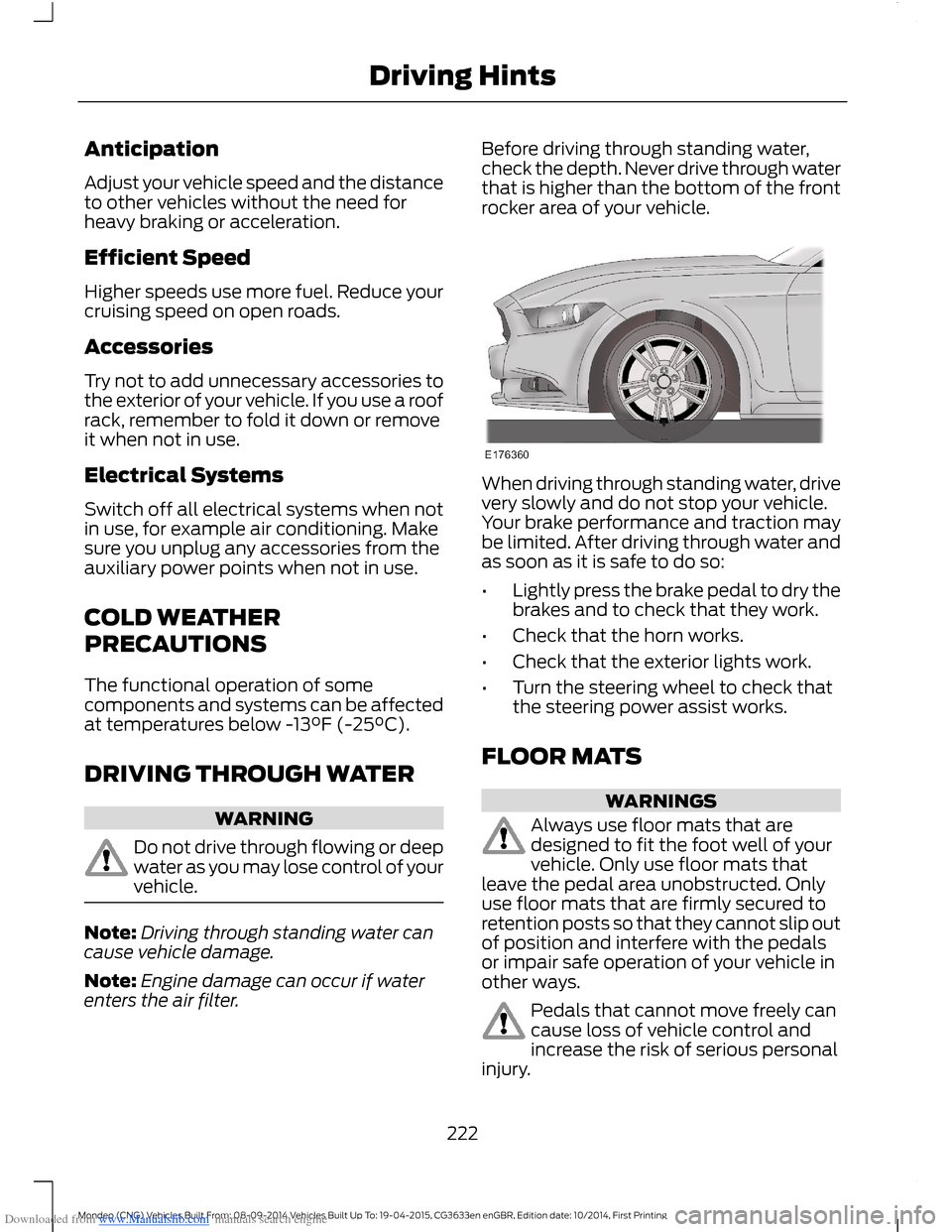
Before driving through standing water,check the depth. Never drive through waterthat is higher than the bottom of the frontrocker area of your vehicle.
When driving through standing water, drivevery slowly and do not stop your vehicle.Your brake performance and traction maybe limited. After driving through water andas soon as it is safe to do so:
•Lightly press the brake pedal to dry thebrakes and to check that they work.
•Check that the horn works.
•Check that the exterior lights work.
•Turn the steering wheel to check thatthe steering power assist works.
FLOOR MATS
WARNINGS
Always use floor mats that aredesigned to fit the foot well of yourvehicle. Only use floor mats thatleave the pedal area unobstructed. Onlyuse floor mats that are firmly secured toretention posts so that they cannot slip outof position and interfere with the pedalsor impair safe operation of your vehicle inother ways.
Pedals that cannot move freely cancause loss of vehicle control andincrease the risk of serious personalinjury.
222Mondeo (CNG) Vehicles Built From: 08-09-2014 Vehicles Built Up To: 19-04-2015, CG3633en enGBR, Edition date: 10/2014, First PrintingDriving Hints
Page 226 of 446
Downloaded from www.Manualslib.com manuals search engine HAZARD WARNING FLASHERS
The hazard warning button is located onthe instrument panel. Use it when yourvehicle is creating a safety hazard for othermotorists.
Press the button to turn on the hazardwarning function, and the front and reardirection indicators will flash.
Press the button again to turn them off.
Note:If used when the engine is notrunning, the battery will lose charge. Theremay be insufficient power to restart yourengine.
Note:Depending on applicable laws andregulations in the country for which yourvehicle was originally built, the hazardwarning flashers may flash if you brakeheavily.
FIRST AID KIT
For 5-door and wagon vehicles, stow thefirst aid kit in the left side wall storage areain the luggage compartment. For 4-doorvehicles, stow the first aid kit in the rearunder floor storage compartment. SeeRear Under Floor Storage (page 208).
WARNING TRIANGLE
Space is provided in the luggagecompartment.
FUEL SHUTOFF
WARNING
Failure to inspect and, if necessary,repair fuel leaks after a collision mayincrease the risk of fire and seriousinjury. Ford Motor Company recommendsthat the fuel system be inspected by anauthorized dealer after any collision.
In the event of a moderate to severecollision, this vehicle includes a fuel pumpshutoff feature that stops the flow of fuelto the engine. Not every impact will causea shutoff.
Should your vehicle shut off after acollision, you may restart your vehicle. Forvehicles equipped with a key system:
1.Switch off the ignition.
2.Switch on the ignition.
3.Repeat Steps 1 and 2 to re-enable thefuel pump.
For vehicles equipped with a push buttonstart system:
1.Press the START/STOP button toswitch off the ignition.
2.Press the brake pedal and press theSTART/STOP button to start thevehicle.
3.Remove your foot from the brake pedaland press the START/STOP buttonto switch off the ignition.
4.You can either attempt to start theengine by pressing the brake pedal andthe START/STOP button, or switchon the ignition only by pressing theSTART/STOP button withoutpressing the brake pedal. Both waysre-enable the fuel system.
224Mondeo (CNG) Vehicles Built From: 08-09-2014 Vehicles Built Up To: 19-04-2015, CG3633en enGBR, Edition date: 10/2014, First PrintingRoadside Emergencies
Page 230 of 446

Downloaded from www.Manualslib.com manuals search engine Protected componentsFuse amp ratingFuse or relay number
Powertrain control module relay.—9
Driver front auxiliary power point.20A310
Powertrain control module.15A211
Powertrain control module.15A212
Powertrain control module.10A213
Powertrain control module.10A214
Run-start relay.—15
Console auxiliary power point.20A316
Auxiliary power point.20A317
Powertrain control module.10A118
Power steering.10A119
Run-start lighting.10A120
Transmission control module.15A121Transmission oil pump.
Air conditioning.10A122
Blind spot monitor.15A123Rear view camera.Adaptive Cruise Control.Pre-collision warning indicator.Voltage quality module.Air quality sensor.
Not used (spare).10A124
Anti-lock brake system.10A225
Powertrain control module.10A226
Not used (spare).10A127
Rear washer pump.10A128
228Mondeo (CNG) Vehicles Built From: 08-09-2014 Vehicles Built Up To: 19-04-2015, CG3633en enGBR, Edition date: 10/2014, First PrintingFuses