2014 FORD MONDEO warning
[x] Cancel search: warningPage 203 of 446
Downloaded from www.Manualslib.com manuals search engine Switching the System Off and On
In certain situations, it is advisable toswitch the system off. For example:
•Driving off road when objects maycover the windshield.
•Driving through a car wash facility.
Selectable settings for this feature are ONand OFF. The default setting for active citystop is ON.
You can switch the system off and on usingthe information display. See (page 86).
COLLISION WARNING SYSTEM
PRINCIPLE OF OPERATION
WARNINGS
You are responsible for controllingyour vehicle at all times. The systemdoes not relieve you of yourresponsibility to drive with due care andattention. Failure to take care may resultin the loss of control of your vehicle, seriouspersonal injury or death.
To achieve full system performanceyou must break in the brakingsystem. See (page 160).Failure totake care may result in the loss of controlof your vehicle, serious personal injury ordeath.
The system does not react tocyclists, animals, pedestrians atnight, or vehicles that are driving in adifferent direction. Failure to take care mayresult in the loss of control of your vehicle,serious personal injury or death.
The system does not operate duringharsh acceleration or steering. Failureto take care may lead to a crash orpersonal injury.
WARNINGS
The system may or may not operateor may operate with reducedfunction during cold or severeweather conditions. Snow, ice, rain, sprayand fog can influence the system. Keepthe front camera and radar free of snowand ice. Failure to take care may result inthe loss of control of your vehicle, seriouspersonal injury or death.
System performance may reduce insituations where the camera'sdetection capability is limited. Thesesituations include but are not limited todirect or low sunlight, vehicles at nightwithout tail lights, unconventional vehicletypes, pedestrians with complexbackgrounds, running pedestrians, partlyobscured pedestrians, or pedestrians whichcannot be distinguished from a group.Failure to take care may result in the lossof control of your vehicle, serious personalinjury or death.
The system cannot help prevent allcollisions. Do not rely on this systemto replace driver judgment and theneed to maintain distance and speed.
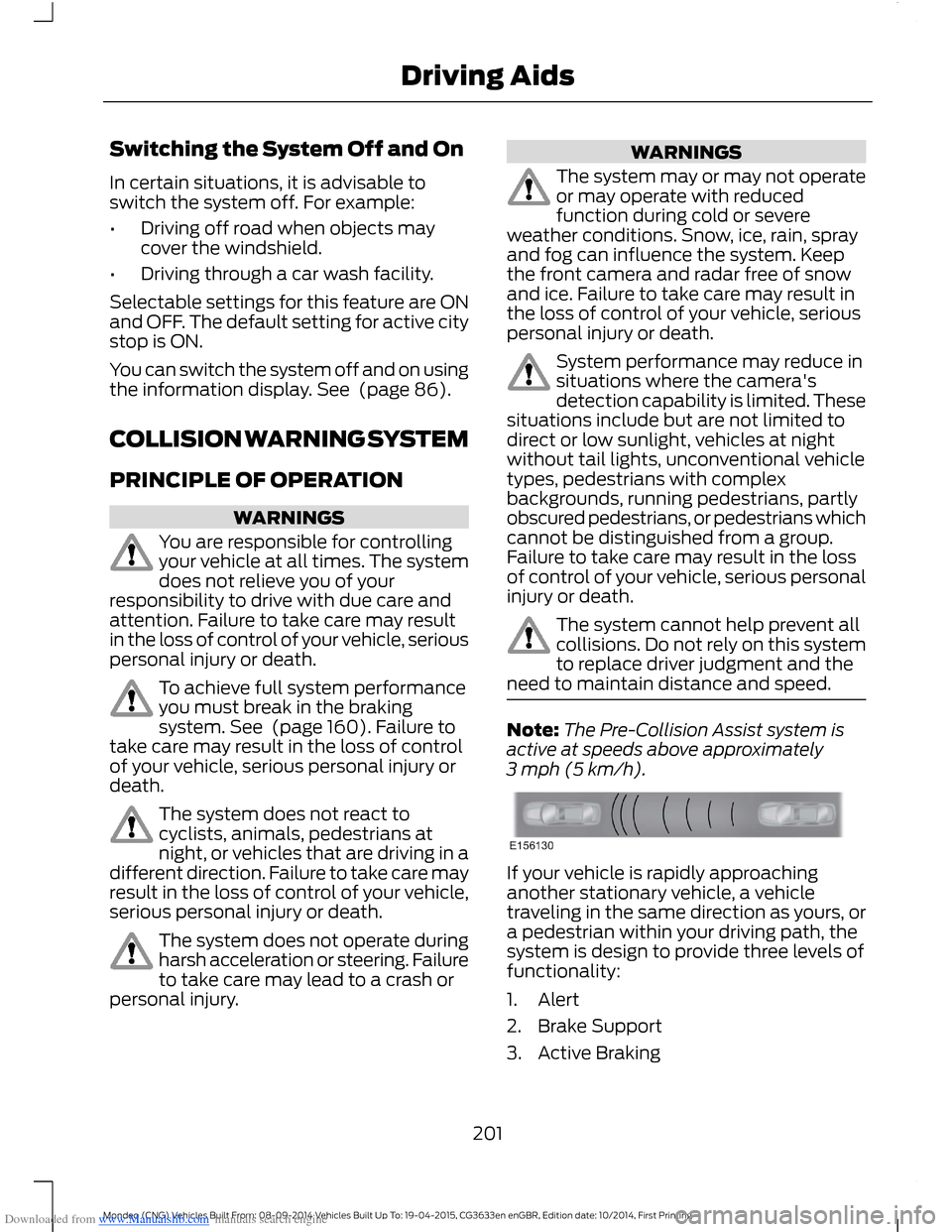
Note:The Pre-Collision Assist system isactive at speeds above approximately3 mph (5 km/h).
If your vehicle is rapidly approachinganother stationary vehicle, a vehicletraveling in the same direction as yours, ora pedestrian within your driving path, thesystem is design to provide three levels offunctionality:
1.Alert
2.Brake Support
3.Active Braking
201Mondeo (CNG) Vehicles Built From: 08-09-2014 Vehicles Built Up To: 19-04-2015, CG3633en enGBR, Edition date: 10/2014, First PrintingDriving Aids
Page 204 of 446
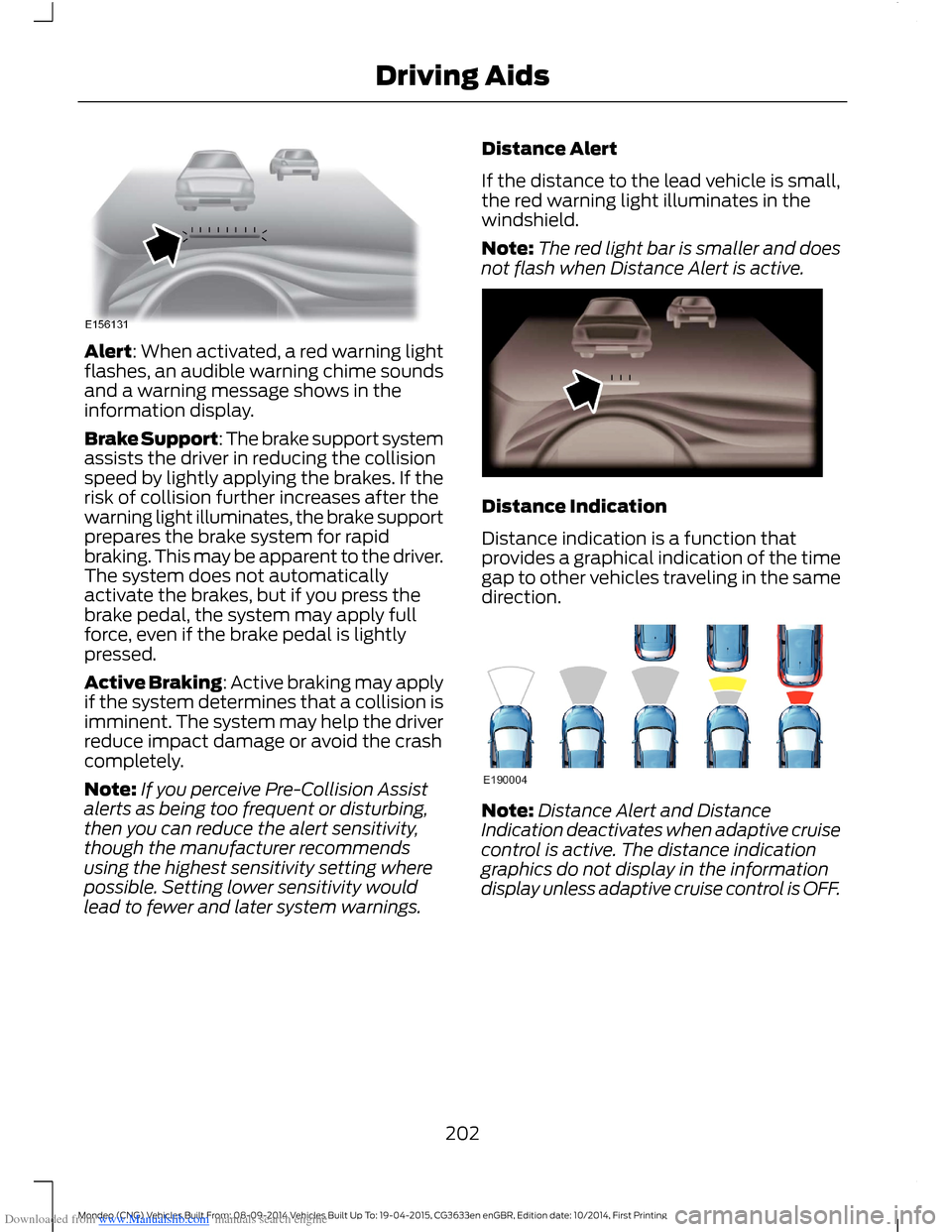
Downloaded from www.Manualslib.com manuals search engine Alert: When activated, a red warning lightflashes, an audible warning chime soundsand a warning message shows in theinformation display.
Brake Support: The brake support systemassists the driver in reducing the collisionspeed by lightly applying the brakes. If therisk of collision further increases after thewarning light illuminates, the brake supportprepares the brake system for rapidbraking. This may be apparent to the driver.The system does not automaticallyactivate the brakes, but if you press thebrake pedal, the system may apply fullforce, even if the brake pedal is lightlypressed.
Active Braking: Active braking may applyif the system determines that a collision isimminent. The system may help the driverreduce impact damage or avoid the crashcompletely.
Note:If you perceive Pre-Collision Assistalerts as being too frequent or disturbing,then you can reduce the alert sensitivity,though the manufacturer recommendsusing the highest sensitivity setting wherepossible. Setting lower sensitivity wouldlead to fewer and later system warnings.
Distance Alert
If the distance to the lead vehicle is small,the red warning light illuminates in thewindshield.
Note:The red light bar is smaller and doesnot flash when Distance Alert is active.
Distance Indication
Distance indication is a function thatprovides a graphical indication of the timegap to other vehicles traveling in the samedirection.
Note:Distance Alert and DistanceIndication deactivates when adaptive cruisecontrol is active. The distance indicationgraphics do not display in the informationdisplay unless adaptive cruise control is OFF.
202Mondeo (CNG) Vehicles Built From: 08-09-2014 Vehicles Built Up To: 19-04-2015, CG3633en enGBR, Edition date: 10/2014, First PrintingDriving Aids
Page 209 of 446
Downloaded from www.Manualslib.com manuals search engine GENERAL INFORMATION
WARNINGS
Use load securing straps to anapproved standard, e.g. DIN.
Make sure that you secure all looseitems properly.
Place luggage and other loads as lowand as far forward as possible withinthe luggage or loadspace.
Do not drive with the liftgate or reardoor open. Exhaust fumes may enteryour vehicle.
Do not exceed the maximum frontand rear axle loads for your vehicle.See Vehicle Identification Plate(page 280).
Do not allow items to contact therear windows.
Note:When loading long objects in to yourvehicle, for example pipes, timber orfurniture be careful not to damage theinterior trim.
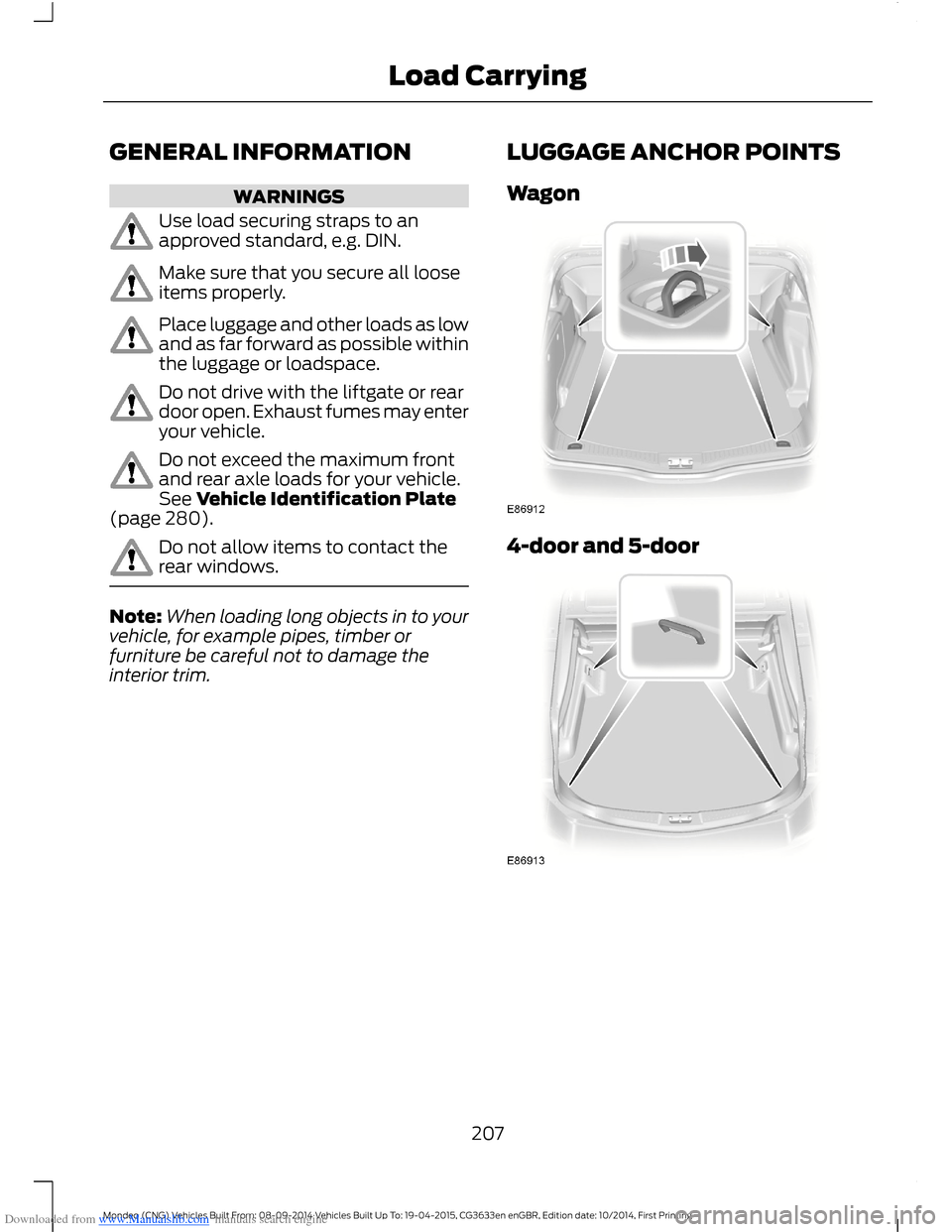
LUGGAGE ANCHOR POINTS
Wagon
4-door and 5-door
207Mondeo (CNG) Vehicles Built From: 08-09-2014 Vehicles Built Up To: 19-04-2015, CG3633en enGBR, Edition date: 10/2014, First PrintingLoad Carrying
Page 211 of 446
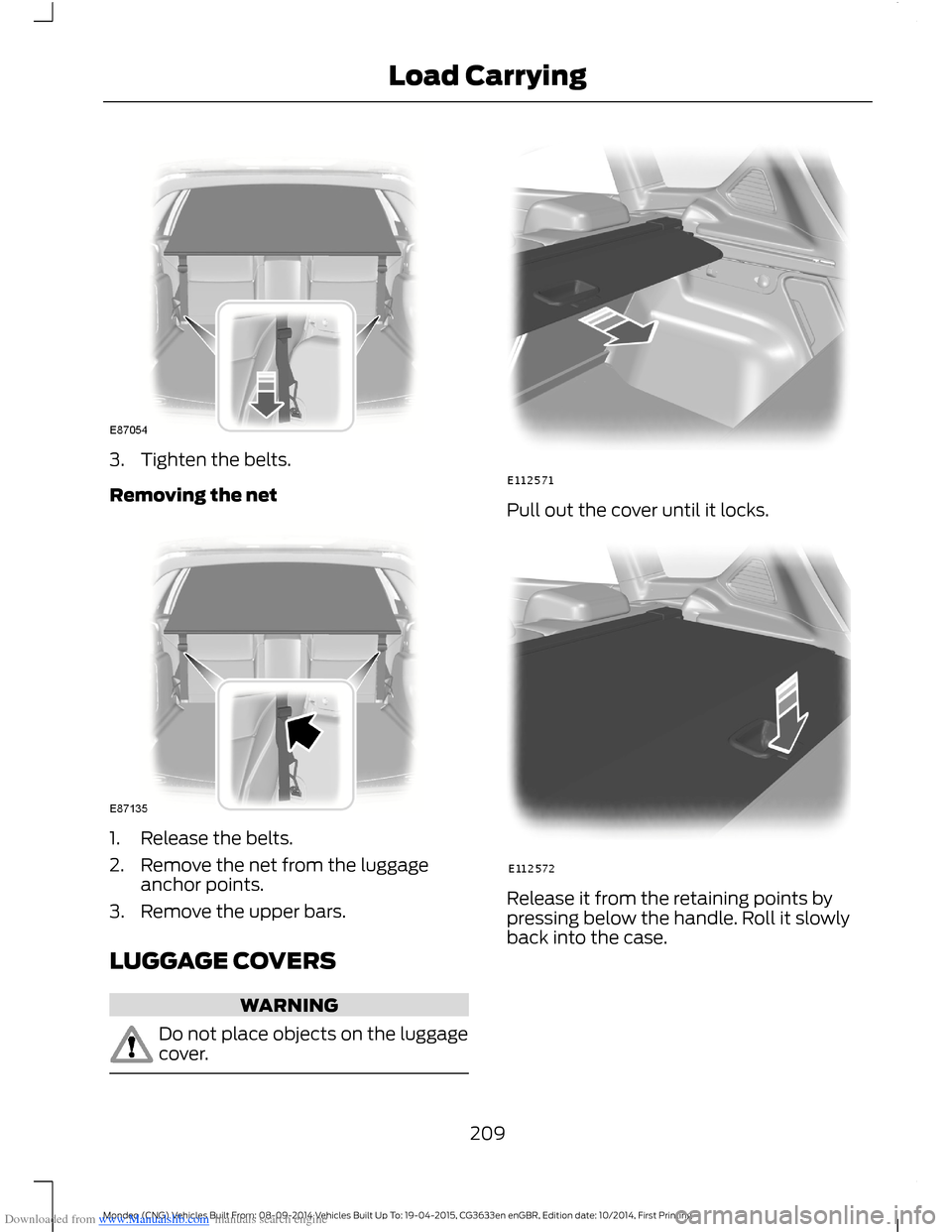
Downloaded from www.Manualslib.com manuals search engine 3.Tighten the belts.
Removing the net
1.Release the belts.
2.Remove the net from the luggageanchor points.
3.Remove the upper bars.
LUGGAGE COVERS
WARNING
Do not place objects on the luggagecover.
Pull out the cover until it locks.
Release it from the retaining points bypressing below the handle. Roll it slowlyback into the case.
209Mondeo (CNG) Vehicles Built From: 08-09-2014 Vehicles Built Up To: 19-04-2015, CG3633en enGBR, Edition date: 10/2014, First PrintingLoad Carrying
Page 212 of 446
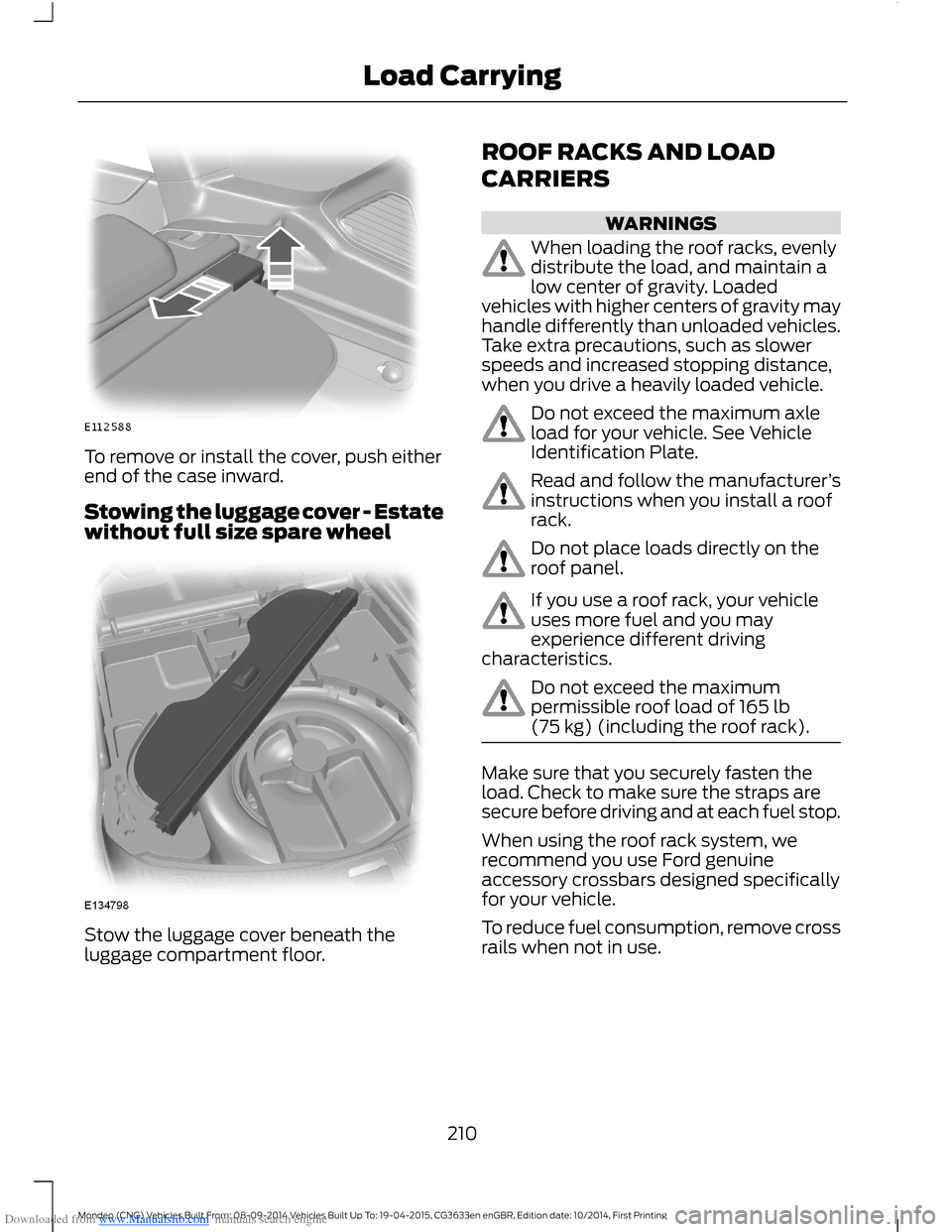
Downloaded from www.Manualslib.com manuals search engine To remove or install the cover, push eitherend of the case inward.
Stowing the luggage cover - Estatewithout full size spare wheel
Stow the luggage cover beneath theluggage compartment floor.
ROOF RACKS AND LOAD
CARRIERS
WARNINGS
When loading the roof racks, evenlydistribute the load, and maintain alow center of gravity. Loadedvehicles with higher centers of gravity mayhandle differently than unloaded vehicles.Take extra precautions, such as slowerspeeds and increased stopping distance,when you drive a heavily loaded vehicle.
Do not exceed the maximum axleload for your vehicle. See VehicleIdentification Plate.
Read and follow the manufacturer’sinstructions when you install a roofrack.
Do not place loads directly on theroof panel.
If you use a roof rack, your vehicleuses more fuel and you mayexperience different drivingcharacteristics.
Do not exceed the maximumpermissible roof load of 165 lb(75 kg) (including the roof rack).
Make sure that you securely fasten theload. Check to make sure the straps aresecure before driving and at each fuel stop.
When using the roof rack system, werecommend you use Ford genuineaccessory crossbars designed specificallyfor your vehicle.
To reduce fuel consumption, remove crossrails when not in use.
210Mondeo (CNG) Vehicles Built From: 08-09-2014 Vehicles Built Up To: 19-04-2015, CG3633en enGBR, Edition date: 10/2014, First PrintingLoad Carrying
Page 213 of 446
Downloaded from www.Manualslib.com manuals search engine LOAD RETAINING FIXTURES
WARNING
Do not exceed the maximumpermissible load of 132 lb (60 kg) ontwo load retaining fixtures and 66 lb(30 kg) on one.
Check the security of the load retainingfixtures and tighten the fittings as follows:
•Before starting.
•After driving 30 mi (50 km).
•At 620 mi (1,000 km) intervals.
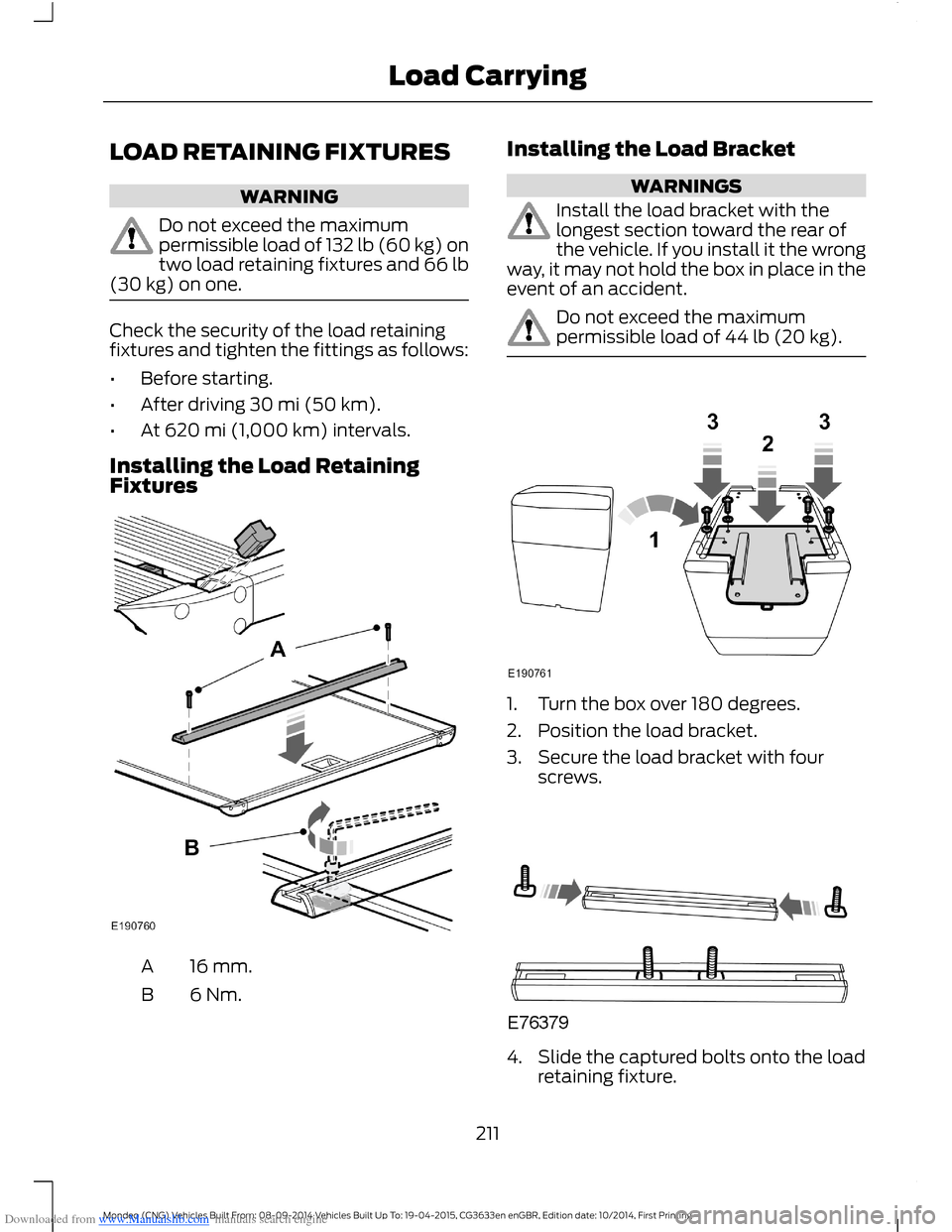
Installing the Load RetainingFixtures
16 mm.A
6 Nm.B
Installing the Load Bracket
WARNINGS
Install the load bracket with thelongest section toward the rear ofthe vehicle. If you install it the wrongway, it may not hold the box in place in theevent of an accident.
Do not exceed the maximumpermissible load of 44 lb (20 kg).
1.Turn the box over 180 degrees.
2.Position the load bracket.
3.Secure the load bracket with fourscrews.
4.Slide the captured bolts onto the loadretaining fixture.
211Mondeo (CNG) Vehicles Built From: 08-09-2014 Vehicles Built Up To: 19-04-2015, CG3633en enGBR, Edition date: 10/2014, First PrintingLoad Carrying
Page 214 of 446
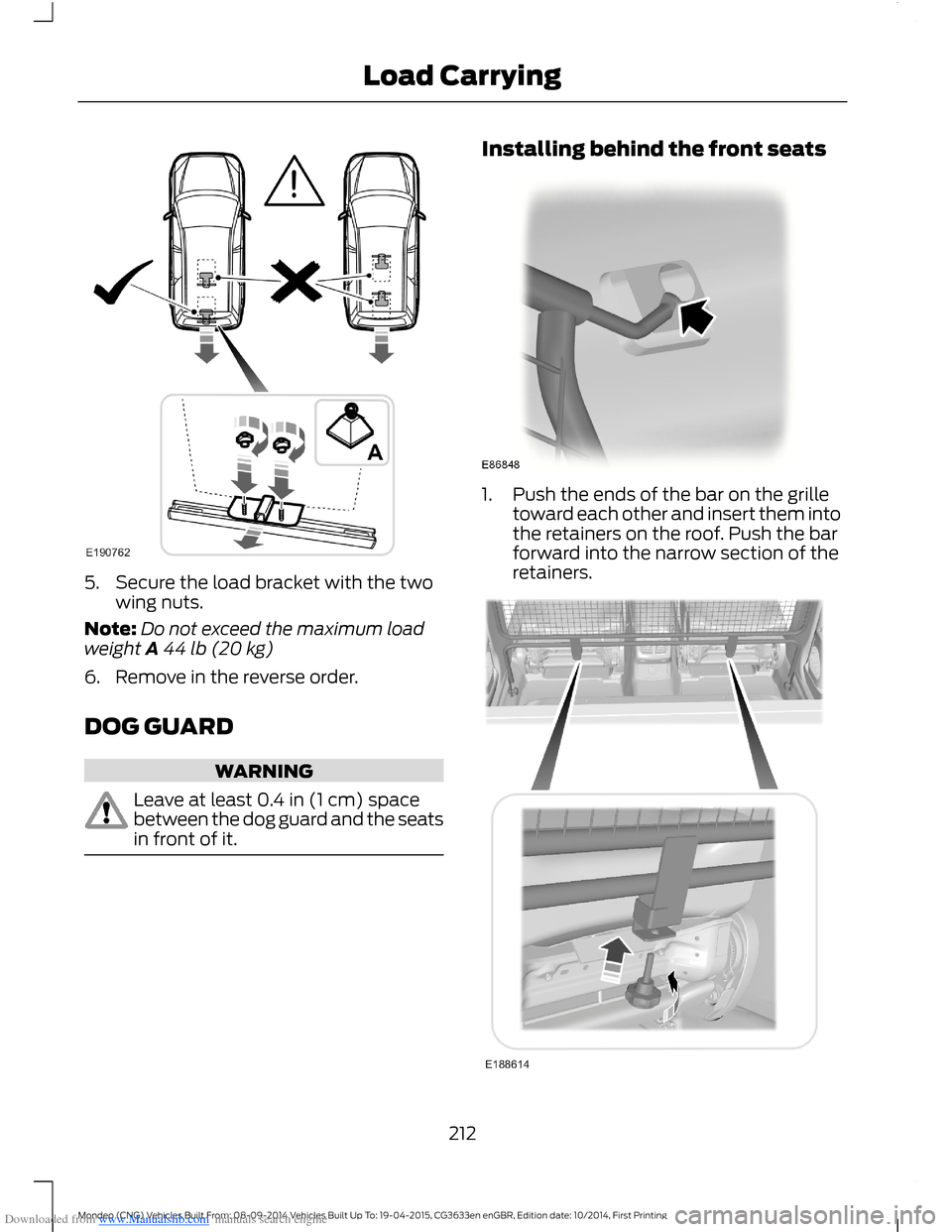
Downloaded from www.Manualslib.com manuals search engine 5.Secure the load bracket with the twowing nuts.
Note:Do not exceed the maximum loadweight A44 lb (20 kg)
6.Remove in the reverse order.
DOG GUARD
WARNING
Leave at least 0.4 in (1 cm) spacebetween the dog guard and the seatsin front of it.
Installing behind the front seats
1.Push the ends of the bar on the grilletoward each other and insert them intothe retainers on the roof. Push the barforward into the narrow section of theretainers.
212Mondeo (CNG) Vehicles Built From: 08-09-2014 Vehicles Built Up To: 19-04-2015, CG3633en enGBR, Edition date: 10/2014, First PrintingLoad Carrying
Page 217 of 446
Downloaded from www.Manualslib.com manuals search engine TOWING A TRAILER
WARNINGS
Do not exceed 60 mph (100 km/h).This could result in the loss of vehiclecontrol, serious personal injury ordeath.
The rear tire pressures must beincreased by 3 psi (0.2 bar) abovespecification. Do not exceed themaximum pressure stated on the tiresidewall. This could cause serious personalinjury. See Wheels and Tires (page 260).
Do not exceed the maximum grosstrain weight stated on your vehicleidentification plate. This could resultin the loss of vehicle control, seriouspersonal injury or death. See VehicleIdentification Plate (page 280).
Do not exceed the maximumpermissible trailer nose weight(vertical weight on the tow ball) asstated in the vehicle specification chart.This could result in the loss of vehiclecontrol, serious personal injury or death.See Capacities and Specifications(page 277).
The anti-lock braking system doesnot control the overrun brake on thetrailer. This could result in the loss ofvehicle control, serious personal injury ordeath.
When towing a trailer:
•Obey country specific regulations fortowing a trailer.
•Do not exceed 60 mph (100 km/h)even if a country allows higher speedsunder certain conditions.
•Place loads as low as possible andcentral to the axle of your trailer. If youare towing with an unladen vehicle,place the load in your trailer toward thenose, within the maximum nose load,as this gives the best stability. SeeCapacities and Specifications (page277).
•The trailer nose weight (vertical weighton the tow ball), is essential for thedriving stability of your vehicle andtrailer.
•The vertical weight on the tow ballshould be at least 4% of the trailerweight and not exceed the maximumpermissable weight. See Capacitiesand Specifications (page 277).
•Reduce speed immediately if the trailershows any sign of swaying. See TrailerSway Control (page 216).
•Use a low gear when descending asteep downhill gradient.
Note:The maximum permissible trailernose weight on the trailer identificationplate is the trailer manufacturer’s testingvalue. The vehicle maximum permissibletrailer nose weight may be lower.
The stability of your vehicle to trailercombination is very much dependent onthe quality of the trailer.
Towing a trailer changes the vehiclehandling characteristics and increasesstopping distances. Adapt your speed anddriving behavior to the load of the trailer.
The gross train weight stated on thevehicle identification plate applies for roadgradients up to 12% and altitudes up to3280 ft (1,000 m) when towing a trailer.In mountainous regions, the engineperformance decreases due to lower airdensity with increasing altitude. In highaltitude regions above 3280 ft (1,000 m),you must reduce the stipulated maximumpermitted gross train weight by 10% forevery extra 3280 ft (1,000 m).
215Mondeo (CNG) Vehicles Built From: 08-09-2014 Vehicles Built Up To: 19-04-2015, CG3633en enGBR, Edition date: 10/2014, First PrintingTowing