2014 FORD MONDEO ice
[x] Cancel search: icePage 206 of 446

Downloaded from www.Manualslib.com manuals search engine ActionCause
Clean the grille surface in front of the radaror remove the object causing the obstruc-tion.
The surface of the radar in the grille is dirtyor obstructed in some way.
Wait a short time. It may take severalminutes for the radar to detect that thereis no obstruction.
The surface of the radar in the grille is cleanbut the message remains in the display.
The Pre-Collision Assist system is tempor-arily disabled. Pre-Collision Assist shouldautomatically reactivate a short time afterthe weather conditions improve.
Heavy rain, spray, snow, or fog is interferingwith the radar signals.
The Pre-Collision Assist system is tempor-arily disabled. Pre-Collision Assist shouldautomatically reactivate a short time afterthe weather conditions improve.
Swirling water, or snow or ice on the surfaceof the road may interfere with the radarsignals.
Contact an authorized dealer to have theradar checked for proper coverage andoperation.
Radar is out of alignment due to a front endimpact.
Clean the outside of the windshield in frontof the camera.The windshield in front of the camera isdirty or obstructed in some way.
Wait a short time. It may take severalminutes for the camera to detect that thereis no obstruction.
The windshield in front of the camera isclean but the message remains in thedisplay.
Note:Proper system operation requires aclear view of the road by the camera. Haveany windshield damage in the area of thecamera's field of view repaired.
Note:If something hits the front end of yourvehicle or damage occurs, the radar sensingzone may change. This could cause missedor false vehicle detections. Contact anauthorized dealer to have the radar checkedfor proper coverage and operation.
Note:If your vehicle detects excessive heatat the camera or a potential misalignmentcondition, a message may display in theinformation display indicating temporarysensor unavailability. This messagedeactivates automatically when operationalconditions are corrected (for example, whenthe ambient temperature around the sensordecreases or the sensor automaticallyrecalibrates successfully).
204Mondeo (CNG) Vehicles Built From: 08-09-2014 Vehicles Built Up To: 19-04-2015, CG3633en enGBR, Edition date: 10/2014, First PrintingDriving Aids
Page 218 of 446

Downloaded from www.Manualslib.com manuals search engine Note:Not all vehicles are suitable orapproved to have tow bars fitted. See anauthorized dealer for further information.
TRAILER SWAY CONTROL
If the trailer begins to sway, the stabilitycontrol warning lamp flashes and amessage appears in the informationdisplay. The system applies the brakes tothe individual wheels and reduces enginetorque to aid vehicle stability.
Stop your vehicle as soon as it is safe todo so. Check the vertical weight on the towball and trailer load distribution. SeeCapacities and Specifications (page277). See Load Carrying (page 207).
Note:This feature does not prevent trailersway, but reduces it once it begins.
Note:This feature cannot stop all trailersfrom swaying.
Note:In some cases, if your vehicle speedis too high, the system may turn on multipletimes, gradually reducing your vehicle speed.
TOW BALL
WARNINGS
An audible warning tone soundswhen the tow ball arm is not in thefully stowed position or in propertowing position. If the audible warning tonedoes not sound when the tow ball armmoves or when the system switches on,do not use the tow bar. See an authorizeddealer.
Do not touch the tow ball arm whenit is moving.
Make sure there are no obstaclespreventing the tow ball arm frommoving.
Note:We recommend keeping the tow ballarm in the stowed position when you arenot using it. In addition, consider localregulations and insurance terms.
Tow ball arm.A
13-pin trailer socket.B
Swiveling the Tow Ball Arm
Note:Do not attach any plug to the 13-pintrailer socket.
Note:Make sure the vehicle battery has afull charge.
Note:The vehicle has to be stationary forthe tow ball arm to operate.
Note:If something is blocking the tow ballarm during its swivel process, the systemtries to reverse. If the tow ball arm stopsbefore it is fully in towing position or stowedposition, restart the swivel process bypressing the button twice.
Swiveling the Tow Ball Arm Out
Note:If the tow ball arm does not operate,but you hear an audible double tone (lowpitch followed by a high pitch), switch onthe ignition for 10 seconds, and then pressthe brake pedal and try operating the towball arm again.
216Mondeo (CNG) Vehicles Built From: 08-09-2014 Vehicles Built Up To: 19-04-2015, CG3633en enGBR, Edition date: 10/2014, First PrintingTowing
Page 219 of 446
Downloaded from www.Manualslib.com manuals search engine 1.Press the button. An audible doubletone (low pitch followed by a highpitch) sounds to let you know thesystem is operating.
2.Press the button again within fourseconds to swivel the tow ball arm. Aseries of audible tones sounds and theLED flashes while the tow ball armswivels.
3.When the tow ball arm finishesswiveling, the LED stops flashing andan audible double tone (high pitchfollowed by a low pitch) sounds.
The tow ball arm is ready for use when itfinishes swiveling into the towing position.
Swiveling the Tow Ball Arm In
Before swiveling the tow ball arm in:
•Unhitch the trailer or dismantle loadcarriers and their attachments.
•Dismantle attachments for trackingstabilization.
•Remove the plug for the trailer powersupply and the adapter from the trailersocket. Failure to do so may causedamage to the bumper when the towball arm swivels into its stowedposition.
To start swiveling the tow ball arm in, pressthe swivel button twice within fourseconds.
The tow ball arm swivels into the stowedposition automatically.
Tow Ball Arm Fault Conditions
If the LED on the swivel button is rapidlyflashing and an audible tone sequence(high pitch) sounds, repeat the swivelprocess. If this does not resolve theproblem, see an authorized dealer.
A message may appear in the informationdisplay. See Information Messages(page 96).
Driving with a Trailer
WARNINGS
In the event of a vehicle breakdown,disconnect the trailer before towingthe vehicle.
If any of the conditions below cannotbe met, do not use the tow bar andhave it checked by a properly trainedtechnician. Before starting your journey,make sure that the tow ball arm is properlylocked.
Check that:
•There is a last audible low pitch tonewhen the locking procedure finishes.
•The tow ball arm properly locks. Makesure it does not move when jerked.
Maintenance
Note:The towing hitch and control unit aremaintenance-free. Do not grease or oil thesecomponents.
Note:Do not attempt to service the towinghitch. Only the manufacturer should carryout repairs or dismantle the hitch.
Note:When cleaning the vehicle with asteam jet, do not direct the high-pressurejet directly onto the swivel joint of the towball arm and socket. After cleaning thevehicle, unplug the connector or open thetrailer socket to make sure no water entered.If water is present, dry the socket.
TOWING POINTS
WARNING
The towing eye has a left-handthread. Turn it counterclockwise toinstall it. Make sure that the towingeye is fully tightened. Failure to do so couldresult in the towing eye becoming loose.
217Mondeo (CNG) Vehicles Built From: 08-09-2014 Vehicles Built Up To: 19-04-2015, CG3633en enGBR, Edition date: 10/2014, First PrintingTowing
Page 223 of 446

Downloaded from www.Manualslib.com manuals search engine BREAKING-IN
Tires
WARNING
New tires need to be run-in forapproximately 300 miles (500kilometers). During this time, youmay experience different drivingcharacteristics.
Brakes and Clutch
WARNING
Avoid heavy use of the brakes andclutch if possible for the first 100miles (150 kilometers) in town andfor the first 1000 miles (1500 kilometers)on freeways.
Engine
WARNING
Avoid driving too fast during the first1000 miles (1500 kilometers). Varyyour speed frequently and changeup through the gears early. Do not laborthe engine.
Vehicles With a Diesel Engine
During the first 2000 miles (3000kilometers), you may notice a ticking soundwhen your vehicle slows down. This is dueto adjustments of your new diesel engineand is normal.
REDUCED ENGINE
PERFORMANCE
WARNING
Continued operation will increase theengine temperature and cause theengine to shut down completely.
If the engine coolant temperature gaugeneedle moves to the upper limit position,the engine is overheating. See Gauges(page 78).
You must only drive your vehicle for a shortdistance if the engine overheats. Thedistance you can travel depends onambient temperature, vehicle load andterrain. The engine will continue to operatewith limited power for a short time.
If the engine temperature continues to rise,the fuel supply to the engine will reduce.The air conditioning will switch off and theengine cooling fan will operate continually.
1.Reduce your speed gradually and stopyour vehicle as soon as it is safe to doso.
2.Switch the engine off immediately toprevent severe engine damage.
3.Wait for the engine to cool down.
4.Check the coolant level. See EngineCoolant Check (page 247).
5.Have your vehicle checked by anauthorized dealer as soon as possible.
ECONOMICAL DRIVING
The following will help to improve fuelconsumption.
Tire Pressures
Check your tire pressures regularly tooptimize fuel economy. For best resultsuse the economy pressures. See TirePressures (page 273).
Gear Shifting
Use the highest drivable gear appropriatefor the road conditions.
221Mondeo (CNG) Vehicles Built From: 08-09-2014 Vehicles Built Up To: 19-04-2015, CG3633en enGBR, Edition date: 10/2014, First PrintingDriving Hints
Page 228 of 446

Downloaded from www.Manualslib.com manuals search engine 4.Connect the negative (-) terminal ofvehicle B to the ground connection ofvehicle A (cable D).
WARNINGS
Do not connect directly to thenegative (–) terminal of the flatbattery.
Make sure that the cables are clearof any moving parts and fuel deliverysystem parts.
To Start the Engine
1.Run the engine of vehicle B at amoderately high speed.
2.Start the engine of vehicle A.
3.Run both vehicles for a minimum ofthree minutes before disconnecting thecables.
WARNING
Do not switch the headlamps onwhen disconnecting the cables. Thepeak voltage could blow the bulbs.
Disconnect the cables in the reverse order.
POST-CRASH ALERT SYSTEM
The system flashes the direction indicatorlamps in the event of a serious impact thatdeploys an airbag (front, side, side curtainor Safety Canopy) or the safety beltpretensioners.
The lamps turn off when:
•You press the hazard control button.
•You press the panic button (ifequipped) on the remote entrytransmitter.
•Your vehicle runs out of power.
SPINOUT DETECTION
If your vehicle detects a spinout and itcomes to a stop, the hazard warningflashers turn on. A spinout detectedmessage appears in the informationdisplay. The message may not appear ifyour vehicle runs out of power.
After your vehicle's hazard warningflashers turn on, you can switch them offby:
•Pressing the hazard warning flasherbutton.
•Pressing the remote control unlockbutton.
•Pressing the remote control panicbutton.
•Switching the ignition on and off twice.
226Mondeo (CNG) Vehicles Built From: 08-09-2014 Vehicles Built Up To: 19-04-2015, CG3633en enGBR, Edition date: 10/2014, First PrintingRoadside Emergencies
Page 237 of 446
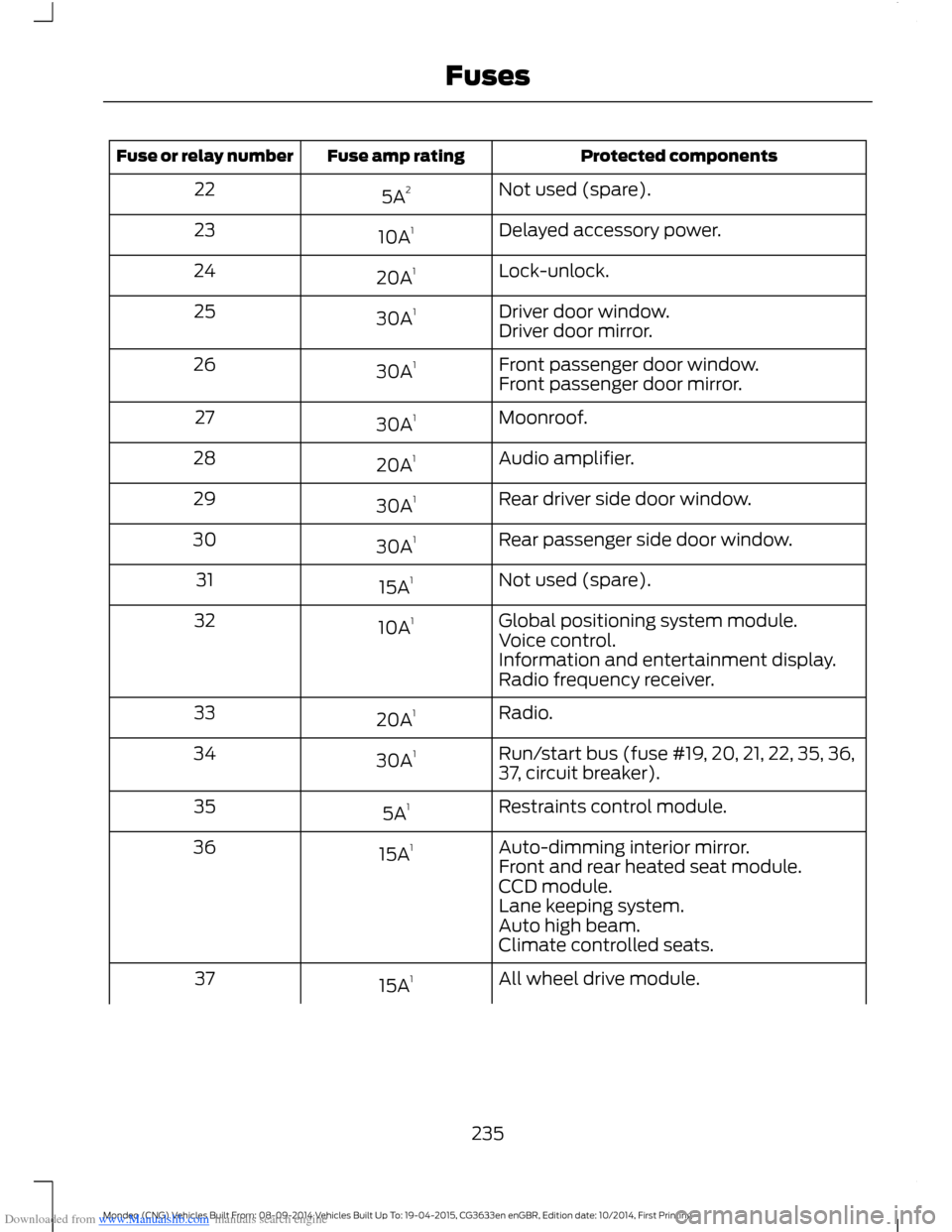
Downloaded from www.Manualslib.com manuals search engine Protected componentsFuse amp ratingFuse or relay number
Not used (spare).5A222
Delayed accessory power.10A123
Lock-unlock.20A124
Driver door window.30A125Driver door mirror.
Front passenger door window.30A126Front passenger door mirror.
Moonroof.30A127
Audio amplifier.20A128
Rear driver side door window.30A129
Rear passenger side door window.30A130
Not used (spare).15A131
Global positioning system module.10A132Voice control.Information and entertainment display.Radio frequency receiver.
Radio.20A133
Run/start bus (fuse #19, 20, 21, 22, 35, 36,37, circuit breaker).30A134
Restraints control module.5A135
Auto-dimming interior mirror.15A136Front and rear heated seat module.CCD module.Lane keeping system.Auto high beam.Climate controlled seats.
All wheel drive module.15A137
235Mondeo (CNG) Vehicles Built From: 08-09-2014 Vehicles Built Up To: 19-04-2015, CG3633en enGBR, Edition date: 10/2014, First PrintingFuses
Page 239 of 446

Downloaded from www.Manualslib.com manuals search engine GENERAL INFORMATION
Have your vehicle serviced regularly to helpmaintain its roadworthiness and resalevalue. There is a large network of Fordauthorized repairers that are there to helpyou with their professional servicingexpertise. Authorized repairers are bestqualified to service your vehicle properlyand expertly, with a wide range of highlyspecialized tools.
In addition to regular servicing, werecommend that you carry out thefollowing checks.
WARNINGS
Switch the ignition off beforetouching or attempting adjustmentof any kind.
Do not touch the electronic ignitionsystem parts after you have switchedthe ignition on or when the engine isrunning. The system operates at highvoltage.
Keep your hands and clothing clearof the engine cooling fan. Undercertain conditions, the fan maycontinue to run for several minutes afteryou have switched the engine off.
Make sure that you fit filler capssecurely after carrying outmaintenance checks.
Daily Checks
•Exterior lamps.
•Interior lamps.
•Warning lamps and indicators.
Check When Refueling
•Engine oil level. See Engine Oil Check(page 246).
•Brake fluid level. See Brake andClutch Fluid Check (page 248).
•Washer fluid level. See Washer FluidCheck (page 248).
•Tire pressures (when cold). See TirePressures (page 273).
•Tire condition. See Wheels and Tires(page 260).
Monthly Checks
•Engine coolant level (engine cold). SeeEngine Coolant Check (page 247).
•Pipes, hoses and reservoirs for leaks.
•Air conditioning operation.
•Parking brake operation.
•Horn operation.
•Tightness of lug nuts. See TirePressures (page 273).
OPENING AND CLOSING THE
HOOD
Opening the Hood
1.Inside the vehicle, pull the hood releasehandle located under the left-handside of the instrument panel.
2.Slightly lift the hood.
237Mondeo (CNG) Vehicles Built From: 08-09-2014 Vehicles Built Up To: 19-04-2015, CG3633en enGBR, Edition date: 10/2014, First PrintingMaintenance
Page 249 of 446
Downloaded from www.Manualslib.com manuals search engine Adding Engine Oil
WARNINGS
Only add oil when the engine is cold.If the engine is hot, wait 10 minutesfor the engine to cool down.
Do not remove the filler cap whenthe engine is running.
1.Remove the engine oil filler cap. SeeMaintenance (page 237).
2.Add engine oil that meets Fordspecifications. See Capacities andSpecifications (page 283).
3.Replace the engine oil filler cap. Turnit until you feel a strong resistance.
Note:Do not add oil further than themaximum mark. Oil levels above themaximum mark may cause engine damage.
Note:Soak up any spillage with anabsorbent cloth immediately.
ENGINE COOLANT CHECK
WARNINGS
Never remove the coolant reservoircap while the engine is running or hot.
Only add coolant when the engine iscold. If the engine is hot, wait 10minutes for the engine to cool down.
Do not allow the fluid to touch yourskin or eyes. If this happens, rinse theaffected areas immediately withplenty of water and contact your physician.
Undiluted coolant is flammable andmay ignite if spilt on a hot exhaust.
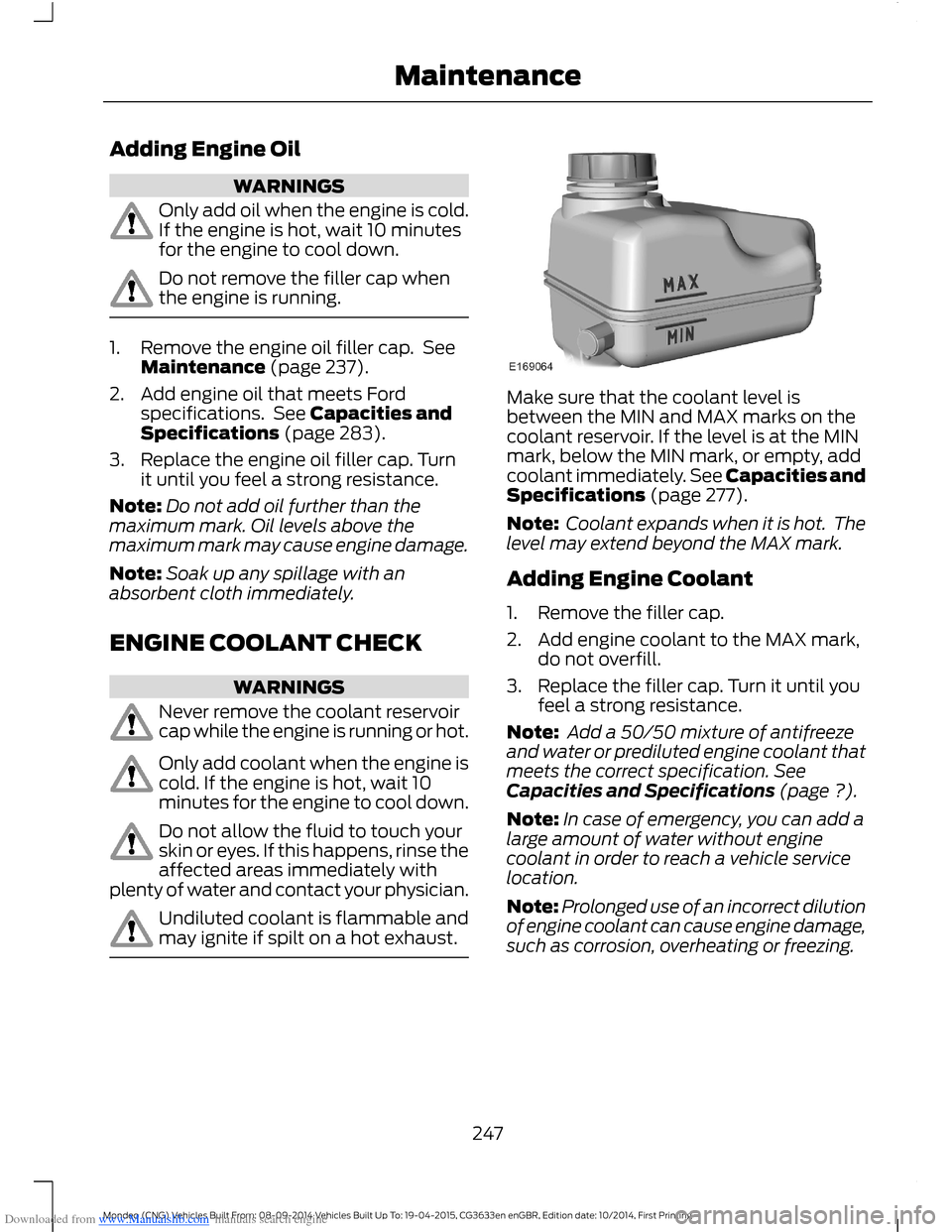
Make sure that the coolant level isbetween the MIN and MAX marks on thecoolant reservoir. If the level is at the MINmark, below the MIN mark, or empty, addcoolant immediately. See Capacities andSpecifications (page 277).
Note: Coolant expands when it is hot. Thelevel may extend beyond the MAX mark.
Adding Engine Coolant
1.Remove the filler cap.
2.Add engine coolant to the MAX mark,do not overfill.
3.Replace the filler cap. Turn it until youfeel a strong resistance.
Note: Add a 50/50 mixture of antifreezeand water or prediluted engine coolant thatmeets the correct specification. SeeCapacities and Specifications (page ?).
Note:In case of emergency, you can add alarge amount of water without enginecoolant in order to reach a vehicle servicelocation.
Note:Prolonged use of an incorrect dilutionof engine coolant can cause engine damage,such as corrosion, overheating or freezing.
247Mondeo (CNG) Vehicles Built From: 08-09-2014 Vehicles Built Up To: 19-04-2015, CG3633en enGBR, Edition date: 10/2014, First PrintingMaintenance