2014 FORD MONDEO ice
[x] Cancel search: icePage 138 of 446

Downloaded from www.Manualslib.com manuals search engine For overloading and shorting conditions,unplug your device and switch the ignitionoff and then on.
For an overheating condition, let thesystem cool first. Then, switch the ignitionoff and on again.
Do not use the power point for certainelectric devices, including:
•Cathode ray tube type televisions.
•Motor loads, for example vacuumcleaners, electric saws and otherelectric power tools, orcompressor-driven refrigerators.
•Measuring devices which processprecise data, for example medicalequipment or measuring equipment.
•Other appliances requiring anextremely stable power supply, forexample microcomputer-controlledelectric blankets or touch sensorlamps.
CIGAR LIGHTER
Note:Do not hold the cigar lighter elementpressed in.
Note:If you use the socket when the engineis not running, the battery may lose charge.
Note:When you switch the ignition on, youcan use the socket to power 12 voltappliances with a maximum current ratingof 20 amps.
Note:After you switch the ignition off thepower supply will only work for a maximumof 30 minutes.
Note:Use only Ford accessory connectorsor connectors specified for use with SAEstandard sockets.
Press the element in to use the cigarlighter. It will pop out automatically.
136Mondeo (CNG) Vehicles Built From: 08-09-2014 Vehicles Built Up To: 19-04-2015, CG3633en enGBR, Edition date: 10/2014, First PrintingAuxiliary Power Points
Page 140 of 446
Downloaded from www.Manualslib.com manuals search engine GENERAL INFORMATION
WARNINGS
Extended idling at high enginespeeds can produce very hightemperatures in the engine andexhaust system, creating the risk of fire orother damage.
Do not park, idle or drive your vehicleon dry grass or other dry groundcover. The emission system heats upthe engine compartment and exhaustsystem, creating the risk of fire.
Do not start the engine in a closedgarage or in other enclosed areas.Exhaust fumes can be toxic. Alwaysopen the garage door before you start theengine.
If you smell exhaust fumes insideyour vehicle, have your vehiclechecked by an authorized dealerimmediately. Do not drive your vehicle ifyou smell exhaust fumes.
If you disconnect the battery, your vehiclemay exhibit some unusual drivingcharacteristics for approximately 5 miles(8 kilometers) after you reconnect it. Thisis because the engine management systemmust realign itself with the engine. You candisregard any unusual drivingcharacteristics during this period.
The powertrain control system meets allCanadian interference-causing equipmentstandard requirements regulating theimpulse electrical field or radio noise.
When you start the engine, avoid pressingthe accelerator pedal before and duringoperation. Only use the accelerator pedalwhen you have difficulty starting theengine.
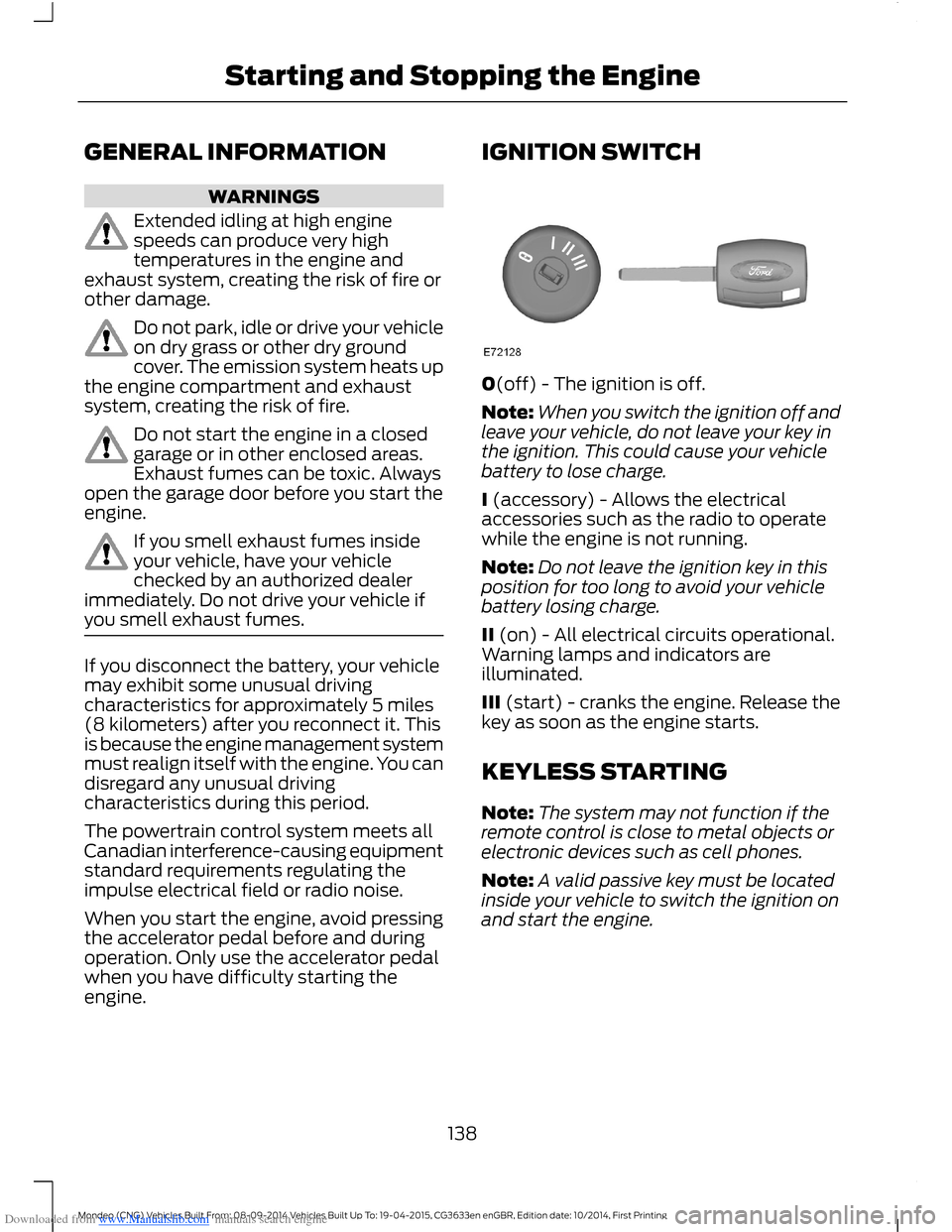
IGNITION SWITCH
0(off) - The ignition is off.
Note:When you switch the ignition off andleave your vehicle, do not leave your key inthe ignition. This could cause your vehiclebattery to lose charge.
I (accessory) - Allows the electricalaccessories such as the radio to operatewhile the engine is not running.
Note:Do not leave the ignition key in thisposition for too long to avoid your vehiclebattery losing charge.
II (on) - All electrical circuits operational.Warning lamps and indicators areilluminated.
III (start) - cranks the engine. Release thekey as soon as the engine starts.
KEYLESS STARTING
Note:The system may not function if theremote control is close to metal objects orelectronic devices such as cell phones.
Note:A valid passive key must be locatedinside your vehicle to switch the ignition onand start the engine.
138Mondeo (CNG) Vehicles Built From: 08-09-2014 Vehicles Built Up To: 19-04-2015, CG3633en enGBR, Edition date: 10/2014, First PrintingStarting and Stopping the Engine
Page 145 of 446

Downloaded from www.Manualslib.com manuals search engine Guarding Against Exhaust Fumes
WARNING
If you smell exhaust fumes insideyour vehicle, have your vehiclechecked by your authorized dealerimmediately. Do not drive your vehicle ifyou smell exhaust fumes. Carbonmonoxide is present in exhaust fumes.Take precautions to avoid its dangerouseffects.
Important Ventilating Information
If you stop your vehicle and then leave theengine idling for long periods, werecommend that you do one of thefollowing:
•Open the windows at least 1.0 in(2.5 cm).
•Set your climate control to outside air.
STARTING A DIESEL ENGINE
Cold or Hot Engine
1.Switch the ignition on and wait untilthe glow plug indicator goes off.
2.Fully depress the clutch pedal (manualtransmission) or brake pedal(automatic transmission).
3.Start the engine.
Note:Do not touch the accelerator pedal.
Note:Releasing the clutch pedal (manualtransmission) or brake pedal (automatictransmission) while the engine is startingwill stop the engine cranking and return toignition on.
Note:When the temperature is below 5°F(-15°C), you may need to crank the enginefor up to 10 seconds.
Note:You can only operate the starter fora limited period of time.
Note:After a limited number of attemptsto start your engine, the system does notallow you to try again until a period of timehas elapsed, for example 30 minutes.
Failure to Start
If the engine does not crank when theclutch pedal has been fully depressed andthe ignition key is turned to position III.
1.Fully depress the clutch and brakepedals.
2.Turn the key to position III until theengine starts.
DIESEL PARTICULATE FILTER
The filter forms part of the emissionsreduction system on your vehicle. It filtersharmful diesel particulates (soot) from theexhaust gas.
Regeneration
WARNING
Do not park or idle your vehicle overdry leaves, dry grass or othercombustible materials. Theregeneration process creates very highexhaust gas temperatures and the exhaustwill radiate a considerable amount of heatduring and after regeneration and after youhave switched the engine off. This is apotential fire hazard.
Note:Avoid running out of fuel.
Note:During regeneration at low speed orengine idle, you may smell a hot metallicodor and could notice a clicking metallicsound. This is due to the high temperaturesreached during regeneration and is normal.
143Mondeo (CNG) Vehicles Built From: 08-09-2014 Vehicles Built Up To: 19-04-2015, CG3633en enGBR, Edition date: 10/2014, First PrintingStarting and Stopping the Engine
Page 149 of 446
Downloaded from www.Manualslib.com manuals search engine The system may also restart the enginerestart under certain conditions, forexample:
•To maintain climate comfort (forexample, air conditioning).
•Low battery charge.
•The heated windshield is switched on.
•Your vehicle has started rollingdownhill.
•The driver seatbelt is undone(automatic transmissions only).
•The driver door is opened (automatictransmissions only).
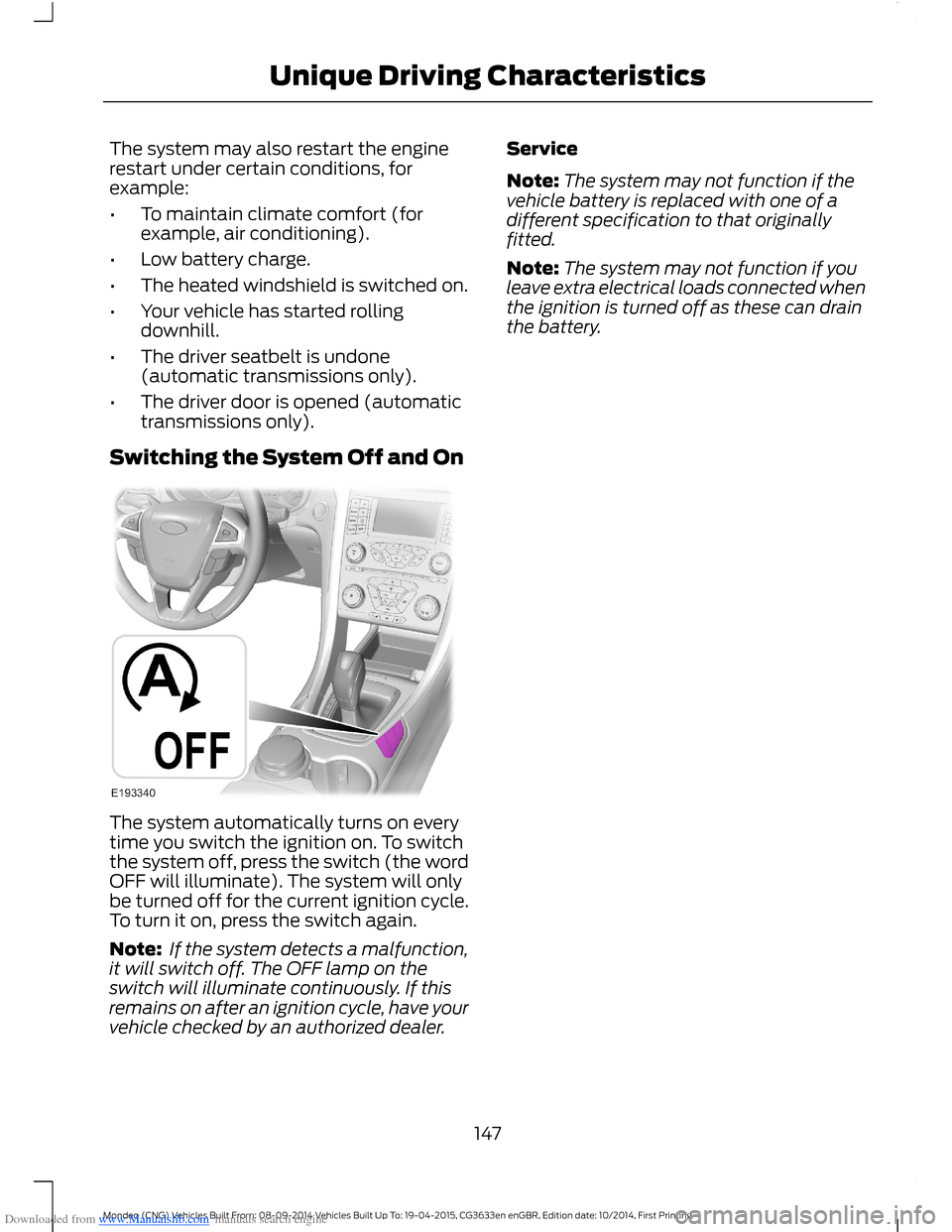
Switching the System Off and On
The system automatically turns on everytime you switch the ignition on. To switchthe system off, press the switch (the wordOFF will illuminate). The system will onlybe turned off for the current ignition cycle.To turn it on, press the switch again.
Note: If the system detects a malfunction,it will switch off. The OFF lamp on theswitch will illuminate continuously. If thisremains on after an ignition cycle, have yourvehicle checked by an authorized dealer.
Service
Note:The system may not function if thevehicle battery is replaced with one of adifferent specification to that originallyfitted.
Note:The system may not function if youleave extra electrical loads connected whenthe ignition is turned off as these can drainthe battery.
147Mondeo (CNG) Vehicles Built From: 08-09-2014 Vehicles Built Up To: 19-04-2015, CG3633en enGBR, Edition date: 10/2014, First PrintingUnique Driving Characteristics
Page 153 of 446
Downloaded from www.Manualslib.com manuals search engine If your vehicle runs out of fuel:
•Add a minimum of 1.1 gal (5 L) of fuelto restart the engine. If your vehicle isout of fuel and on a steep slope, morefuel may be required.
•You may need to switch the ignitionfrom off to on several times afterrefueling to allow the fuel system topump the fuel from the tank to theengine. When restarting, cranking timetakes a few seconds longer thannormal.
Filling a Portable Fuel Container
Use the following guidelines to avoidelectrostatic charge build-up when fillingan ungrounded fuel container:
•Only use an approved fuel container totransfer fuel to your vehicle. Place thecontainer on the ground when filling it.
•Do not fill a fuel container when it isinside your vehicle (including the cargoarea).
•Keep the fuel pump nozzle in contactwith the fuel container when filling it.
•Do not use a device that holds the fuelpump nozzle lever in the fill position.
Adding Fuel From a Portable FuelContainer
WARNINGS
Do not insert the nozzle of a fuelcontainer or an aftermarket funnelinto the fuel system filler neck. Thismay damage the fuel system filler neck orits seal and cause fuel to run onto theground.
Do not try to pry open or push openthe capless fuel system with foreignobjects. This could damage the fuelsystem and its seal and cause injury to youor others.
WARNINGS
Do not dispose of fuel in thehousehold refuse or the publicsewage system. Use an authorizedwaste disposal facility.
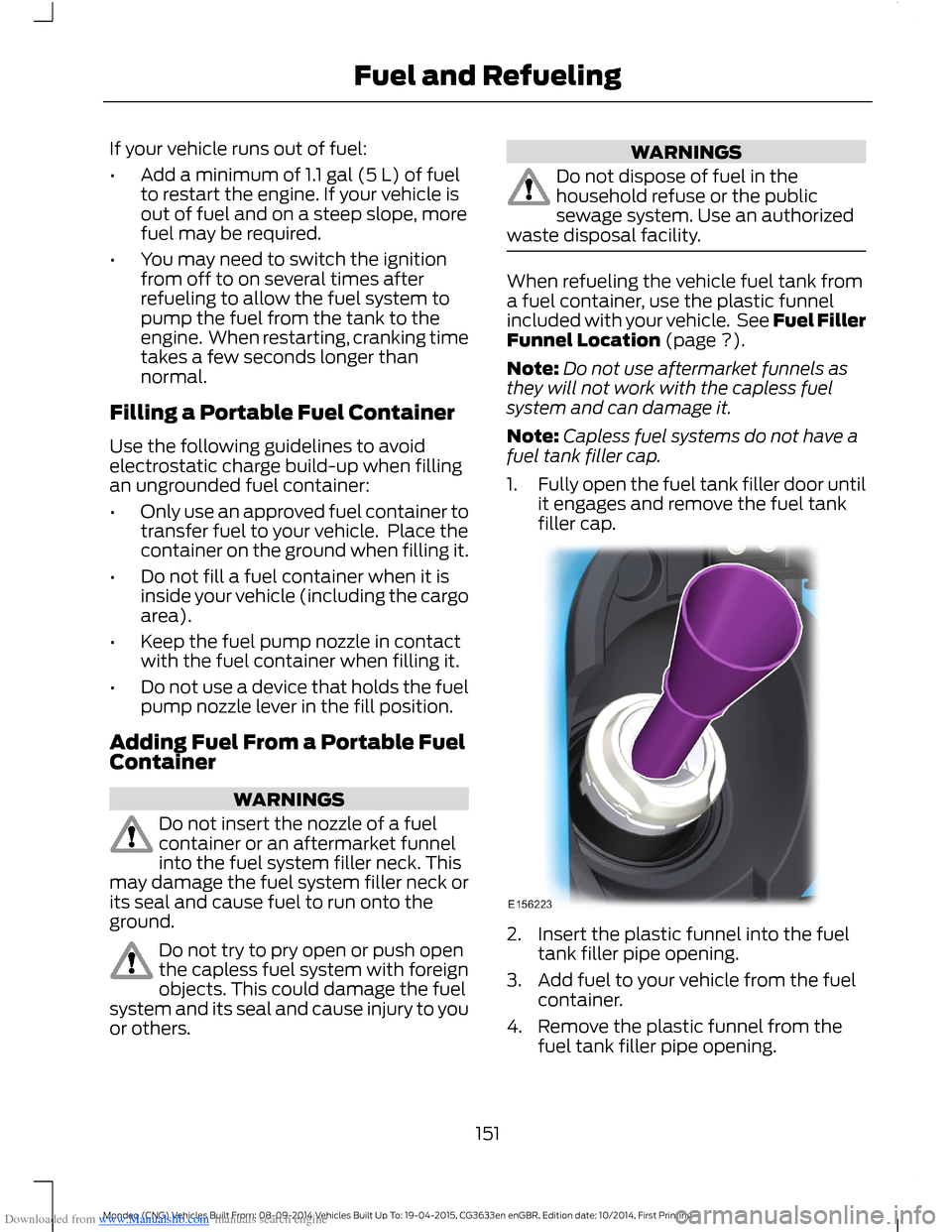
When refueling the vehicle fuel tank froma fuel container, use the plastic funnelincluded with your vehicle. See Fuel FillerFunnel Location (page ?).
Note:Do not use aftermarket funnels asthey will not work with the capless fuelsystem and can damage it.
Note:Capless fuel systems do not have afuel tank filler cap.
1.Fully open the fuel tank filler door untilit engages and remove the fuel tankfiller cap.
2.Insert the plastic funnel into the fueltank filler pipe opening.
3.Add fuel to your vehicle from the fuelcontainer.
4.Remove the plastic funnel from thefuel tank filler pipe opening.
151Mondeo (CNG) Vehicles Built From: 08-09-2014 Vehicles Built Up To: 19-04-2015, CG3633en enGBR, Edition date: 10/2014, First PrintingFuel and Refueling
Page 158 of 446
Downloaded from www.Manualslib.com manuals search engine In this position, power is not transmittedto the driven wheels and the transmissionis locked. You can start the engine with thegearshift lever in this position.
Note:A warning tone sounds if you openthe driver door and you have not shifted thegearshift lever to park (P).
Reverse (R)
WARNINGS
Shift the gearshift lever to reverse(R) only when your vehicle isstationary and the engine is at idlespeed.
Always come to a complete stopbefore shifting the gearshift lever outof reverse (R).
Shift the gearshift lever to reverse (R) toallow your vehicle to move backward.
Neutral (N)
In this position, power is not transmittedto the driven wheels but the transmissionis not locked. You can start the engine withthe gearshift lever in this position.
Drive (D)
Shift the gearshift lever to drive (D) toallow your vehicle to move forward andshift automatically through the forwardgears.
The transmission will shift to theappropriate gear for optimum performancebased on ambient temperature, roadgradient, vehicle load and your input.
Grade Assist
To activate Grade Assist, pressthe button on the gearshift lever.The grade assist indicator lightwill illuminate in the instrument display.
The grade assist feature:
•Provides additional grade braking witha combination of engine motoring andhigh-voltage battery charging to helpmaintain vehicle speed whendescending a grade.
•As your vehicle determines the amountof engine motoring and high-voltagebattery charging, you may notice theengine speed increasing and/ordecreasing to help maintain yourvehicle speed while descending agrade.
To deactivate Grade Assist, press thebutton on the gearshift lever when GradeAssist is active. The grade assist light willdeactivate.
Sport Mode (S)
Switch on sport mode by shifting thegearshift lever to Sport (S).
Note:In sport mode the transmissionoperates as normal but gears are selectedmore quickly and at higher engine speeds.
SelectShift Automatic™Transmission (If Equipped)
Your vehicle is equipped with a SelectShiftAutomatic transmission gearshift lever.The SelectShift Automatic transmissiongives you the ability to change gears up ordown (without a clutch) as desired.
In order to prevent the engine from runningat too low an RPM, which may cause it tostall, SelectShift still automatically makessome downshifts if it has determined thatyou have not downshifted in time.Although SelectShift makes somedownshifts for you, it still allows you todownshift at any time as long as theSelectShift determines that damage willnot be caused to the engine fromover-revving.
156Mondeo (CNG) Vehicles Built From: 08-09-2014 Vehicles Built Up To: 19-04-2015, CG3633en enGBR, Edition date: 10/2014, First PrintingTransmission
Page 160 of 446
Downloaded from www.Manualslib.com manuals search engine WARNINGS
This procedure requires you to shiftthe gearshift lever out of park (P)causing your vehicle to roll. Makesure you fully set the parking brake beforeattempting to release the gearshift lever.
If you release the parking brake andthe brake warning lamp remainsilluminated, the brakes may not beworking correctly. The system hasdetected a fault that requires service.
Note:For some markets this feature will bedisabled.
Your vehicle is equipped with a brake-shiftinterlock feature that prevents moving thegearshift lever from park (P) when theignition is in the on position and the brakepedal is not pressed.
If you cannot move the gearshift lever outof park (P) position with the ignition in theon position and the brake pedal pressed,a malfunction may have occurred. It ispossible that a fuse has blown or yourvehicle’s brake lamps are not operatingproperly. See Fuse Specification Chart(page 227).
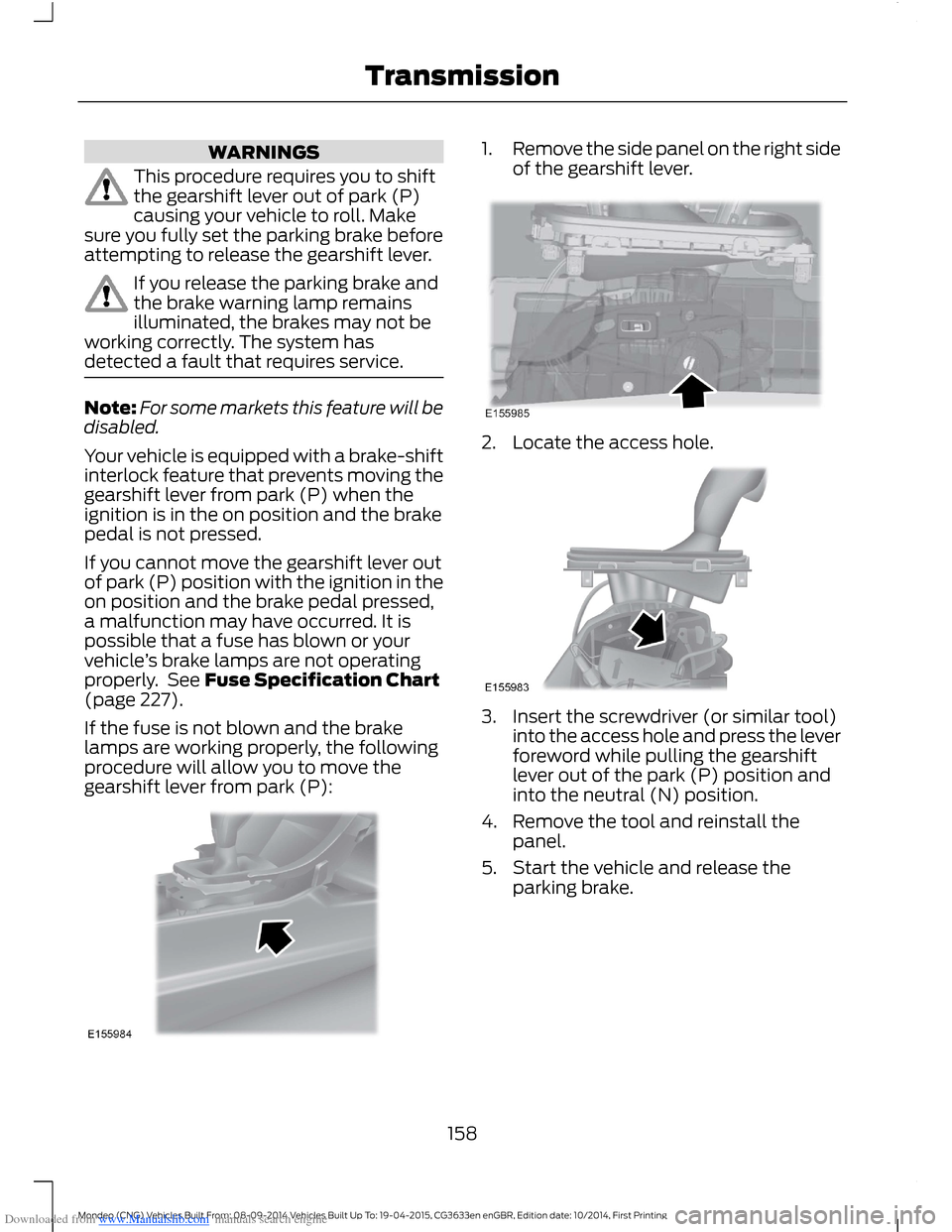
If the fuse is not blown and the brakelamps are working properly, the followingprocedure will allow you to move thegearshift lever from park (P):
1.Remove the side panel on the right sideof the gearshift lever.
2.Locate the access hole.
3.Insert the screwdriver (or similar tool)into the access hole and press the leverforeword while pulling the gearshiftlever out of the park (P) position andinto the neutral (N) position.
4.Remove the tool and reinstall thepanel.
5.Start the vehicle and release theparking brake.
158Mondeo (CNG) Vehicles Built From: 08-09-2014 Vehicles Built Up To: 19-04-2015, CG3633en enGBR, Edition date: 10/2014, First PrintingTransmission
Page 162 of 446
Downloaded from www.Manualslib.com manuals search engine GENERAL INFORMATION
WARNING
Driving while distracted can result inloss of vehicle control, crash andinjury. We strongly recommend thatyou use extreme caution when using anydevice that may take your focus off theroad. Your primary responsibility is the safeoperation of your vehicle. We recommendagainst the use of any handheld devicewhile driving and encourage the use ofvoice-operated systems when possible.Make sure you are aware of all applicablelocal laws that may affect the use ofelectronic devices while driving.
Note:Occasional brake noise is normal. Ifa metal-to-metal, continuous grinding orcontinuous squeal sound is present, thebrake linings may be worn-out. If yourvehicle has continuous vibration or shudderin the steering wheel while braking, haveyour vehicle checked by an authorizeddealer.
Note:Brake dust may accumulate on thewheels, even under normal drivingconditions. Some dust is inevitable as thebrakes wear. See Cleaning the AlloyWheels (page 258).
Note:Depending on applicable laws andregulations in the country for which yourvehicle was originally built, the brake lampsmay flash during heavy braking. Followingthis the hazard warning flashers may alsoflash when your vehicle comes to a stop.
Wet brakes result in reduced brakingefficiency. Gently press the brake pedal afew times when driving from a car wash orstanding water to dry the brakes.
Brake Assist
Brake assist detects when you brakeheavily by measuring the rate at which youpress the brake pedal. It providesmaximum braking efficiency as long as youpress the pedal. Brake assist can reducestopping distances in critical situations.
Anti-lock Brake System
This system helps you maintain steeringcontrol and vehicle stability duringemergency stops by keeping the brakesfrom locking.
HINTS ON DRIVING WITH
ANTI-LOCK BRAKES
Note:When the system is operating, thebrake pedal will pulse and may travelfurther. Maintain pressure on the brakepedal. You may also hear a noise from thesystem. This is normal.
The anti-lock braking system will noteliminate the risks when:
•You drive too closely to the vehicle infront of you.
•Your vehicle is hydroplaning.
•You take corners too fast.
•The road surface is poor.
ELECTRIC PARKING BRAKE
The electric parking brake replaces theconventional handbrake. The operatingswitch is located in the center console.
WARNING
Always set the parking brake andleave your vehicle with thetransmission in park (P) (automatictransmission) or in first gear (1) or reverse(R) (manual transmission).
160Mondeo (CNG) Vehicles Built From: 08-09-2014 Vehicles Built Up To: 19-04-2015, CG3633en enGBR, Edition date: 10/2014, First PrintingBrakes