2014 FORD FUSION (AMERICAS) warning
[x] Cancel search: warningPage 16 of 458

GENERAL INFORMATION
See the following sections for directionson how to properly use safety restraintsfor children.
WARNINGS
Always make sure your child issecured properly in a device that isappropriate for their height, age andweight. Child safety restraints must bebought separately from your vehicle.Failure to follow these instructions andguidelines may result in an increased riskof serious injury or death to your child.
All children are shaped differently.The recommendations for safetyrestraints are based on probablechild height, age and weight thresholdsfrom National Highway Traffic SafetyAdministration and other safetyorganizations, or are the minimum
WARNINGS
requirements of law. Ford recommendschecking with a NHTSA Certified ChildPassenger Safety Technician (CPST) andconsult your pediatrician to make sure yourchild seat is appropriate for your child, andis compatible with and properly installedin your vehicle. To locate a child seat fittingstation and CPST, contact the NHTSA tollfree at 1-888-327-4236 or go tohttp://www.nhtsa.dot.gov. In Canada,check with your local St. John Ambulanceoffice for referral to a CPST or for furtherinformation, contact your provincialministry of transportation, locate your localSt. John Ambulance office by searching forSt. John Ambulance on the internet, orTransport Canada at 1-800-333-0371(http://www.tc.gc.ca). Failure to properlyrestrain children in safety seats madeespecially for their height, age, and weightmay result in an increased risk of seriousinjury or death to your child.
13Fusion (CC7) , enUSAChild Safety
Page 18 of 458
Use a child safety seat (sometimes calledan infant carrier, convertible seat, ortoddler seat) for infants, toddlers, orchildren weighing 40 pounds (18kilograms) or less (generally age four oryounger).
Using Lap and Shoulder Belts
WARNINGS
Airbags can kill or injure a child in achild seat. Never place a rear-facingchild seat in front of an active airbag.If you must use a forward-facing child seatin the front seat, move the seat upon whichthe child seat is installed all the way back.
Airbags can kill or injure a child in achild seat. Children 12 and undershould be properly restrained in therear seat whenever possible.
Depending on where you secure achild restraint, and depending on thechild restraint design, you may blockaccess to certain safety belt buckleassemblies and LATCH lower anchors,rendering those features potentiallyunusable. To avoid risk of injury, occupantsshould only use seating positions wherethey are able to be properly restrained.
When installing a child safety seat withcombination lap and shoulder belts:
•Use the correct safety belt buckle forthat seating position.
•Insert the belt tongue into the properbuckle until you hear a snap and feel itlatch. Make sure the tongue is securelyfastened in the buckle.
•Keep the buckle release buttonpointing up and away from the safetyseat, with the tongue between the childseat and the release button, to preventaccidental unbuckling.
•Place the vehicle seat upon which thechild seat will be installed in the uprightposition.
•Put the safety belt in the automaticlocking mode. See Step 5. This vehicledoes not require the use of a lockingclip.
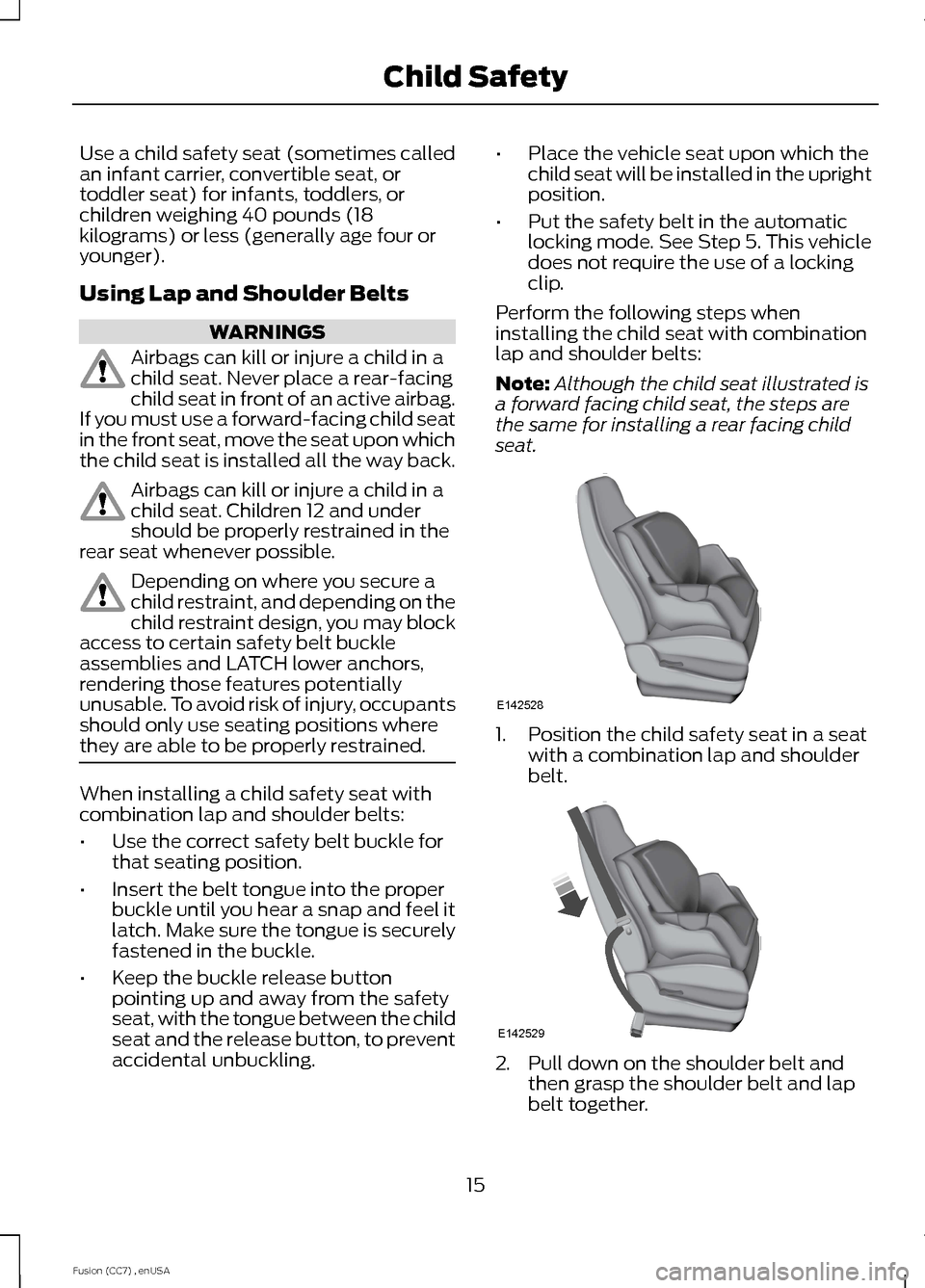
Perform the following steps wheninstalling the child seat with combinationlap and shoulder belts:
Note:Although the child seat illustrated isa forward facing child seat, the steps arethe same for installing a rear facing childseat.
1.Position the child safety seat in a seatwith a combination lap and shoulderbelt.
2.Pull down on the shoulder belt andthen grasp the shoulder belt and lapbelt together.
15Fusion (CC7) , enUSAChild SafetyE142528 E142529
Page 20 of 458

8.Remove remaining slack from the belt.Force the seat down with extra weight,for example, by pressing down orkneeling on the child restraint whilepulling up on the shoulder belt in orderto force slack from the belt. This isnecessary to remove the remainingslack that will exist once the extraweight of the child is added to the childrestraint. It also helps to achieve theproper snugness of the child seat toyour vehicle. Sometimes, a slight leantoward the buckle will additionally helpto remove remaining slack from thebelt.
9.Attach the tether strap (if the child seatis equipped).
10.Before placing the child in the seat,forcibly move the seat forward andback to make sure the seat is securelyheld in place. To check this, grab theseat at the belt path and attempt tomove it side to side and forward andback. There should be no more than1 inch (2.5 centimeters) of movementfor proper installation.
Ford recommends checking with a NHTSACertified Child Passenger SafetyTechnician to make certain the childrestraint is properly installed. In Canada,check with your local St. John Ambulanceoffice for referral to a Certified PassengerSeat Technician.
Using Lower Anchors and Tethersfor CHildren (LATCH)
WARNINGS
Never attach two child safety seatsto the same anchor. In a crash, oneanchor may not be strong enough tohold two child safety seat attachmentsand may break, causing serious injury ordeath.
Depending on where you secure achild restraint, and depending on thechild restraint design, you may blockaccess to certain safety belt buckleassemblies or LATCH lower anchors,rendering those features potentiallyunusable. To avoid risk of injury, occupantsshould only use seating positions wherethey are able to be properly restrained.
The LATCH system is composed of threevehicle anchor points: two lower anchorslocated where seat back and seat cushionmeet (called the seat bight) and one toptether anchor located behind that seatingposition.
LATCH compatible child safety seats havetwo rigid or webbing mountedattachments that connect to the two loweranchors at the LATCH equipped seatingpositions in your vehicle. This type ofattachment method eliminates the needto use safety belts to attach the child seat,however the safety belt can still be usedto attach the child seat. For forward-facingchild seats, the top tether strap must alsobe attached to the proper top tetheranchor, if a top tether strap has beenprovided with your child seat.
17Fusion (CC7) , enUSAChild SafetyE142534
Page 21 of 458
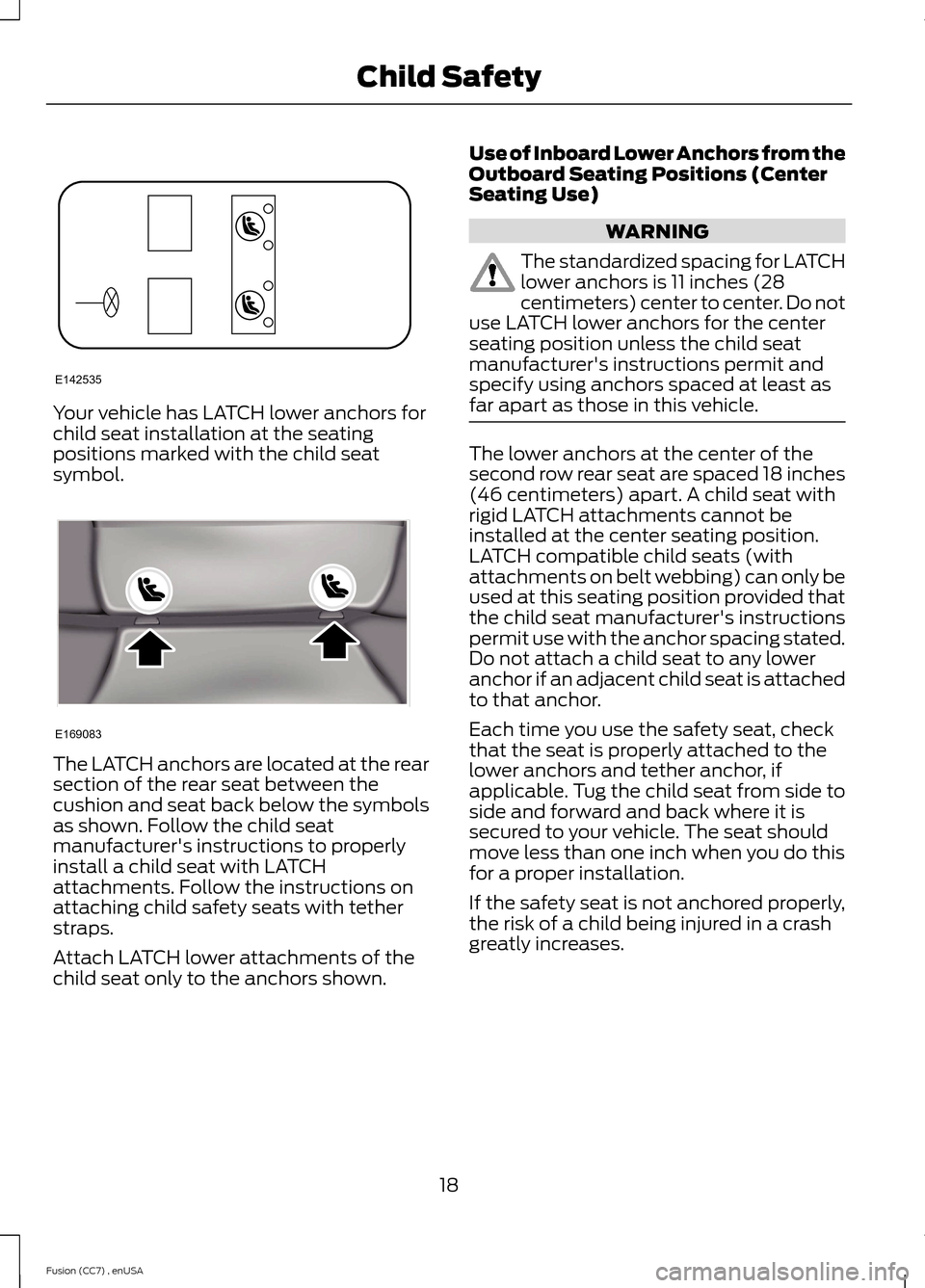
Your vehicle has LATCH lower anchors forchild seat installation at the seatingpositions marked with the child seatsymbol.
The LATCH anchors are located at the rearsection of the rear seat between thecushion and seat back below the symbolsas shown. Follow the child seatmanufacturer's instructions to properlyinstall a child seat with LATCHattachments. Follow the instructions onattaching child safety seats with tetherstraps.
Attach LATCH lower attachments of thechild seat only to the anchors shown.
Use of Inboard Lower Anchors from theOutboard Seating Positions (CenterSeating Use)
WARNING
The standardized spacing for LATCHlower anchors is 11 inches (28centimeters) center to center. Do notuse LATCH lower anchors for the centerseating position unless the child seatmanufacturer's instructions permit andspecify using anchors spaced at least asfar apart as those in this vehicle.
The lower anchors at the center of thesecond row rear seat are spaced 18 inches(46 centimeters) apart. A child seat withrigid LATCH attachments cannot beinstalled at the center seating position.LATCH compatible child seats (withattachments on belt webbing) can only beused at this seating position provided thatthe child seat manufacturer's instructionspermit use with the anchor spacing stated.Do not attach a child seat to any loweranchor if an adjacent child seat is attachedto that anchor.
Each time you use the safety seat, checkthat the seat is properly attached to thelower anchors and tether anchor, ifapplicable. Tug the child seat from side toside and forward and back where it issecured to your vehicle. The seat shouldmove less than one inch when you do thisfor a proper installation.
If the safety seat is not anchored properly,the risk of a child being injured in a crashgreatly increases.
18Fusion (CC7) , enUSAChild SafetyE142535 E169083
Page 23 of 458
4.Tighten the child safety seat tetherstrap according to the manufacturer'sinstructions. If your child restraintsystem is equipped with a tether strap,and the child restraint manufacturerrecommends its use, Ford alsorecommends its use.
BOOSTER SEATS
WARNING
Never place, or allow a child to place,the shoulder belt under a child's armor behind the back because itreduces the protection for the upper partof the body and may increase the risk ofinjury or death in a crash.
Use a belt-positioning booster seat forchildren who have outgrown or no longerproperly fit in a child safety seat (generallychildren who are less than 4 feet 9 inches(1.45 meters) tall, are greater than age four(4) and less than age twelve (12), andbetween 40 pounds (18 kilograms) and80 pounds (36 kilograms) and upward to100 pounds (45 kilograms) ifrecommended by your child restraintmanufacturer). Many state and provinciallaws require that children use approvedbooster seats until they reach age eight, aheight of 4 feet 9 inches (1.45 meters) tall,or 80 pounds (36 kilograms).
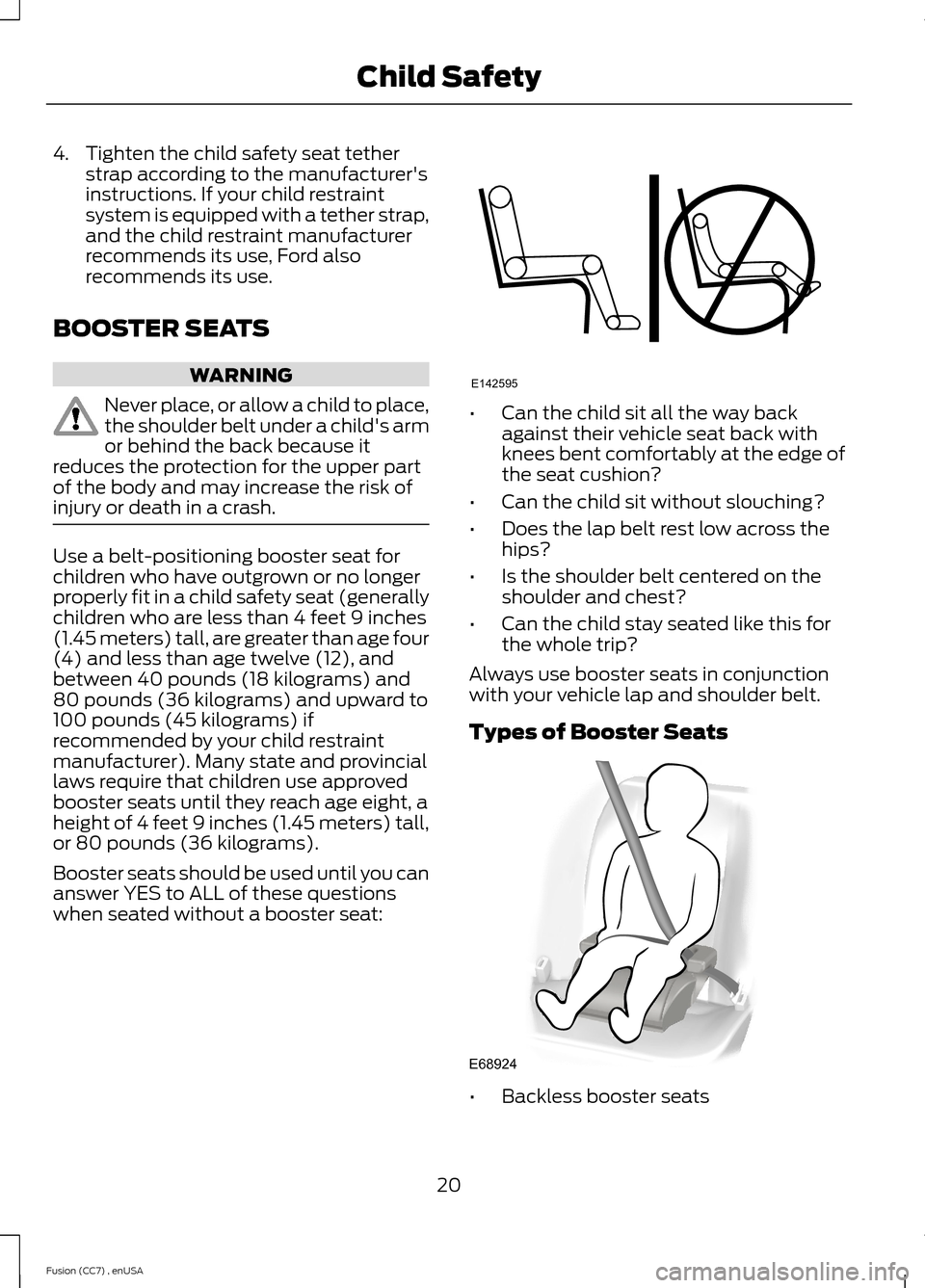
Booster seats should be used until you cananswer YES to ALL of these questionswhen seated without a booster seat:
•Can the child sit all the way backagainst their vehicle seat back withknees bent comfortably at the edge ofthe seat cushion?
•Can the child sit without slouching?
•Does the lap belt rest low across thehips?
•Is the shoulder belt centered on theshoulder and chest?
•Can the child stay seated like this forthe whole trip?
Always use booster seats in conjunctionwith your vehicle lap and shoulder belt.
Types of Booster Seats
•Backless booster seats
20Fusion (CC7) , enUSAChild SafetyE142595 E68924
Page 25 of 458

If the booster seat slides on the vehicleseat upon which it is being used, placing arubberized mesh sold as shelf or carpetliner under the booster seat may improvethis condition. Do not introduce any itemthicker than this under the booster seat.Check with the booster seatmanufacturer's instructions.
CHILD SEAT POSITIONING
WARNINGS
Airbags can kill or injure a child in achild seat. Never place a rear-facingchild seat in front of an active airbag.If you must use a forward-facing child seatin the front seat, move the vehicle seatupon which the child seat is installed allthe way back. When possible, all childrenage 12 and under should be properlyrestrained in a rear seating position. If allchildren cannot be seated and restrainedproperly in a rear seating position, properlyrestrain the largest child in the front seat.
Always carefully follow theinstructions and warnings providedby the manufacturer of any childrestraint to determine if the restraint deviceis appropriate for your child's size, height,weight, or age. Follow the child restraintmanufacturer's instructions and warningsprovided for installation and use inconjunction with the instructions and
WARNINGS
warnings provided by your vehiclemanufacturer. A safety seat that isimproperly installed or utilized, isinappropriate for your child's height, age,or weight or does not properly fit the childmay increase the risk of serious injury ordeath.
Never let a passenger hold a child onhis or her lap while your vehicle ismoving. The passenger cannotprotect the child from injury in a crash,which may result in serious injury or death.
Never use pillows, books, or towelsto boost a child. They can slidearound and increase the likelihoodof injury or death in a crash.
Always restrain an unoccupied childseat or booster seat. These objectsmay become projectiles in a crash orsudden stop, which may increase the riskof serious injury.
Never place, or allow a child to place,the shoulder belt under a child's armor behind the back because itreduces the protection for the upper partof the body and may increase the risk ofinjury or death in a crash.
To avoid risk of injury, do not leavechildren or pets unattended in yourvehicle.
22Fusion (CC7) , enUSAChild SafetyE142597
Page 28 of 458

PRINCIPLE OF OPERATION
WARNINGS
Always drive and ride with your seatback upright and the lap belt snugand low across the hips.
To reduce the risk of injury, makesure children sit where they can beproperly restrained.
Never let a passenger hold a child onhis or her lap while your vehicle ismoving. The passenger cannotprotect the child from injury in a crash.
All occupants of your vehicle,including the driver, should alwaysproperly wear their safety belts, evenwhen an airbag supplemental restraintsystem is provided. Failure to properly wearyour safety belt could seriously increasethe risk of injury or death.
It is extremely dangerous to ride in acargo area, inside or outside of avehicle. In a crash, people riding inthese areas are more likely to be seriouslyinjured or killed. Do not allow people to ridein any area of your vehicle that is notequipped with seats and safety belts. Besure everyone in your vehicle is in a seatand using a safety belt properly.
In a rollover crash, an unbeltedperson is significantly more likely todie than a person wearing a safetybelt.
Each seating position in your vehiclehas a specific safety belt assemblywhich is made up of one buckle andone tongue that are designed to be usedas a pair. 1) Use the shoulder belt on theoutside shoulder only. Never wear theshoulder belt under the arm. 2) Neverswing the safety belt around your neck overthe inside shoulder. 3) Never use a singlebelt for more than one person.
WARNINGS
When possible, all children 12 yearsold and under should be properlyrestrained in a rear seating position.Failure to follow this could seriouslyincrease the risk of injury or death.
Safety belts and seats can becomehot in a vehicle that has been closedup in sunny weather; they could burna small child. Check seat covers andbuckles before you place a child anywherenear them.
Front and rear seat occupants,including pregnant women, shouldwear safety belts for optimumprotection in an accident.
All seating positions in your vehicle havelap and shoulder safety belts. Alloccupants of the vehicle should alwaysproperly wear their safety belts, even whenan airbag supplemental restraint systemis provided.
The safety belt system consists of:
•lap and shoulder safety belts.
•shoulder safety belt with automaticlocking mode, (except driver safetybelt).
•height adjuster at the front outboardseating positions.
•safety belt pretensioner at the frontoutboard seating positions.
•belt tension sensor at the frontoutboard passenger seating position.
•Safety belt warning light and chime.
25Fusion (CC7) , enUSASafety Belts
Page 29 of 458

•Crash sensors and monitoring systemwith readiness indicator.
The safety belt pretensioners at the frontseating positions are designed to tightenthe safety belts when activated. In frontaland near-frontal crashes, the safety beltpretensioners may be activated alone or,if the crash is of sufficient severity, togetherwith the front airbags. The pretensionersmay also activate when a side curtainairbag is deployed.
FASTENING THE SAFETY
BELTS
Standard belts shown, inflatable beltssimilar
The front outboard and rear safetyrestraints in the vehicle are combinationlap and shoulder belts.
1.Insert the belt tongue into the properbuckle (the buckle closest to thedirection the tongue is coming from)until you hear a snap and feel it latch.Make sure you securely fasten thetongue in the buckle.
2.To unfasten, press the release buttonand remove the tongue from thebuckle.
Using Safety Belts DuringPregnancy
WARNING
Always ride and drive with yourseatback upright and the safety beltproperly fastened. The lap portion ofthe safety belt should fit snug and bepositioned low across the hips. Theshoulder portion of the safety belt shouldbe positioned across the chest. Pregnantwomen should also follow this practice.See the following figure.
26Fusion (CC7) , enUSASafety BeltsE142587 E142588 E142590