2014 FORD F SERIES MOTORHOME AND COMMERCIAL CHASSIS automatic transmission fluid
[x] Cancel search: automatic transmission fluidPage 5 of 143
Hazard Warning Flashers.............................51
Jump Starting the Vehicle............................51
Customer Assistance
Getting the Services You Need.................54
In California (U.S. Only)...............................55
The Better Business Bureau (BBB) AutoLine Program (U.S. Only)........................56
Utilizing the Mediation/ArbitrationProgram (Canada Only).........................56
Getting Assistance Outside the U.S. andCanada...........................................................57
Ordering Additional Owner'sLiterature.......................................................58
Reporting Safety Defects (U.S.Only)...............................................................58
Reporting Safety Defects (CanadaOnly)...............................................................59
Fuses
Fuse Specification Chart............................60
Changing a Fuse...............................................71
Maintenance
General Information......................................72
Under Hood Overview..................................73
Engine Oil Dipstick.........................................75
Engine Oil Check.............................................75
Engine Coolant Check..................................76
Automatic Transmission FluidCheck..............................................................79
Brake Fluid Check..........................................80
Power Steering Fluid Check.......................82
Fuel Filter...........................................................83
Changing the 12V Battery...........................83
Changing the Engine Air Filter...................85
Vehicle Care
General Information......................................87
Cleaning the Exterior.....................................87
Cleaning the Engine......................................87
Cleaning the Alloy Wheels.........................88
Vehicle Storage..............................................88
Wheels and Tires
Tire Care.............................................................91
Using Snow Chains.....................................106
Changing a Road Wheel............................107
Technical Specifications.............................110
Capacities and Specific-ations
Engine Specifications....................................111
Motorcraft Parts.............................................112
Vehicle Identification Number..................113
Vehicle Certification Label.........................113
Transmission Code Designation..............114
Technical Specifications.............................115
Extended Service Plan(ESP)
Extended Service Plan (ESP)...................119
Scheduled Maintenance
General Maintenance Information..........121
Normal Scheduled Maintenance...........124
Special Operating Conditions ScheduledMaintenance..............................................126
Scheduled Maintenance Record............128
2Motorhome (TY3) , enUSATable of Contents
Page 76 of 143
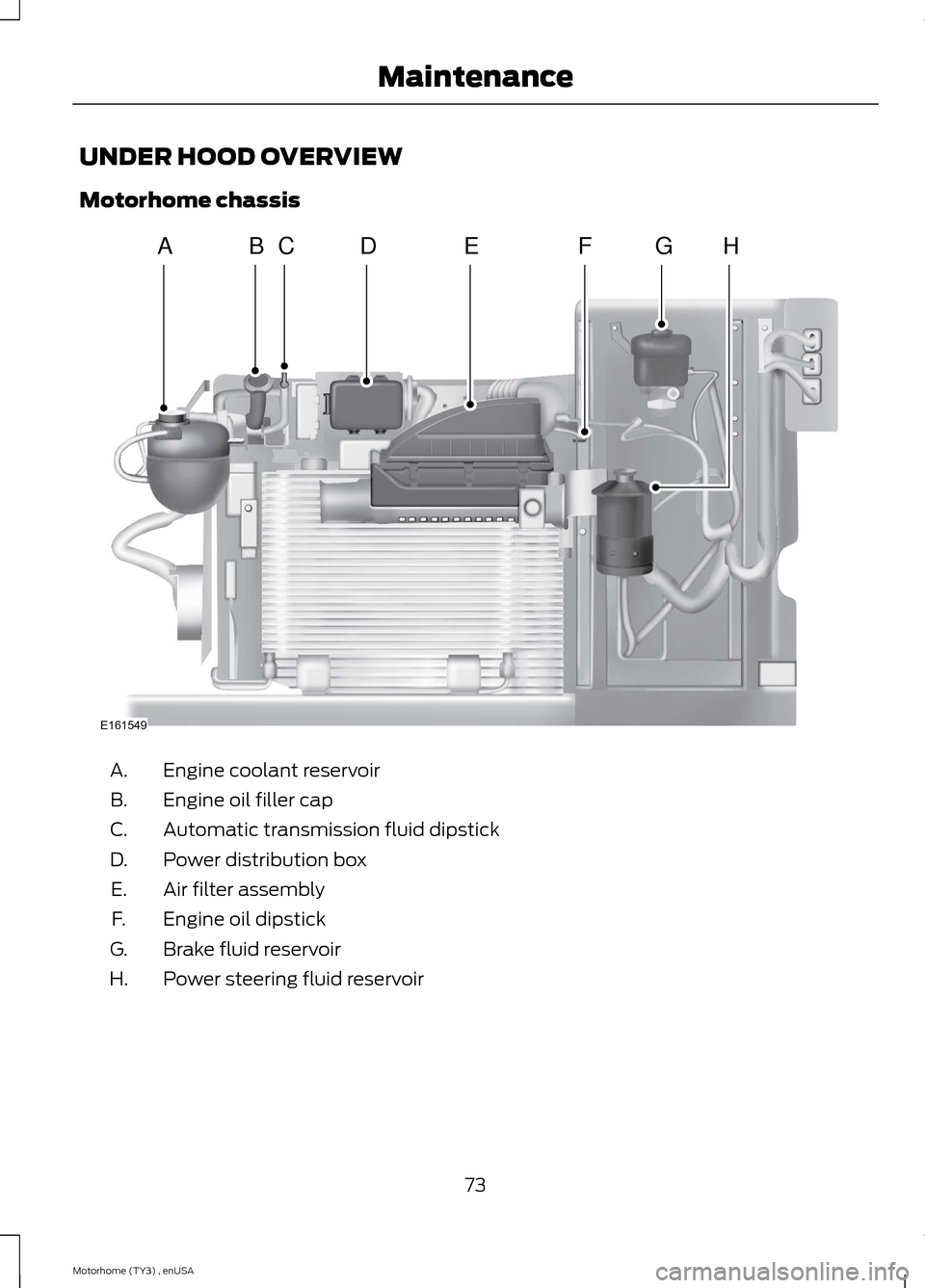
UNDER HOOD OVERVIEW
Motorhome chassis
Engine coolant reservoirA.
Engine oil filler capB.
Automatic transmission fluid dipstickC.
Power distribution boxD.
Air filter assemblyE.
Engine oil dipstickF.
Brake fluid reservoirG.
Power steering fluid reservoirH.
73Motorhome (TY3) , enUSAMaintenanceE161549ABCDEGFH
Page 77 of 143
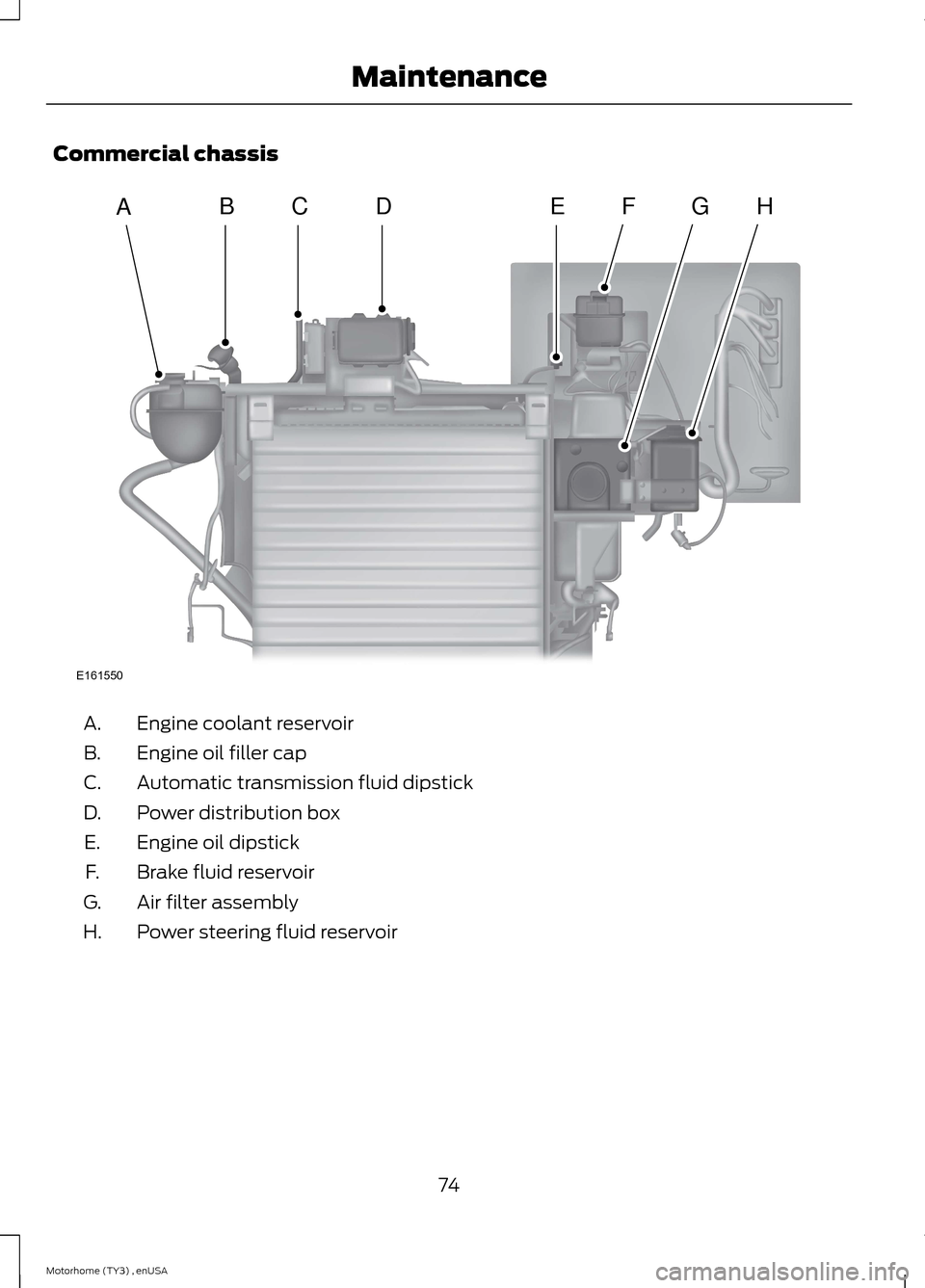
Commercial chassis
Engine coolant reservoirA.
Engine oil filler capB.
Automatic transmission fluid dipstickC.
Power distribution boxD.
Engine oil dipstickE.
Brake fluid reservoirF.
Air filter assemblyG.
Power steering fluid reservoirH.
74Motorhome (TY3) , enUSAMaintenanceE161550ABCDEFGH
Page 82 of 143
AUTOMATIC TRANSMISSION
FLUID CHECK
WARNING
The dipstick cap and surroundingcomponents may be hot; gloves arerecommended.
Note:Automatic transmission fluidexpands when warmed. To obtain anaccurate fluid check, drive the vehicle untilit is at normal operating temperature(approximately 20 miles [30 km]). If yourvehicle has been operated for an extendedperiod at high speeds, in city traffic duringhot weather or pulling a trailer, the vehicleshould be turned off for about 30 minutesto allow fluid to cool to normal operatingtemperature 150°F - 170°F (66°C - 77°C)before checking.
Refer to your scheduled maintenanceinformation for scheduled intervals for fluidchecks and changes.
Your transmission does not consume fluid.However, the fluid level should be checkedif the transmission is not working properly,(i.e., if the transmission slips or shiftsslowly) or if you notice some sign of fluidleakage. To check the fluid level:
1.Drive the vehicle 20 miles (30 km) oruntil it reaches normal operatingtemperature
2.Park the vehicle on a level surface andengage the parking brake
3.With the engine running, parking brakeengaged and your foot on the brakepedal, move the gearshift lever throughall of the gear ranges. Allow sufficienttime for each gear to engage
4.Latch the gearshift lever in P (Park)and leave the engine running.
5.Remove the dipstick, wiping it cleanwith a clean, dry lint free rag. Ifnecessary, refer to Under HoodOverview in this chapter for thelocation of the dipstick.
6.Install the dipstick making sure it is fullyseated in the filler tube.
7.Remove the dipstick and inspect thefluid level. The fluid should be in thedesignated area for normal operatingtemperature or ambient temperature.
Do not use supplemental transmissionfluid additives, treatments or cleaningagents. The use of these materials mayaffect transmission operation and resultin damage to internal transmissioncomponents.
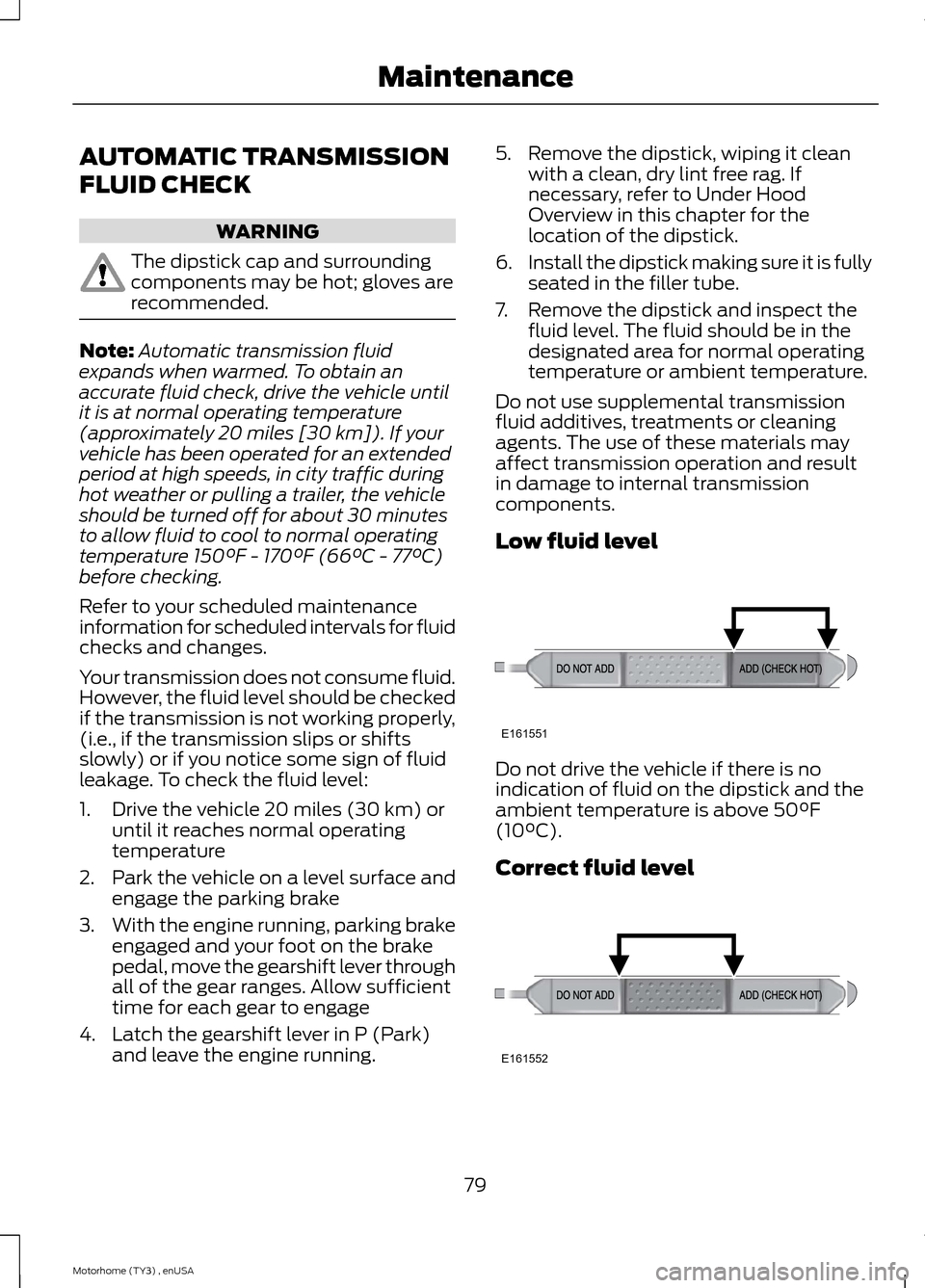
Low fluid level
Do not drive the vehicle if there is noindication of fluid on the dipstick and theambient temperature is above 50°F(10°C).
Correct fluid level
79Motorhome (TY3) , enUSAMaintenanceE161551 E161552
Page 83 of 143
![FORD F SERIES MOTORHOME AND COMMERCIAL CHASSIS 2014 12.G Owners Manual The transmission fluid should be in thisrange if at normal operating temperature(150°F-170°F [66°C-77°C]).
The transmission fluid should be checkedat normal operating temperature150°F-170°F (66Â](/manual-img/11/5010/w960_5010-82.png "FORD F SERIES MOTORHOME AND COMMERCIAL CHASSIS 2014 12.G Owners Manual The transmission fluid should be in thisrange if at normal operating temperature(150°F-170°F [66°C-77°C]).
The transmission fluid should be checkedat normal operating temperature150°F-170°F (66Â")
The transmission fluid should be in thisrange if at normal operating temperature(150°F-170°F [66°C-77°C]).
The transmission fluid should be checkedat normal operating temperature150°F-170°F (66°C-77°C) on a levelsurface. The normal operating temperaturecan be reached after approximately 20miles (30 km) of driving. You can checkthe fluid without driving if the ambienttemperature is above 50°F (10°C).However, if fluid is added at this time, anoverfill condition could result when thevehicle reaches normal operatingtemperature
High fluid level
Fluid levels above the safe range mayresult in transmission failure. An overfillcondition of transmission fluid may causeshift and/or engagement concerns and/orpossible damage. High fluid levels can becaused by an overheating condition.
Adjusting automatic transmissionfluid levels
Note:Use of a non-approved automatictransmission fluid may cause internaltransmission damage. Before adding anyfluid, make sure the correct type is used. Thetype of fluid used is normally indicated onthe transmission dipstick and also in theSee Capacities and Specifications (page111).
Add fluid in ½ pint (250 ml) incrementsthrough the filler tube until the level iscorrect.
Note:If an overfill occurs, excess fluidshould be removed by an authorized dealer.An overfill condition of transmission fluidmay cause shift and/or engagementconcerns and/or possible damage.
Do not use supplemental transmissionfluid additives, treatments or cleaningagents. The use of these materials mayaffect transmission operation and resultin damage to internal transmissioncomponents.
Automatic transmission fluid filter
The TorqShift™ automatic transmissionis equipped with a serviceable transmissionfluid filter located inside the transmissionbottom pan. Refer to the scheduledmaintenance information for serviceintervals for the automatic transmissionfluid and transmission filter. Fortransmission filter maintenance, see yourauthorized dealer.
BRAKE FLUID CHECK
Fluid levels between the MIN and MAXlines are within the normal operating range;there is no need to add fluid. If the fluidlevels are outside of the normal operatingrange, the performance of the systemcould be compromised; seek service fromyour authorized dealer immediately.
80Motorhome (TY3) , enUSAMaintenanceE161553 E161554
Page 118 of 143
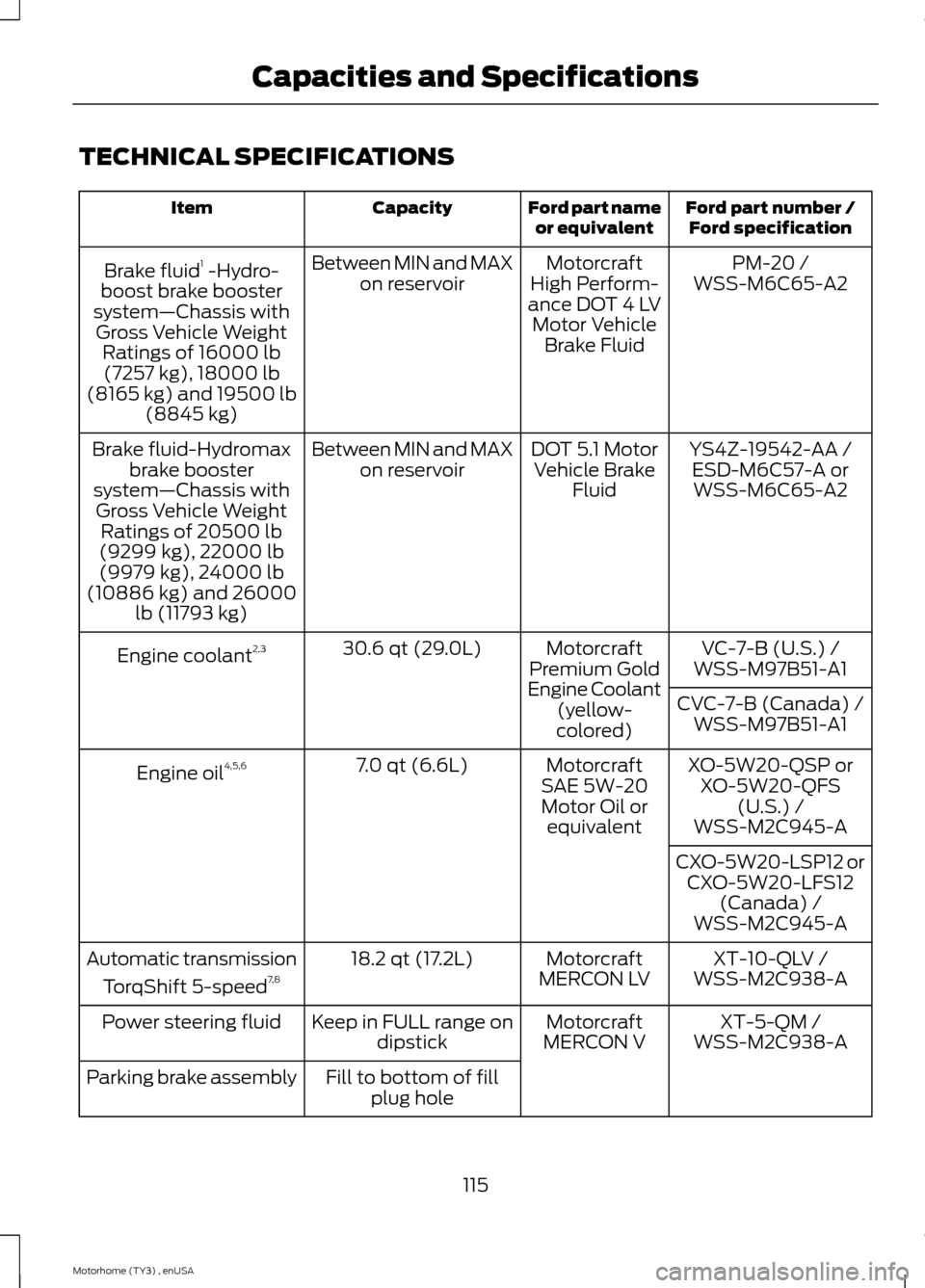
TECHNICAL SPECIFICATIONS
Ford part number /Ford specificationFord part nameor equivalentCapacityItem
PM-20 /MotorcraftHigh Perform-ance DOT 4 LVMotor VehicleBrake Fluid
Between MIN and MAXon reservoirBrake fluid1 -Hydro-boost brake boostersystem—Chassis withGross Vehicle WeightRatings of 16000 lb(7257 kg), 18000 lb(8165 kg) and 19500 lb(8845 kg)
WSS-M6C65-A2
YS4Z-19542-AA /DOT 5.1 MotorVehicle BrakeFluid
Between MIN and MAXon reservoirBrake fluid-Hydromaxbrake boostersystem—Chassis withGross Vehicle WeightRatings of 20500 lb(9299 kg), 22000 lb(9979 kg), 24000 lb(10886 kg) and 26000lb (11793 kg)
ESD-M6C57-A orWSS-M6C65-A2
VC-7-B (U.S.) /MotorcraftPremium GoldEngine Coolant(yellow-colored)
30.6 qt (29.0L)Engine coolant2,3WSS-M97B51-A1
CVC-7-B (Canada) /WSS-M97B51-A1
XO-5W20-QSP orXO-5W20-QFS(U.S.) /
MotorcraftSAE 5W-20Motor Oil orequivalent
7.0 qt (6.6L)Engine oil4,5,6
WSS-M2C945-A
CXO-5W20-LSP12 orCXO-5W20-LFS12(Canada) /WSS-M2C945-A
XT-10-QLV /MotorcraftMERCON LV18.2 qt (17.2L)Automatic transmission
TorqShift 5-speed7,8WSS-M2C938-A
XT-5-QM /MotorcraftMERCON VKeep in FULL range ondipstickPower steering fluidWSS-M2C938-A
Fill to bottom of fillplug holeParking brake assembly
115Motorhome (TY3) , enUSACapacities and Specifications
Page 120 of 143
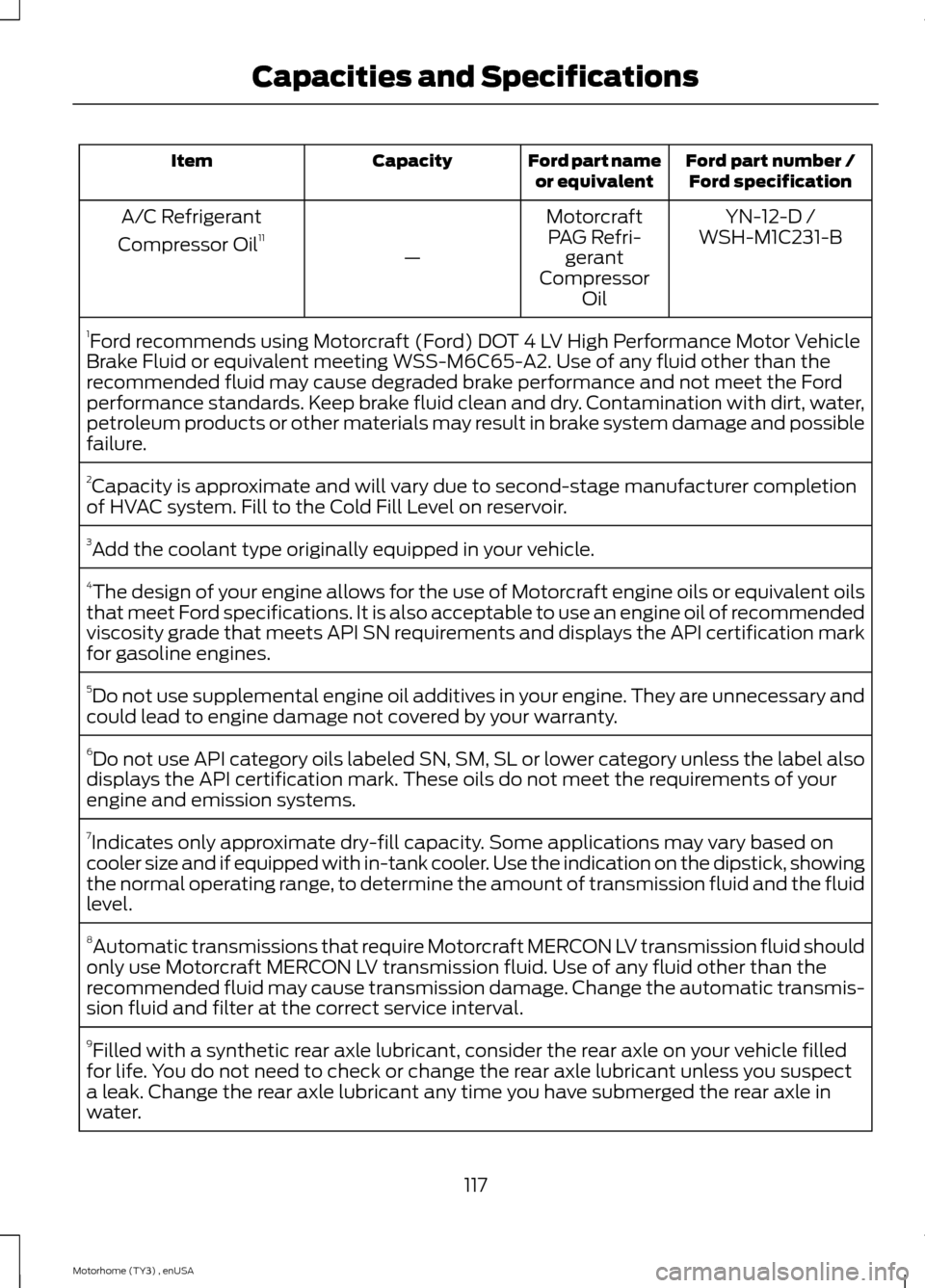
Ford part number /Ford specificationFord part nameor equivalentCapacityItem
YN-12-D /MotorcraftPAG Refri-gerantCompressorOil
—
A/C Refrigerant
Compressor Oil11WSH-M1C231-B
1Ford recommends using Motorcraft (Ford) DOT 4 LV High Performance Motor VehicleBrake Fluid or equivalent meeting WSS-M6C65-A2. Use of any fluid other than therecommended fluid may cause degraded brake performance and not meet the Fordperformance standards. Keep brake fluid clean and dry. Contamination with dirt, water,petroleum products or other materials may result in brake system damage and possiblefailure.
2Capacity is approximate and will vary due to second-stage manufacturer completionof HVAC system. Fill to the Cold Fill Level on reservoir.
3Add the coolant type originally equipped in your vehicle.
4The design of your engine allows for the use of Motorcraft engine oils or equivalent oilsthat meet Ford specifications. It is also acceptable to use an engine oil of recommendedviscosity grade that meets API SN requirements and displays the API certification markfor gasoline engines.
5Do not use supplemental engine oil additives in your engine. They are unnecessary andcould lead to engine damage not covered by your warranty.
6Do not use API category oils labeled SN, SM, SL or lower category unless the label alsodisplays the API certification mark. These oils do not meet the requirements of yourengine and emission systems.
7Indicates only approximate dry-fill capacity. Some applications may vary based oncooler size and if equipped with in-tank cooler. Use the indication on the dipstick, showingthe normal operating range, to determine the amount of transmission fluid and the fluidlevel.
8Automatic transmissions that require Motorcraft MERCON LV transmission fluid shouldonly use Motorcraft MERCON LV transmission fluid. Use of any fluid other than therecommended fluid may cause transmission damage. Change the automatic transmis-sion fluid and filter at the correct service interval.
9Filled with a synthetic rear axle lubricant, consider the rear axle on your vehicle filledfor life. You do not need to check or change the rear axle lubricant unless you suspecta leak. Change the rear axle lubricant any time you have submerged the rear axle inwater.
117Motorhome (TY3) , enUSACapacities and Specifications
Page 126 of 143
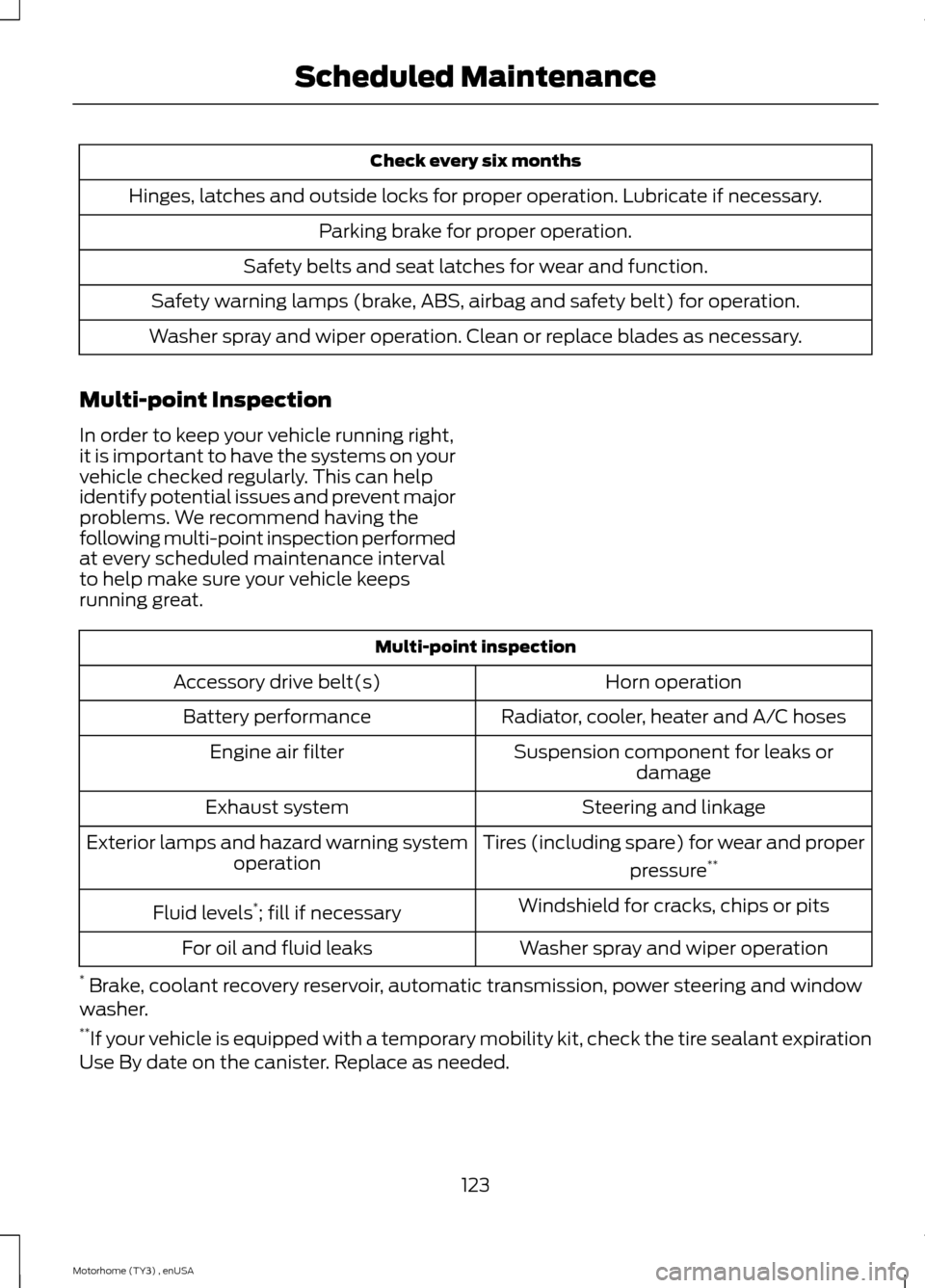
Check every six months
Hinges, latches and outside locks for proper operation. Lubricate if necessary.
Parking brake for proper operation.
Safety belts and seat latches for wear and function.
Safety warning lamps (brake, ABS, airbag and safety belt) for operation.
Washer spray and wiper operation. Clean or replace blades as necessary.
Multi-point Inspection
In order to keep your vehicle running right,it is important to have the systems on yourvehicle checked regularly. This can helpidentify potential issues and prevent majorproblems. We recommend having thefollowing multi-point inspection performedat every scheduled maintenance intervalto help make sure your vehicle keepsrunning great.
Multi-point inspection
Horn operationAccessory drive belt(s)
Radiator, cooler, heater and A/C hosesBattery performance
Suspension component for leaks ordamageEngine air filter
Steering and linkageExhaust system
Tires (including spare) for wear and proper
pressure**Exterior lamps and hazard warning systemoperation
Windshield for cracks, chips or pitsFluid levels*; fill if necessary
Washer spray and wiper operationFor oil and fluid leaks
* Brake, coolant recovery reservoir, automatic transmission, power steering and windowwasher.**If your vehicle is equipped with a temporary mobility kit, check the tire sealant expirationUse By date on the canister. Replace as needed.
123Motorhome (TY3) , enUSAScheduled Maintenance