2014 FORD F SERIES MOTORHOME AND COMMERCIAL CHASSIS brake
[x] Cancel search: brakePage 110 of 143
•Install chains securely, verifying thatthe chains do not touch any wiring,brake lines or fuel lines.
•Drive cautiously. If you hear the chainsrub or bang against your vehicle, stopand retighten the chains. If this doesnot work, remove the chains to preventdamage to your vehicle.
•Remove the tire chains when they areno longer needed. Do not use tirechains on dry roads.
If you have any questions regarding snowchains or cables, please contact yourauthorized dealer.
CHANGING A ROAD WHEEL
If you get a flat tire while driving, do notapply the brake heavily. Instead, graduallydecrease your speed. Hold the steeringwheel firmly and slowly move to a safeplace on the side of the road.
Dissimilar Spare Wheel and TireAssembly Information
WARNING
Failure to follow these guidelinescould result in an increased risk ofloss of vehicle control, injury or death.
If you have a dissimilar spare wheel andtire, then it is intended for temporary useonly. This means that if you need to use it,you should replace it as soon as possiblewith a road wheel and tire assembly thatis the same size and type as the road tiresand wheels that were originally providedby Ford. If the dissimilar spare tire or wheelis damaged, it should be replaced ratherthan repaired.
A dissimilar spare wheel and tire assemblyis defined as a spare wheel and tireassembly that is different in brand, size orappearance from the road tires and wheelsand can be one of three types:
1.T-type mini-spare: This spare tirebegins with the letter T for tire size andmay have Temporary Use Only molded inthe sidewall.
2.Full-size dissimilar spare with labelon wheel: This spare tire has a label onthe wheel that states: THIS WHEEL ANDTIRE ASSEMBLY FOR TEMPORARY USEONLY
When driving with one of the dissimilarspare tires listed above, do not:
•Exceed 50 mph (80 km/h).
•Load the vehicle beyond maximumvehicle load rating listed on the SafetyCompliance Label.
•Tow a trailer.
•Use snow chains on the end of thevehicle with the dissimilar spare tire.
•Use more than one dissimilar spare tireat a time.
•Use commercial car washingequipment.
•Try to repair the dissimilar spare tire.
Use of one of the dissimilar spare tireslisted above at any one wheel location canlead to impairment of the following:
•Handling, stability and brakingperformance.
•Comfort and noise.
•Ground clearance and parking at curbs.
•Winter weather driving capability.
•Wet weather driving capability.
•All-wheel driving capability
3.Full-size dissimilar spare withoutlabel on wheel
107Motorhome (TY3) , enUSAWheels and Tires
Page 111 of 143
When driving with the full-size dissimilarspare wheel and tire assembly, do not:
•Exceed 70 mph (113 km/h).
•Use more than one dissimilar sparewheel and tire assembly at a time.
•Use commercial car washingequipment.
•Use snow chains on the end of thevehicle with the dissimilar spare wheeland tire assembly.
The usage of a full-size dissimilar sparewheel and tire assembly can lead toimpairment of the following:
•Handling, stability and brakingperformance.
•Comfort and noise.
•Ground clearance and parking at curbs.
•Winter weather driving capability.
•Wet weather driving capability.
•All-wheel driving capability
When driving with the full-size dissimilarspare wheel and tire assembly additionalcaution should be given to:
•Towing a trailer.
•Driving vehicles equipped with acamper body.
•Driving vehicles with a load on thecargo rack.
Drive cautiously when using a full-sizedissimilar spare wheel and tire assemblyand seek service as soon as possible.
Tire Change Procedure
WARNINGS
When one of the front wheels is offthe ground, the transmission alonewill not prevent the vehicle frommoving or slipping off the jack, even if thetransmission is in park (P).
WARNINGS
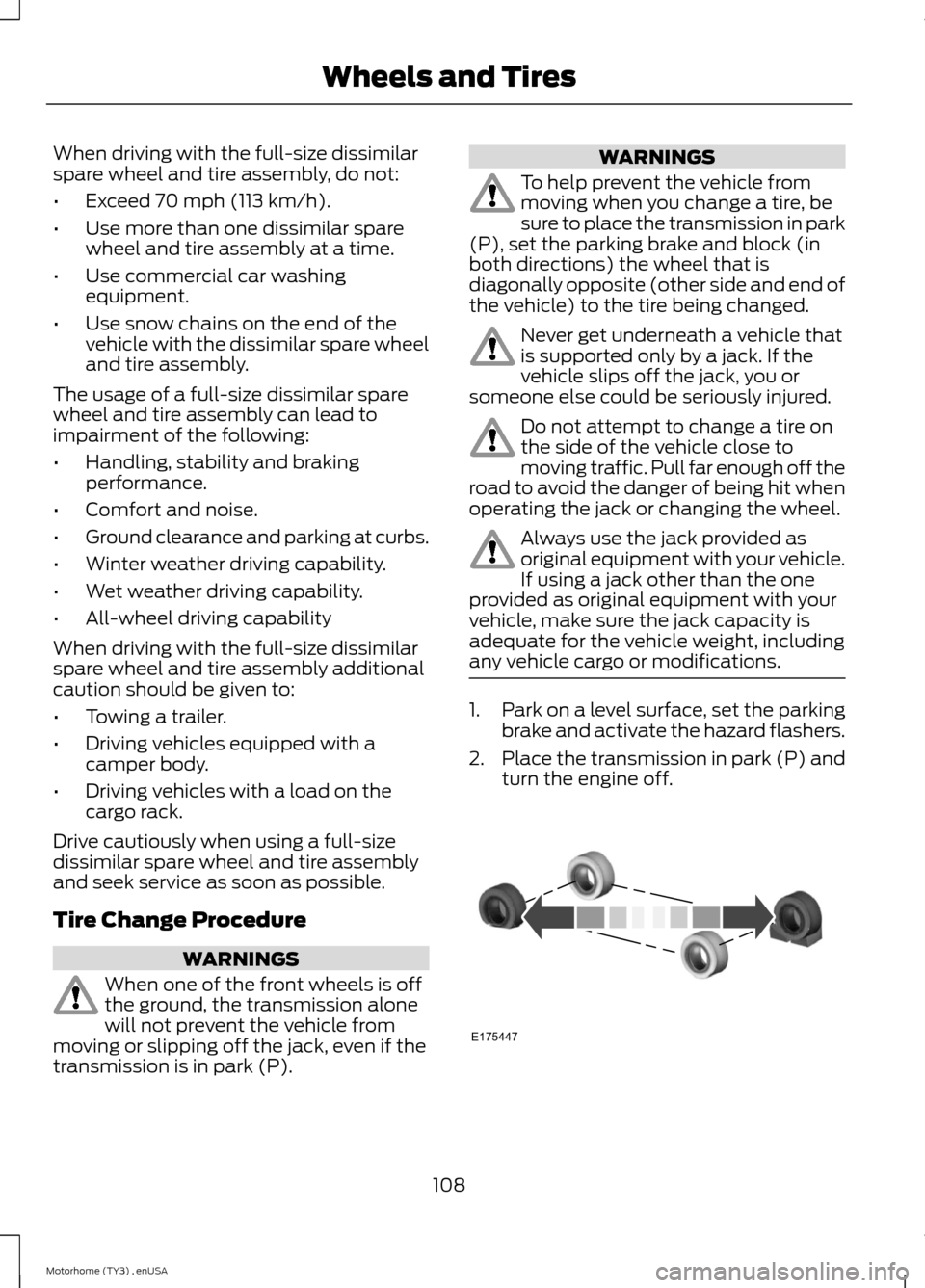
To help prevent the vehicle frommoving when you change a tire, besure to place the transmission in park(P), set the parking brake and block (inboth directions) the wheel that isdiagonally opposite (other side and end ofthe vehicle) to the tire being changed.
Never get underneath a vehicle thatis supported only by a jack. If thevehicle slips off the jack, you orsomeone else could be seriously injured.
Do not attempt to change a tire onthe side of the vehicle close tomoving traffic. Pull far enough off theroad to avoid the danger of being hit whenoperating the jack or changing the wheel.
Always use the jack provided asoriginal equipment with your vehicle.If using a jack other than the oneprovided as original equipment with yourvehicle, make sure the jack capacity isadequate for the vehicle weight, includingany vehicle cargo or modifications.
1.Park on a level surface, set the parkingbrake and activate the hazard flashers.
2.Place the transmission in park (P) andturn the engine off.
108Motorhome (TY3) , enUSAWheels and TiresE175447
Page 112 of 143
3.Block the diagonally opposite wheel.The parking brake is on thetransmission. Therefore, the vehicle willnot be prevented from moving when arear wheel is lifted, even if the parkingbrake is applied. Be sure to block bothdirections of the wheel that isdiagonally opposite to the wheel thatis being lifted.
4.Remove the spare tire and jack fromthe storage location.
5.Loosen the wheel nut by pulling up onthe handle of the lug nut wrench aboutone-half turn (counterclockwise). Donot remove the wheel lug nuts until youraise the tire off the ground.
6.Position the jack to raise the front orrear wheel. Raise the vehicle with thejack applied to the axle(s).
Note:Never use the rear differential as ajacking point.
7.Raise the vehicle until the wheel iscompletely off the ground.
8.Remove the lug nuts with the lug nutwrench.
9.Replace the flat tire with the spare tire.
10.Use the lug nut wrench to screw thelug nut snugly against the wheel.
11.Lower the vehicle.
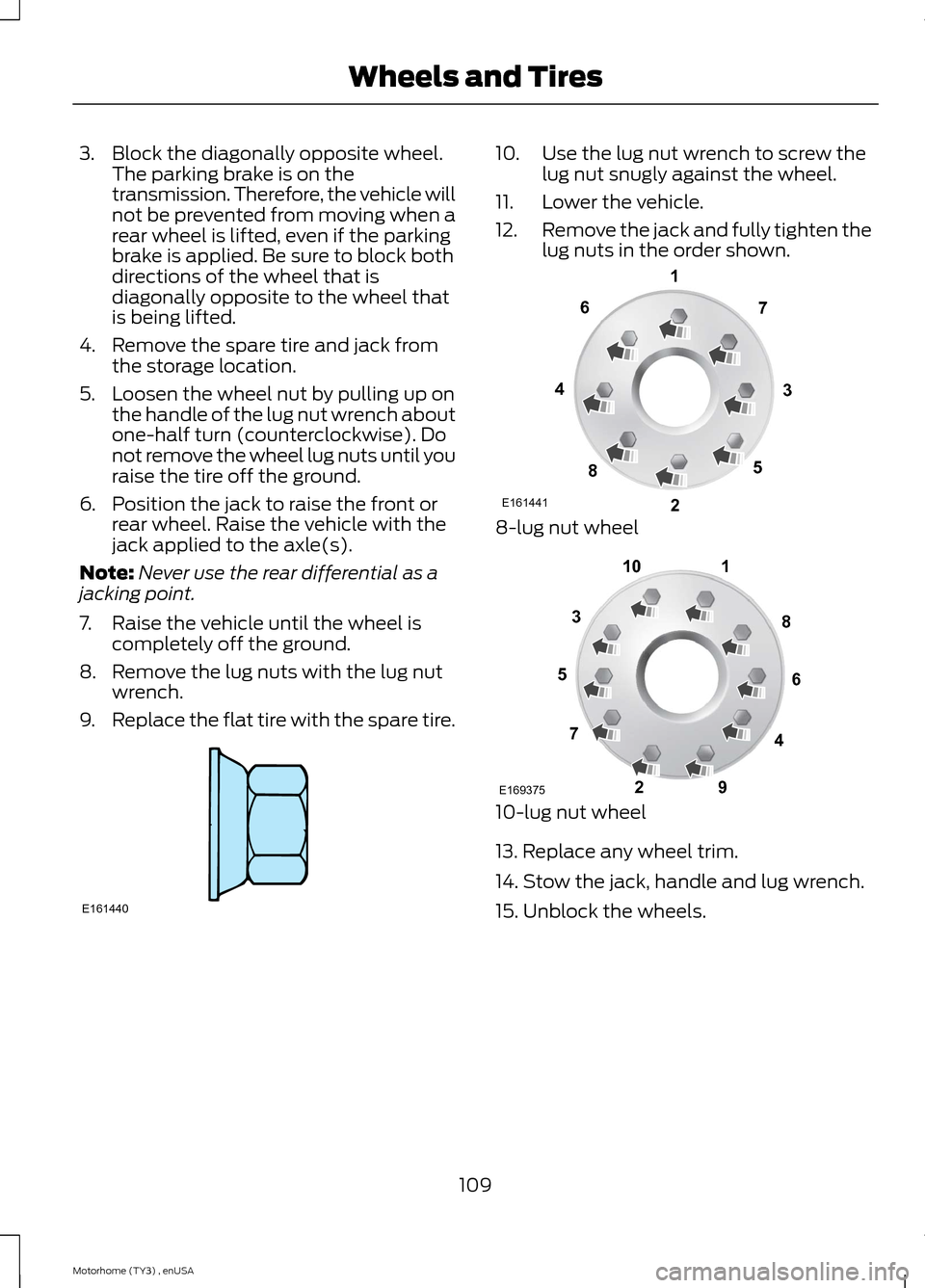
12.Remove the jack and fully tighten thelug nuts in the order shown.
8-lug nut wheel
10-lug nut wheel
13. Replace any wheel trim.
14. Stow the jack, handle and lug wrench.
15. Unblock the wheels.
109Motorhome (TY3) , enUSAWheels and TiresE161440 E16144113427658 12345678910E169375
Page 113 of 143
TECHNICAL SPECIFICATIONS
Wheel Lug Nut Torque Specifications
WARNING
When a wheel is installed, always remove any corrosion, dirt or foreign materialspresent on the mounting surfaces of the wheel or the surface of the wheel hub,brake drum or brake disc that contacts the wheel. Make sure that any fastenersthat attach the rotor to the hub are secured so they do not interfere with the mountingsurfaces of the wheel. Installing wheels without correct metal-to-metal contact at thewheel mounting surfaces can cause the wheel nuts to loosen and the wheel to come offwhile the vehicle is in motion, resulting in loss of control.
Ib-ft (Nm)*Bolt size
150 (200)M14 x 1.5(19.5 inch wheels)
450 (610)M22 x 1.5(22.5 inch wheels)
*Torque specifications are for nut and bolt threads free of dirt and rust. Use only Fordrecommended replacement fasteners.
On vehicles equipped with dual rear wheels, retighten the wheel lug nuts to the specifiedtorque at 100 miles (160 kilometers), and again at 500 miles (800 kilometers) of newvehicle operation and after any wheel disturbance (such as tire rotation, changing a flattire, wheel removal).
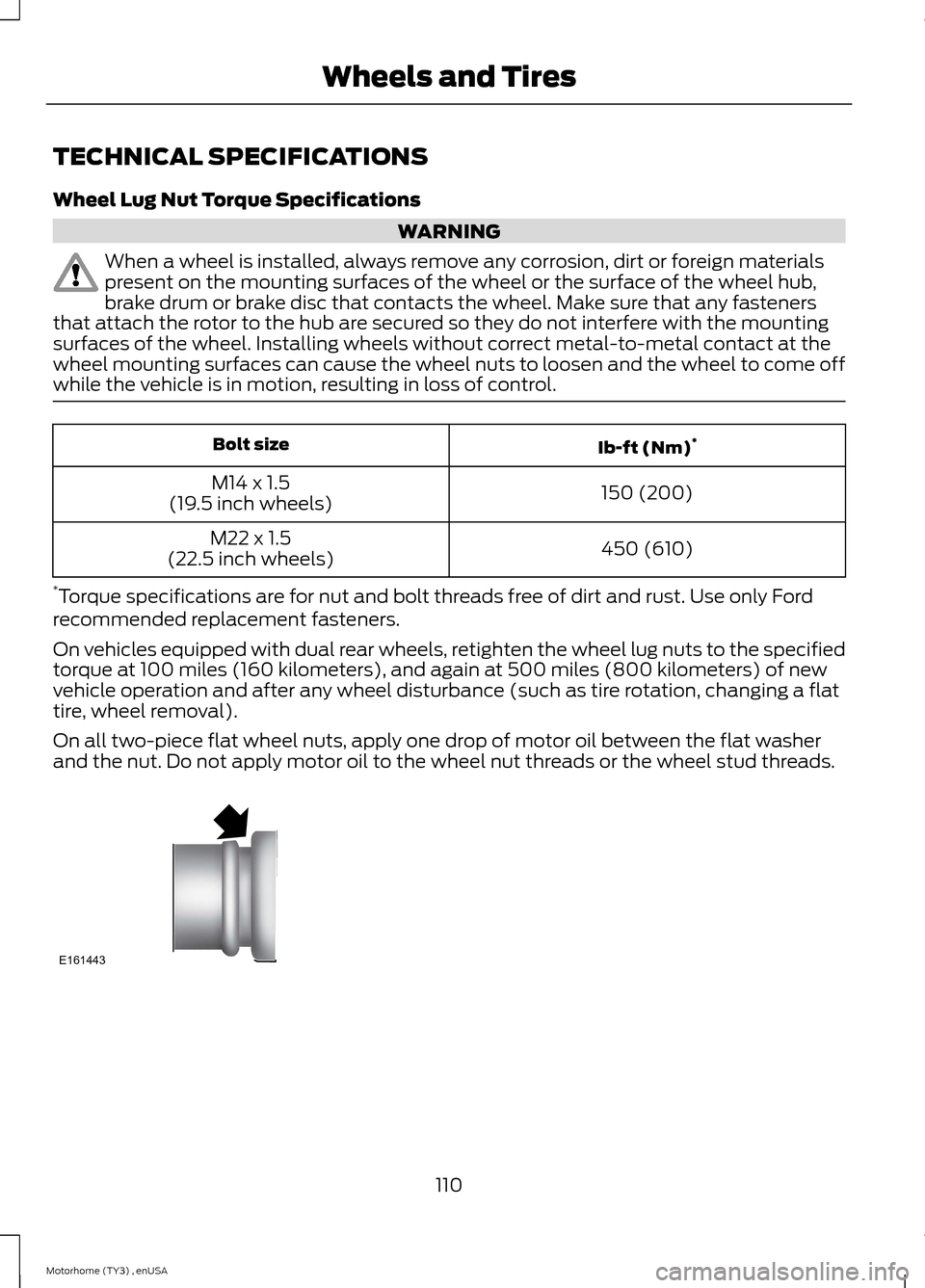
On all two-piece flat wheel nuts, apply one drop of motor oil between the flat washerand the nut. Do not apply motor oil to the wheel nut threads or the wheel stud threads.
110Motorhome (TY3) , enUSAWheels and TiresE161443
Page 116 of 143
VEHICLE IDENTIFICATION
NUMBER
The vehicle identification number islocated near the cowl to the right of the airfilter.
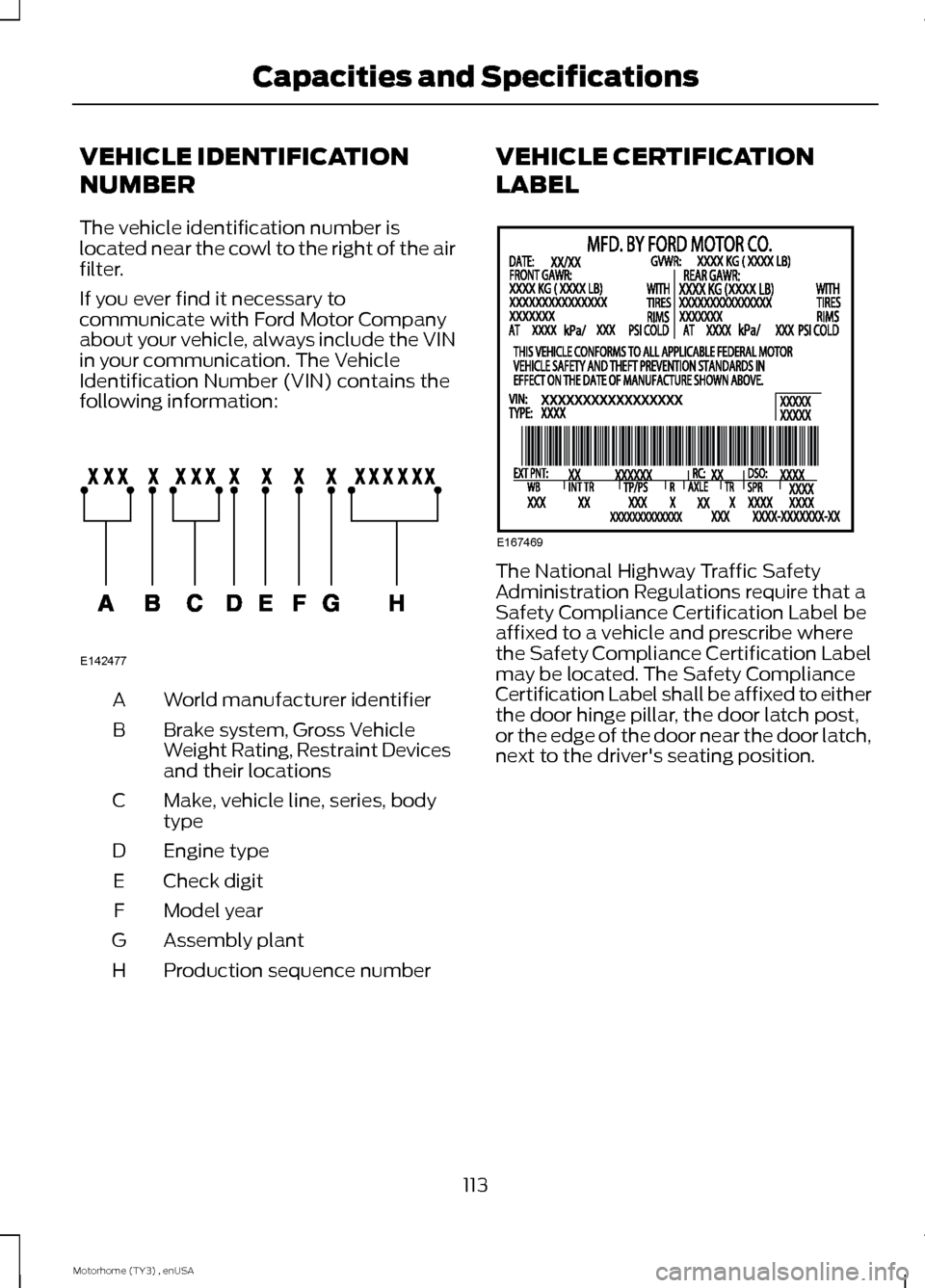
If you ever find it necessary tocommunicate with Ford Motor Companyabout your vehicle, always include the VINin your communication. The VehicleIdentification Number (VIN) contains thefollowing information:
World manufacturer identifierA
Brake system, Gross VehicleWeight Rating, Restraint Devicesand their locations
B
Make, vehicle line, series, bodytypeC
Engine typeD
Check digitE
Model yearF
Assembly plantG
Production sequence numberH
VEHICLE CERTIFICATION
LABEL
The National Highway Traffic SafetyAdministration Regulations require that aSafety Compliance Certification Label beaffixed to a vehicle and prescribe wherethe Safety Compliance Certification Labelmay be located. The Safety ComplianceCertification Label shall be affixed to eitherthe door hinge pillar, the door latch post,or the edge of the door near the door latch,next to the driver's seating position.
113Motorhome (TY3) , enUSACapacities and SpecificationsE142477 E167469
Page 118 of 143
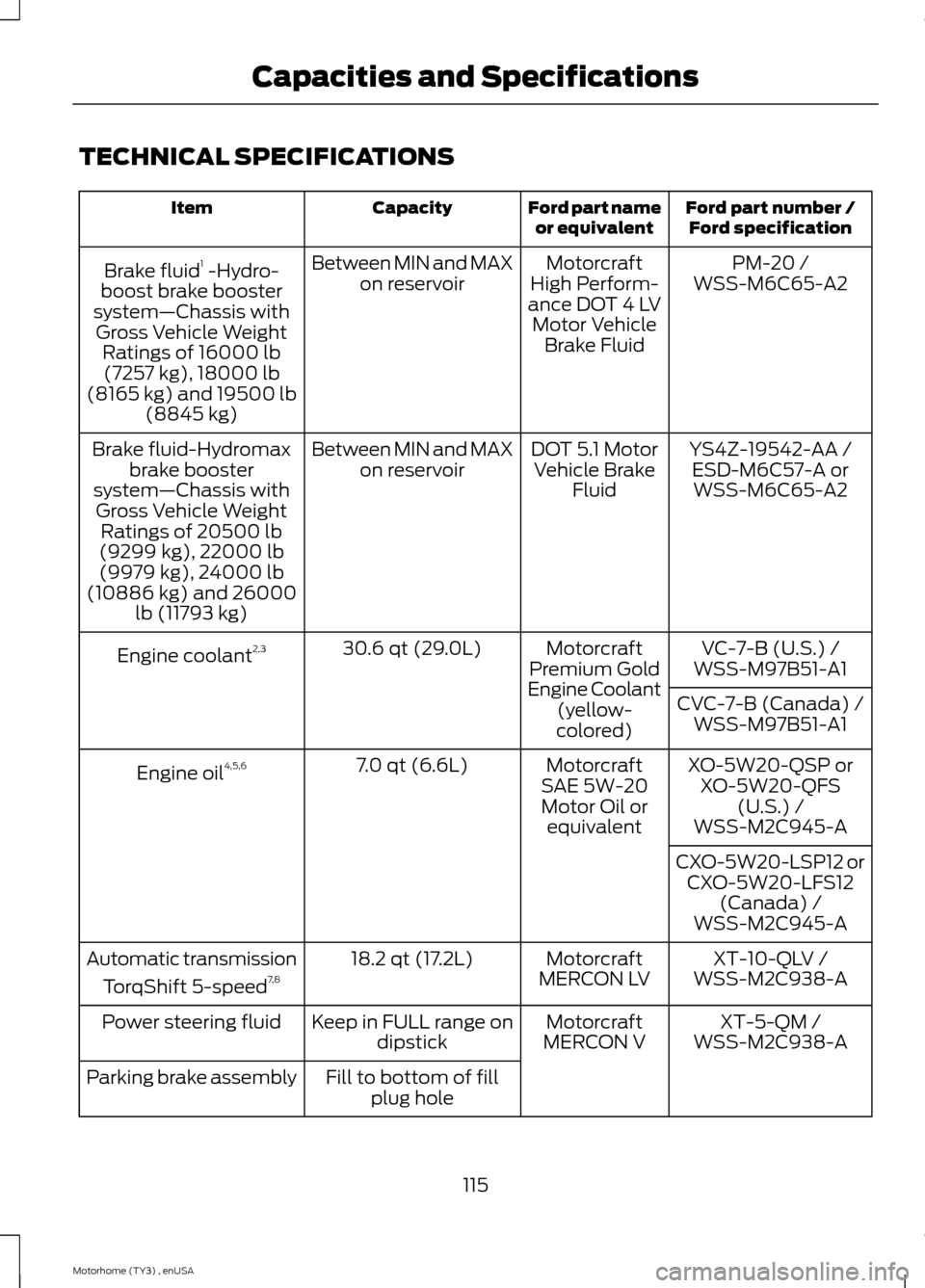
TECHNICAL SPECIFICATIONS
Ford part number /Ford specificationFord part nameor equivalentCapacityItem
PM-20 /MotorcraftHigh Perform-ance DOT 4 LVMotor VehicleBrake Fluid
Between MIN and MAXon reservoirBrake fluid1 -Hydro-boost brake boostersystem—Chassis withGross Vehicle WeightRatings of 16000 lb(7257 kg), 18000 lb(8165 kg) and 19500 lb(8845 kg)
WSS-M6C65-A2
YS4Z-19542-AA /DOT 5.1 MotorVehicle BrakeFluid
Between MIN and MAXon reservoirBrake fluid-Hydromaxbrake boostersystem—Chassis withGross Vehicle WeightRatings of 20500 lb(9299 kg), 22000 lb(9979 kg), 24000 lb(10886 kg) and 26000lb (11793 kg)
ESD-M6C57-A orWSS-M6C65-A2
VC-7-B (U.S.) /MotorcraftPremium GoldEngine Coolant(yellow-colored)
30.6 qt (29.0L)Engine coolant2,3WSS-M97B51-A1
CVC-7-B (Canada) /WSS-M97B51-A1
XO-5W20-QSP orXO-5W20-QFS(U.S.) /
MotorcraftSAE 5W-20Motor Oil orequivalent
7.0 qt (6.6L)Engine oil4,5,6
WSS-M2C945-A
CXO-5W20-LSP12 orCXO-5W20-LFS12(Canada) /WSS-M2C945-A
XT-10-QLV /MotorcraftMERCON LV18.2 qt (17.2L)Automatic transmission
TorqShift 5-speed7,8WSS-M2C938-A
XT-5-QM /MotorcraftMERCON VKeep in FULL range ondipstickPower steering fluidWSS-M2C938-A
Fill to bottom of fillplug holeParking brake assembly
115Motorhome (TY3) , enUSACapacities and Specifications
Page 119 of 143
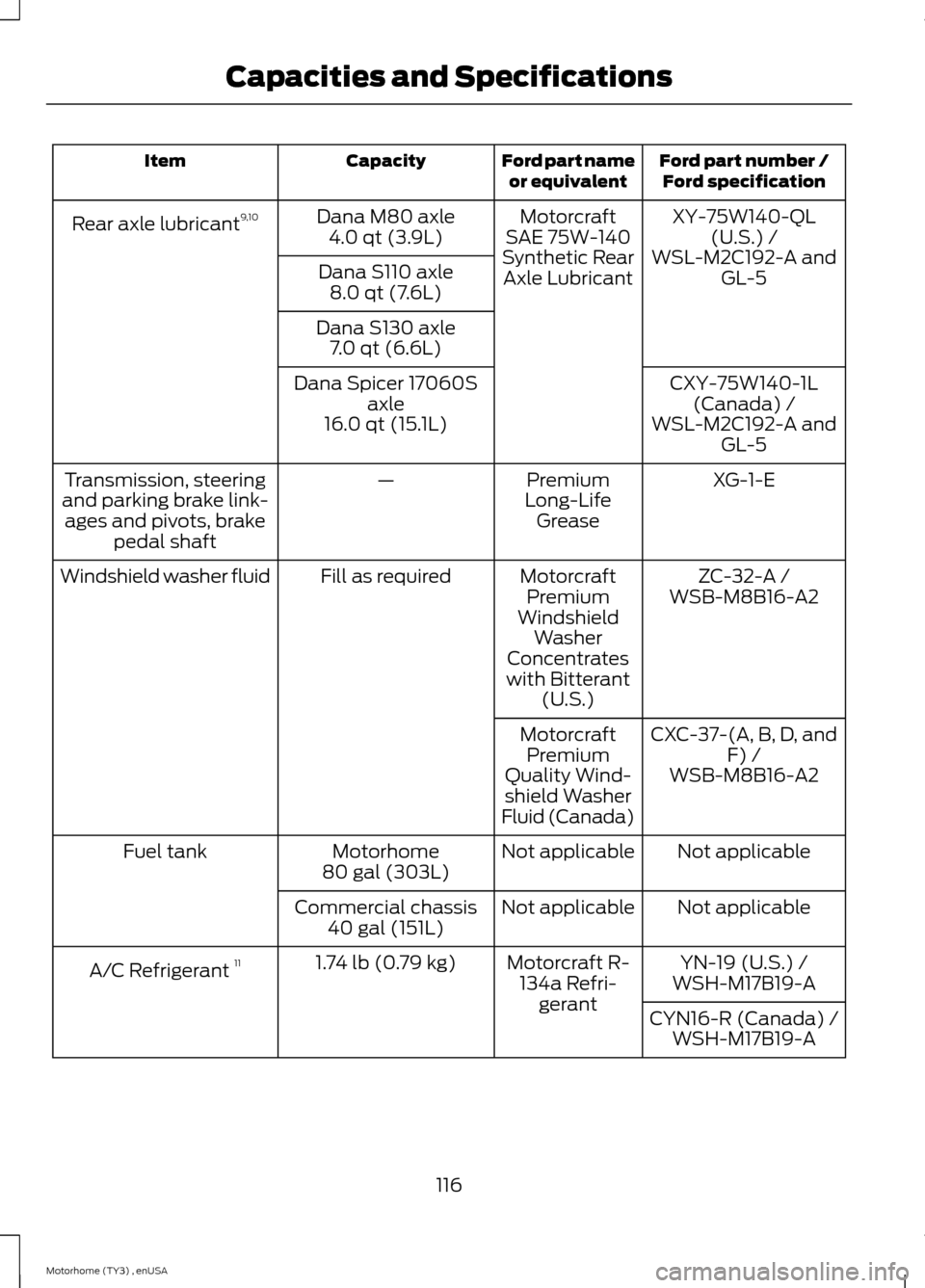
Ford part number /Ford specificationFord part nameor equivalentCapacityItem
XY-75W140-QL(U.S.) /MotorcraftSAE 75W-140Synthetic RearAxle Lubricant
Dana M80 axle4.0 qt (3.9L)Rear axle lubricant9,10
WSL-M2C192-A andGL-5Dana S110 axle8.0 qt (7.6L)
Dana S130 axle7.0 qt (6.6L)
Dana Spicer 17060SaxleCXY-75W140-1L(Canada) /16.0 qt (15.1L)WSL-M2C192-A andGL-5
XG-1-EPremiumLong-LifeGrease
—Transmission, steeringand parking brake link-ages and pivots, brakepedal shaft
ZC-32-A /MotorcraftPremiumWindshieldWasherConcentrateswith Bitterant(U.S.)
Fill as requiredWindshield washer fluidWSB-M8B16-A2
CXC-37-(A, B, D, andF) /MotorcraftPremiumQuality Wind-shield WasherFluid (Canada)
WSB-M8B16-A2
Not applicableNot applicableMotorhomeFuel tank80 gal (303L)
Not applicableNot applicableCommercial chassis40 gal (151L)
YN-19 (U.S.) /Motorcraft R-134a Refri-gerant
1.74 lb (0.79 kg)A/C Refrigerant 11WSH-M17B19-A
CYN16-R (Canada) /WSH-M17B19-A
116Motorhome (TY3) , enUSACapacities and Specifications
Page 120 of 143
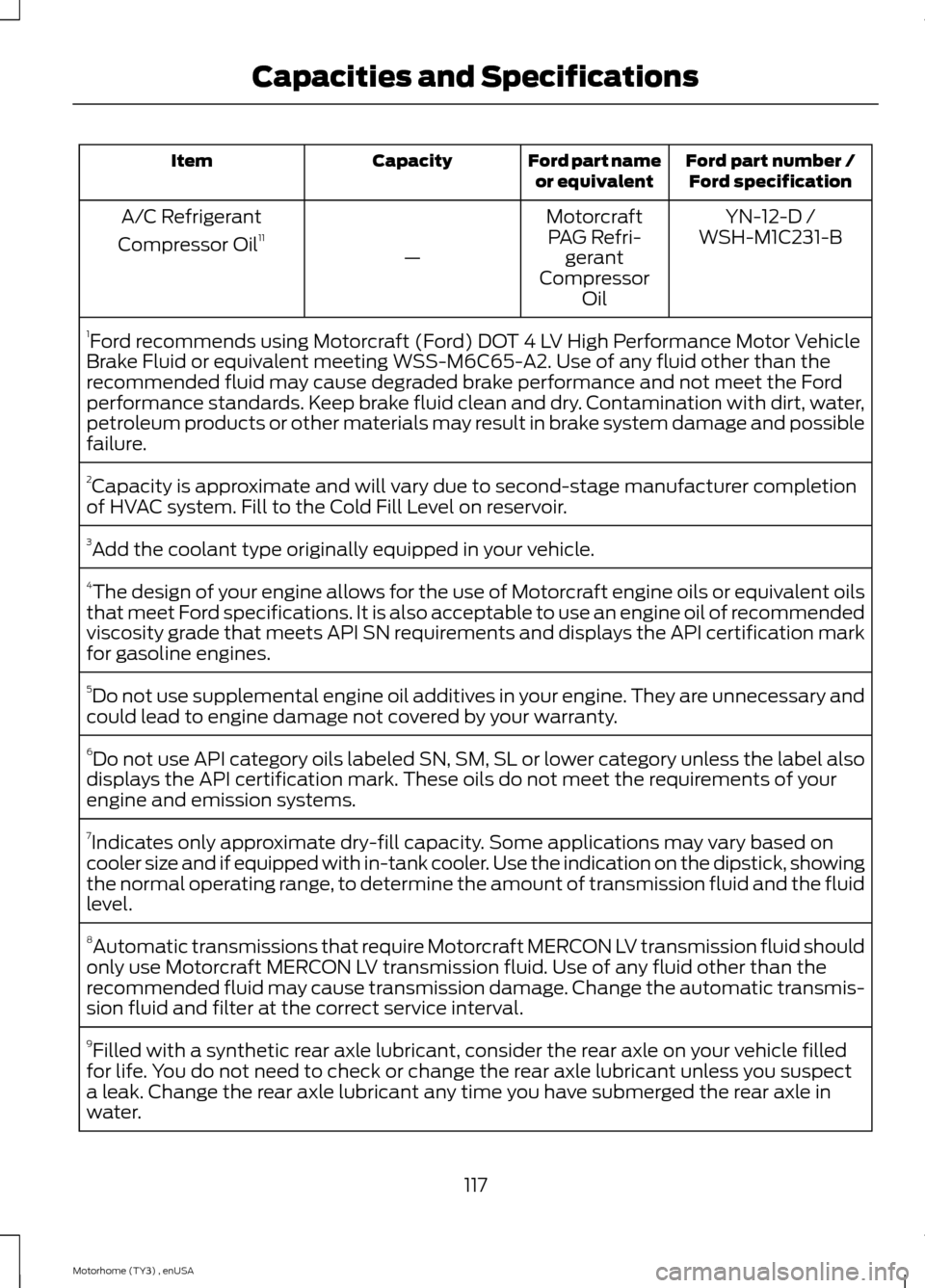
Ford part number /Ford specificationFord part nameor equivalentCapacityItem
YN-12-D /MotorcraftPAG Refri-gerantCompressorOil
—
A/C Refrigerant
Compressor Oil11WSH-M1C231-B
1Ford recommends using Motorcraft (Ford) DOT 4 LV High Performance Motor VehicleBrake Fluid or equivalent meeting WSS-M6C65-A2. Use of any fluid other than therecommended fluid may cause degraded brake performance and not meet the Fordperformance standards. Keep brake fluid clean and dry. Contamination with dirt, water,petroleum products or other materials may result in brake system damage and possiblefailure.
2Capacity is approximate and will vary due to second-stage manufacturer completionof HVAC system. Fill to the Cold Fill Level on reservoir.
3Add the coolant type originally equipped in your vehicle.
4The design of your engine allows for the use of Motorcraft engine oils or equivalent oilsthat meet Ford specifications. It is also acceptable to use an engine oil of recommendedviscosity grade that meets API SN requirements and displays the API certification markfor gasoline engines.
5Do not use supplemental engine oil additives in your engine. They are unnecessary andcould lead to engine damage not covered by your warranty.
6Do not use API category oils labeled SN, SM, SL or lower category unless the label alsodisplays the API certification mark. These oils do not meet the requirements of yourengine and emission systems.
7Indicates only approximate dry-fill capacity. Some applications may vary based oncooler size and if equipped with in-tank cooler. Use the indication on the dipstick, showingthe normal operating range, to determine the amount of transmission fluid and the fluidlevel.
8Automatic transmissions that require Motorcraft MERCON LV transmission fluid shouldonly use Motorcraft MERCON LV transmission fluid. Use of any fluid other than therecommended fluid may cause transmission damage. Change the automatic transmis-sion fluid and filter at the correct service interval.
9Filled with a synthetic rear axle lubricant, consider the rear axle on your vehicle filledfor life. You do not need to check or change the rear axle lubricant unless you suspecta leak. Change the rear axle lubricant any time you have submerged the rear axle inwater.
117Motorhome (TY3) , enUSACapacities and Specifications