Page 163 of 284
❒adjust the catch C fig. 129 and disconnect the
electrical connector D;
❒turn and remove the bulb holder E;
❒release and replace the bulb;
❒refit the new lamp and carry out the procedure
described previously in reverse.SIDE LIGHTS/DAY LIGHTS (DRL)
(for versions/markets, where provided)
Replace the bulb as follows:
❒steer the wheel completely;
❒adjust the screws A fig. 128 and remove the flap B;
❒adjust the catch C fig. 130 and disconnect the
electrical connector D;
❒turn and remove the bulb holder E;
❒release and replace the bulb;
❒refit the new lamp and carry out the procedure
described previously in reverse.
fig. 129
F0W0198
fig. 130
F0W0069
159GETTING TO KNOW
YOUR CAR
SAFETY
STARTING AND
DRIVING
WARNING LIGHTS
AND MESSAGESIN AN
EMERGENCYSERVICING AND
MAINTENANCE
TECHNICAL
SPECIFICATIONS
INDEX
Page 164 of 284
REAR LIGHT CLUSTERS
These contain the bulbs for the side lights, brake
lights and direction indicators. The reversing lights
and rear fog lights are located instead in the rear
bumper.
To change the bulb proceed as follows:
❒slacken the two screws fig. 131 from their seats,
pull gently outwards until releasing the whole
headlight from the two clips (press-fitted D fig. 13
and release the connector;
❒undo the five screws B from their seats and
remove the bulb holder C fig. 132;
❒remove the bulbs, pushing them slightly and
turning them anti-clockwise;
❒refit the new lamp and carry out the procedure
described previously in reverse.3
rd
BRAKE LIGHTS
These are located in the tailgate and are LED lights.
For replacement, contact a Fiat Dealership.
fig. 132
F0W0311
fig. 131
F0W0310
160
GETTING TO KNOW
YOUR CAR
SAFETY
STARTING AND
DRIVING
WARNING LIGHTS
AND MESSAGES
IN AN
EMERGENCY
SERVICING AND
MAINTENANCE
TECHNICAL
SPECIFICATIONS
INDEX
A
2)
Page 165 of 284
FOG LIGHT/REAR FOG LIGHT
To change the bulb, proceed as follows:
❒adjust the tabs A and remove the flap B fig. 133;
❒adjust the catch C and disconnect the electrical
connector D fig. 134;
❒turn and remove the bulb holder E;
❒extract the bulb and replace it;
❒refit the new lamp and carry out the procedure
described previously in reverse.
WARNING
Before replacing the bulb, wait for the
catalytic conver ter to cool down: RISK
OF BURNSNUMBER PLATE LIGHTS
To replace the bulbs proceed as follows:
❒remove lens A fig. 135;
❒replace the bulb A fig. 136, releasing it from the
side contacts;
fig. 133
F0W0205
fig. 134
F0W0206
fig. 135
F0W0259
161GETTING TO KNOW
YOUR CAR
SAFETY
STARTING AND
DRIVING
WARNING LIGHTS
AND MESSAGESIN AN
EMERGENCYSERVICING AND
MAINTENANCE
TECHNICAL
SPECIFICATIONS
INDEX
Page 191 of 284

ENGINE OIL
Check the oil level a few minutes (about five) after
the engine has stopped, with the vehicle parked
on level ground.
For 1.2 8V 69 HP and 1.3 16V MultiJet
versionsfig. 152 fig. 153
Remove the engine oil dipstick B, clean it with a
cloth that does not leave any trace and reinsert it.
Extract the engine oil dipstick again and check that
the level is between the MIN and MAX marks on the
dipstick.
The range between the MIN and MAX marks
corresponds to about 1 litre of oil.
If the oil level is near or under the MIN mark, add oil
through the filler A until it reaches the MAX mark.
The oil level should never exceed the MAX
mark.
For 0.9 TwinAir 65 HP fig. 150 and 0.9 TwinAir
85 HP versions fig. 151
The engine oil dipstick B is integral with plug A.
Loosen the plug, clean the dipstick with a cloth that
does not leave traces, reinsert the dipstick and
re-tighten the plug. Extract the plug again and check
that the level is between the MIN and MAX marks
on the dipstick.Engine oil consumption
The maximum engine oil consumption is
approximately 400 grams every 1,000 km.
During the initial period of usage for the vehicle, the
engine is bedding in, therefore the engine oil
consumption may settle down only after the first
5,000 - 6,000 km.
IMPORTANT After adding or changing the oil, let the
engine run for a few seconds and wait a few minutes
after switching it off before checking the level.
Do not add oil with characteristics that
are different from those of the oil
currently in the engine.Used engine oil and filter contain harmful
substances for the environment .To change
the oil and filters, we advise you to
contact a Fiat Dealership.
ENGINE COOLANT FLUID
The coolant level must be checked when the engine
is cold and must be between the MIN and MAX
marks on the reservoir.
If the level is too low, undo reservoir cap C (see
previous pages) and add the fluid described in the
chapter "Technical Specifications".
187GETTING TO KNOW
YOUR CAR
SAFETY
STARTING AND
DRIVING
WARNING LIGHTS
AND MESSAGES
IN AN EMERGENCYSERVICING AND
MAINTENANCETECHNICAL
SPECIFICATIONS
INDEX
Page 192 of 284

PARAFLU
UP
anti-freeze is used in the
engine cooling system. Use the same fluid
as in the cooling system when topping
up. PARAFLU
UP
cannot be mixed with any other
type of fluid. If this happens, do not start the
engine and contact a Fiat Dealership.
WARNING
The cooling system is pressurised. If
necessary, only replace the cap with
another genuine one or the operation of the
system may be adversely affected. Do not
remove the reservoir cap when the engine is
hot : you risk scalding yourself.
WINDSCREEN/REAR WINDOW WASHING
FLUID
If the level is too low, raise reservoir cap D (see
previous pages) and add the fluid described in the
chapter "Technical Specifications".
WARNING
Do not travel if the windscreen washer
reservoir is empty: using the windscreen
washer is essential for improving visibility. Some
commercial windscreen washer additives are
flammable.The engine compartment contains
hot components which may set it on fire.BRAKE FLUID
Check that the liquid is at the maximum level (the
fluid level in the reservoir must not exceed the MAX
mark). If the fluid level in the tank is too low, undo
reservoir cap E (see previous pages) and add the fluid
described in the chapter "Technical Specifications".
NoteCarefully clean the cap of the reservoir E and
the surrounding surface.
When opening the cap, make sure that no dirt gets
into the reservoir.
For topping-up, always use a funnel with integrated
filter with mesh equal to or lower than 0.12 mm.
IMPORTANT Brake fluid is hygroscopic (i.e. it
absorbs moisture). For this reason, if the car is
mainly used in areas with a high degree of
atmospheric humidity, the fluid should be replaced at
more frequent intervals than specified in the
“Scheduled Servicing Plan”.
Prevent brake fluid, which is highly
corrosive, from coming into contact with
painted parts. Should it happen,
immediately wash with water.
188
GETTING TO KNOW
YOUR CAR
SAFETY
STARTING AND
DRIVING
WARNING LIGHTS
AND MESSAGES
IN AN EMERGENCYSERVICING AND
MAINTENANCE
TECHNICAL
SPECIFICATIONS
INDEX
Page 217 of 284
COLD TYRE INFLATION PRESSURE (bar)
When the tyres are warm, the inflation pressure should be +0.3 bar compared with the prescribed figure.
However, recheck that the value is correct with the tyre cold.
With snow tyres, add +0.2 bar to the pressure value prescribed for standard tyres.Ty r e sNo load/medium load Full load
Front Rear Front Rear
165/65 R14 79T
(*)
2,5 2,2 2,7 2,4
165/70 R14 81T
(*)
2,3 2,0 2,5 2,2
175/65 R14 82T 2,2 2,0 2,5 2,5
175/65 R15 84T (M+S)
(**)
2,2 2,1 2,5 2,5
185/55 R15 82T 2,2 2,0 2,5 2,5
(*) For versions/markets, where provided
(**) For Trekking versionsSpace-saver wheel
(*)
bar
135/80 R14 84M 2,8
125/80 R15 95M 4,2
(*) For versions/markets, where provided
213GETTING TO KNOW
YOUR CAR
SAFETY
STARTING AND
DRIVING
WARNING LIGHTS
AND MESSAGES
IN AN EMERGENCY
SERVICING AND
MAINTENANCETECHNICAL
SPECIFICATIONSINDEX
Page 223 of 284

REFUELLINGPetrol versions 0.9 TwinAir 65 HP0.9 TwinAir Turbo 85
HPPrescribed fuels and
original lubricants
Fuel tank (litres): 37
37/35
(*)
Unleaded petrol not less
than 95 RON (EN 228
specification) including a reserve of (litres): 5 ÷ 7 5 ÷ 7
Engine cooling system (litres): 4,8 5,2Mixture of 50% distilled
water and 50%
PARAFLU
UP
(**)
Engine sump (litres): - 2,8
SELENIA K P.E.
Engine sump and filter (litres): - 3,2
Engine sump (litres): 2,8 -
SELENIA DIGITEK P.E.
Engine sump and filter (litres): 3,2 -
Gearbox casing/differential (litres): 1,65 1,65TUTELA
TRANSMISSION
GEARFORCE
Hydraulic brake circuit (litres): 0,55 0,55 TUTELA TOP 4
Windscreen and rear window
washer fluid reservoir (litres):2,7 2,7Mixture of water and
TUTELA
PROFESSIONAL SC35(*) Trekking versions
(**) When the vehicle is used in particularly harsh weather conditions, we recommend using a mixture of 60%PARAFLU
UP
and 40%
demineralised water.
219GETTING TO KNOW
YOUR CAR
SAFETY
STARTING AND
DRIVING
WARNING LIGHTS
AND MESSAGES
IN AN EMERGENCY
SERVICING AND
MAINTENANCETECHNICAL
SPECIFICATIONSINDEX
Page 226 of 284
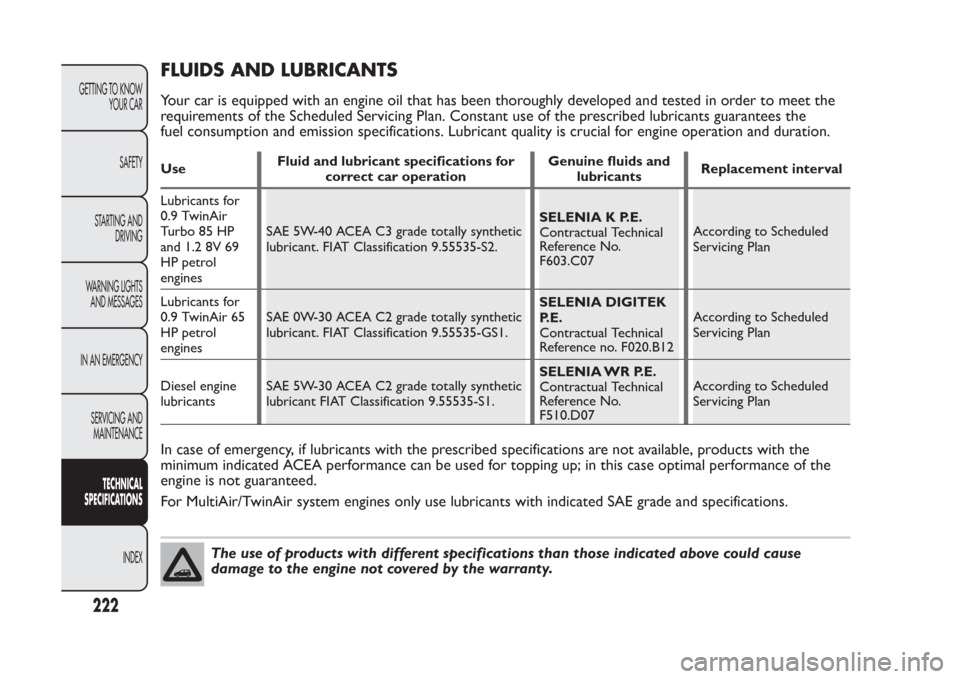
FLUIDS AND LUBRICANTSYour car is equipped with an engine oil that has been thoroughly developed and tested in order to meet the
requirements of the Scheduled Servicing Plan. Constant use of the prescribed lubricants guarantees the
fuel consumption and emission specifications. Lubricant quality is crucial for engine operation and duration.UseFluid and lubricant specifications for
correct car operationGenuine fluids and
lubricantsReplacement interval
Lubricants for
0.9 TwinAir
Turbo 85 HP
and 1.2 8V 69
HP petrol
enginesSAE 5W-40 ACEA C3 grade totally synthetic
lubricant. FIAT Classification 9.55535-S2.SELENIA K P.E.
Contractual Technical
Reference No.
F603.C07According to Scheduled
Servicing Plan
Lubricants for
0.9 TwinAir 65
HP petrol
enginesSAE 0W-30 ACEA C2 grade totally synthetic
lubricant. FIAT Classification 9.55535-GS1.SELENIA DIGITEK
P.E.
Contractual Technical
Reference no. F020.B12According to Scheduled
Servicing Plan
Diesel engine
lubricantsSAE 5W-30 ACEA C2 grade totally synthetic
lubricant FIAT Classification 9.55535-S1.SELENIA WR P.E.
Contractual Technical
Reference No.
F510.D07According to Scheduled
Servicing PlanIn case of emergency, if lubricants with the prescribed specifications are not available, products with the
minimum indicated ACEA performance can be used for topping up; in this case optimal performance of the
engine is not guaranteed.
For MultiAir/TwinAir system engines only use lubricants with indicated SAE grade and specifications.
The use of products with different specifications than those indicated above could cause
damage to the engine not covered by the warranty.
222
GETTING TO KNOW
YOUR CAR
SAFETY
STARTING AND
DRIVING
WARNING LIGHTS
AND MESSAGES
IN AN EMERGENCY
SERVICING AND
MAINTENANCE
TECHNICAL
SPECIFICATIONS
INDEX


