2014 FIAT PANDA Esc
[x] Cancel search: EscPage 78 of 284

ESC SYSTEM (Electronic Stability
Control)(for versions/markets, where provided)
This is an electronic system that controls car stability
in the event of tyre grip loss, helping maintain
directional control. The system is capable of
recognising potentially dangerous situations in terms
of the stability and intervenes automatically on the
brakes in a differentiated manner for the four wheels
in order to provide a stabilizing torque.
The ESC system also includes the following
subsystems:
❒Hill Holder
❒ASR
❒HBA
❒ABS
❒EBD
SYSTEM INTERVENTION
It is signalled by the flashing of theESCwarning light
on the instrument panel, to inform the driver that
the car is in critical stability and grip conditions.
SYSTEM ACTIVATION
The ESC system switches on automatically when the
engine is started and cannot be switched off.HILL HOLDER SYSTEM
This system is an integral part of the ESC system and
facilitates starting on slopes.
It is activated automatically in the following instances:
❒uphill: car stationary on a road with a gradient
higher than 5%, engine running, brake pressed and
gearbox in neutral or gear (other than reverse)
engaged;
❒downhill: car stationary on a road with a gradient
higher than 5%, engine running, brake pressed and
reverse gear engaged.
When setting off, the ESC system control unit
maintains braking pressure on the wheels until the
torque required for starting is reached or, in any
case, for a maximum of 2 seconds so that the right
foot can be moved easily from the brake pedal to the
accelerator pedal.
When 2 seconds have elapsed, without any
departure having taken place, the system is
automatically deactivated, gradually releasing the
braking pressure. During this release stage, a typical
mechanical brake release noise can be heard,
indicating that the car is about to move.
NOTE: the Hill Holder system is not active with
engaged parking brake.
74GETTING TO
KNOW YOUR CAR
SAFETY
STARTING AND
DRIVING
WARNING LIGHTS
AND MESSAGES
IN AN EMERGENCY
SERVICING AND
MAINTENANCE
TECHNICAL
SPECIFICATIONS
INDEX
Page 79 of 284

IMPORTANT The Hill Holder system is not a parking
brake; therefore, never leave the vehicle without
having engaged the handbrake, turned the engine off
and engaged the first gear, so that the parked vehicle
is in safe conditions (further read the paragraph
"When parked" in the chapter "Starting and driving").
ASR SYSTEM (AntiSlip Regulation)
It is an integral part of the ESC system. It
automatically operates in the event of drive wheels
slipping, loss of grip on wet roads (aquaplaning)
and acceleration on slippery, snowy or icy roads,
etc…
Depending on the slipping conditions, two different
control systems are activated:
❒if the slipping involves both drive wheels, the ASR
intervenes reducing the power transmitted by the
engine;
❒if the slipping only involves one of the drive
wheels, it intervenes automatically braking the
wheel that is slipping.Activation/deactivation of the ASR system
The ASR system activates automatically each time
the engine is started.
Whilst driving, the ASR can be switched off and
subsequently switched on again by pressing the ASR
OFF button fig. 67.
fig. 67
F0W0040
75GETTING TO
KNOW YOUR CARSAFETY
STARTING AND
DRIVING
WARNING LIGHTS
AND MESSAGES
IN AN EMERGENCY
SERVICING AND
MAINTENANCE
TECHNICAL
SPECIFICATIONS
INDEX
Page 80 of 284
On some versions, the intervention of the system is
indicated by a message shown on the display. When
the system is not active, the LED on the button ASR
OFF turns on and, on some versions, a message
appears on the display.
When the ASR is deactivated whilst driving, the next
time the car is started the ASR is automatically
activated.
When travelling on snowy roads with snow chains, it
may be helpful to turn the ASR off: in fact, in these
conditions, slipping of the drive wheels when moving
off makes it possible to obtain better traction.
WARNING
For the correct operation of the ESC
and ASR systems it is vital that the tyres
are the same make and the same type on all
the wheels, in perfect condition and, above all,
the recommended type, make and size.
WARNING
The ESC functions even when the
space-saver wheel is being used. Always
remember that the space-saver wheel, being
smaller than the original wheel, provides less
grip.
WARNING
Do not take unnecessary risks, even if
your vehicle is fitted with the ESC and
ASR systems.Your driving style must always be
suited to the road conditions, visibility and
traffic .The driver is always responsible for road
safety.
76GETTING TO
KNOW YOUR CAR
SAFETY
STARTING AND
DRIVING
WARNING LIGHTS
AND MESSAGES
IN AN EMERGENCY
SERVICING AND
MAINTENANCE
TECHNICAL
SPECIFICATIONS
INDEX
Page 82 of 284

TRACTION PLUS SYSTEM(for versions/markets, where provided)
Traction Plus is a driving aid, useful for setting off in
poor grip conditions (snow, ice, mud, etc.) which
allows the drive force to be distributed in the best
way over the front axle when one wheel is slipping.
In effect, Traction Plus acts by braking the wheels
with poor grip (or those slipping more than the
others), thereby transferring the drive force to those
which have more grip on the ground.
This function can be activated manually by pressing
the button T+ close to the gear lever fig. 68 and
operates under 30 km/h. When this speed is
exceeded, it is automatically deactivated (the LED on
the button is still on) and it is reactivated again
when the speed is below 30 km/h.Traction Plus operation
The system is deactivated when starting. To activate
the Traction Plus system, press the T+ button fig. 68:
the LED on the button switches on; the display
shows a dedicated message.
The activation of the Traction Plus system causes the
differential locking effect on the front axle, through
the braking system, to improve traction on irregular
grounds.
If the Traction Plus system is faulty, theESCwarning
light on the instrument panel switches on
constantly.
fig. 68
F0W0309
78GETTING TO
KNOW YOUR CAR
SAFETY
STARTING AND
DRIVING
WARNING LIGHTS
AND MESSAGES
IN AN EMERGENCY
SERVICING AND
MAINTENANCE
TECHNICAL
SPECIFICATIONS
INDEX
Page 87 of 284
CITY BRAKE CONTROL - "Collision
Mitigation" SYSTEM(for versions/markets, where provided)
This is a driving assistance system that can detect the
presence of nearby cars in front of the vehicle and,
in case of imminent collision, intervenes
automatically, braking the car to prevent the impact
or mitigate its effects.
The system only works if:
❒the ignition key is at MAR-ON;
❒the car speed is between 5 and 30 km/h;
❒the front seat belts are fastened.
The system can be deactivated (and then reactivated)
with the display setup menu (see paragraph “Menu
items” in this chapter).
The system activates if there is risk of imminent
collision and the driver does not press the brake
pedal promptly.
If the system detects that the vehicle ahead could be
hit, it may prepare the car to a possible emergency
braking.
If the driver does not carry out any action to prevent
the collision, the system may automatically slow
down the car, in order to prepare it to a possible
impact.When there is risk of impact, if the action on the
brake pedal by the driver is not sufficient, the system
may intervene in order to improve the reaction of
the braking system, therefore reducing car speed
further.
When driving uphill on a steep slope, the system may
intervene, activating the braking system.
Versions equipped with Start&Stop system:at
the end of the automatic braking, the Start&Stop
system will activate as described in paragraph
"Start&Stop system" of this chapter.
Versions equipped with manual gearbox:atthe
end of the automatic braking the engine may stall
and turn off, unless the driver presses the clutch
pedal.
Versions equipped with Dualogic automatic
transmission(for versions/markets, where
provided): at the end of braking the last gear stored
remains engaged.
IMPORTANT Both on versions equipped with
manual gearbox and on those with Dualogic
automatic transmission (for versions/markets, where
provided), after the car is stopped the brake calipers
may be stuck for about 2 seconds for safety reasons.
Make sure you press the brake pedal if the car moves
slightly forwards.
IMPORTANT The system doesNOTactivate
engaging the reverse. The system doesNOTactivate
if the front seat belts are not fastened.
83GETTING TO
KNOW YOUR CARSAFETY
STARTING AND
DRIVING
WARNING LIGHTS
AND MESSAGES
IN AN EMERGENCY
SERVICING AND
MAINTENANCE
TECHNICAL
SPECIFICATIONS
INDEX
Page 93 of 284

For correct operation, sensors must always
be clean from mud, dirt , snow or ice. Be
careful not to scratch or damage the
sensors while cleaning them. Avoid using dr y,
rough or hard cloths.The sensors should be
washed using clean water with the addition of car
shampoo if necessary.When using special
washing equipment such as high pressure jets or
steam cleaning, clean the sensors very quickly
keeping the jet more than 10 cm away.
GENERAL WARNINGS
❒When parking, take the utmost care over
obstacles that may be above or under the sensors.
❒Objects close to the car, are not detected under
certain circumstances and could therefore cause
damage to the car or be damaged.
Some of the conditions that could affect the
performance of the parking system are described
below:
❒Reduced sensor sensitivity and a reduction in the
parking assistance system performance could be
due to the presence on the surface of the sensor
of: ice, snow, mud, thick paint
❒The sensor may detect a non-existent obstacle
(echo interference) due to mechanical
interference, for example when washing the
vehicle, in rain, (strong wind), hail.❒The signals sent by the sensors can also be altered
by the presence of ultrasonic systems (e.g.
pneumatic brake systems or pneumatic drills) near
the vehicle.
❒Parking assistance system performance can also be
influenced by the position of the sensors, for
example due to a change in the ride setting
(caused by wear to the shock absorbers,
suspension), or by changing tyres, overloading the
car or carrying out specific tuning operations
that require the car to be lowered.
❒The presence of a tow hook without trailer
interferes with the correct operation of the
parking sensors. If a fixed tow hook is installed, the
sensors cannot be used. If the customer installs a
removable tow hook, this must always be
disconnected from the crossmember whenever
the trailer is not attached to prevent the activation
of the sensors.
WARNING
The responsibility for parking and other
dangerous manoeuvres always and in
every case lies with the driver.When making
these manoeuvres, always make sure that no
people (especially children) or animals are
present in your manoeuvering space.The parking
sensors serve to assist the driver, but must never
allow his attention to lapse during potentially
dangerous manoeuvres, even those executed at
low speeds.
89GETTING TO
KNOW YOUR CARSAFETY
STARTING AND
DRIVING
WARNING LIGHTS
AND MESSAGES
IN AN EMERGENCY
SERVICING AND
MAINTENANCE
TECHNICAL
SPECIFICATIONS
INDEX
Page 99 of 284
In order to avoid these problems, different types of
diesel fuel are distributed according to the season:
summer type, winter type and arctic type
(cold/mountain areas). If refuelling with diesel fuel
whose specifications are not suitable for the current
temperature, it is advisable to mix TUTELA DIESEL
ART additive in the proportions shown on the
container with the fuel. Pour the additive into the
tank before the diesel fuel.
When using or parking the car for a long time in the
mountains or cold areas, it is advisable to refuel
using locally available diesel. In this case, it is also
advisable to keep the tank over 50% full.
For diesel engines, only use diesel fuel for
motor vehicles in accordance with EN590
European specifications.The use of other
products or mixtures may damage the engine
beyond repair and consequently invalidate the
warranty, due to the damage caused. If you
accidentally refuel with another type of fuel, do
not start the engine, and drain the tank. If the
engine has been run, even for only a very short
time, you will need to have the entire fuel system
emptied in addition to the tank.
FILLING THE TANK
To fill the tank completely, top up twice after the
first click of the fuel delivery gun. Further top-ups
could cause faults in the fuel supply system.REFUELLING PROCEDURE FOR VERSIONS
EQUIPPED WITH "SMART FUEL" SYSTEM
"Smart Fuel" is a device integrated with the end of
the fuel filler pipe which opens and recloses
automatically when the fuel delivery gun is
introduced/removed. "Smart Fuel" is provided with
an inhibiter which prevents refuelling with incorrect
fuel.
The refuelling procedure described below is
illustrated on label B fig. 82, which is applied inside
the fuel flap. The label also indicates the fuel type
(UNLEADED FUEL=petrol, DIESEL=diesel fuel).
To refuel proceed as follows:
❒open the flap A fig. 82 pulling it outwards;
❒introduce the dispenser in the filler and refuel;
❒at the end of refuelling, before removing the
dispenser, wait for at least 10 seconds in order for
the fuel to flow inside the tank;
❒then remove the dispenser from the filler and
close flap A.
Flap A fig. 82 is provided with a dust cowl C which
prevents deposits of impurities and dust at the
end of the filler when the flap is closed.
Emergency refuelling (only for versions
equipped with "Smart Fuel")
If there is no fuel in the car or the supply circuit is
completely empty, proceed as follows to reintroduce
fuel to the tank:
95GETTING TO
KNOW YOUR CARSAFETY
STARTING AND
DRIVING
WARNING LIGHTS
AND MESSAGES
IN AN EMERGENCY
SERVICING AND
MAINTENANCE
TECHNICAL
SPECIFICATIONS
INDEX
Page 106 of 284
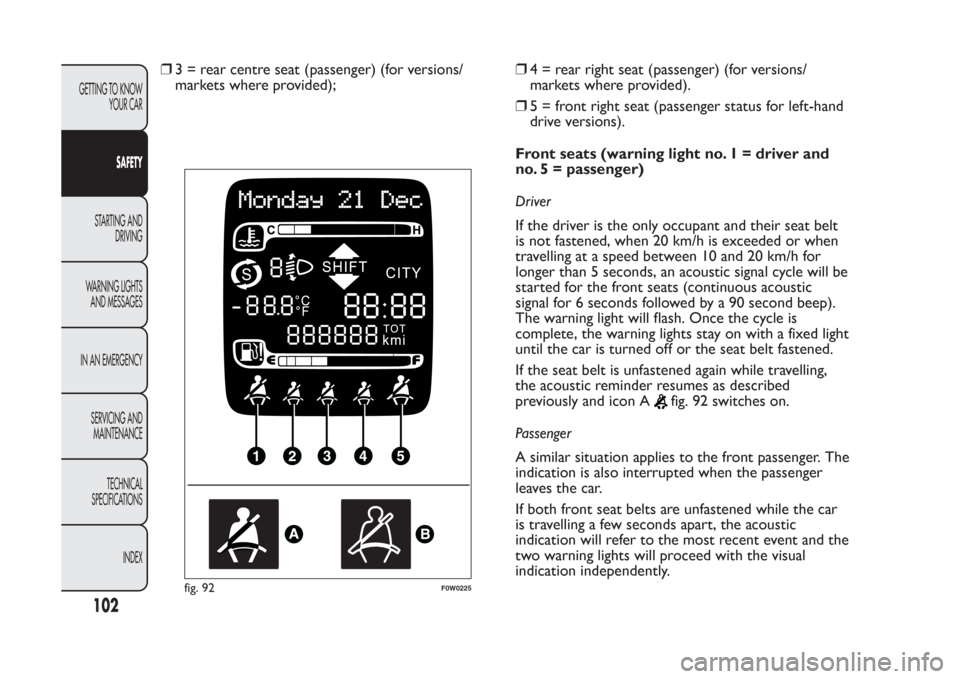
❒3 = rear centre seat (passenger) (for versions/
markets where provided);❒4 = rear right seat (passenger) (for versions/
markets where provided).
❒5 = front right seat (passenger status for left-hand
drive versions).
Front seats (warning light no. 1 = driver and
no. 5 = passenger)
Driver
If the driver is the only occupant and their seat belt
is not fastened, when 20 km/h is exceeded or when
travelling at a speed between 10 and 20 km/h for
longer than 5 seconds, an acoustic signal cycle will be
started for the front seats (continuous acoustic
signal for 6 seconds followed by a 90 second beep).
The warning light will flash. Once the cycle is
complete, the warning lights stay on with a fixed light
until the car is turned off or the seat belt fastened.
If the seat belt is unfastened again while travelling,
the acoustic reminder resumes as described
previously and icon A
fig. 92 switches on.
Passenger
A similar situation applies to the front passenger. The
indication is also interrupted when the passenger
leaves the car.
If both front seat belts are unfastened while the car
is travelling a few seconds apart, the acoustic
indication will refer to the most recent event and the
two warning lights will proceed with the visual
indication independently.
fig. 92
F0W0225
102
GETTING TO KNOW
YOUR CAR
SAFETY
STARTING AND
DRIVING
WARNING LIGHTS
AND MESSAGES
IN AN EMERGENCY
SERVICING AND
MAINTENANCE
TECHNICAL
SPECIFICATIONS
INDEX