Page 145 of 476
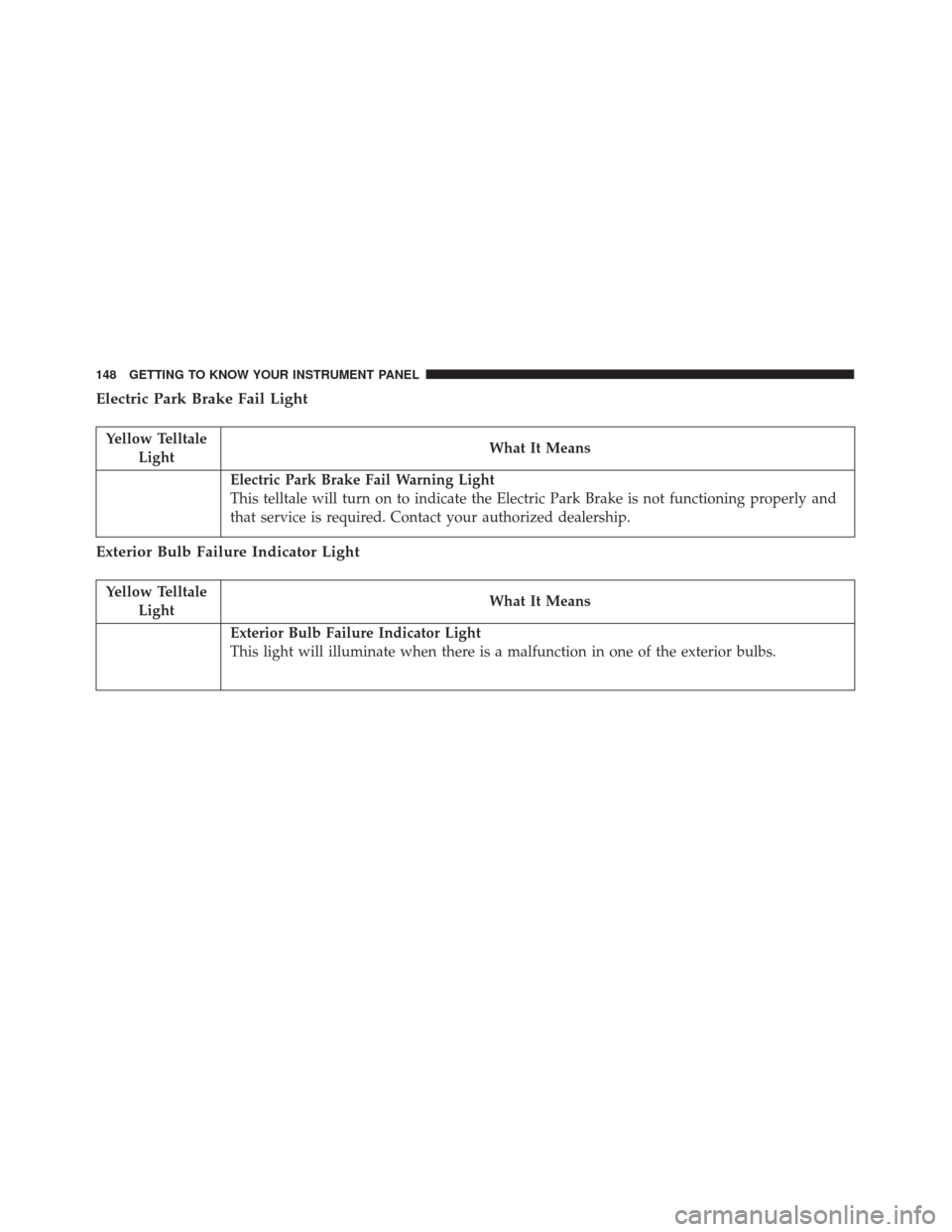
Transmission Temperature Indicator Light
Yellow TelltaleLight What It Means
Transmission Temperature Indicator Light
This light indicates that the transmission fluid temperature is running hot. This may occur
with severe usage, such as trailer towing. If this light turns on, safely pull over and stop the
vehicle. Then, shift the transmission into NEUTRAL and run the engine at idle or faster un-
til the light turns off.
WARNING!
If you continue operating the vehicle when the
Transmission Temperature Warning Light is illumi-
nated you could cause the fluid to boil over, come in
contact with hot engine or exhaust components and
cause a fire.
CAUTION!
Continuous driving with the Transmission Tem-
perature Warning Light illuminated will eventually
cause severe transmission damage or transmission
failure.
5
GETTING TO KNOW YOUR INSTRUMENT PANEL 143
Page 146 of 476
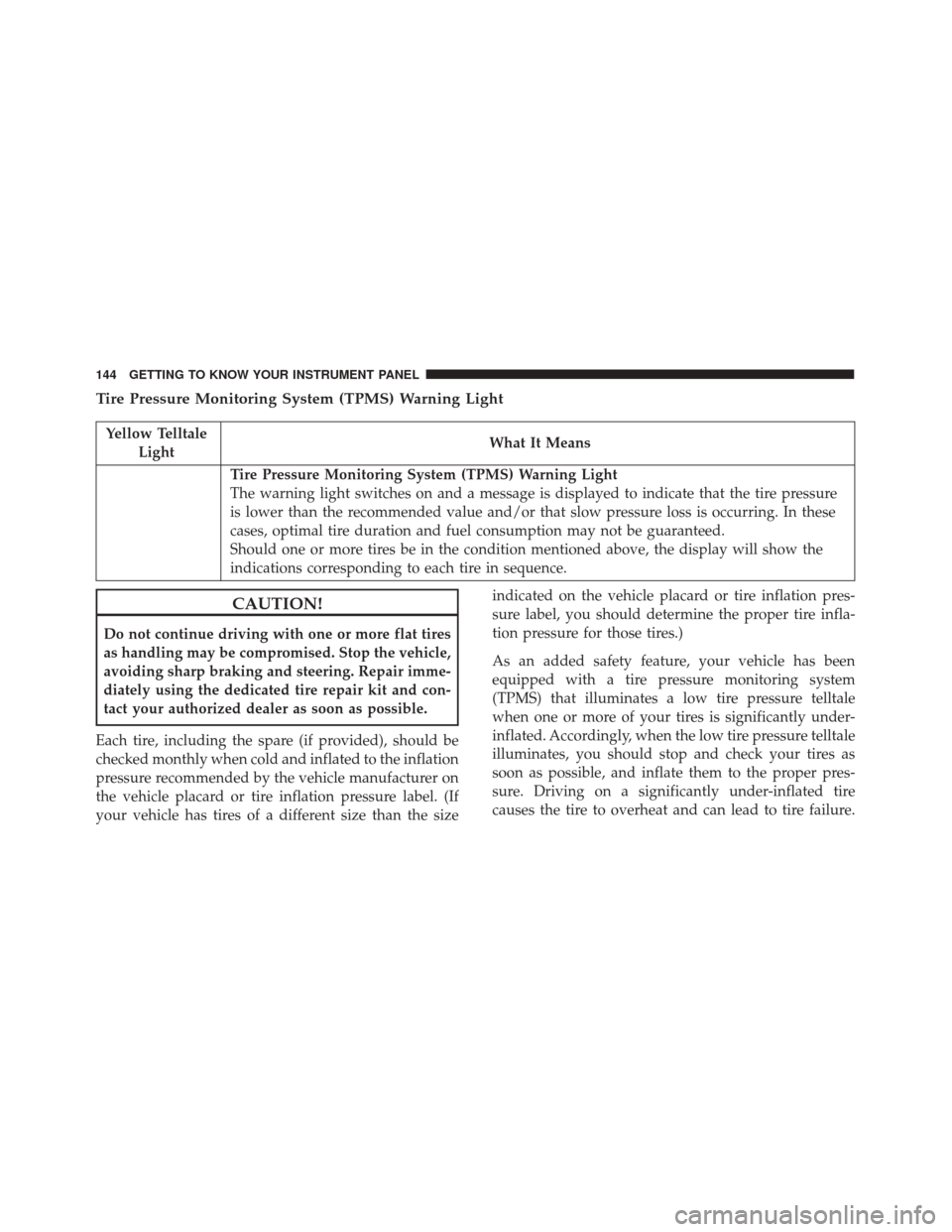
Tire Pressure Monitoring System (TPMS) Warning Light
Yellow TelltaleLight What It Means
Tire Pressure Monitoring System (TPMS) Warning Light
The warning light switches on and a message is displayed to indicate that the tire pressure
is lower than the recommended value and/or that slow pressure loss is occurring. In these
cases, optimal tire duration and fuel consumption may not be guaranteed.
Should one or more tires be in the condition mentioned above, the display will show the
indications corresponding to each tire in sequence.
CAUTION!
Do not continue driving with one or more flat tires
as handling may be compromised. Stop the vehicle,
avoiding sharp braking and steering. Repair imme-
diately using the dedicated tire repair kit and con-
tact your authorized dealer as soon as possible.
Each tire, including the spare (if provided), should be
checked monthly when cold and inflated to the inflation
pressure recommended by the vehicle manufacturer on
the vehicle placard or tire inflation pressure label. (If
your vehicle has tires of a different size than the size indicated on the vehicle placard or tire inflation pres-
sure label, you should determine the proper tire infla-
tion pressure for those tires.)
As an added safety feature, your vehicle has been
equipped with a tire pressure monitoring system
(TPMS) that illuminates a low tire pressure telltale
when one or more of your tires is significantly under-
inflated. Accordingly, when the low tire pressure telltale
illuminates, you should stop and check your tires as
soon as possible, and inflate them to the proper pres-
sure. Driving on a significantly under-inflated tire
causes the tire to overheat and can lead to tire failure.
144 GETTING TO KNOW YOUR INSTRUMENT PANEL
Page 148 of 476
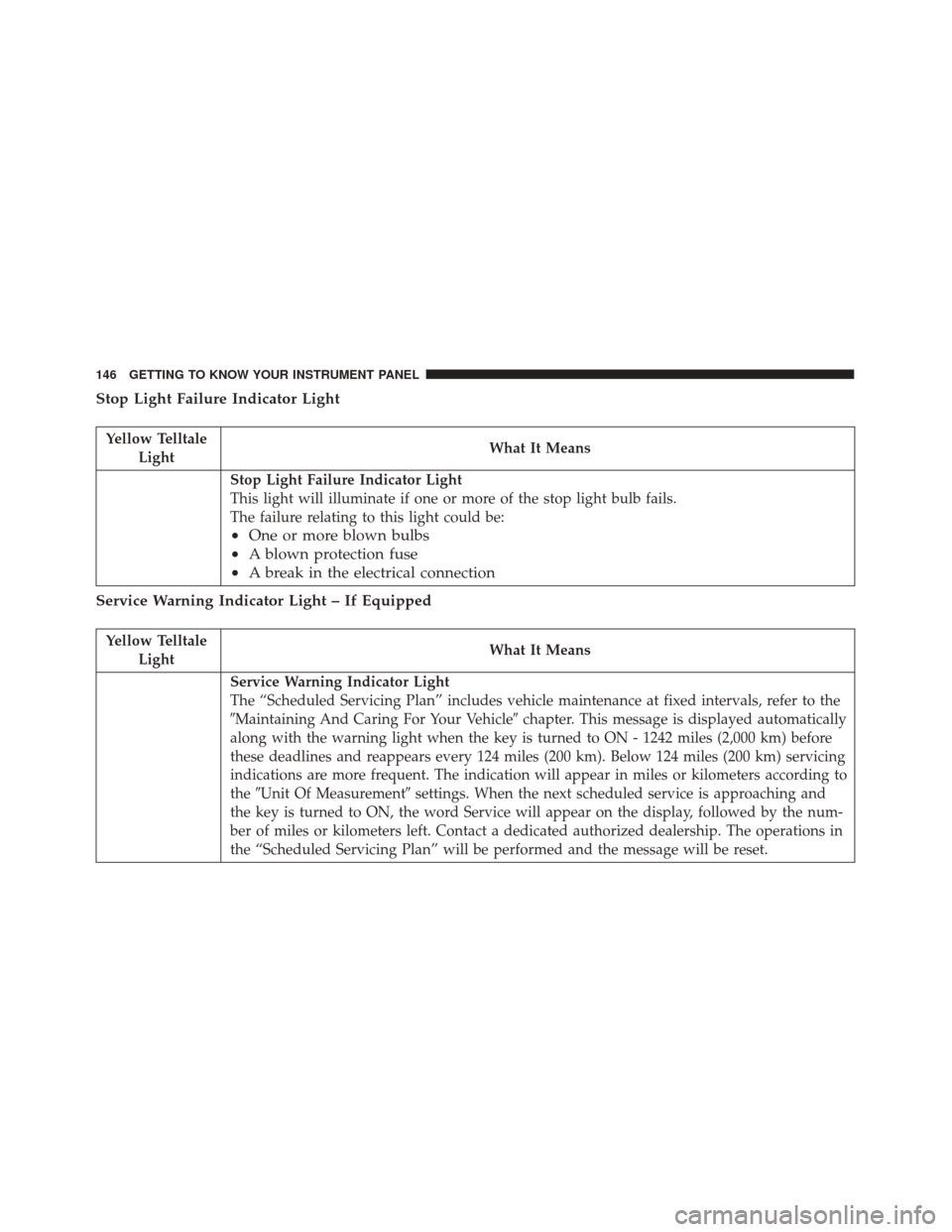
Stop Light Failure Indicator Light
Yellow TelltaleLight What It Means
Stop Light Failure Indicator Light
This light will illuminate if one or more of the stop light bulb fails.
The failure relating to this light could be:
•
One or more blown bulbs
• A blown protection fuse
• A break in the electrical connection
Service Warning Indicator Light – If Equipped
Yellow Telltale Light What It Means
Service Warning Indicator Light
The “Scheduled Servicing Plan” includes vehicle maintenance at fixed intervals, refer to the
�Maintaining And Caring For Your Vehicle�
chapter. This message is displayed automatically
along with the warning light when the key is turned to ON - 1242 miles (2,000 km) before
these deadlines and reappears every 124 miles (200 km). Below 124 miles (200 km) servicing
indications are more frequent. The indication will appear in miles or kilometers according to
the �Unit Of Measurement� settings. When the next scheduled service is approaching and
the key is turned to ON, the word Service will appear on the display, followed by the num-
ber of miles or kilometers left. Contact a dedicated authorized dealership. The operations in
the “Scheduled Servicing Plan” will be performed and the message will be reset.
146 GETTING TO KNOW YOUR INSTRUMENT PANEL
Page 149 of 476
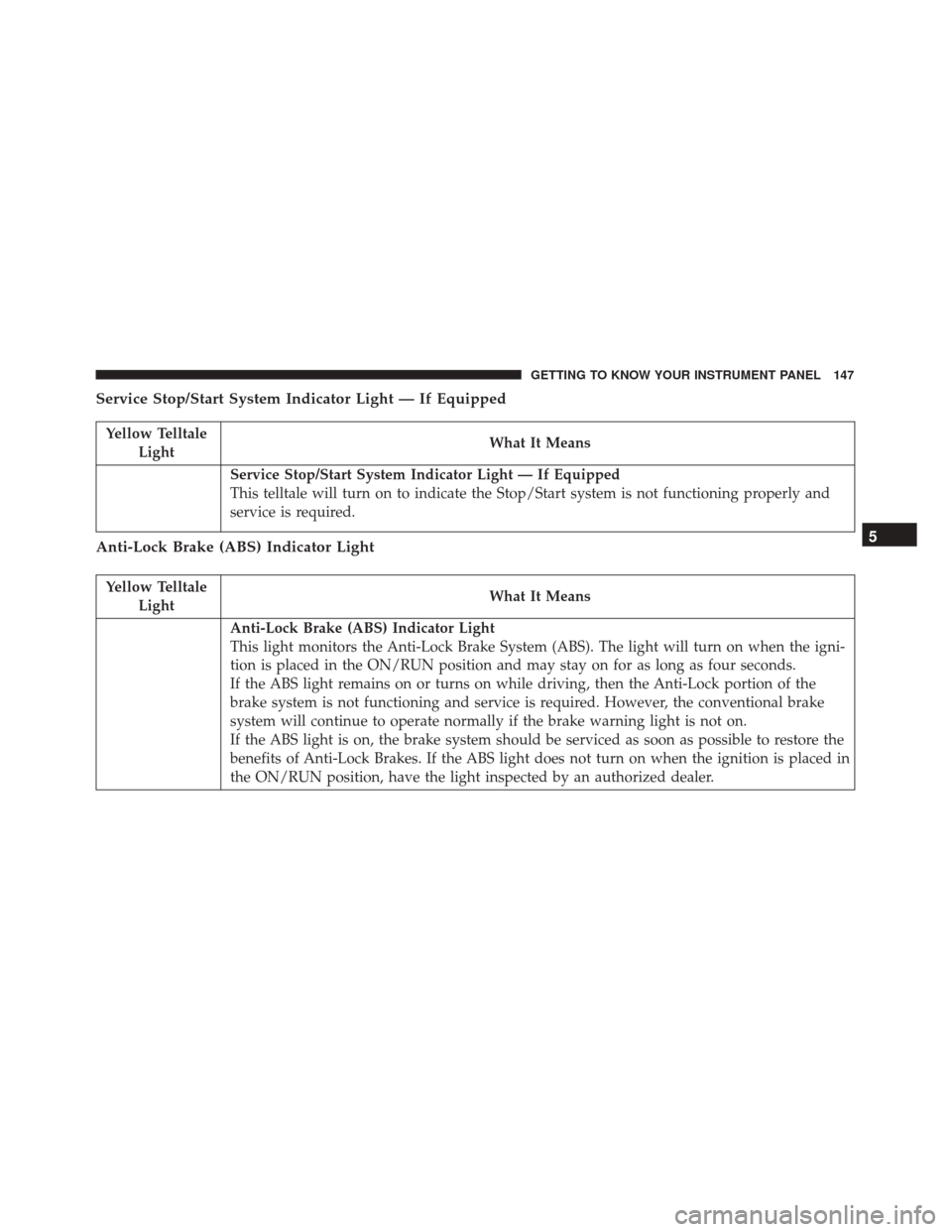
Service Stop/Start System Indicator Light — If Equipped
Yellow TelltaleLight What It Means
Service Stop/Start System Indicator Light — If Equipped
This telltale will turn on to indicate the Stop/Start system is not functioning properly and
service is required.
Anti-Lock Brake (ABS) Indicator Light
Yellow Telltale
Light What It Means
Anti-Lock Brake (ABS) Indicator Light
This light monitors the Anti-Lock Brake System (ABS). The light will turn on when the igni-
tion is placed in the ON/RUN position and may stay on for as long as four seconds.
If the ABS light remains on or turns on while driving, then the Anti-Lock portion of the
brake system is not functioning and service is required. However, the conventional brake
system will continue to operate normally if the brake warning light is not on.
If the ABS light is on, the brake system should be serviced as soon as possible to restore the
benefits of Anti-Lock Brakes. If the ABS light does not turn on when the ignition is placed in
the ON/RUN position, have the light inspected by an authorized dealer.
5
GETTING TO KNOW YOUR INSTRUMENT PANEL 147
Page 150 of 476
Electric Park Brake Fail Light
Yellow TelltaleLight What It Means
Electric Park Brake Fail Warning Light
This telltale will turn on to indicate the Electric Park Brake is not functioning properly and
that service is required. Contact your authorized dealership.
Exterior Bulb Failure Indicator Light
Yellow Telltale
Light What It Means
Exterior Bulb Failure Indicator Light
This light will illuminate when there is a malfunction in one of the exterior bulbs.
148 GETTING TO KNOW YOUR INSTRUMENT PANEL
Page 155 of 476
SAFETY
CONTENTS
�BRAKE SYSTEM ..................... .154
� ELECTRONIC BRAKE CONTROL SYSTEM . . .154
▫ Electronic Brake Force Distribution (EBD) . . .155
▫ Brake System Warning Light .............155
▫ Anti-Lock Brake System (ABS) ...........155
▫ Anti-Lock Brake Warning Light ...........156
▫ Brake Assist System (BAS) ..............157
▫ Hill Start Assist (HSA) ................157
▫ Traction Control System (TCS) ...........159
▫ Electronic Stability Control (ESC) .........159
▫ Electronic Roll Mitigation (ERM) .........161
▫ Dynamic Steering Torque (DST) ..........161
� OCCUPANT RESTRAINT SYSTEMS ........162▫
Occupant Restraint Systems Features ......162
▫ Important Safety Precautions ............162
▫ Seat Belt Systems ....................163
▫ Supplemental Restraint Systems (SRS) ......174
▫ Child Restraints .....................188
▫ Transporting Pets ....................205
� SAFETY TIPS ....................... .205
▫ Transporting Passengers ................205
▫ Exhaust Gas ....................... .206
▫ Safety Checks You Should Make Inside The
Vehicle .......................... .207
▫ Periodic Safety Checks You Should Make
Outside The Vehicle ..................209
6
Page 156 of 476

BRAKE SYSTEM
Your vehicle is equipped with dual hydraulic brake
systems. If either of the two hydraulic systems loses
normal capability, the remaining system will still func-
tion. However, there will be some loss of overall brak-
ing effectiveness. This will be evident by increased
pedal travel during application and greater pedal force
required to slow or stop the vehicle. In addition, if the
malfunction is caused by a leak in the hydraulic system,
the “Brake Warning Light” will turn on as the brake
fluid level drops in the master cylinder.
In the event power assist is lost for any reason (i.e.,
repeated brake applications with the engine OFF) the
brakes will still function. However, the effort required
to brake the vehicle will be much greater than that
required with the power system operating.
WARNING!
•Riding the brakes can lead to brake failure and
possibly a collision. Driving with your foot rest-
ing or riding on the brake pedal can result in
abnormally high brake temperatures, excessive
(Continued)
WARNING! (Continued)
lining wear, and possible brake damage. You
would not have your full braking capacity in an
emergency.
• Driving a vehicle with the “Brake Warning Light”
on is dangerous. A significant decrease in braking
performance or vehicle stability during braking
may occur. It will take you longer to stop the
vehicle or will make your vehicle harder to con-
trol. You could have a collision. Have the vehicle
checked immediately.
ELECTRONIC BRAKE CONTROL SYSTEM
Your vehicle is equipped with an advanced Electronic
Brake Control system (EBC). This system includes Elec-
tronic Brake Force Distribution (EBD), Anti-Lock Brake
System (ABS), Brake Assist System (BAS), Hill Start
Assist (HSA), Traction Control System (TCS), Electronic
Stability Control (ESC), Dynamic Steering Torque (DST)
and Electronic Roll Mitigation (ERM). These systems
work together to enhance both vehicle stability and
control in various driving conditions.
154 SAFETY
Page 157 of 476
Electronic Brake Force Distribution (EBD)
This function manages the distribution of the braking
torque between the front and rear axles by limiting
braking pressure to the rear axle. This is done to prevent
overslip of the rear wheels to avoid vehicle instability,
and to prevent the rear axle from entering ABS before
the front axle.
Brake System Warning Light
The red “Brake System Warning Light” will turn on
when the ignition switch is turned to the ON position
and may stay on for as long as four seconds.
If the “Brake System Warning Light” remains on or
comes on while driving, it indicates that the brake
system is not functioning properly and that immediate
service is required. If the “Brake System Warning Light”
does not come on when the ignition switch is turned to
the ON position, have the light repaired as soon as
possible.
Anti-Lock Brake System (ABS)
The Anti-Lock Brake System (ABS) provides increased
vehicle stability and brake performance under mostbraking conditions. The system automatically prevents
wheel lock, and enhances vehicle control during brak-
ing.
The ABS performs a self-check cycle to ensure that the
ABS is working properly each time the vehicle is started
and driven. During this self-check, you may hear a
slight clicking sound as well as some related motor
noises.
ABS is activated during braking when the system
detects one or more wheels begins to lock. Road condi-
tions such as ice, snow, gravel, bumps, railroad tracks,
loose debris, or panic stops may increase the likelihood
of ABS activation(s).
You also may experience the following when ABS
activates:
•
The ABS motor noise (it may continue to run for a
short time after the stop).
• The clicking sound of solenoid valves.
• Brake pedal pulsations.
•A slight drop of the brake pedal at the end of the stop.
These are all normal characteristics of ABS.
6
SAFETY 155