2014 FIAT 500X seats
[x] Cancel search: seatsPage 202 of 476
5. Tighten all of the straps as you push the childrestraint rearward and downward into the seat.
Remove slack in the straps according to the child
restraint manufacturer ’s instructions.
6. Test that the child restraint is installed tightly by pulling back and forth on the child seat at the belt
path. It should not move more than 1 inch (25.4 mm)
in any direction.
How To Stow An Unused Switchable-ALR (ALR)
Seat Belt
When using the LATCH attaching system to install a
child restraint, stow all ALR seat belts that are not being
used by other occupants or being used to secure child
restraints. An unused belt could injure a child if they
play with it and accidentally lock the seat belt retractor.
Before installing a child restraint using the LATCH
system, buckle the seat belt behind the child restraint
and out of the child’s reach. If the buckled seat belt
interferes with the child restraint installation, instead of
buckling it behind the child restraint, route the seat belt
through the child restraint belt path and then buckle it.
Do not lock the seat belt. Remind all children in the vehicle that the seat belts are not toys and that they
should not play with them.
WARNING!
•
Improper installation of a child restraint to the
LATCH anchorages can lead to failure of the
restraint. The child could be badly injured or
killed. Follow the child restraint manufacturer ’s
directions exactly when installing an infant or
child restraint.
• Child restraint anchorages are designed to with-
stand only those loads imposed by correctly-fitted
child restraints. Under no circumstances are they
to be used for adult seat belts, harnesses, or for
attaching other items or equipment to the vehicle.
Installing Child Restraints Using The Vehicle
Seat Belt
Child restraint systems are designed to be secured in
vehicle seats by lap belts or the lap belt portion of a
lap/shoulder belt.
200 SAFETY
Page 204 of 476
Frequently Asked Questions About Installing Child Restraints With Seat Belts
What is the weight limit (child’s weight + weight of the child re-
straint) for using the Tether Anchor with the seat belt to attach a for- ward facing child restraint? Weight limit of the Child Restraint Always use the tether anchor when
using the seat belt to install a for-ward facing child restraint, up to
the recommended weight limit of the child restraint.
Can the rear-facing child restraint
touch the back of the front passen- ger seat? Yes
Contact between the front passen-
ger seat and the child restraint is allowed, if the child restraint
manufacturer also allows contact.
Can the head restraints be re- moved? Yes
The head restraints can be removed
in every rear seating position.
Can the buckle stalk be twisted to
tighten the seat belt against the belt path of the child restraint? No
Do not twist the buckle stalk in a
seating position with an ALR re- tractor.
Installing A Child Restraint With A Switchable
Automatic Locking Retractor (ALR):
Child restraint systems are designed to be secured in
vehicle seats by lap belts or the lap belt portion of a
lap/shoulder belt.
WARNING!
•Improper installation or failure to properly secure
a child restraint can lead to failure of the restraint.
The child could be badly injured or killed.
• Follow the child restraint manufacturer ’s direc-
tions exactly when installing an infant or child
restraint.
202 SAFETY
Page 205 of 476
1. Place the child seat in the center of the seatingposition. For some second row seats, you may need
to recline the seat and/or raise the head restraint to
get a better fit. If the rear seat can be moved forward
and rearward in the vehicle, you may wish to move
it to its rear-most position to make room for the child
seat. You may also move the front seat forward to
allow more room for the child seat.
2. Pull enough of the seat belt webbing from the retractor to pass it through the belt path of the child
restraint. Do not twist the belt webbing in the belt
path.
3. Slide the latch plate into the buckle until you hear a “click.”
4. Pull on the webbing to make the lap portion tight against the child seat.
5. To lock the seat belt, pull down on the shoulder part of the belt until you have pulled all the seat belt
webbing out of the retractor. Then, allow the web-
bing to retract back into the retractor. As the webbing
retracts, you will hear a clicking sound. This means
the seat belt is now in the Automatic Locking mode. 6. Try to pull the webbing out of the retractor. If it is
locked, you should not be able to pull out any
webbing. If the retractor is not locked, repeat step 5.
7. Finally, pull up on any excess webbing to tighten the lap portion around the child restraint while you push
the child restraint rearward and downward into the
vehicle seat.
8. If the child restraint has a top tether strap and the seating position has a top tether anchorage, connect
the tether strap to the anchorage and tighten the
tether strap. See the section “Installing Child Re-
straints Using the Top Tether Anchorage” for direc-
tions to attach a tether anchor.
9. Test that the child restraint is installed tightly by pulling back and forth on the child seat at the belt
path. It should not move more than 1 inch (25.4 mm)
in any direction.
Any seat belt system will loosen with time, so check the
belt occasionally, and pull it tight if necessary.
6
SAFETY 203
Page 208 of 476
WARNING!
•Do not leave children or animals inside parked
vehicles in hot weather. Interior heat build-up
may cause serious injury or death.
• It is extremely dangerous to ride in a cargo area,
inside or outside of a vehicle. In a collision,
people riding in these areas are more likely to be
seriously injured or killed.
• Do not allow people to ride in any area of your
vehicle that is not equipped with seats and seat
belts.
• Be sure everyone in your vehicle is in a seat and
using a seat belt properly.
Exhaust Gas
WARNING!
Exhaust gases can injure or kill. They contain
carbon monoxide (CO), which is colorless and odor-
less. Breathing it can make you unconscious and
can eventually poison you. To avoid breathing
(CO), follow these safety tips:
(Continued)
WARNING! (Continued)
•Do not run the engine in a closed garage or in
confined areas any longer than needed to move
your vehicle in or out of the area.
• If you are required to drive with the trunk/
liftgate/rear doors open, make sure that all win-
dows are closed and the climate control BLOWER
switch is set at high speed. DO NOT use the
recirculation mode.
• If it is necessary to sit in a parked vehicle with the
engine running, adjust your heating or cooling
controls to force outside air into the vehicle. Set
the blower at high speed.
The best protection against carbon monoxide entry into
the vehicle body is a properly maintained engine ex-
haust system.
Whenever a change is noticed in the sound of the
exhaust system, when exhaust fumes can be detected
inside the vehicle, or when the underside or rear of the
vehicle is damaged, have a competent mechanic inspect
the complete exhaust system and adjacent body areas
for broken, damaged, deteriorated, or mispositioned
parts. Open seams or loose connections could permit
exhaust fumes to seep into the passenger compartment.
206 SAFETY
Page 315 of 476
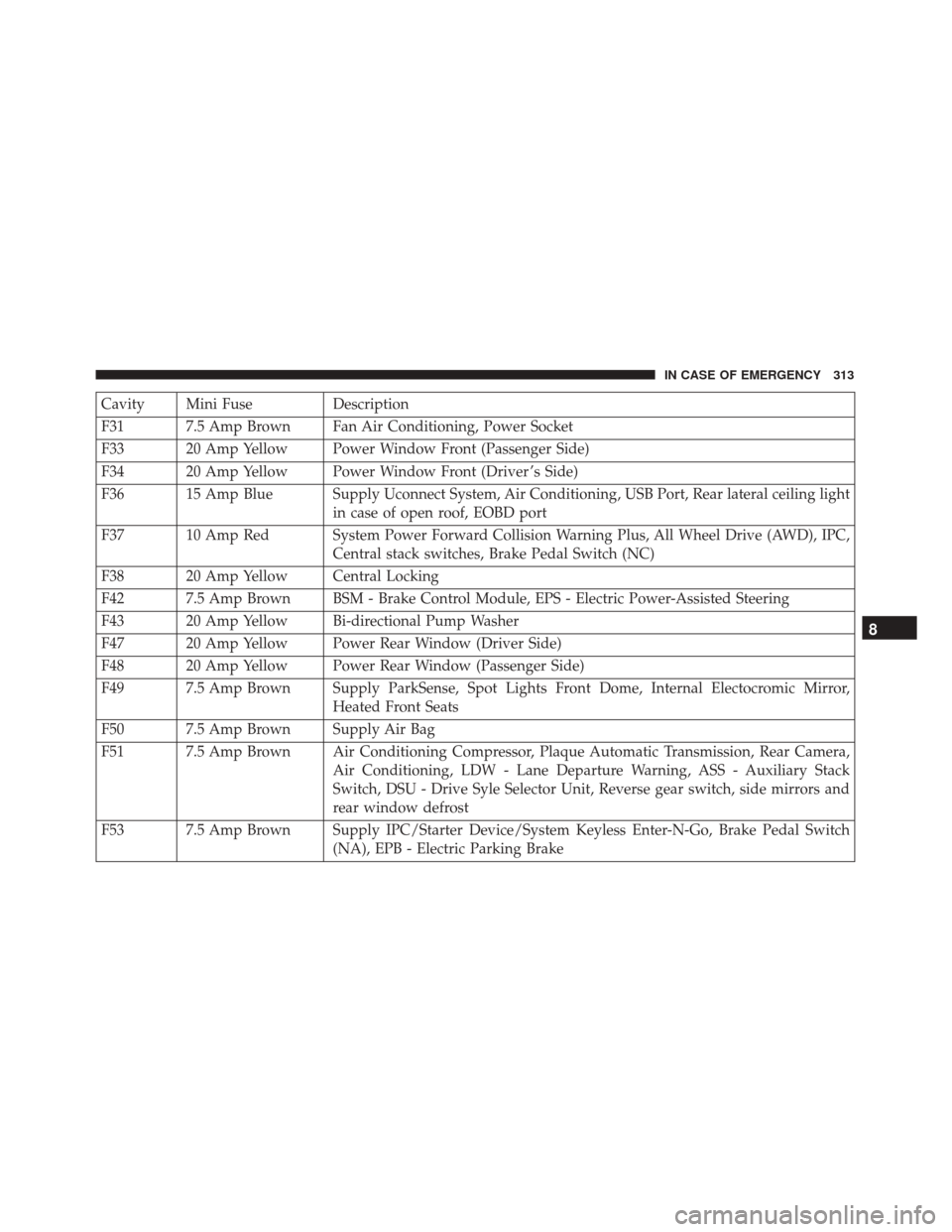
Cavity Mini FuseDescription
F31 7.5 Amp Brown Fan Air Conditioning, Power Socket
F33 20 Amp Yellow Power Window Front (Passenger Side)
F34 20 Amp Yellow Power Window Front (Driver ’s Side)
F36 15 Amp Blue Supply Uconnect System, Air Conditioning, USB Port, Rear lateral ceiling light in case of open roof, EOBD port
F37 10 Amp Red System Power Forward Collision Warning Plus, All Wheel Drive (AWD), IPC, Central stack switches, Brake Pedal Switch (NC)
F38 20 Amp Yellow Central Locking
F42 7.5 Amp Brown BSM - Brake Control Module, EPS - Electric Power-Assisted Steering
F43 20 Amp Yellow Bi-directional Pump Washer
F47 20 Amp Yellow Power Rear Window (Driver Side)
F48 20 Amp Yellow Power Rear Window (Passenger Side)
F49 7.5 Amp Brown Supply ParkSense, Spot Lights Front Dome, Internal Electocromic Mirror, Heated Front Seats
F50 7.5 Amp Brown Supply Air Bag
F51 7.5 Amp Brown Air Conditioning Compressor, Plaque Automatic Transmission, Rear Camera, Air Conditioning, LDW - Lane Departure Warning, ASS - Auxiliary Stack
Switch, DSU - Drive Syle Selector Unit, Reverse gear switch, side mirrors and
rear window defrost
F53 7.5 Amp Brown Supply IPC/Starter Device/System Keyless Enter-N-Go, Brake Pedal Switch (NA), EPB - Electric Parking Brake
8
IN CASE OF EMERGENCY 313
Page 316 of 476
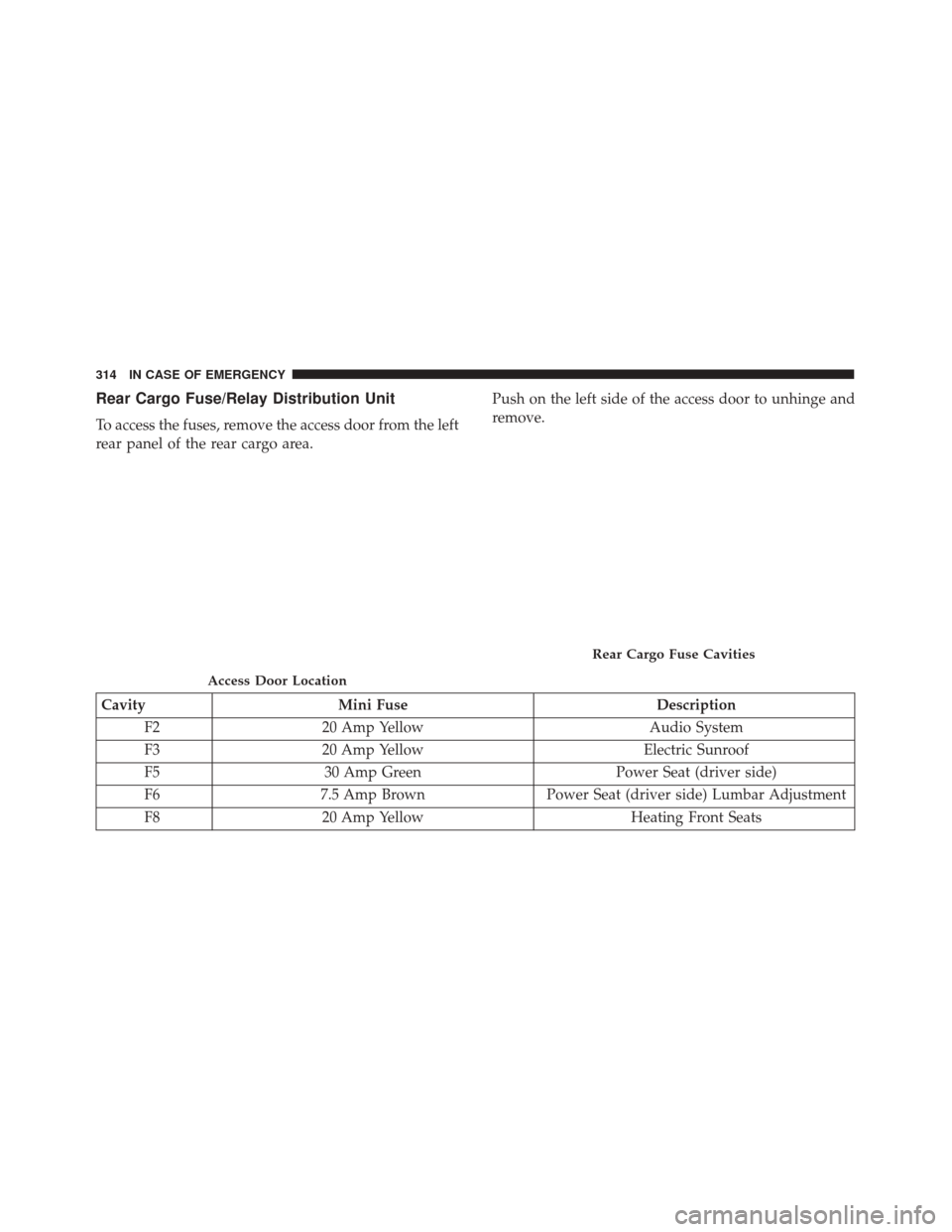
Rear Cargo Fuse/Relay Distribution Unit
To access the fuses, remove the access door from the left
rear panel of the rear cargo area.Push on the left side of the access door to unhinge and
remove.
Cavity
Mini Fuse Description
F2 20 Amp Yellow Audio System
F3 20 Amp Yellow Electric Sunroof
F5 30 Amp Green Power Seat (driver side)
F6 7.5 Amp Brown Power Seat (driver side) Lumbar Adjustment
F8 20 Amp Yellow Heating Front Seats
Access Door Location
Rear Cargo Fuse Cavities
314 IN CASE OF EMERGENCY
Page 377 of 476
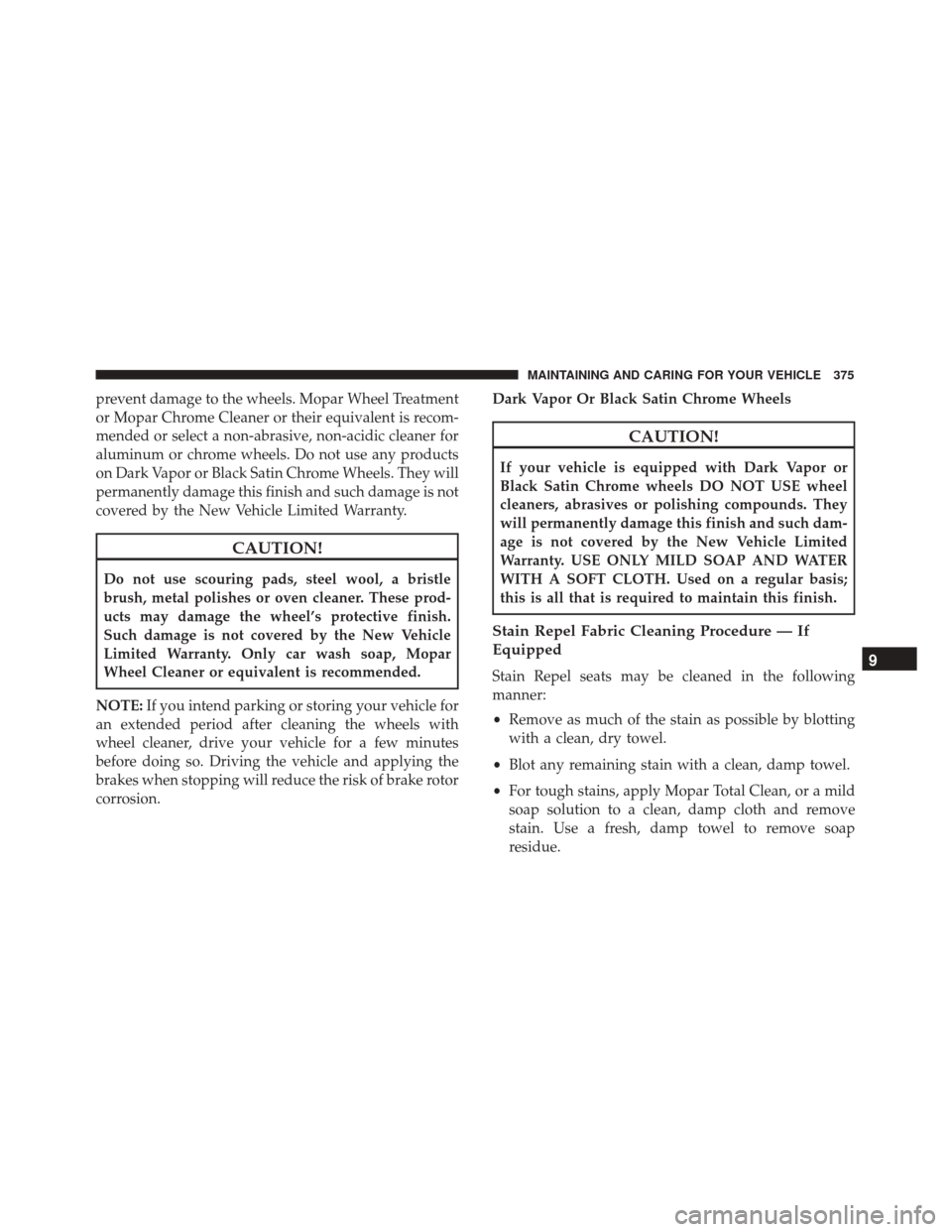
prevent damage to the wheels. Mopar Wheel Treatment
or Mopar Chrome Cleaner or their equivalent is recom-
mended or select a non-abrasive, non-acidic cleaner for
aluminum or chrome wheels. Do not use any products
on Dark Vapor or Black Satin Chrome Wheels. They will
permanently damage this finish and such damage is not
covered by the New Vehicle Limited Warranty.
CAUTION!
Do not use scouring pads, steel wool, a bristle
brush, metal polishes or oven cleaner. These prod-
ucts may damage the wheel’s protective finish.
Such damage is not covered by the New Vehicle
Limited Warranty. Only car wash soap, Mopar
Wheel Cleaner or equivalent is recommended.
NOTE: If you intend parking or storing your vehicle for
an extended period after cleaning the wheels with
wheel cleaner, drive your vehicle for a few minutes
before doing so. Driving the vehicle and applying the
brakes when stopping will reduce the risk of brake rotor
corrosion. Dark Vapor Or Black Satin Chrome Wheels
CAUTION!
If your vehicle is equipped with Dark Vapor or
Black Satin Chrome wheels DO NOT USE wheel
cleaners, abrasives or polishing compounds. They
will permanently damage this finish and such dam-
age is not covered by the New Vehicle Limited
Warranty. USE ONLY MILD SOAP AND WATER
WITH A SOFT CLOTH. Used on a regular basis;
this is all that is required to maintain this finish.
Stain Repel Fabric Cleaning Procedure — If
Equipped
Stain Repel seats may be cleaned in the following
manner:
•
Remove as much of the stain as possible by blotting
with a clean, dry towel.
• Blot any remaining stain with a clean, damp towel.
• For tough stains, apply Mopar Total Clean, or a mild
soap solution to a clean, damp cloth and remove
stain. Use a fresh, damp towel to remove soap
residue.9
MAINTAINING AND CARING FOR YOUR VEHICLE 375
Page 378 of 476
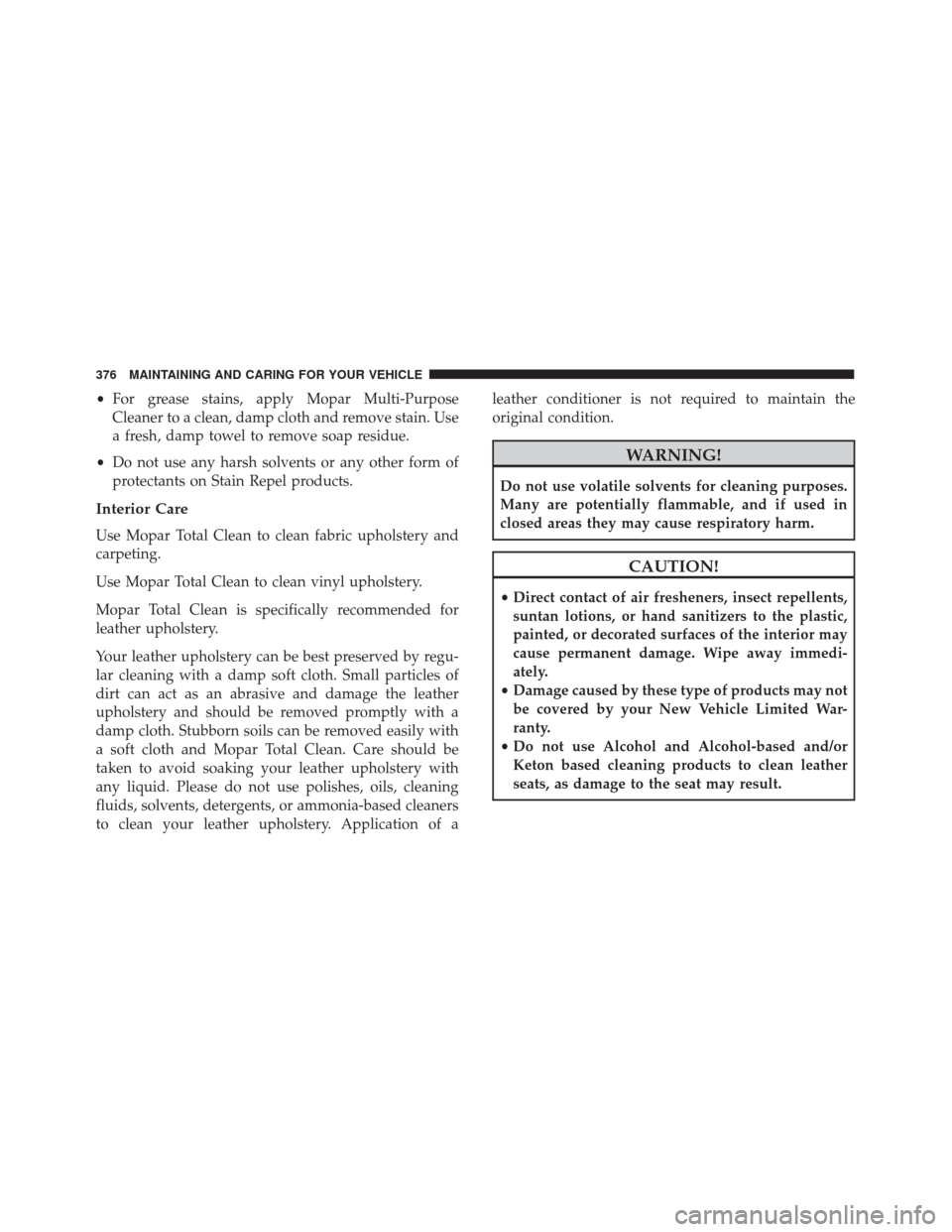
•For grease stains, apply Mopar Multi-Purpose
Cleaner to a clean, damp cloth and remove stain. Use
a fresh, damp towel to remove soap residue.
• Do not use any harsh solvents or any other form of
protectants on Stain Repel products.
Interior Care
Use Mopar Total Clean to clean fabric upholstery and
carpeting.
Use Mopar Total Clean to clean vinyl upholstery.
Mopar Total Clean is specifically recommended for
leather upholstery.
Your leather upholstery can be best preserved by regu-
lar cleaning with a damp soft cloth. Small particles of
dirt can act as an abrasive and damage the leather
upholstery and should be removed promptly with a
damp cloth. Stubborn soils can be removed easily with
a soft cloth and Mopar Total Clean. Care should be
taken to avoid soaking your leather upholstery with
any liquid. Please do not use polishes, oils, cleaning
fluids, solvents, detergents, or ammonia-based cleaners
to clean your leather upholstery. Application of a leather conditioner is not required to maintain the
original condition.
WARNING!
Do not use volatile solvents for cleaning purposes.
Many are potentially flammable, and if used in
closed areas they may cause respiratory harm.
CAUTION!
•
Direct contact of air fresheners, insect repellents,
suntan lotions, or hand sanitizers to the plastic,
painted, or decorated surfaces of the interior may
cause permanent damage. Wipe away immedi-
ately.
• Damage caused by these type of products may not
be covered by your New Vehicle Limited War-
ranty.
• Do not use Alcohol and Alcohol-based and/or
Keton based cleaning products to clean leather
seats, as damage to the seat may result.
376 MAINTAINING AND CARING FOR YOUR VEHICLE