2014 Citroen JUMPER jump start
[x] Cancel search: jump startPage 130 of 240

Levels and checks
128
JUMPER-PAPIER_EN_CHAP07_VERIFICATIONS_ED01-2014
Operating fault
If this alert persists, do not ignore the
warning; it indicates that a fault has occurred
in the exhaust / particle filter system.
Have the whole system checked by a
CITROËN dealer or a qualified workshop.
If there is risk of blockage of the
filter, this warning lamp comes on
in the instrument panel.
Saturation / Regeneration Because of the higher exhaust
gas temperature resulting from the
normal operation of the particle filter, it is
recommended that you do not park the
vehicle over inflammable materials (grass,
dry leaves, pine needles, ...) so as to avoid
any risk of fire.
Particle filter system (Diesel)
An addition to the catalytic converter, this
filter makes an active contribution to the
preservation of air quality by the retaining
of the unburnt pollutant particles. Black
exhaust fumes are thus no longer emitted.
Operation
This filter, fitted to the exhaust system,
accumulates particles of soot. The engine
management unit controls the automatic
periodic elimination of the soot particles
(regeneration).
The regeneration procedure is invoked
according to the quantity of particles
accumulated and the driving conditions
of the vehicle. During this phase, you
may notice some unusual phenomena -
increased idling speed, cooling fan running,
increase in smoke and higher exhaust gas
temperature - which does not affect the
operation of the vehicle or the environment. After prolonged idling or driving at very
low speeds, you may occasionally
notice water vapour being emitted from the
exhaust when accelerating. This is of no
consequence to the running of the vehicle or
to the environment. To regenerate the filter, it is advised to drive
as soon as possible, when traffic conditions
and the law permit, at a speed of at least
40 mph (around 60 km/h), with an engine
speed above 2 000 rpm for about fifteen
minutes (until the warning lamp and/or the
message disappears).
If possible, avoid switching off the engine
before the end of regeneration of the
filter; repeated interruptions could cause
premature deterioration of the engine oil. It
is not recommended to end regeneration of
the filter with the vehicle stationary.
This alert tells you that the particle filter
is starting to fill up (in conditions of urban
driving of exceptionally long duration: low
speeds, traffic jams etc.)
Page 131 of 240

Fuel
129
7
CHECKS
JUMPER-PAPIER_EN_CHAP07_VERIFICATIONS_ED01-2014
Low fuel level
When the fuel tank level E
(Empty) is reached, this warning
lamp comes on. At this moment,
you have around 10 to 12 litres
in the reserve, depending on the capacity
of the tank, the engine type, the driving
conditions and the profile of the road. Refuel
without delay to avoid running out of fuel.
The capacity of the fuel tank is
approximately 90 litres.
Fuel tanks of different capacities, 60 and
125 litres, may be fitted.
REFUELLING
In low temperatures
In mountainous and/or cold areas, it is
advisable to use a "winter" type fuel suited
to low or minus temperatures. With Stop & Start, never refuel
with the system in STOP mode;
you must switch off the ignition with
the key. The fuel tank must be filled
with the
engine off.
- Open the fuel filler flap.
- Support the cap with one hand.
- With the other hand, insert the key, then turn it anticlockwise.
- Remove the cap and hook it onto the clip located on the inside of the flap.
A label affixed to the inside of the flap
reminds you of the type of fuel to be used.
When filling the fuel tank, do not continue
after the 3rd cut-off of the nozzle. This could
cause malfunctions.
- After filling the fuel tank, lock the cap and close the flap.
Page 133 of 240

131
Discharged battery
QUICK HELP
8
JUMPER-PAPIER_EN_CHAP08_AIDE RAPIDE_ED01-2014
A. Positive metal point on your vehicle
B. Slave battery
C. Earth on your vehicle
Starting from another battery
- Connect the red cable to the metal point A then to the positive (+) terminal
of the slave battery B .
- Connect one end of the green or black cable to the negative (-) terminal of the
slave battery B .
- Connect the other end of the green or black cable to the earth point C on your
vehicle.
- Operate the starter, let the engine run.
- Wait for the engine to return to idle, then disconnect the cables.
Charging the battery using a charger
- Go to the battery located in the front left floor.
- Disconnect the battery.
- Follow the instructions for use given by the battery charger manufacturer.
- Reconnect starting with the negative (-) terminal.
- Check that the terminals and connectors are clean. If they are covered with
sulphate (white or greenish deposit),
disconnect them and clean them.
BATTERY
Page 134 of 240

132
Discharged battery
JUMPER-PAPIER_EN_CHAP08_AIDE RAPIDE_ED01-2014
The charging operation must be carried
out in a ventilated area away from
naked flames or any possible sources of
sparks to eliminate the risk of explosion
and fire.
Do not attempt to charge a frozen battery: it
must first be thawed to eliminate the risks of
explosion. If the battery has frozen, before
charging it have it checked by a specialist
who will check that the internal components
have not been damaged and that the
container is not cracked, which could mean
that there is a risk of a leak of toxic and
corrosive acid.
Proceed with a slow charge charge at low
current for a maximum pf about 24 hours to
avoid damaging the battery. The batteries contain harmful
substances such as sulphuric acid and
lead. They must be discarded in accordance
with the provisions of the law and must not,
in any circumstances, be discarded with
household waste.
Take used batteries to a special collection
point.
Before disconnecting the battery, you must
wait for 2 minutes after switching off the
ignition.
Never disconnect a terminal when the
engine is running.
Never charge a battery without first
disconnecting the terminals.
Close the windows and doors before
disconnecting the battery.
After every reconnection of the battery,
switch on the ignition and wait 1 minute
before starting to allow the electronic
systems to be initialised. If slight difficulties
are experienced after this, please contact a
CITROËN dealer or a qualified workshop.
Unscrew the 6 access cover retaining
screws.
Lift off or remove completely the access
cover.
Press lever
1 downwards to spread the
clamp.
Remove the terminal 2 from the negative (-)
post.
Access to the battery
Page 135 of 240

133
Discharged battery
QUICK HELP
8
JUMPER-PAPIER_EN_CHAP08_AIDE RAPIDE_ED01-2014
The presence of this label, in particular
with the Stop & Start system, indicates
the use of a 12 V lead-acid battery with
special technology and specification;
the involvement of a CITROËN dealer or
a qualified workshop is essential when
replacing or disconnecting the battery.
Failure to observe this recommendation may
cause premature wear of the battery.
After refi tting the battery by a CITROËN
dealer or a qualifi ed workshop, the
Stop & Start system will only be active after
a continuous period of immobilisation of
the vehicle, a period which depends on the
climatic conditions and the state of charge of
the battery (up to about 8 hours).
Do not disconnect the battery to
charge it.
It is advisable to disconnect the
negative (-) terminal of the battery
if the vehicle is not to be used for a
period of more than one month.
The description of the battery charging
procedure is given as an indication only.
If the battery has been disconnected
for some time, it may be necessary to
reinitialise the following functions:
- the display parameters (date, time, language, distance unit and temperature
unit),
- the radio stations,
- the central locking.
Some settings are cleared and must be
reprogrammed, consult a CITROËN.
If your vehicle is fitted with a tachograph or
an alarm, disconnection of the negative (-)
terminal of the battery (located under the
floor on the left-hand side, in the cab) is
recommended if the vehicle is not to be used
for a period of more than 5 days.
Page 149 of 240

Puncture
147
QUICK HELP
8
JUMPER-PAPIER_EN_CHAP08_AIDE RAPIDE_ED01-2014
Refitting the repaired wheel
Refitting the repaired wheel is the same as
fitting the spare wheel; don't forget to refit
the wheel trim. Refer to the "Technical data -
Identification markings" section for the
location of the tyre pressure label.
The spare wheel is not designed to be used
over long distances. Have the tightening of
the bolts and pressure of the spare wheel
checked by a CITROËN dealer or a qualified
workshop without delay.
Also, have the original wheel repaired and
refitted by a CITROËN dealer or a qualified
workshop as soon as possible.
Fitting the spare wheel
- Put the spare wheel in place on the hub and start screwing in the bolts by hand.
- Carry out an initial tightening of the bolts using the wheelbrace E .
- Lower the vehicle completely by folding the jack, then remove the jack.
- Tighten the bolts again using the wheelbrace E , tighten them fully without
forcing them.
- Stow the wheel to be repaired at the rear of the vehicle. - Hook the support H
and screw in the
handle G .
- Insert the long socket A in the hole then
wind the bolt fully, using the ratchet
wrench B , to raise the wheel.
- Stow the tools and the trim.
If you have a retractable foot board, the jack
must be positioned at 45°.
- Extend the jack using the ratchet wrench B until the wheel is a
few centimetres off the ground.
- Unscrew the bolts fully and remove the wheel to be repaired.
Page 150 of 240

Puncture
148
JUMPER-PAPIER_EN_CHAP08_AIDE RAPIDE_ED01-2014
PUNCTURE REPAIR KIT Repairing the tyre
- Apply the parking brake. Unscrew the tyre valve cap, remove the filling hose B
and screw the ring E onto the valve, - start the engine,
- insert the connector G
into the nearest
power socket on the vehicle,
- switch on the compressor by placing the switch F in position I (on),
- inflate the tyre to a pressure of 4 bars.
To obtain a more accurate reading, you are
advised to check the pressure value on the
pressure gauge H , with the compressor off.
- check that the switch F on the
compressor is in position 0 (off),
This temporary puncture repair kit is located
at the front of the passenger compartment.
It consists of:
- a cartridge A
, containing the sealant
fluid, equipped with:
● a filling hose B ,
● a sticker C indicating "max. 80 km/h",
which the driver must affix in full view
(on the dashboard) after repairing the
tyre,
- a quick guide to use of the repair kit,
- a compressor D equipped with a
pressure gauge and unions,
- adaptors, for the inflation of various items.
Page 152 of 240
Being towed or towing
150
JUMPER-PAPIER_EN_CHAP08_AIDE RAPIDE_ED01-2014
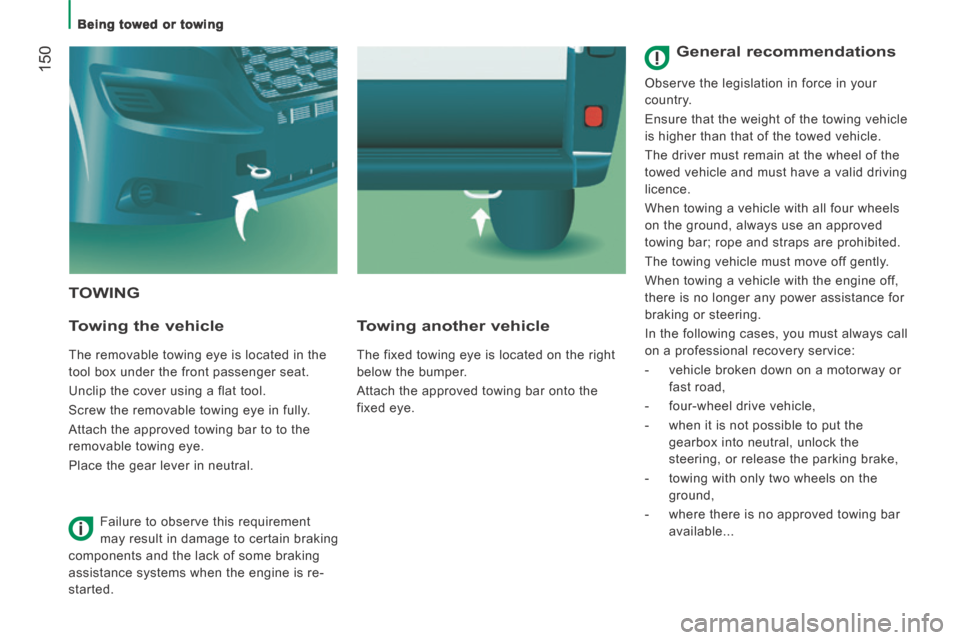
TOWING
Towing the vehicle
The removable towing eye is located in the
tool box under the front passenger seat.
Unclip the cover using a flat tool.
Screw the removable towing eye in fully.
Attach the approved towing bar to to the
removable towing eye.
Place the gear lever in neutral.
Towing another vehicle
The fixed towing eye is located on the right
below the bumper.
Attach the approved towing bar onto the
fixed eye.
Failure to observe this requirement
may result in damage to certain braking
components and the lack of some braking
assistance systems when the engine is re-
started.
General recommendations
Observe the legislation in force in your
country.
Ensure that the weight of the towing vehicle
is higher than that of the towed vehicle.
The driver must remain at the wheel of the
towed vehicle and must have a valid driving
licence.
When towing a vehicle with all four wheels
on the ground, always use an approved
towing bar; rope and straps are prohibited.
The towing vehicle must move off gently.
When towing a vehicle with the engine off,
there is no longer any power assistance for
braking or steering.
In the following cases, you must always call
on a professional recovery service:
- vehicle broken down on a motorway or fast road,
- four-wheel drive vehicle,
- when it is not possible to put the gearbox into neutral, unlock the
steering, or release the parking brake,
- towing with only two wheels on the ground,
- where there is no approved towing bar available...