2014 CHRYSLER 300 SRT belt
[x] Cancel search: beltPage 296 of 590
Cargo Area — Vehicles Equipped With 60/40
Split-Folding Rear Seat
The 60/40 split-folding rear seat provides cargo-carrying
versatility. The seatbacks fold down easily by pulling
nylon tabs between the seatbacks and the bolsters. When
the seats are folded down, they provide a continuous,
nearly-flat extension of the load floor.
When the seatback is folded to the upright position, make
sure it is latched by strongly pulling on the top of the
seatback above the seat strap.
WARNING!
•Be certain that the seatback is securely locked into
position. If the seatback is not securely locked into
position, the seat will not provide the proper sta-
bility for child seats and/or passengers. An improp-
erly latched seat could cause serious injury.
• The cargo area in the rear of the vehicle (with the
rear seatbacks in the locked-up or folded down
position) should not be used as a play area by
children when the vehicle is in motion. They could
be seriously injured in a collision. Children should
be seated and using the proper restraint system.
• To help protect against personal injury, passengers
should not be seated in the rear cargo area. The rear
cargo space is intended for load carrying purposes
only, not for passengers, who should sit in seats
and use seat belts.
294 UNDERSTANDING THE FEATURES OF YOUR VEHICLE
Page 314 of 590

20. Seat Belt Reminder LightWhen the ignition switch is first turned to ON/
RUN, this light will turn on for four to eight
seconds as a bulb check. During the bulb check, if
the driver’s seat belt is unbuckled, a chime will sound.
After the bulb check or when driving, if the driver’s seat
belt remains unbuckled, the Seat Belt Reminder Light
will illuminate and the chime will sound. Refer to
“Occupant Restraints” in “Things To Know Before Start-
ing Your Vehicle” for further information.
21. Temperature Gauge
The temperature gauge shows engine coolant tempera-
ture. Any reading within the normal range indicates that
the engine cooling system is operating satisfactorily. The gauge pointer will likely indicate a higher tempera-
ture when driving in hot weather, up mountain grades,
or when towing a trailer. It should not be allowed to
exceed the upper limits of the normal operating range.
CAUTION!
Driving with a hot engine cooling system could
damage your vehicle. If the temperature gauge reads
“260” pull over and stop the vehicle. Idle the vehicle
with the air conditioner turned off until the pointer
drops back into the normal range. If the pointer
remains on the “260” and you hear continuous
chimes, turn the engine off immediately and call an
authorized dealer for service.
312 UNDERSTANDING YOUR INSTRUMENT PANEL
Page 373 of 590
STARTING PROCEDURES
Before starting your vehicle, adjust your seat, adjust the
inside and outside mirrors, fasten your seat belt, and if
present, instruct all other occupants to buckle their seat
belts.
WARNING!
•When leaving the vehicle, always remove the Key
Fob from the ignition and lock your vehicle.
• Never leave children alone in a vehicle, or with
access to an unlocked vehicle. Allowing children to
be in a vehicle unattended is dangerous for a
number of reasons. A child or others could be
seriously or fatally injured. Children should be
warned not to touch the parking brake, brake pedal
or the shift lever.
(Continued)
WARNING! (Continued)
•Do not leave the Key Fob in or near the vehicle (or
in a location accessible to children), and do not
leave the ignition of a vehicle equipped with
Keyless Enter-N-Go™ in the ACC or ON/RUN
mode. A child could operate power windows, other
controls, or move the vehicle.
Automatic Transmission
The shift lever must be in the NEUTRAL or PARK
position before you can start the engine. Apply the brakes
before shifting into any driving gear.5
STARTING AND OPERATING 371
Page 494 of 590
CAUTION!
•It is essential when replacing the cables on the
battery that the positive cable is attached to the
positive post and the negative cable is attached to
the negative post. Battery posts are marked positive
(+) and negative (-) and are identified on the
battery case. Cable clamps should be tight on the
terminal posts and free of corrosion.
• If a “fast charger” is used while the battery is in the
vehicle, disconnect both vehicle battery cables be-
fore connecting the charger to the battery. Do not
use a “fast charger” to provide starting voltage.
Air Conditioner Maintenance
For best possible performance, your air conditioner should
be checked and serviced by an authorized dealer at the
start of each warm season. This service should include cleaning of the condenser fins and a performance test.
Drive belt tension should also be checked at this time.
WARNING!
•
Use only refrigerants and compressor lubricants
approved by the manufacturer for your air condi-
tioning system. Some unapproved refrigerants are
flammable and can explode, injuring you. Other
unapproved refrigerants or lubricants can cause the
system to fail, requiring costly repairs. Refer to
Warranty Information Book, located on the DVD,
for further warranty information.
• The air conditioning system contains refrigerant
under high pressure. To avoid risk of personal
injury or damage to the system, adding refrigerant
or any repair requiring lines to be disconnected
should be done by an experienced technician.
492 MAINTAINING YOUR VEHICLE
Page 518 of 590
Cleaning Plastic Instrument Cluster Lenses
The lenses in front of the instruments in this vehicle are
molded in clear plastic. When cleaning the lenses, care
must be taken to avoid scratching the plastic.
1. Clean with a wet soft rag. A mild soap solution may beused, but do not use high alcohol content or abrasive
cleaners. If soap is used, wipe clean with a clean damp
rag.
2. Dry with a soft cloth.
Seat Belt Maintenance
Do not bleach, dye, or clean the belts with chemical
solvents or abrasive cleaners. This will weaken the fabric.
Sun damage can also weaken the fabric.
If the belts need cleaning, use MOPAR® Total Clean, a mild
soap solution, or lukewarm water. Do not remove the belts
from the vehicle to wash them. Dry with a soft cloth.
Replace the belts if they appear frayed or worn or if the
buckles do not work properly.
WARNING!
A frayed or torn belt could rip apart in a collision and
leave you with no protection. Inspect the belt system
periodically, checking for cuts, frays, or loose parts.
Damaged parts must be replaced immediately. Do
not disassemble or modify the system. Seat belt
assemblies must be replaced after a collision if they
have been damaged (i.e., bent retractor, torn web-
bing, etc.).
Cleaning The Center Console Cupholders
Clean with a damp cloth or towel using a mild detergent
with the cupholder in the center console.
NOTE: The cupholder cannot be removed.
516 MAINTAINING YOUR VEHICLE
Page 569 of 590

Automatic Oil Change Indicator...............323
Automatic Temperature Control (ATC) ..........362
Automatic Transmission ....................379
Adding Fluid ......................... .510
Fluid and Filter Changes ..................510
Fluid Change ......................... .510
Fluid Level Check ...................... .508
Fluid Type ........................... .536
Special Additives ...................... .509
Auto Unlock, Doors ........................32
Auto Up Power Windows ....................40
Axle Fluid ............................. .536
Axle Lubrication (Axle Fluid) .................536
Battery ................................ .490
Keyless Transmitter Replacement (RKE) ........24
Location ............................. .490
Remote Battery Replacement ................24
Transmitter Battery Replacement .............24Belts, Seat
...............................49
Bluetooth® Connecting To A Particular Mobile Phone Or Audio
Device After Pairing .....................136
Connect Or Disconnect Link Between the
Uconnect® Phone And Mobile Phone .........152
Body Mechanism Lubrication .................495
B-Pillar Location ......................... .418
Brake Assist System ...................... .403
Brake Control System, Electronic ..............402
Brake Fluid ............................ .536
Brake, Parking .......................... .397
Brake System ........................... .506
Anti-Lock (ABS) ....................... .400
Fluid Check .......................... .506
Master Cylinder ....................... .506
Parking ............................. .397
Warning Light ........................ .309
Brake/Transmission Interlock .................379
10
INDEX 567
Page 570 of 590
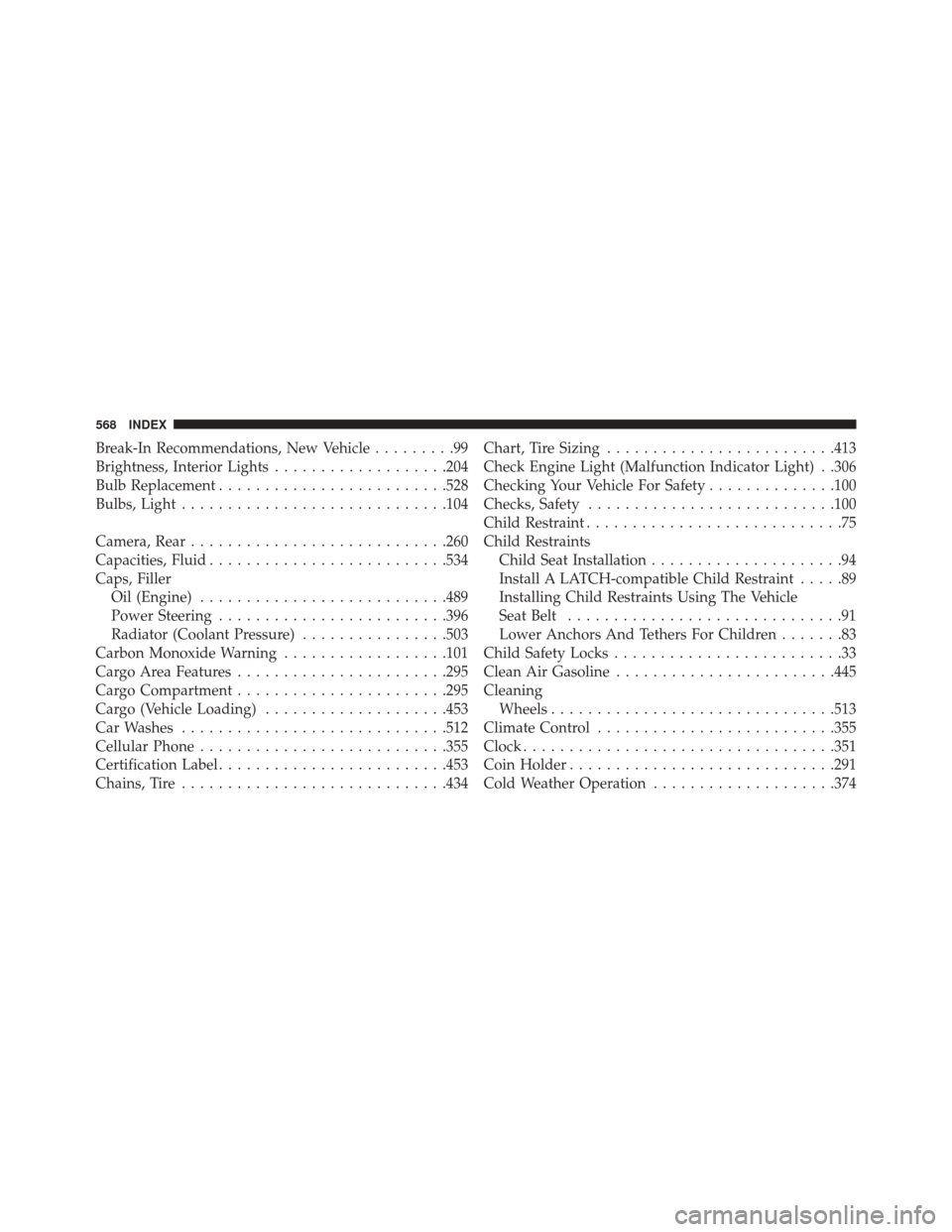
Break-In Recommendations, New Vehicle.........99
Brightness, Interior Lights ...................204
Bulb Replacement ........................ .528
Bulbs, Light ............................ .104
Camera, Rear ........................... .260
Capacities, Fluid ......................... .534
Caps, Filler Oil (Engine) .......................... .489
Power Steering ........................ .396
Radiator (Coolant Pressure) ................503
Carbon Monoxide Warning ..................101
Cargo Area Features ...................... .295
Cargo Compartment ...................... .295
Cargo (Vehicle Loading) ....................453
Car Washes ............................ .512
Cellular Phone .......................... .355
Certification Label ........................ .453
Chains, Tire ............................ .434Chart, Tire Sizing
........................ .413
Check Engine Light (Malfunction Indicator Light) . .306
Checking Your Vehicle For Safety ..............100
Checks, Safety .......................... .100
Child Restraint ............................75
Child Restraints Child Seat Installation .....................94
Install A LATCH-compatible Child Restraint .....89
Installing Child Restraints Using The Vehicle
Seat Belt ..............................91
Lower Anchors And Tethers For Children .......83
Child Safety Locks .........................33
Clean Air Gasoline ....................... .445
Cleaning Wheels .............................. .513
Climate Control ......................... .355
Clock ................................. .351
Coin Holder ............................ .291
Cold Weather Operation ....................374
568 INDEX
Page 577 of 590

Programming Additional Transmitters.........18
Remote Battery Replacement ................24
Unlatch The Trunk .......................23
Unlock The Doors .......................22
Key-In Reminder ..........................15
Keyless Enter-N-Go ........................34
Keyless Enter-N-Go™ Enter The Trunk .........................23
Lock The Vehicle’s Doors ..................23
Passive Entry Programming .................34
Unlock From The Passenger Side .............22
Keyless Enter-N-Go™™ Keyless Enter-N-Go™™ ...................34
Passive Entry ...........................34
Unlock From The Driver’s Side ..............22
Keyless Entry System .......................21
Keyless Go ...............................12
Key, Replacement ..........................17
Keys ...................................12 Key, Sentry (Immobilizer)
....................16
Knee Bolster ..............................59
Lane Change and Turn Signals ................201
Lane Change Assist ....................... .202
Lap/Shoulder Belts .........................49
Latches ............................... .104
Hood ............................... .193
Latch Plate ...............................50
Lead Free Gasoline ....................... .445
Leaks, Fluid ............................ .104
Life of Tires ............................ .432
Light Bulbs ............................. .104
Lights ................................ .104
Airbag ................................67
Alarm .............................. .309
Anti-Lock ............................ .308
Automatic Headlights ....................196
Brake Assist Warning ....................410
10
INDEX 575