Page 347 of 590
equipped), and power outlets will remain active for up to
10 minutes after the ignition is cycled to OFF. Opening
either front door will cancel this feature. To change the
Engine Off Power Delay status touch the 0 seconds, 45
seconds, 5 minutes or 10 minutes soft-key. Then touch the
arrow back soft-key.
•Headlight Off Delay
When this feature is selected, the driver can choose to
have the headlights remain on for 0, 30, 60, or 90 seconds
when exiting the vehicle. To change the Headlight Off
Delay status touch the + or - soft-key to select your
desired time interval. Touch the back arrow soft-key to
return to the previous menu.Audio
After pressing the Audio soft-key the following settings
will be available.
• Balance/Fade
When in this display you may adjust the Balance and
Fade settings.
• Equalizer
When in this display you may adjust the Bass, Mid and
Treble settings. Adjust the settings with the + and –
setting soft-keys or by selecting any point on the scale
between the + and – soft-keys. Then touch the back arrow
soft-key.
NOTE: Bass/Mid/Treble allow you to simply slide your
finger up or down to change the setting as well as touch
directly on the desired setting.
4
UNDERSTANDING YOUR INSTRUMENT PANEL 345
Page 350 of 590
The Performance Features include the following:
•Home
• Timers
• Engine Values
• Digital Gauge Displays
• 0-60 mph (0-100 km/h)
• Braking Distance
• 1/8 Mile
• 1/4 Mile
• Instantaneous G-Force
• Peak G-Force
• Digital Speedometer
• Options The following describes each feature and its operation:
Home
When selected, this screen allows you to choose Sport
Track mode.
•
This mode provides performance based suspension
tuning with improved handling and acceleration
through an electronic controlled dampening system.
• This system reduces body roll and pitch in many
driving situations including cornering, acceleration
and braking.
Timers
0-60 mph (0-100 km/h), 1/8 Mile, 1/4 Mile
When selected, this screen displays the time it takes for
the vehicle to go from 0 to 60 mph (0 to 100 km/h),
1/8 mile or 1/4 mile.
348 UNDERSTANDING YOUR INSTRUMENT PANEL
Page 352 of 590
Gauges 2
When selected, this screen displays the following values:
•Coolant Temperature
Shows the actual coolant temperature within the range of
the gauge.
• Oil Temperature
Shows the actual oil temperature within the range of the
gauge.
• Transmission Temperature
Shows the actual transmission temperature within the
range of the gauge.
• Intake Air Temperature
Shows the actual intake air temperature within the range
of the gauge. •
Oil Pressure
Shows the actual oil pressure.
• Battery Voltage
Shows the actual battery voltage.
Engine
When selected, this screen displays miles per hour (mph),
horsepower (hp), torque (ft/lb), oil pressure (psi) and
gear selector values.
Handling
When selected, this screen displays peak g-force, steering
and yaw angles.
Options
When selected, this screen allows you to choose a stan-
dard or customize display for your SRT home page.
350 UNDERSTANDING YOUR INSTRUMENT PANEL
Page 365 of 590
3. When the system is set up for your comfort level, it isnot necessary to change the settings. You will experi-
ence the greatest efficiency by simply allowing the
system to function automatically.
NOTE:
• It is not necessary to move the temperature settings for
cold or hot vehicles. The system automatically adjusts
the temperature, mode, and blower speed to provide
comfort as quickly as possible.
• The temperature can be displayed in U.S. or Metric
units by selecting the US/M customer-programmable
feature. Refer to the “Uconnect® System Settings” in
this section of the manual.
To provide you with maximum comfort in the Automatic
mode, during cold start-ups the blower fan will remain
on low until the engine warms up. The blower will
increase in speed and transition into Auto mode.Manual Operation Override
The system allows for manual selection of blower speed,
air distribution mode, A/C status and recirculation con-
trol.
The blower fan speed can be set to any fixed speed by
adjusting the blower control. The fan will now operate at
a fixed speed until additional speeds are selected. This
allows the front occupants to control the volume of air
circulated in the vehicle and cancel the Auto mode.
The operator can also select the direction of the airflow
by selecting one of the available mode settings. A/C
operation and Recirculation control can also be manually
selected in Manual operation.
4
UNDERSTANDING YOUR INSTRUMENT PANEL 363
Page 366 of 590

Operating Tips
Summer Operation
The engine cooling system must be protected with a
high-quality antifreeze coolant to provide proper corro-
sion protection and to protect against engine overheating.
A solution of 50% OAT (Organic Additive Technology)
coolant that meets the requirements of Chrysler Material
Standard MS-12106 and 50% water is recommended.
Refer to “Maintenance Procedures” in “Maintaining Your
Vehicle” for proper coolant selection.
Winter Operation
Use of the air Recirculation mode during winter months
is not recommended because it may cause window
fogging.
Vacation Storage
Any time you store your vehicle or keep it out of service
(i.e., vacation) for two weeks or more, run the air
conditioning system at idle for about five minutes in the
fresh air and high blower setting. This will ensure
adequate system lubrication to minimize the possibility
of compressor damage when the system is started again.
Window Fogging
Interior fogging on the windshield can be quickly re-
moved by turning the mode selector to Defrost. The
Defrost/Floor mode can be used to maintain a clear
windshield and provide sufficient heating. If side win-
dow fogging becomes objectionable, increase blower
speed to improve airflow and clearing of the side win-
dows. Vehicle windows tend to fog on the inside in mild
but rainy or humid weather.
364 UNDERSTANDING YOUR INSTRUMENT PANEL
Page 369 of 590
STARTING AND OPERATING
CONTENTS
�STARTING PROCEDURES ................371
▫ Automatic Transmission ................371
▫ Keyless Enter-N-Go™ ..................372
▫ Normal Starting ...................... .372
▫ Extreme Cold Weather (Below –20°F Or
29°C) ............................ .374
▫ If Engine Fails To Start .................374
▫ After Starting ....................... .376
� ENGINE BLOCK HEATER — IF EQUIPPED . . .376
� AUTOMATIC TRANSMISSION ............377▫
Key Ignition Park Interlock ...............378
▫ Brake/Transmission Shift Interlock System . . .379
▫ Five-Speed Automatic Transmission ........379
� AUTOSTICK® ........................ .386
▫ Steering Wheel Mounted Paddle Shifters Or
Console Mounted Shifter ................386
� SPORT MODE ........................ .389
� LAUNCH MODE — IF EQUIPPED ..........390
� DRIVING ON SLIPPERY SURFACES .........392
▫ Acceleration ........................ .392
5
Page 371 of 590
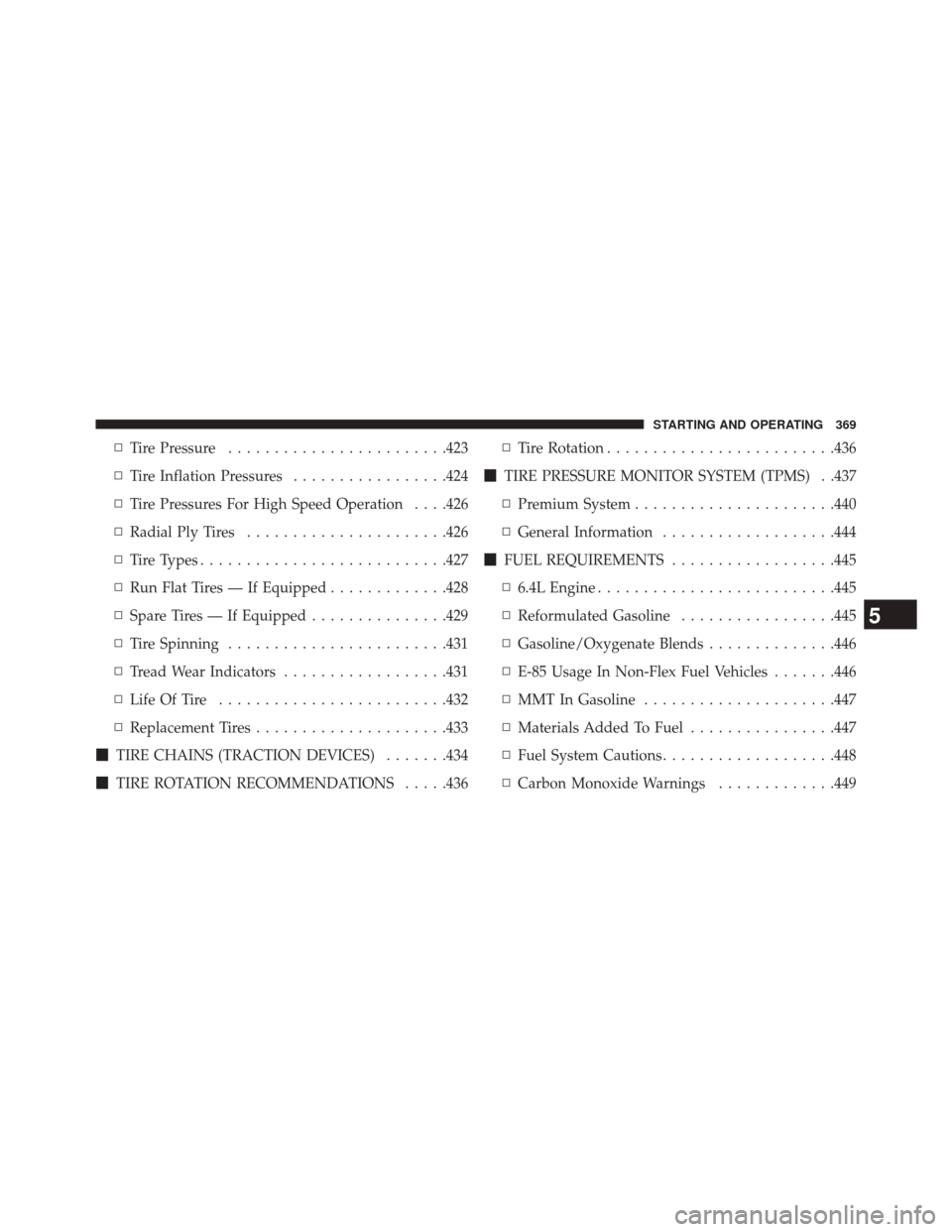
▫Tire Pressure ....................... .423
▫ Tire Inflation Pressures .................424
▫ Tire Pressures For High Speed Operation . . . .426
▫ Radial Ply Tires ..................... .426
▫ Tire Types .......................... .427
▫ Run Flat Tires — If Equipped .............428
▫ Spare Tires — If Equipped ...............429
▫ Tire Spinning ....................... .431
▫ Tread Wear Indicators ..................431
▫ Life Of Tire ........................ .432
▫ Replacement Tires .....................433
� TIRE CHAINS (TRACTION DEVICES) .......434
� TIRE ROTATION RECOMMENDATIONS .....436▫
Tire Rotation ........................ .436
� TIRE PRESSURE MONITOR SYSTEM (TPMS) . .437
▫ Premium System ..................... .440
▫ General Information ...................444
� FUEL REQUIREMENTS ..................445
▫ 6.4L Engine ......................... .445
▫ Reformulated Gasoline .................445
▫ Gasoline/Oxygenate Blends ..............446
▫ E-85 Usage In Non-Flex Fuel Vehicles .......446
▫ MMT In Gasoline .....................447
▫ Materials Added To Fuel ................447
▫ Fuel System Cautions ...................448
▫ Carbon Monoxide Warnings .............449
5
STARTING AND OPERATING 369
Page 373 of 590
STARTING PROCEDURES
Before starting your vehicle, adjust your seat, adjust the
inside and outside mirrors, fasten your seat belt, and if
present, instruct all other occupants to buckle their seat
belts.
WARNING!
•When leaving the vehicle, always remove the Key
Fob from the ignition and lock your vehicle.
• Never leave children alone in a vehicle, or with
access to an unlocked vehicle. Allowing children to
be in a vehicle unattended is dangerous for a
number of reasons. A child or others could be
seriously or fatally injured. Children should be
warned not to touch the parking brake, brake pedal
or the shift lever.
(Continued)
WARNING! (Continued)
•Do not leave the Key Fob in or near the vehicle (or
in a location accessible to children), and do not
leave the ignition of a vehicle equipped with
Keyless Enter-N-Go™ in the ACC or ON/RUN
mode. A child could operate power windows, other
controls, or move the vehicle.
Automatic Transmission
The shift lever must be in the NEUTRAL or PARK
position before you can start the engine. Apply the brakes
before shifting into any driving gear.5
STARTING AND OPERATING 371