2014 AUDI TT ROADSTER ESP
[x] Cancel search: ESPPage 130 of 244
128 Airbag system
How supplemental side airbags work
Side airbags deploy instantly and con help re
duce the risk of upper torso injuries for occu
pants who ore properly restrained.
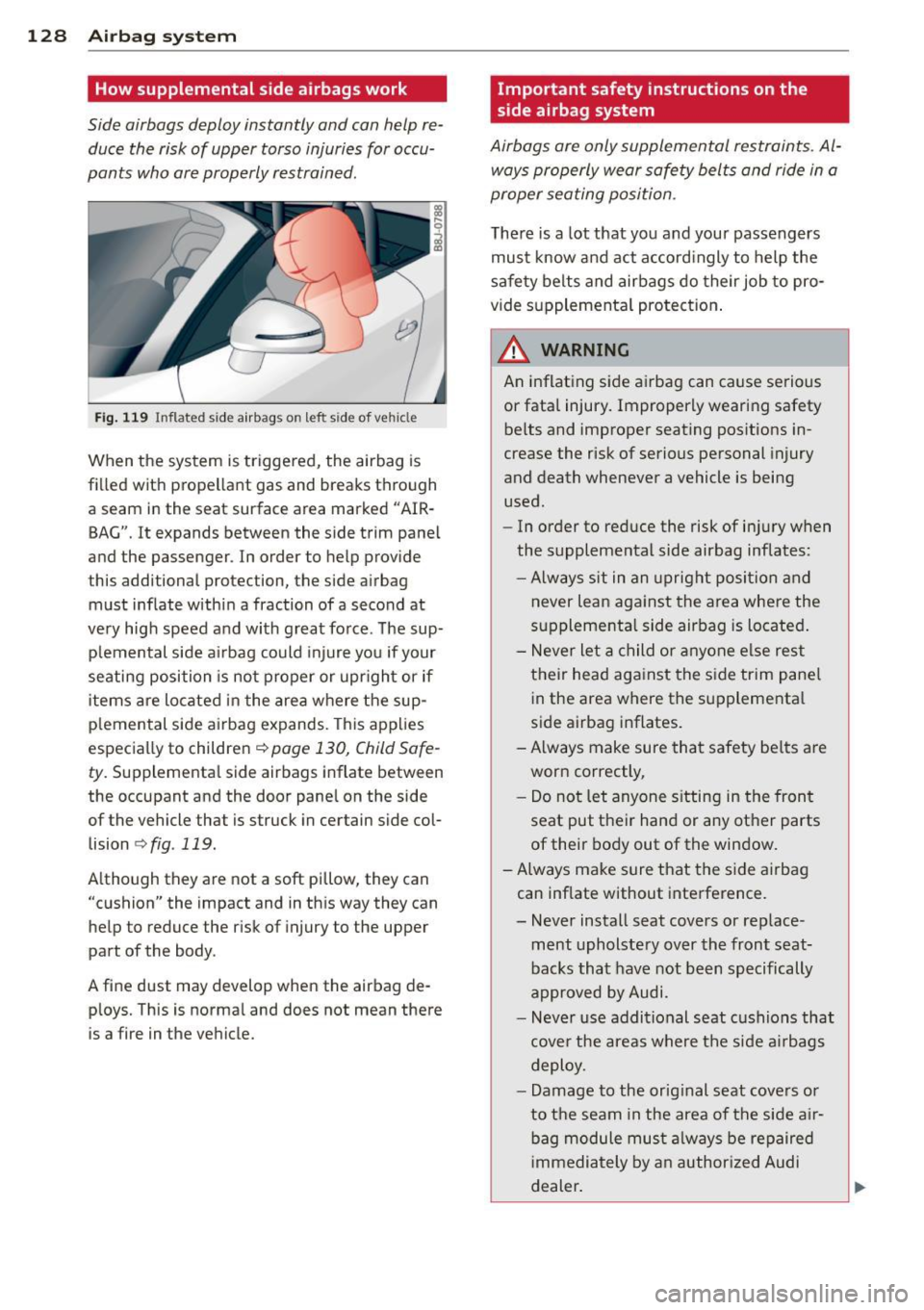
Fig. 119 Inflated s ide airbags on left side of vehicle
When the system is triggered, the airbag is
filled with propellant gas and breaks through
a seam in the seat surface area marked "AIR
BAG". It expands between the side trim panel
and the passenger . In order to help provide
this additional protection, the side airbag
must inflate within a fraction of a second at
very high speed and with great force. The sup plemental side airbag could injure you if your
seating position is not proper or upright or if
items are located in the area where the sup
plemental side airbag expands. This applies
especially to children
Q page 130, Child Safe
ty.
Supplemental side airbags inflate between
the occupant and the door panel on the side
of the vehicle that is struck in certain side col
lision
Q fig . 119.
Although they are not a soft pillow, they can
"cushion" the impact and in this way they can
help to reduce the risk of injury to the upper
part of the body.
A fine dust may develop when the airbag de
ploys. This is normal and does not mean there
is a fire in the vehicle. Important safety instructions on the
side airbag system
Airbags ore only
supplemental restraints. Al
ways properly wear safety belts and ride in a
proper seating position.
There is a lot that you and your passengers
must know and act accordingly to help the
safety belts and airbags do their job to pro
vide supplemental protection.
A WARNING
An inflating side airbag can cause serious
or fatal injury. Improperly wearing safety
belts and improper seating positions in
crease the risk of serious personal injury
and death whenever a vehicle is being
used.
- In order to reduce the risk of injury when
the supplemental side airbag inflates:
- Always sit in an upright position and
never lean against the area where the
supplemental side airbag is located.
- Never let a child or anyone else rest
their head against the side trim panel
in the area where the supplemental
side airbag inflates.
-Always make sure that safety belts are worn correctly,
- Do not let anyone sitting in the front
seat put their hand or any other parts
of their body out of the window.
-Always make sure that the side airbag can inflate without interference.
- Never install seat covers or replace ment upholstery over the front seat
backs that have not been specifically
approved by Audi.
- Never use additional seat cushions that
cover the areas where the side airbags
deploy.
- Damage to the original seat covers or
to the seam in the area of the side air
bag module must always be repaired
immediately by an authorized Audi
dealer.
Page 132 of 244

130 Child Safety
Child Safety
Important things to know
Introduction
The physical principles of what happens when
your vehicle is in a crash apply also to children
c::> page 102, What happens to occupants not
wearing safety belts? .
But unlike adults and
teenagers, their muscles and bones are not
fully developed . In many respects children are
at greater risk of serious injury in crashes than
adults.
Because children's bodies are not fully devel
oped, they require restraint systems especial
ly designed for their size, weight, and body
structure . Many countries and all states of the
United States and provinces of Canada have
laws requiring the use of approved child re
straint systems for infants and small children.
In a frontal crash at a speed of 20-35 mph
(30-56 km/h) the forces acting on a 13-pound
(6 kg) infant will be more than 20 times the
weight of the child. This means the weight of
the child would suddenly be more than 260 pounds (120 kg). Under these conditions,
only an appropriate child restraint properly used can reduce the risk of serious injury.
Child restraints, like adult safety belts, must
be used properly to be effective. Used improp
erly, they can increase the risk of serious in
jury in an accident.
Consult the child safety seat manufacturer's instructions in order to be sure the seat is
right for your child's size
c::> page 133, Impor
tant safety instructions for using child safety
seats.
Please be sure to read and heed all of
the important information and WARNINGS
about child safety, Advanced Airbags, and the
installation of child restraints in this chapter.
There is a lot you need to know about the Ad
vanced Airbags in your vehicle and how they
work when infants and children in child re
straints are on the front passenger seat. Be
cause of the large amount of important infor- mation, we cannot repeat it all here. We urge
you to read the detailed information in this
owner's manual about airbags and the Ad
vanced Airbag System in your vehicle and the
very important information about transport ing children on the front passenger seat.
Please be sure to heed the WARNINGS - they
are extremely important for your safety and
the safety of your passengers, especially in
fants and small children.
A WARNING
-
All vehicle occupants and especially chil
dren must be restrained properly whenev
er riding in a vehicle. An unrestrained or
improperly restrained child could be in
jured by striking the interior or by being
ejected from the vehicle during a sudden maneuver or impact. An unrestrained or
improperly restrained child is also at great
er risk of injury or death through contact
with an inflating airbag.
_& WARNING
Children on the front seat of any car even
with Advanced Airbags can be seriously in
jured or even killed when an airbag in
flates. A child in a rearward-facing child
safety seat installed on the front passen
ger seat will be seriously injured and can
be killed if the front airbag inflates.
- The inflating airbag will hit the child
safety seat or infant carrier with great
force and will smash the child safety seat
and child against the backrest, door or roof.
- Never install a rearward facing child
safety seat on the front passenger seat
unless the
PASSENGER AIR BAG OFF
light comes on and stays on. If the PAS·
SENGER AIR BAG OFF
light does not
come on and stay on, have the airbag
system inspected immediately by your
Audi dealer.
.
Page 135 of 244
Model Manufactured on or
after
Cosco Summit Deluxe September 25, 2007
High Back Booster
22-262
Cosco High Back September 25, 2007
Booster 22-209
Evenflo Tribute V September 25, 2007
379xxxx
Evenflo Medallion December 1, 1999
254
Evenflo Generations September 25, 200 7
352xxxx
Graco ComfortSport September 25, 2007
Graco Toddler Sa fety September 25, 2007
Seat Step 2
Graco Platinum Cargo September 25, 2007
_& WARNING
To reduce the risk of serious injury, make
sure that the
PASSENGER AIR BAG OFF
light comes on and stays on whenever a
child restraint is installed on the front pas
senger seat and the ignition is switched
on.
- Never install a rearward facing child
safety seat on the front passenger seat
unless the
PASSENGER AIR BAG OFF
light comes on and stays on. If the PAS
SENGER AIR BAG OFF
light does not
come on and stay on the inflating airbag
will hit the child safety seat o r infant car
rie r wi th great force and will smash the
child safety seat and child against the
backrest, door or roof . Have the airbag
system inspected immediately by your
Audi dealer.
@ Tips
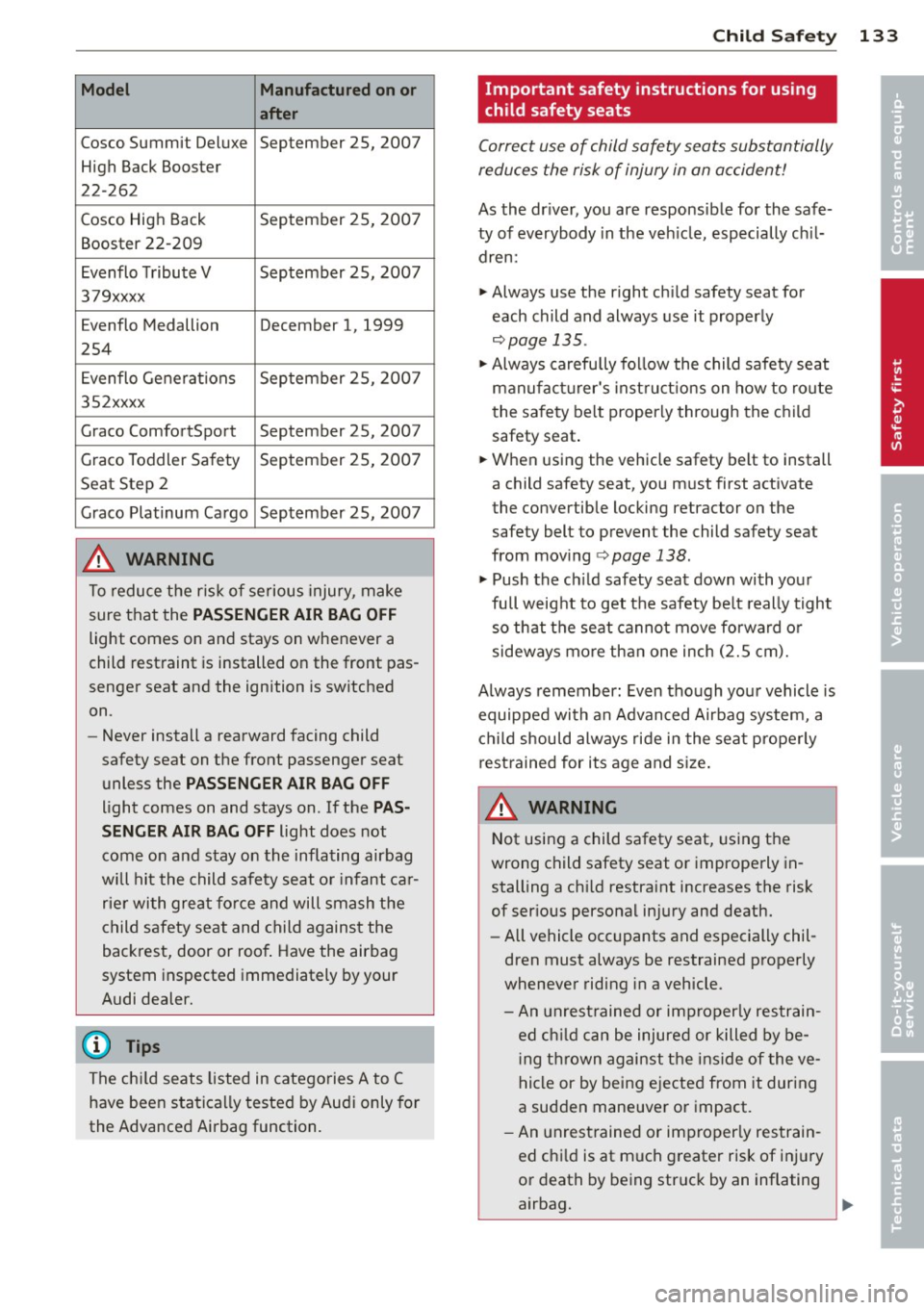
The ch ild seats listed in categories A to C
have been statically tested by Audi only for
the Advanced Airbag function.
Child Sa fet y 133
Important safety instructions for us ing
child safety seats
Correct use of child safety seats substantially
reduces the risk of injury in an accident!
As the dr iver, you are responsible for the safe
ty of everybody in the veh icle, especially ch il
dren:
.. Always use the right child safety seat for
each child and always use it properly
r=;, page 135.
.. Always carefully fo llow the child safe ty seat
manufact urer's inst ruct ions on how to ro ute
the sa fe ty belt properly through the c hild
safety seat .
.. When using the vehicle safety belt to install
a child safety seat, you must first activate
the convertible locking retractor on the
safety belt to prevent the child safety seat
from mov ing
¢ page 138.
.. Push the ch ild safety seat down with your
full weight to get the safety be lt really tight
so that the seat cannot move fo rward o r
sideways more th an one inch
(2.5 cm).
Always remember: Even tho ugh your vehicle is
equipped with an Advan ced Airbag system, a
ch ild should always ride in the sea t properly
restrained for its age and s ize .
_& WARNING ,-= ~
Not using a child safety seat, using the
wrong child safety seat or improperly in
stalling a ch ild restraint increases the risk
of ser ious personal injury and death.
- All vehicle occupants and especially chil
dren must always be restrained properly
whenever riding i n a vehicle.
- An unrest rained or imp roper ly restrain
ed ch ild ca n be injured or killed by be
i ng th rown against the ins ide of the ve
hicle or by being e jected from it during
a sudden maneuve r or impact.
- An unrest rained or improper ly res train
ed ch ild is at much greater risk of inj ury
or death by being struck by an inflating
airbag.
•
•
Page 139 of 244
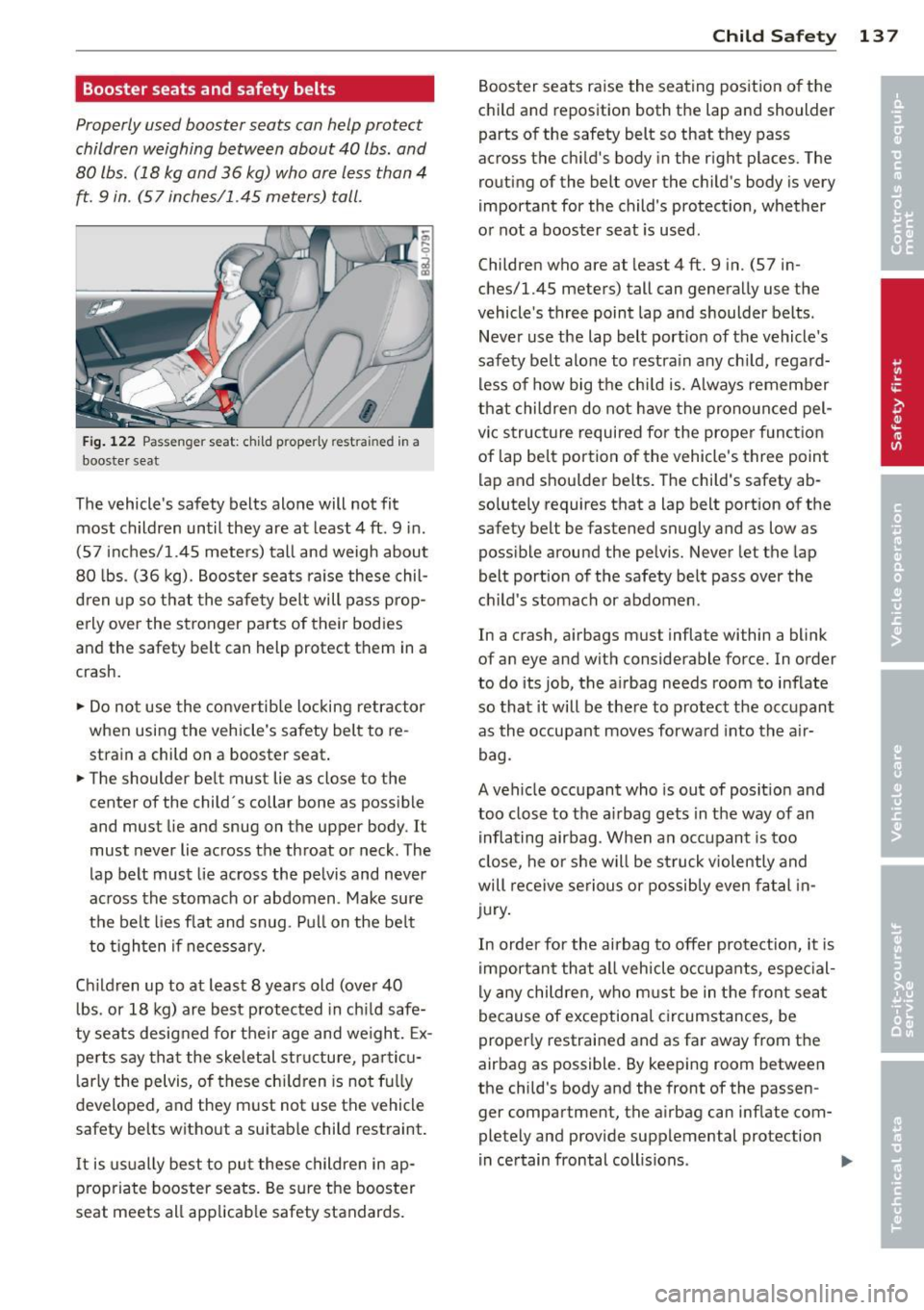
Booster seats and safety belts
Properly used booster seats can help protect
children weighing between about 40 lbs. and
80 lbs. (18 kg and 36 kg) who are less than 4
ft. 9 in . (57 inches/1 .45 meters) tall.
F ig . 122 Passen ger seat : child p roper ly rest ra in ed in a
booster sea t
The vehicle's safety belts alone will not fit
most children until they are at least 4
ft . 9 in .
(57 inches/1.45 meters) tall and weigh about
80 lbs .
(36 kg). Booster sea ts ra ise these chil
dren up so that the safety belt will pass prop
erly over the stronger parts of their bodies
and the safety belt can help protect them in a
crash.
.,. Do no t use the convertible locking retr actor
when using the vehicle's safety belt to re strain a child on a booster seat .
.. The shoulder be lt must lie as close to the
center of the child 's collar bone as possible
and must lie and snug on the upper body. It must never lie across the throat or neck . The
lap belt must lie across the pelvis and never
across the stomach or abdomen . Make sure
the belt lies flat and snug . P ull on the be lt
to t ighten if necessary.
Ch ildren up to at least 8 years old (over 40
lbs . or 18 kg) are best protected in child safe
ty seats designed for the ir age and we ight. Ex
perts say that the ske letal structu re, pa rticu
l arly the pelvis, of these ch ildren is not fully
developed, and they m ust not use the vehicle
safety belts without a suitab le child restraint.
It is us ually best to put these childre n in ap
propriate booster seats. Be sure the booster
seat meets all app licab le safety standards. Child S
afety 13 7
Booster seats ra ise the seating pos ition o f the
child and reposition both the lap and shoulder
parts of the safety belt so that they pass
across the ch ild's body in the right p laces. The
routing of the belt over the ch ild's body is very
important for the child's protect ion, whether
o r not a booster seat is used.
Children who are at least 4
ft. 9 in. (57 in
ches/1.45 meters) tall can generally use the
vehicle's three point lap and shoulder belts .
Never use the lap belt port io n of the vehicle's
safety be lt alone to restra in any chi ld, regard
less of how big the ch ild is. Always remember
that children do not have the prono unced pel
vic struc ture required for the proper funct ion
of lap belt portion of the vehicle's three point
lap and shou lder belts. The child 's safety ab
solutely requires that a lap belt portion of the
safety belt be fastened snugly and as low as poss ible around the pelvis. Never let the lap
belt portion of the safety belt pass over the
c hi ld 's stomach or abdomen.
In a crash , a irbags must inflate within a blink
of an eye and with considerable force. In order
to do its job, the a irbag needs room to i nflate
so that it will be the re to protect the occupant
as the occupant moves forward into the a ir
bag .
A vehicle occupant who is out of posit ion and
too close to the a irbag gets in the way of an
inflating airbag . When an occupant is too
close, he or she will be st ruck violently and
will receive se rious or possibly even fat al in-
J LI ry .
In order for the airbag to offer protection, it is
importan t that all veh icle occupants, espec ial
ly any children, who m ust be in t he front sea t
because of exceptional c ircumstances, be
properly restrained and as far away from the
airbag as possible. By keeping room between
the child's body and the front of the passen ger compartment, the a irbag can inflate com
pletely and provide supplemental protection
in ce rtain frontal collisions .
Page 142 of 244
140 Child Saf ety
and child against the backrest, door or
ro of.
- Always be especially careful if you mu st
ins tall a rearward facing c hild safety seat
on the front passenger seat in exception
al circumstanc es.
- Make sure that the
PA SS ENGER AIR BAG
OFF
light comes on and stays on all the
t ime w henever the ignition is switched
on.
- Never install a rearward facing child
safety seat on the front passenger seat
unless the
PASSENGER AIR BAG OFF
light comes on and stays on. If the PAS·
SENGER AIR BAG OFF
light does not
come on and stay on h ave the airbag sys
tem inspec ted immediately by your Aud i
dealer .
Activating the convertible locking
retractor
Use the convertible locking retractor to se
cure a child restraint.
A lways heed the child sa fety seat man ufactur
er's instructions when ins talling a chi ld re
straint in your vehicle . To activate the conver
tib le locking retractor:
., Place the child restrain t on a seat .
., Slow ly pull the be lt
all the wa y out.
., Route it around or through the chi ld re
stra int be lt path
c:> ,&. .
., Push the child safety seat down with your
full weight to get the safety belt rea lly t ight.
., In sert the be lt tongue into the buckle fo r
t h at seating posi tion.
., Gu ide the safety be lt back into the retracto r
u nt il the belt lies flat a nd snug on the chi ld
sa fe ty seat.
., You should hear a "clicking" noise as the
belt winds bac k into the ine rtia reel. Test the
conve rtible locking retractor by pull ing on
the be lt . You should no longer be able to
pull the belt out of the retractor. The con
vertib le lock ing retractor is now act ivated. .,
Ma ke s ure that the red release button is fac
ing away from the child rest raint so that it
can be unbuckled q uick ly .
., Pull on the belt to make sure the safety be lt
is properly tight and fastened so that the
seat ca nnot move forward or sideways more
t han one inch (2.5 cm) .
A WARNING
Using the wrong child res traint o r an i m
pr operly ins talled chi ld restraint can cause
se rious pe rsonal injury or death in a crash.
- Always ma ke sure that the safety belt re-
trac to r i s lo cked when insta lling a child
safety seat . An un locked safety bel t re
tracto r cannot hold the child safety seat
in place dur ing no rma l dr iving o r in a
crash.
- Always buckle the child safety seat firmly
in place even if a ch ild is not sitt ing in it.
A loose child safety seat can fly around
during a sudden stop or in a crash.
- Always make sure the seat backrest to
which the child restraint is installed is in
an upright pos ition. Otherw ise, the seat
back with the ch ild safety seat attached
to it could fly forward in the event of an
accident o r othe r emergency situation.
- Always read and heed all WAR NIN GS
wheneve r using a child res trained in ave
h icle is being used
c:> page 130. Special
p re ca utions apply when insta lling a child
safe ty se at on the fron t passenger seat
<=> page 110, Child restraints on the front
seat -some important things to know .
Deactivating the convertible locking
retractor
-
The convertible locking retractor for child re
straints will be deactivated automatically when the belt is wound all the way back into
the retractor.
., Press the red b utton on the safety belt buck
le . The belt tong ue will pop out of the b uck
le .
., Guide the safety be lt all the way back into
its stowed position .
Page 145 of 244

switched on all the time. In certain situations
when you need less traction, you can switch
off ESC by pressing the button
lru. Be sure to
switch ESC on again when you no longer need
less traction.
Anti-lock braking system (ABS)
ABS prevents the wheels from locking up
when braking . The vehicle can still be steered
even during hard braking . Apply steady pres
sure to the brake pedal. Do not pump the ped
al. A pulsing in the brake pedal indicates that
the system is helping you to brake the vehicle.
Brake assist system
The brake assist system can decrease braking
d istance. It increases braking power when the
driver presses the brake pedal quickly in emer
gency si tuations. You must press and hold the
brake pedal until the situation is over .
Anti-slip regulation (ASR)
ASR reduces engine power when the drive
wheels begin to spin and adapts the force to
the road condit ions. This makes it easier to
start, accelerate and drive up hills.
Electronic differential lock (EDL)
The EDL brakes wheels that are spinning and
transfers the drive power to the other drive
wheel or whee ls if the vehicle is equipped with
all-wheel drive*. This function is available up
to about 60 mph (100 km/h) .
In extreme cases, EDL automat ica lly switches
off to help keep the brake on the braked wheel
from overheating. EDL w ill switch on again au
tomatically when conditions have returned to
normal.
..&, WARNING
- ESC, ABS, ASR and EDL cannot overcome
th e laws of physics. This is especially im
portant on slippery or wet roads.
If the
systems begin acting to stabilize your ve
hicle, you should immediately change
your speed to match the road and traffic
condit ions. Do not let the increased safe
ty provided by these systems tempt you
Intelligent technology 143
to take risks. Doing so will increase the
risk of a lo ss of vehicle control, co llision
and serious personal injuries.
- Always adapt your speed to road, traffic
and weather conditions. The risk of los
ing control of the vehicle increases when
driving too fast, especially through
curves and on slippery or wet roads, and
when driving too close to vehicles up
ahead. ESC, ABS, the brake assist sys
tem, EDL and ASR cannot prevent colli
sions.
- Always accelerate with special care on
even, smooth surfaces such as those that
are wet or covered with ice and snow.
The drive wheels can spin even with
these assistance systems that cannot al
ways he lp to reduce the risk of loss of ve
hicle control.
@ Tips
- ABS and ASR only work correct ly when
all four whee ls are equipped with identi
cal tires. D ifferent tire si zes can lead to a
reduction in engine power.
- You may hear noises when the systems
described are working.
- If the ind icator lightD] orE (USA
models)/ [iJ (Canada models) appears,
there may be a malfunction¢
page 18,
¢ page 18.
Switching on and off
ESC turns on au tomatically when you start
the engine.
Fig . 123 Ce nter conso le: ESC OFF butto n
Page 146 of 244

144 Intelligent technology
Switching ESC off (sport mode )
In certain situat ions, it m ight make sense to
allow some sl ip. For example :
- Rocking the vehicle to free it when it is stuck
- Driv ing in deep snow or on loose ground
- Driving with snow chains
Press the~ button . The ESC ind icator light
II
turns on and Stabilization prog ram off ap
pears in the d isplay. ASR deactivates com
p letely and the stabi lizat ion effects from the
ESC system are limited .
Switch ing on
Press the~ button again. The message Stabi
li zation p rogram on
appears briefly in the dis
p lay.
A WARNING
Only switch ESC sport mode on when your
driving abilities and the traffic s ituation
permit. Please note that the dr iv ing
wheels can spin and the vehicle can break a w ay in ESC sport mode, especia lly when
the road is slippe ry.
(D Tips
If the re are faults in the rea r spo ile r sys
tem or in Audi magnet ic r ide, it may not be
possible to a ct ivate ESC spor t mode or
normal m ode may a ct ivate aga in a utomat
ically.
Rear spoiler
A ppl ies to vehicles: with ret ractab le rear spoil er
The rear spoiler improves vehicle handling
and enhances driver control.
F ig. 124 Sw itch fo r rear spo ile r
The rear spoi le r deploys and retracts . Spoiler
operation can be set for a utomatic or man ua l
operation.
Automatic mode (normal operation )
-Automatic deployme nt: At a speed of about
75 mph (120 km/h), t he rear spo ile r deploys
automatically.
- Au tomatic retraction: When speed drops be
low about SO mph (80 km/h), the rear spoil
er retracts automat ica lly.
Manual mode
- Manual deployment: Tapp ing briefly on the
sw itch
¢fig. 124 deploys the rear spoiler.
- Manual retraction: At sp eeds up to about
10 mph ( 20 km/h), retract the rear spoiler
by pressing a nd ho ldi ng the sw itch
¢ fig . 124. At speeds be twee n 10 mph ( 20
km/h) a nd 75 mph ( 120 km/h), retract the
rear spoi ler by tapping on the switch
¢fig. 124.
A WARNING
-
Driving at higher speeds witho ut the rear
spoiler deployed ca n impair handling char
acter istics, making the vehicle harder to
control.
- Always ma ke sure that the spo ile r is de
p loyed when driving at speeds over
85 mph (140 km/h) .
If the rear spoiler
war ning/ indicato r light in the inst ru
men t clu ster comes on, the rear sp oiler
may not have deployed.
- N ever d rive a t speeds h igher than
85 mph (140 km/h) i f the spoiler is no t
deploye d. Have the spoiler inspected as
soon as possible by an a uthorized Audi
deale r or q ualified workshop.
- Always obey speed limits and othe r tra f
fic laws .
A WARNING
-Improper operation of the rear spoi ler can
cause crushing injuries.
- Always make sure that nobody, especially
chi ldren, is in t he way when the rear
spoiler is deployed or retracted.
Page 148 of 244

146 Intellig ent technolog y
gear or lower driving range. Do no t ride
t h e brakes or hold the pedal down too
long or too often. This cou ld cause the
bra kes to get hot and dimin ish braking
efficiency .
- Do no t "ride the brakes" by resting your
foot on the pedal when you do not intend
to brake . Th is may cause the brakes to
overheat, prematu re wear and inc reased
stopp ing distan ce.
- Under certain climat ic and operating
c ondit ions such as passing through wa
ter, driving i n heavy ra in or after wash ing
the vehicle, the effect iveness of the
brakes can be red uced . In winter, ice can
accumulate on the brake pads, linings,
discs and d rums . Carefully apply brakes
for a test . Brakes will dry and ice coat
ings will be cleaned off after a few care
ful brake applications.
- Driving for an extended period of time on
salt-covered roads w ithout us ing your
brakes can also affect braking efficiency .
Clean off accumulated salt coating from
brake d iscs and pads w it h a few cautious
brake appli cat ions.
- If you damage the fro nt spo iler, or if you
ins tall a different spoiler, be su re the air
flow to the fron t bra kes is not o bstr uct
ed. O therwise the brake system co uld
overheat reducing the effectiveness of
the entire brake system.
- F ailure o f one bra ke c ircuit will impair
the b raking capability resulting in an in
creased stopp ing distance . Avoid driv ing
the vehicle and have it towed to the near
est Aud i dea le r o r qualified workshop.
- Never let the vehicle ro ll to a stop w ith
the engine shut off.
- If the brake booster is not working, t he
brake pedal must be pressed considera
bly harder to make up for the lack of
booster assistance . Electro-mechanical
power assist
The electro-mechanical power assist helps
the driver when steering .
The degree of power assi st is electronically
matched to vehicle speed .
T he power steering system assists the driver
so that he can steer the vehicle with reduced
physical effor t.
Power steering will not work if t he engine is
off . As a result, the steering wheel will be hard
to turn.
A WARNING
If the system develops a problem , you
must seek qualified profess iona l assis
tance .
(D Note
-
If there is an e lectronic malfunction, ser
votronic
will still function like a conven
tiona l power steering system, providing a
constant steering support force that is no
l onge r proportionate to the vehicle speed .
This is most not icea ble whe n tu rni ng the
s tee ring w heel a t low speeds (fo r example
when pa rking), -more effort w ill be re
q uired than us ua l.
- Be aware o f the diffe rent than usual
steering response and adjust your steer
ing force acco rdingly.
- Have the problem checked and set right
by an autho rize d Aud i dealer as soon as
possible.
- If a s teer ing mal func tion occurs, this is
signa led wit h the
,'Zr~ or .• indicato r
lights and a warning tone, see.
(D Tips
- If the powe r stee ring system sho uld fai l,
or if the engine is not ru nning (fo r exam
ple, whi le being towed), you will still be
able to steer the vehicle. However, more
effort will be required to do so.
11-