2014 AUDI TT ROADSTER oil
[x] Cancel search: oilPage 147 of 244

(D Note
Never push the vehicle or apply force to
the rear spoiler -it could be damaged.
@ Tips
Clean the spoiler compartment every 2 to
3 months . The spoiler compartment must
always be free of ice, snow, leaves or other
debris.
Braking
General information
What affects braking efficiency?
Oper ating condit ions and d riving hab it s
T he brakes on today's automobi les are st ill
s ubject to wear, depending largely on opera t
ing conditions and dr iv ing habi ts
c> & . On
vehicles that are e ither driven mostly in stop
and-go city traffic or are d riven hard , the
b rake pads should be checked by you r author
i zed Audi dealer more often than specified i n
the
Warr ant y & Maint enan ce booklet . Failure
to have your brake pads inspected can res ult
in red uced brake performance.
On steep slopes, you shou ld use the brak ing
effect of the eng ine. This way, you p revent un
necessa ry wear on the brake system . If you
must use yo ur brakes, do not hold the brakes
down continuously. Pump th e brakes at inter
vals.
Noises may occur when braking d epending on
the speed, braki ng force and outside condi
tions such as temperature and humidity.
Moistu re or road salt
Unde r certain conditions, for example, w hen
driving through water or ve ry heavy rain, or
even after washing your vehicle, the braking
effect can be reduced d ue to moisture (or in
fre ezing conditions ice) on the brake pads . A
few ca utious brake applicat ions should dry off
the b rake pads or remove any ice coatings.
The effectiveness of the brakes can be reduced
when th e vehicle is driven on a salt-covered
Int ellig ent technolog y 145
road and the b rakes are no t used. Likewise ,
you clean off accumulated salt coating from brake d iscs and pads with a few cautious ap
plications of the brake
c> & .
Cor ro sion
T here may be a tendency for dir t to build up
on the brake pads and corrosion to form on
the discs if the car is not driven regu larly or
on ly fo r short trips with litt le use of the
brakes.
If the brakes are not used frequently, or if cor
rosion has formed on the discs, it is advisable
to clean off the pads and discs by braking
firmly a few times from a moderately high
speed
c> & .
Faults in the brak e syst em
If you shou ld notice a sudden increase in
brake pedal trave l, then one of the two brake
c ircuits may have fai led
c> & .
Low brake fluid lev el
Malfunctions can occur in the brake system if
the b rake fluid level is too low. The brake fluid
level is monitored electronica lly.
Brake booster
T he brake booster inc reases the pressure that
you generate with the brake peda l. It works
o nl y when the engine is running
.c> &
Brake lining wear status
Brake lining wear may be checked by visual in
spection of the condition of the brake pads
through the open ings in the wheel. If neces
sary, the wheel may be removed for t his in
spection
c> page 209, What should I be
aware of when changing a tire? .
A WARNING
--=
-You should perform braking maneuvers
for the purpose of cleaning the brake
system only if road conditions permit.
Other road users must not be put at risk -
you may cause an accident!
- Before descend ing a steep grade, reduce
speed and sh ift transmission into a lower
~
•
•
Page 148 of 244

146 Intellig ent technolog y
gear or lower driving range. Do no t ride
t h e brakes or hold the pedal down too
long or too often. This cou ld cause the
bra kes to get hot and dimin ish braking
efficiency .
- Do no t "ride the brakes" by resting your
foot on the pedal when you do not intend
to brake . Th is may cause the brakes to
overheat, prematu re wear and inc reased
stopp ing distan ce.
- Under certain climat ic and operating
c ondit ions such as passing through wa
ter, driving i n heavy ra in or after wash ing
the vehicle, the effect iveness of the
brakes can be red uced . In winter, ice can
accumulate on the brake pads, linings,
discs and d rums . Carefully apply brakes
for a test . Brakes will dry and ice coat
ings will be cleaned off after a few care
ful brake applications.
- Driving for an extended period of time on
salt-covered roads w ithout us ing your
brakes can also affect braking efficiency .
Clean off accumulated salt coating from
brake d iscs and pads w it h a few cautious
brake appli cat ions.
- If you damage the fro nt spo iler, or if you
ins tall a different spoiler, be su re the air
flow to the fron t bra kes is not o bstr uct
ed. O therwise the brake system co uld
overheat reducing the effectiveness of
the entire brake system.
- F ailure o f one bra ke c ircuit will impair
the b raking capability resulting in an in
creased stopp ing distance . Avoid driv ing
the vehicle and have it towed to the near
est Aud i dea le r o r qualified workshop.
- Never let the vehicle ro ll to a stop w ith
the engine shut off.
- If the brake booster is not working, t he
brake pedal must be pressed considera
bly harder to make up for the lack of
booster assistance . Electro-mechanical
power assist
The electro-mechanical power assist helps
the driver when steering .
The degree of power assi st is electronically
matched to vehicle speed .
T he power steering system assists the driver
so that he can steer the vehicle with reduced
physical effor t.
Power steering will not work if t he engine is
off . As a result, the steering wheel will be hard
to turn.
A WARNING
If the system develops a problem , you
must seek qualified profess iona l assis
tance .
(D Note
-
If there is an e lectronic malfunction, ser
votronic
will still function like a conven
tiona l power steering system, providing a
constant steering support force that is no
l onge r proportionate to the vehicle speed .
This is most not icea ble whe n tu rni ng the
s tee ring w heel a t low speeds (fo r example
when pa rking), -more effort w ill be re
q uired than us ua l.
- Be aware o f the diffe rent than usual
steering response and adjust your steer
ing force acco rdingly.
- Have the problem checked and set right
by an autho rize d Aud i dealer as soon as
possible.
- If a s teer ing mal func tion occurs, this is
signa led wit h the
,'Zr~ or .• indicato r
lights and a warning tone, see.
(D Tips
- If the powe r stee ring system sho uld fai l,
or if the engine is not ru nning (fo r exam
ple, whi le being towed), you will still be
able to steer the vehicle. However, more
effort will be required to do so.
11-
Page 153 of 244

Avoid damaging the
vehicle
When you are driving on poor roads, or over
curbs, steep ramps, etc., make certain that
low-lying parts such as spoilers and exhaust
system parts do not bottom out and get dam
aged.
T his is especially true for vehicles with low
slung chassis (sports chassis) and fully loaded
vehicles .
Driving through water
on roads
Note the following to avoid vehicle damage
when driving through water, for example on
flooded roads:
- T he water must not be any higher than the
bottom of the veh icle body.
- Do not d rive faster than wa lking speed.
..&, WARNING
After driving through wate r, m ud, slush,
etc., the brakes may be slow to take effect
because of wet brake rotors and pads . Dry
the brakes first by braking carefully to re
store the full braking effect.
(D Note
Vehicle components such as the engine,
transmiss ion, suspension or electrical sys
tem can be severely damaged by driving
through water.
- Check the depth of the water before driv
ing through it.
- Do not s top the veh icle, drive in reverse
or switch the engine off when driving
through water.
- Keep in mind that oncoming vehicles may create waves that raise the water
level and make it too deep for your vehi
cle to drive through safely.
- Avoid driving thro ugh sa lt water because
it can cause corrosion.
-
Dri vin g and en vironm ent 151
Catalytic converter
It is very important that your emission con
trol system (catalytic converter) is function
ing properly to ensure that your vehicle is run
ning in an environmentally sound manner .
.,. Always use lead-free gasoline¢ page 161 ,
Fuel supply.
.,. Never run the tank down all the way to emp
ty.
.,. Never put too much motor o il in your engine
c:::> page 170, Adding engine oil 9::71 .
.,. Never try to push- or tow-sta rt you r vehicle.
The catalytic converter is an efficient "clean
up" dev ice built into the exhaust system of
the vehicle. The cata lytic conve rter bu rns
many of the pollutants in the exha ust gas be
f ore they are re leased into the atmosphere .
T he exclusive use of unleaded fuel is critically
important for the life of the catalyt ic convert
er and prope r fu nct ion ing of the engine .
A WARNING
-
- Do not park or operate the vehicle in
areas where the hot exha ust system may
come in contact with dry grass, brush,
fue l spill or other materia l wh ich can
cause a fire .
- Do not apply additional undercoating or
rustproof ing on or near the exhaust
manifold, exhaust pipes, catalytic con
verter or heat shields. Dur ing driving, the
substance used for undercoating could
overheat and cause a fire .
(I) Note
-Be aware that just one tank filling with
leaded fuel w ill already ser iously de
grade the performance of the catalytic
converte r.
- Do not exceed the correct eng ine oil level
c:::> page 170.
- Do not drive until the fue l tank becomes
completely empty . The engine could m is-
fire. Unburned fuel could also get into
IJ,,
•
•
Page 155 of 244

Avoid full throttle
Driving at moderate speeds saves fuel and
improves your mileage.
""Try and keep well below your car's maximum
speed.
Accelerating gently reduces fuel consump
tion, engine wear, and does not disturb the
environment.
Fu el consumption, exhaust emissions and en
g ine noise increase disproportionately at high
speeds. If you drive at approximately three
quarters of top speed, fuel consumption will
be reduced by one half. Never drive faster
than the posted speed limit and weather con
ditions permit .
Reducing unnecessary idling
Even when your car is just idling it burns up
fuel.
""Shut the engine off when you are not driving
the vehicle.
""Do not warm up the vehicle by letting the
engine run at idle .
It makes sense to shut
off the engine in traff ic
jams, when waiting for trains to pass at ra il
road crossings, or at traffic lights that have
l ong wa its on red. Turning the engine
off for
just
30-40 seconds saves more fue l than is
burned starting the engine again .
It takes a long time for the engine to warm up
fully when it is running at idle. However, wear
and noxious emissions are especially high
when the engine is warming up. So you should
drive away as soon as you start the engine and
avoid running at high RPMs whi le the engine
is sti ll warming up .
(D Note
Do not leave engine idling unattended af
ter starting . If warning lights should come
on to indicate improper operation, they
would go unheeded. Extended idling also
produces heat, which could result in over-
Driving and environment 153
'
heating or othe r damage to the vehicle or
other property.
Regular maintenance
A badly tuned engine unnecessarily wastes a
lot of fuel.
""H ave your veh icle serviced at regular inter-
vals.
By having your vehicle regu larly serviced by an
Audi dealer helps to ensu re that it runs prop
erly and economically. The condition of your
vehicle not only affects its safety and ability to
hold its value, it also affects
fuel consump
tion.
Check your oil each time you fill your tank.
The amount of o il used is related to engine
load and speed.
It is normal for the oil consumption of a new
engine to reach its lowest value after a certain
mileage has been driven.
You must drive your vehicle about 3,000 miles
(5,000 kilometres) before you can properly
assess oil consumpt ion.
This also app lies to fue l consumption and en
gine output.
(U) Note
- Have your vehicle maintained properly
and in accordance with the service rec
ommendations in your Warranty
& Main
tenance booklet. Lack of proper mainte
nance as well as improper use of the ve
hicle will impair the function of the
emission control system and could lead
to damage.
- Do not alter or remove any component of
the Emission Control System unless ap
proved by the manufacturer.
- Do not alter or remove any device, such
as heat shields, switches, ignition wires,
valves, which are designed to protect
your vehicle's Emission Control System
and other important vehicle compo
nents .
•
•
Page 158 of 244

156 Vehicle care and cleaning
_& WARNING
- Only wash the vehicle when the ignition
is off and follow the instructions from
the car wash operator to reduce the risk
of accidents.
- To reduce the risk of cuts, protect your
self from sharp metal components when
washing the underbody or the inside of
the wheel housings.
- After washing the vehicle, the braking ef
fect may be delayed due to moisture on
the brake rotors or ice in the winter. The
brakes must be dried first with a few
careful brake applications .
@ Note
- If you wash the vehicle in an automatic
car wash, you must fold the exterior mir
rors in to reduce the risk of damage to
the mirrors. Power folding exterior mir rors* must only be folded in and out us
ing the power folding function.
- To prevent paint damage, do not wash
the vehicle in direct sunlight.
- To reduce the risk of damage, do not
wash the power top with a pressure
washer. -
To reduce the risk of damage, do not
wash decorative decals* with a pressure
washer.
- To reduc e the risk of damage to the sur
face, do not use insect removing spong
es, kitchen sponges or similar items.
- Matte finish painted vehicle compo
nents:
- To reduce the risk of damage to the
surface, do not use polishing agents or
hard wax.
- Never use car wash cycles that apply
protective wax.
It can destroy the
matte finish effect.
- Do not place any stickers or magnetic
signs on vehicle parts painted with matte finish paint. The paint could be
damaged when the stickers or magnets
are removed.
@ For the sake of the environment
Only wash the vehicle in facilities specially
designed for that purpose. This will reduce
the risk of dirty water contaminated with
oil from entering the sewer system.
Cleaning and care information
When cleaning and caring for individual vehi
cle components, refer to the following table.
The information contained there is simply rec
ommendations. For questions or for compo- nents that are not listed,
refer to an author
ized Audi dealer or a qualified workshop. Also
follow the information found in~.&. .
Cleaning exterior Component Situation Solution
Wiper blades Dirty
~ page 56, Cleaning windshield wiper blades
Headlights/ Dirty Soft sponge with a mild soap solutional
tail lights
Sensors Dirty Sensors: soft cloth with a solvent-free cleaning product
Camera lenses: soft cloth with an alcohol-free cleaning
solution
Snow/ice Hand brush/solvent-free de-icing spray
Wheels Road salt Water
Brake dust Acid-free special
cleaning solution
Page 159 of 244
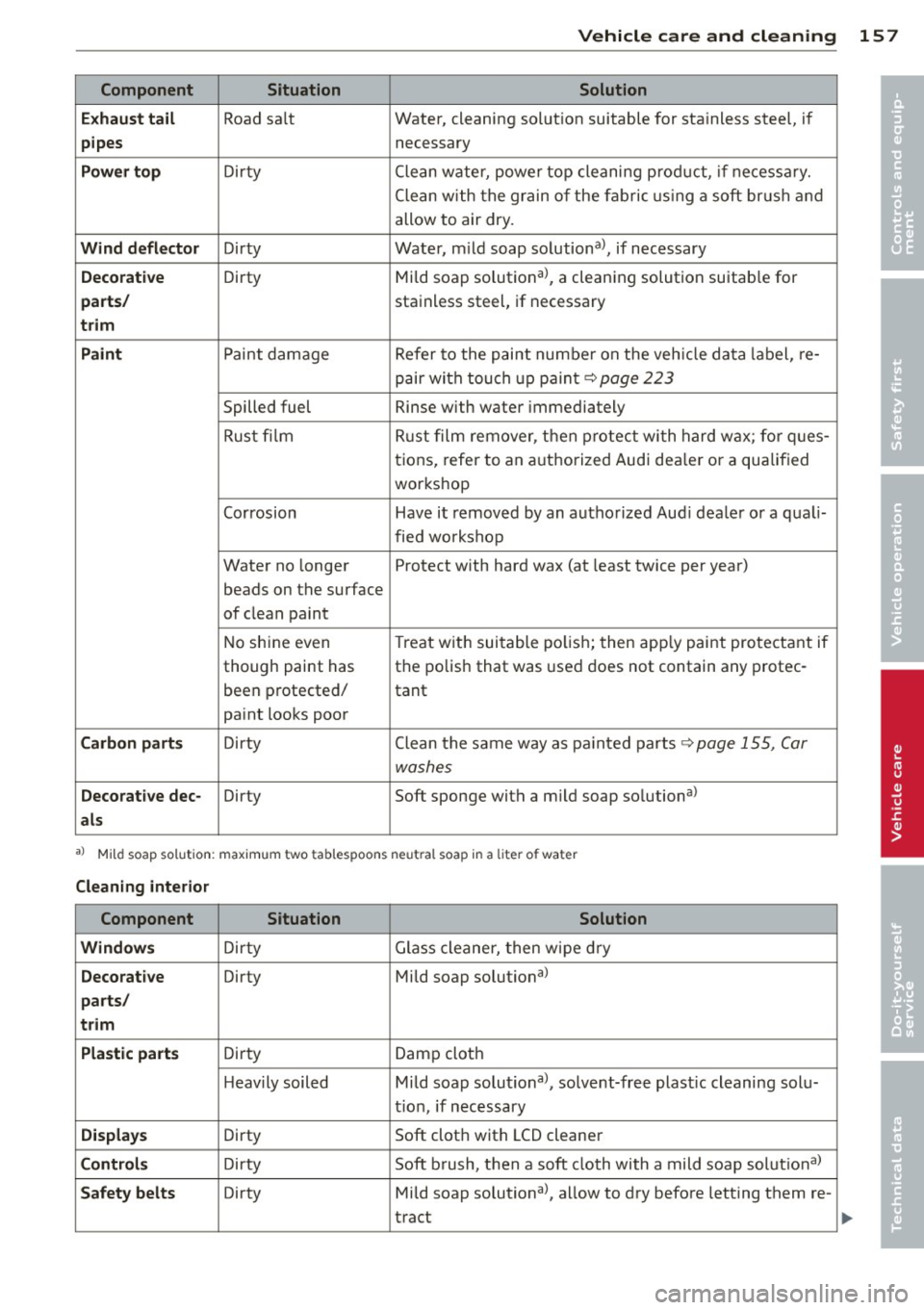
Vehicl e ca re a nd cl eanin g 157
Component Situat ion Solution
Ex ha ust t ail
Road sa lt Water,
cleaning solution suitable for stainless steel, if
pip es necessary
Power to p Dirty Clean water, power top cleaning product, if necessary.
Clean with the grain of the fabric using a soft brush and
allow to air dry.
Wind d efl ec tor Dirty Water, mild soap solutiona>, if necessary
Deco rati ve Dirty Mild soap solutiona>, a cleaning solution suitab le for
p ar ts/ stainless steel, if necessary
trim
P ai nt
Paint damage Refer to the paint number on the veh icle data label, re-
pair with touch up paint ~
page 223
Spilled fuel Rinse with water immediately
Rust fi lm Rust film 1 remover, then protect with hard wax; for q ues -
tions, refer to an authorized Audi dea ler or a qualified
workshop
Corrosion Have it removed by an authorized Aud i dealer or a qua li-
fied workshop
Water no longer Protect with hard wax (at least twice per year)
beads on the surface
of clean paint
No shine even Treat
wit h suitable polish; then app ly paint protectant if
though paint has the
polish that was used does not contain any protec-
been protected/ tant
pa int looks poor
Carbon part s Dirty Clean the same way as pa inted parts ~ page 155, Car
washes
De corat ive d ee-
Dirty Soft sponge with a mild soap solutiona>
als
al Mi ld soap solution : maximu m two tablespoons neutral soap in a liter of water
Clean ing int erior
Component Situ ation Solution
Wind ow s
Dirty Glass cleaner, then wipe dry
Dec orat ive Dirty Mild soap solutional
part s/
t rim
Pl as tic part s
Dirty Damp cloth
H eav ily soiled Mild soap solutional, solvent-free plastic cleaning solu-
t ion, if necessary
Di spl ays Dirty Soft cloth with LCD cleaner
Co nt rols Dirty Soft brus .h, then a soft cloth with a mild soap solutional
Sa fet y bel ts Dirty Mild soap solutional, allow to dry before letting them re-
tract
•
•
Page 160 of 244
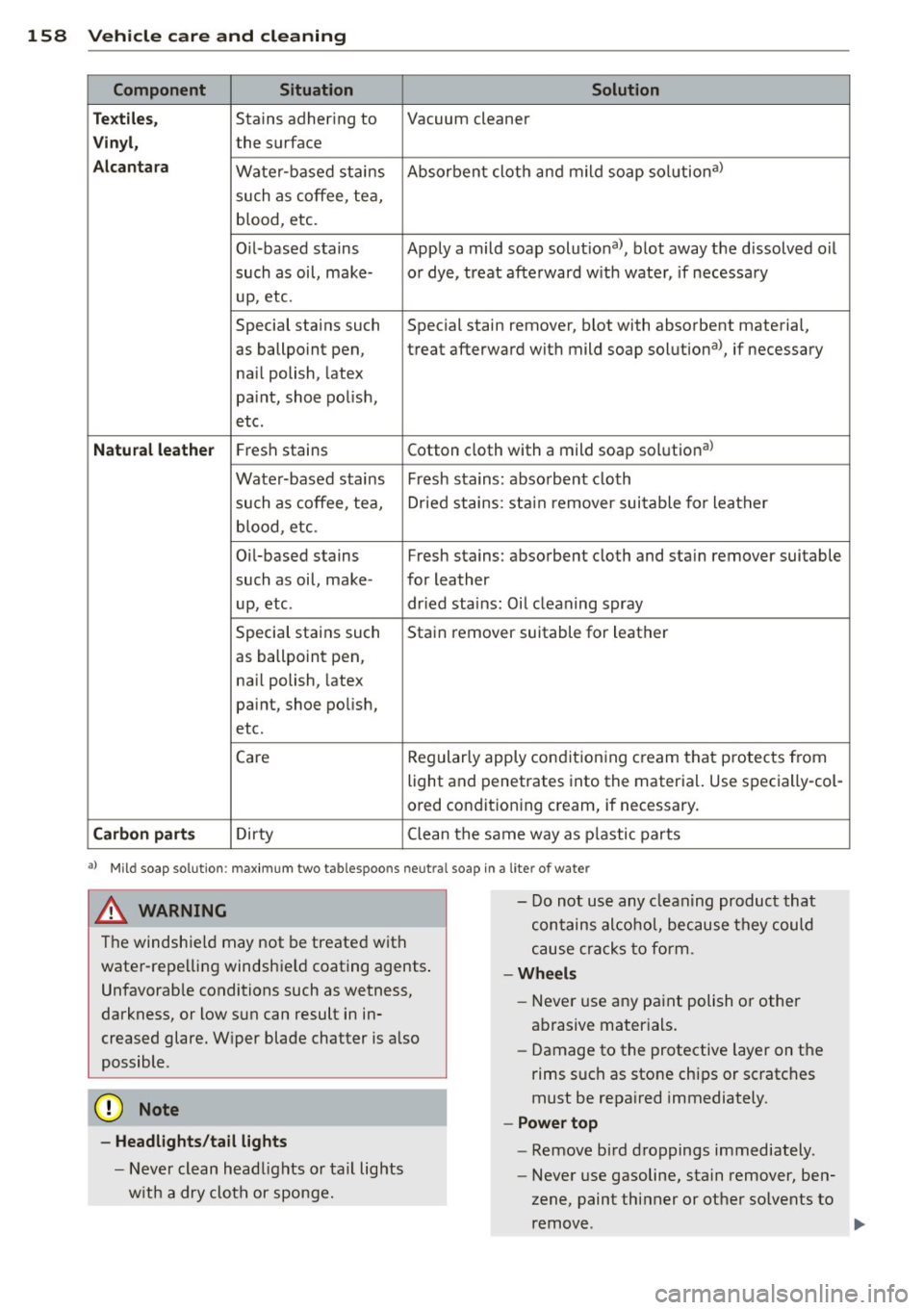
158 Vehicle care and cleaning
Component Situation Solution
T ex tile s,
Stains adhering to Vacuum cleaner
Vin yl, the surface
Alcan ta ra Water -based stains Absorbent cloth and mild soap solutiona>
such as coffee, tea,
blood, etc.
O il-based stains Apply a mild soap solutiona>, blot away the d issolved oil
such as oil, make- or dye, treat afte rward w ith water, if necessary
up, etc.
Special stains such Special stain remover, b lot with absorbent material,
as ballpoint pen, treat afterward with mild soap solutiona>, if necessary
na il polish, latex
pa int, shoe po lish,
etc.
Natu ral leather Fresh stains Cotton cloth with a mild soap solutiona>
Wate r-based stains Fresh s tains: absorbent cloth
such as coffee, tea, Dr ied stains: sta in remover sui table for leather
blood, etc.
Oi l-based stains Fresh stains: absorbent cloth and sta in remover suitable
such as oil, make- for leather
up, etc. dried stains: Oil cleaning spray
Special stains such Stain remover suitable for leather
as ballpo int pen,
na il polish, latex
pa int, shoe polish,
etc.
Care Regular
ly apply condit ion ing c ream that protec ts from
light a nd penetrates into the materia l. Use specially-col-
ored conditioning cream, if necessary.
Carbon part s Dirty Clean tlhe same way as plastic parts
a) Mi ld soap solut ion : maximum two tablespoons neut ra l soap in a lite r of wate r
& WARNING
The windshie ld may not be treated with
water -repe lling windshield coating agents .
Unfavorab le conditions such as wetness,
darkness, or low sun can result in in
creased glare. W iper blade chatter is a lso
possible .
(V Note
- Headlights /tail lights
- Never clean headlights or tail lights
w it h a dry cloth or sponge. -
Do not us e any cleaning product that
contains alcohol, because they could
cause cracks to form.
-Wheels
- Never use any paint polish or other
abrasive mater ials.
- Damage to the protective layer on the
rims such as stone chips or scratc hes
must be repa ired immediately.
- Power top
-Remove bird droppings immediately.
- Never use gasoline, stain remover, ben-
zene, paint thinner or other so lvents to
remove .
Page 168 of 244

166 Checking and filling
-Apply the parking brake.
- Move selector lever to "P" (Park).
- Always let the engine cool down. Hot
components will burn skin on contact.
- To reduce the risk of being burned, never
open the hood if you see or hear steam
or coolant escaping from the engine
compartment . Wait until no steam or
coolant can be seen or heard before care
fully opening the hood.
- Keep children away from the engine com
partment .
- Never spill fluids on hot engine compo
nents. They can cause a fire.
- Never touch the radiator fan. The auxili
ary electric fan is temperature controlled
and can switch on suddenly.
- Never open the coolant reservoir cap
when the engine is still warm. The cool
ant system is pressurized and hot cool
ant could spray out .
- Protect your face, hands and arm from
steam or hot engine coolant by placing a
thick rag over the cap when you open the coolant reservoir .
- Do not remove the engine cover under
any circumstances . This increases the
risk of burns.
- If work on the fuel system or the electri
cal system is necessary:
- Always disconnect the battery .
- Never smoke or work near heaters or
open flames. Fluids in the engine com
partment could start a fire.
- Keep an approved fire extinguisher im
mediately available.
- To avoid electrical shock and personal in
jury while the engine is running or being
started, never touch:
- Ignition cables
- Other components of the high voltage
electronic ignition system.
- If you must perform a check or repair
with the engine running: -
First, fully apply the parking brake,
move selector lever to "P" (Park) .
- Always use extreme caution to prevent
clothing, jewelry, or long hair from get
ting caught in the radiator fan, V-belts
or other moving parts, or from contact ing hot parts. Tie back hair before
starting, and wear no clothing that will hang or droop into the engine.
- Minimize exposure to emission and chemical hazards~&, .
A WARNING
=
California Proposition 65 Warning:
- Engine exhaust, some of its constituents, and certain vehicle components contain
or emit chemicals known to the State of
California to cause cancer and birth de
fects and reproductive harm. In addition,
certain fluids contained in vehicles and
certain products of component wear con
tain or emit chemicals known to the
State of California to cause cancer and
birth defects or other reproductive harm.
- Battery posts, terminals and related ac
cessories contain lead and lead com
pounds, chemicals known to the State of
California to cause cancer and reproduc
tive harms. Wash hands after handling.
(D Note
When adding fluids, always make sure that
they are poured into the proper container
or filler opening, otherwise serious dam
age to vehicle systems will occur.
@) For the sake of the environment
To detect leaks in time, inspect the vehicle
floor pan from underneath regularly. If
you see spots from oil or other vehicle flu ids, have your vehicle inspected by an au
thorized Audi dealer.