2014 AUDI S4 height
[x] Cancel search: heightPage 42 of 296

40 Opening and closing
Power opening/closing rear lid
Applies to vehicles: wit h au tomat ic rear lid ope rat ion
The open position can be adjusted .
Fig. 29 Drive r's door: Unlock ing the rea r lid
-
Fig. 30 Locking sw itch in the rear lid
Opening rear lid
• Press the button cs on the remote key for
at least one second . Or
• Pull the unlock button
cs in the driver's
door¢
fig. 29. Or
• Press the handle on the rear lid~
page 39,
fig. 27.
Closing rear lid
• Press the close button in the open rear lid
~ fig. 30. T he rear lid moves to the closed
position by itself and soft close locks it auto
matically ¢,&. .
Saving the opening angle of the rear lid
• Bring the luggage compartment lid into the
desired open position. The position can only
be stored when the lid is above a certain
height.
• Press and hold the
~ fig. 30 button for at
least four seconds until the lights blink to
store the desired open position . •
To set a highe r open position, wait at least
five seconds and then carefully press the
luggage compartment lid upward.
• Press and hold the¢
fig. 30 button aga in for
at least four seconds and this will store the
new open position .
The settings in the radio or MMI* determine if
the rear lid can be opened using the handle
¢page 37.
Opening will be stopped immediately when:
- You press the
cs button on the remote con-
trol maste r key for at least one second, or
- You press the
cs button in the rear lid , or
- You push the handle in the rear lid, or
- You pull the
cs button in the driver's door,
or
- When something blocks the rear lid or
makes it d ifficult for the lid to move .
If you press one of the buttons
cs now, the
rear lid will ei ther open or close, depending on
its ang le .
If you pull lightly on its handle, the rear lid
will close .
Closing will be stopped immed iately when :
- You press the
cs button in the rear lid , or
- You push the handle in the rear lid, or
- You release the
cs button on the driver's
door, or
- When something blocks the rear lid or
makes it difficult for the lid to move .
If you press one of the buttons
cs now, the
rear lid will either close or open, depending on
its angle.
If you pull lightly on its handle, the rear lid
will close .
You can manually stop the automatic open
ing/closing of the luggage compartment lid.
T he automatic closing process begins if you
push down on the rear lid.
Page 60 of 296

58 Seat s a nd s tor ag e
Seats and storage
General recommen
dations
Why is your seat adjustment so
important?
The safety belts and the airbag system can
only provide maximum protection if the front
seats are correctly adjusted.
There are various ways of adjust ing the front
seats to provide safe and comfortable support
for the driver and the front passenger . Adjust
your seat properly so that :
- you can easily and quick ly reach all the
switches and controls in the instrument
panel
-your body is prope rly supported thus reduc
ing physical stress and fatigue
- the safety be lts and a irbag system can offer
maximum protection ¢
page 146.
In the following sec tions, you will see exactly
how you can best adjust you r seats .
There are special regulations and instructions
for insta lling a child safety seat on the front
passenger's seat. Always follow the informa
tion rega rd ing child safety provided in
G page 167, Child Safety.
WARNING
Refer to G page 128, Driving Safely for
important information, tips, suggestions
and warnings that you should read and fol
low for your own safety and the safety of
your passengers.
A WARNING
, -
Incorrect seating position of the dr iver and
all other passengers can result in serious
personal inj ury .
- Always keep your feet on the f loor when
the vehicle is in mo tion -never put your
feet on top of the instrument panel, out of the w indow or on top of the seat cush
ion. This app lies especially to the passen- gers
. If your seating position is incorrect,
you increase the risk of injury in the case of sudden braking or an accident. If the
airbag inflates and the seating position is incorrect, this could result in pe rsonal
in ju ry or even death.
- It is important for both the driver and front passenge r to keep a distance of at
least 10 inches (25 cm) between them
selves and the steering wheel and/or in
s trumen t panel.
If you're s itting any
closer than th is, the a irbag system can
not protect you properly. In addition, the
front seats and head restraints m ust be
adj usted to your body height so that they
can give you max imum protect ion.
- Always try to keep as much distance as
possible between yourself and the steer
ing wheel or instrument panel.
- Do not adjust the driver's or front pas senger's seat while the vehicle is moving.
Your seat may move unexpected ly , caus
ing sudden loss of veh icle control and
pe rsonal injury. If you ad just you r seat
while the veh icle is moving, yo u are out
of posit ion.
Driver's seat
The correct seat position is important for safe
and relaxed driving .
We recommend that you adjust the dr iver's
seat in the follow ing manner:
.. Adjust the seat in fore and aft direction so
that you can easily push the pedals to the
floor wh ile keeping your knees slightly bent
G &. in Why is your seat adjustment so im
portant? on page 58 .
.,. Adj ust the seatback so that when you s it
w ith your back against t he seatback, you can
s till grasp the top of the steering whee l.
.. App lies to ve hicles w ith ad justable head re
straints: Adjust the head restraint so the up
pe r edge is as even as possible with the top
of yo ur head. If that is not possib le, try to
adjust the head restraint so that it is as .,.
Page 63 of 296

Head restraints
Front head restraints
Applies to vehicles: with adj ustable head restraints
Head restraints that are adjusted according
to body size, along with the seat belt , offer
effective protection .
Fig. 61 Fron t seat: adjusting the head rest ra in ts
Ad just the head restraint so the upper edge is
as even as possible with the top of your head.
If that is not poss ible, try to adjust the head
restraint so that it is as close to this position
as possible
c> page 61.
~ To adjust the height of the head restraint,
grip the head restraint on the sides with
both hands and slide it up/down until it
locks into place
c>fig. 61.
Refer to ¢ page 132 , Proper adjustment of
head restraints
for guidelines on how to ad
just the height of the front head restraints to
suit the occupant's body size .
A WARNING
- Driving without head restra ints or with
head restraints that are not properly ad
justed increases the r isk of serious or fa
tal neck injury dramatically.
- Read and heed all WARNINGS
c> page 132, Proper adjustment of head
restraints.
l ) The head restr aints cann ot be re move d fro m rear
se ats with fixe d backr ests.
-
Seats and storage 61
@ Tips
Correctly adjusted head restraints and
safety be lts are an extreme ly effective
combination of safety features.
Rear head restraints
Fig. 62 Rea r seat: head restraints
Fig. 63 Rear head res traints : release
If there is a passenger in the rear center seat
ing position, slide the center head restraint
upward at least to the next notch
c> &_.
Adjusting the head restraints
~ To move the head restraint up, hold it at the
sides with both hands and slide it upward
until you feel it click into place
c> &_.
~ To move the head restraint down, press the
button @¢
fig. 62 and slide the head re
straint downward .
Removing the head restraints
1>
~ Fold the backrest forward c> page 69.
~ Move the head restraint upwa rd as far as it
can go.
~ Press the release@¢ fig. 63 with the me-
chanical key ¢
page 34 and the button @ ..,.
Page 69 of 296

Roof rack
Description and mounting locations
Additional cargo can be carried with a roof
luggage rack .
Fig. 72 Seda n: Roof ra ck atta chmen t po ints
Fig. 73 allroa d: Roof ra ck atta chm ent points
~ Always read and follow the instructions pro
vided by the roof rack manufacturer when
installing the roof rack system.
If luggage or cargo is to be carried on the roof, you must observe the following:
- Only use roof racks approved for your vehi
cle. These approved roof racks are the basis
for a complete roof rack system. Additional
attachments or carrier systems are needed
to transport luggage a nd sports equ ipment .
We recommend using roof racks from the
Audi original accessories program.
- When installing the roof rack, make sure it
is only mounted on the designated locations
on the roof ¢
fig. 72 or¢ fig. 73 .
-We recommend that you keep the installa
tion instructions for your roof rack system
together with your Owner 's literature in the
veh icle .
Sea ts a nd s to rage 67
Wh en sh ould th e ro of rac k be r emo ved ?
-Before going through an automatic car wash
(it is best to ask the car wash operator for
advice).
- When not in use, to reduce fuel cons ump
tion, wind noise and to guard against theft.
A WARNING
=
- Use of an unapproved roof rack or incor-
rect mounting of an approved roof rack
can cause the roof rack or the items at
tached to it to fall off the roof onto the road.
- Objects falling from the roof of a vehicle
can cause a crash and personal injury.
- Only mount the roof rack on the desig
nated locations on the roof
i:> fig . 72.
- The roof rack system must be installed
exactly according to the instruct ions pro
vided.
- When driving with a roof rack system,
changes to the center of gravity and wind
resistance can change the vehicle han
dling and lead to a collision . Always
adapt your driving and your speed to the
cur ren t conditions.
(D Note
- Your vehicle warranty does not cover any
damages to the veh icle caused by using
roof racks or mounting structures not
approved by Aud i for your veh icle. The
same app lies to damage resulting from
incorrect roof rack installation.
- Always check the roof rack mountings
and hardware before each trip and d ur
ing a trip to make sure everything is se
curely tightened. If necessary, retighten
the mountings and check the entire sys
tem from time to time.
- After mounting a roof rack system, or
when you transport objects on the roof
of your vehicle, the height of the vehicle
is naturally increased. Be careful when
dr iving under low bridges or in parking
garages for example. This cou ld cause
111>
Page 130 of 296

128 Driving Safely
Driving Safely
General notes
Safe driving habits
Please remember -safety first!
This chapter contains important information,
tips, instructions and warnings that you need
to read and observe for your own safety, the
safety of your passengers and others . We have
summarized here what you need to know
about safety belts, airbags, child restraints as
well as child safety. Your safety is for us
priori
ty number 1.
Always observe the information
and warnings in this section - for your own
safety as well as that of your passengers.
The information in this section applies to all
model versions of your vehicle . Some of the
features described in this sections may be
standard equipment on some models, or may
be optional equipment on others. If you are
not sure, ask your authorized Audi dealer.
A WARNING
- Always make sure that you follow the in
structions and heed the WARNINGS in
this Manual. It is in your interest and in
the interest of your passengers.
- Always keep the complete Owner's Liter
ature in your Audi when you lend or sell
your vehicle so that this important infor
mation will always be available to the
driver and passengers.
- Always keep the Owner's literature handy
so that you can find it easily if you have
questions.
Safety equipment
The safety features are part of the occupant
restraint system and work together to help
reduce the risk of injury in a wide variety of
accident situations.
Your safety and the safety of your passengers
should not be left to chance. Advances in
technology have made a variety of features
available to help reduce the risk of injury in an accident.
The following is a list of just a few of
the safety features in your Audi:
- sophisticated safety belts for driver and all
passenger seating positions,
- belt force limiters for the front seats,
- belt pretensioners for the seats,
- head restraints for each seating position,
- front airbags,
- side airbags in the front seats,
- side curtain airbags,
- special LATCH anchorages for child re-
straints,
- adjustable steering column.
These individual safety features, can work to gether as a system to help protect you and
your passengers in a wide range of accidents .
These features cannot work as a system if
they are not always correctly adjusted and cor
rectly used.
Safety is everybody's responsibility!
Important things to do before driving
Safety is everybody's job! Vehicle and occu
pant safety always depends on the informed and careful driver.
For your safety and the safety of your passen
gers,
before driving always:
.,. Make sure that all lights and signals are op
erating correctly.
.,. Make sure that the tire pressure is correct .
.,. Make sure that all windows are clean and af
ford good visibility to the outside.
.,. Secure all luggage and other items carefully
qpage 64 .
.,. Make sure that nothing can interfere with
the pedals.
.,. Adjust front seat, head restraint and mirrors
correctly for your height.
.,. Instruct rear seat passengers to adjust the
head restraints according to their height.
.,. Make sure to use the right child restraint
correctly to protect children¢
page 167,
Child Safety. "'
Page 144 of 296

142 Safet y belt s
To provide maximum protection, sa fety belts
must always be positioned correctly on the
wearer 's body .
.,. Adjust the front seat and head restr aint
properly ¢
page 58, Seats and storage .
.,. Make sure the seatback of the rear seat
bench is in an upright pos ition and securely
latched in place before using the belt¢.&, .
.,. Hold the belt by the tongue and pull it even-
ly across the chest and pelvis¢.&, .
.,. Inse rt the tongue into the correct buckle of
you r seat until you hea r it latch securely
¢ fig . 148.
.,. Pull on the be lt to m ake s ure th at it is se-
curely latched in the b uckle .
Automatic safety belt retractors
Every safety belt is eq uipped w ith an automat
ic belt retractor on the shoulder be lt . T his fea
ture locks the be lt when the belt is pulled out
fast, dur ing hard bra king and in an acci dent.
The belt may also lock when yo u drive up or
down a steep hill or through a sharp curve. During normal driving the belt lets you move
freely.
Safety belt pret ensioners
The sa fe ty belts are equippe d wi th a be lt pre
tensioner that helps to tigh ten the safety bel t
and remove s lack when the pretensioner is ac
tivated. The function of the pretensioner is
monitored by a warning light¢
page 20 .
Switchable locking feature
Every sa fe ty belt ex cep t the one on the dr iver
seat is eq uipped w it h a switchable locking fea
ture that
mu st be used w hen the safety belt is
used to attach a child safety seat . Be sure to
read the important inf ormation abo ut this
feature
¢page 177.
A WARNING
Improperly positioned safety belts can
cause serious injury in an accident
¢ page 142, Safety belt position .
- Safety belts offer optimum protection
only when the seatback is up right and
-
be lts are properly posit ioned on the
body.
- Always make sure that the rear seat
backrest to wh ich the center rear safety
be lt is attached is securely latched when
ever the rea r center safety belt is being
used. If the backrest is not secure ly
latched, t he passenger w ill move for
ward with the ba ckr est dur ing sudd en
bra king, in a sudden maneuver and es pe
ci ally in a crash .
- Neve r attach the safety be lt to t he buck
le for an other sea t. At taching the belt to
the wrong buckle will redu ce s afe ty be lt
effec tiveness and can cause serio us per
sonal injury.
- A passenger who is not properly restrain
ed can be seriously injured by the safety
be lt itself w hen it moves from the stro n
ger parts of the body into cr itical areas
like the abdomen.
- Always loc k the convertible locking re
tractor when you are secu ring a child
safety seat in the vehicle
c:> page 179 .
Safety belt position
Correct belt position is the key to getting
maximum protection from safety belts.
Fig . 149 Safe ty bel t pos it ion
Standard features on your veh icle help you ad
j u st the pos ition of the safety be lt to match
you r body si ze.
- be lt height adjustment for the front seats,
- automatic belt height adjustment for the
rear seats .
Page 146 of 296
144 Safet y belt s
• Let the belt wind up on the ret ractor as you
guide the belt tongue to its stowed position .
A WARNING
Never unfasten safety belt while the veh i
cle is moving. Doing so will increase your
r isk of being injured or killed .
Adjusting safety belt height
-
With the aid of the safety belt height adjust
ment, the three point safety belt strap rout
ing can be fitted to the shoulder area, accord
ing to body size .
~ 0 0 6
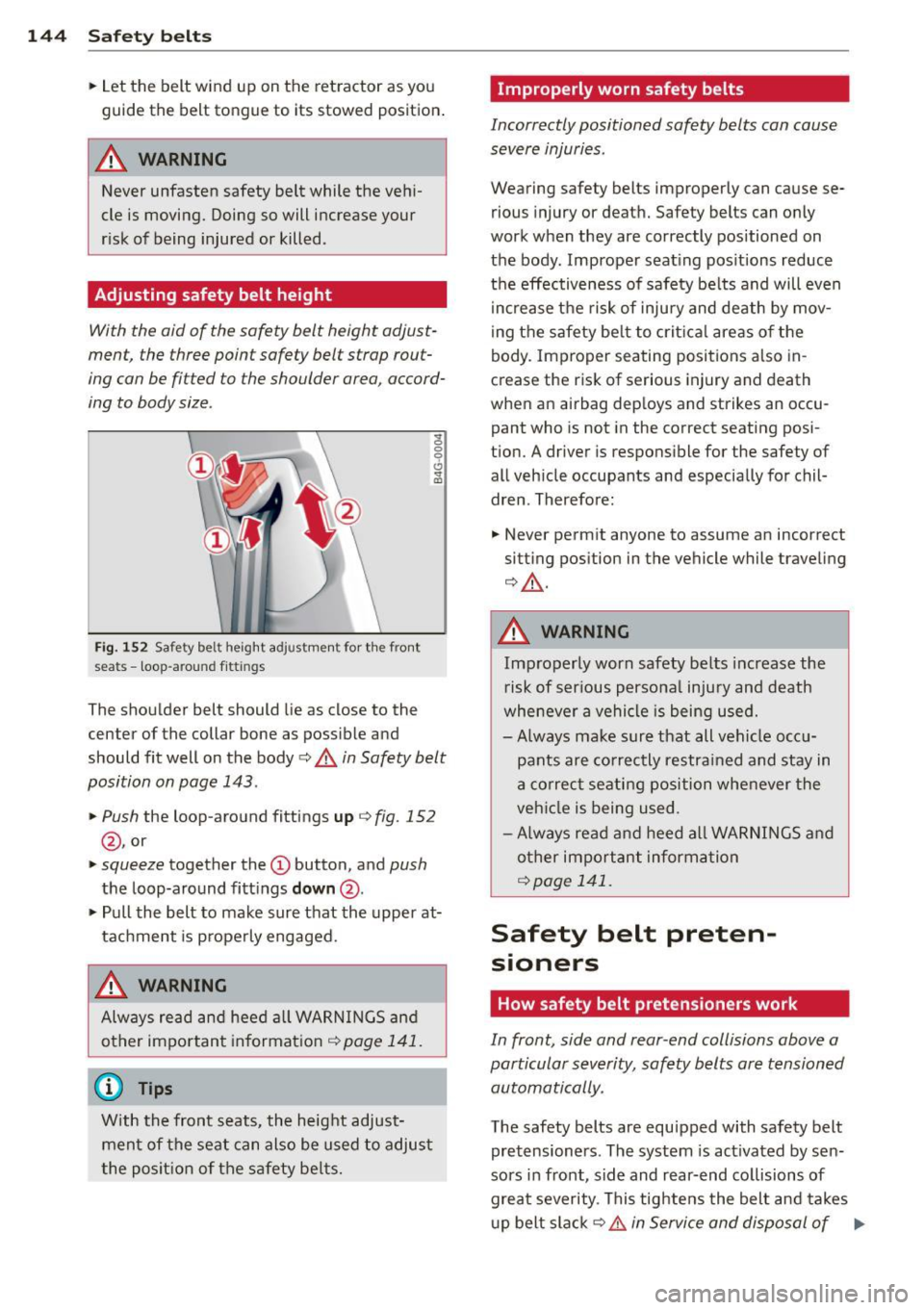
Fig. 152 Safety belt heig ht adj ustme nt for th e fro nt
seats -loop -around fittings
.. (0
The shoulder belt should lie as close to the
center of the collar bone as possib le and
should fit well on the body
c:> .&. in Safety belt
position on page 143 .
• Push
the loop-around fittings up c:> fig. 152
@, or
• squeeze together the(!) button, and push
the loop-around fitt ings down @.
• Pull the belt to make sur e that the upper at
tachment is properly engaged.
.&, WARNING
Alw ays read and heed a ll WARNINGS and
other impo rtant informat ion ¢
page 141.
(D Tips
With the front seats, the height adjust
ment of the seat can also be used to a djus t
the posit ion of the safety be lts.
Improperly worn safety belts
Incorrectly positioned safety belts can cause
severe injuries .
Wearing safety belts improperly can cause se
rious injury or deat h. Safety belts can o nly
work when they are correctly positioned on
the body . Improper seat ing pos itions reduce
the effectiveness of safety be lts and will even
i ncrea se t he risk of inju ry and death by mov
ing the safety be lt to crit ica l areas o f the
body. Improper seating positions also in
crease the risk of serious injury and death
when an a irbag dep loys and strikes an occu
pant who is not in the correct seating posi
tion. A driver is respons ible for the safety of
all veh icle occupants and especially for chil
dren . Therefore:
• Never perm it anyone to assume an incorrect
sitting position in the vehicle while traveling
c:> ,&. .
.&, WARNING
Improperly worn safety be lts increase the
r isk of ser ious p ersona l injury and death
whenever a vehicle is being used.
- Always ma ke sur e that all vehicle occ u
pants are co rrectly restra ined and stay in
a co rrec t seating position whe never the
veh icle is being used .
- Always read and heed all WAR NINGS a nd
o ther impo rtant inform ation
¢page 141.
Safety belt preten
sioners
How safety belt pretensioners work
In front, side and rear-end collisions above a
particular severity, safety belts are tensioned
automatically .
The safety belts are equipped with safety belt
pretensioners . The system is act ivated by sen
sors in front, side and rear-end collisions of
grea t severity. This tightens the belt and takes
u p belt slac k
c:> .&. in Service and disposal of .,._
Page 177 of 296
to the backrest on the vehicle seat. Ad
just or remove the rear seat head restraint if it is diff icult to install the
child seat w ith the head restraint in place
¢ page 61 . Install the head restraint
again immed iate ly once the child seat is
removed. Driving without head rest raints
o r with he ad restraints that are not prop
erly adjusted increases the risk of serious
or fatal neck injury dramatically.
- Always read and heed all WARNINGS
whenever using a child rest rained in ave
hicle is being used
¢page 138, Safety
belts,
¢ page 146, Airbag system and
¢ page 167, Important things to know.
A WARNING
If except ional circumstances requ ire the
use of a forward-facing child restra int on
the front passenger's seat, the ch ild's safe
ty and well-being require that the follow
ing special precautions be taken:
- Make sure the forward-fac ing seat has
been designed and certified by its manu
factur er for use on a front seat with a
passenge r fron t and side airbag.
- Always follow the manufacturer's in
st ruct ions provided with the child sa fety
sea t or infan t carrier.
- Always mov e the front passenge r seat in
to the rearmost posit ion of the passen
ger seat's fore and aft ad justment r ange,
and as far away from the airbag as possi
ble before instal ling the child restraint.
- Always make sure that noth ing prevents
the front passenger's seat from bei ng
moved to the rearmost position in its
fore and aft adjustment range .
- Always make sure the backrest is in an upright position.
- Make su re that the
PASSENGER AIR BAG
OFF
light comes on and stays on all the
time whenever the ignition is switched
on.
- If the light does not stay on, perform the
checks¢
page 156, Monitoring the Ad
vanced Airbag System.
-
Child S afety 175
- Take the chi ld restraint off the front pas
senger seat and install it properly at one
of the rear seat positions if the
PASSEN
GER AIR BA G OF F
light does not stay on
whenever the ignit ion is switched on.
Booster seats and safety belts
Properly used booster seats con help protect
children weighing between about 40 lbs. and
80 lbs . (18 kg and 36 kg) who are less than 4
ft. 9 in . (57 inches/1 .45 meters) tall.
In .... N 0 ±
~
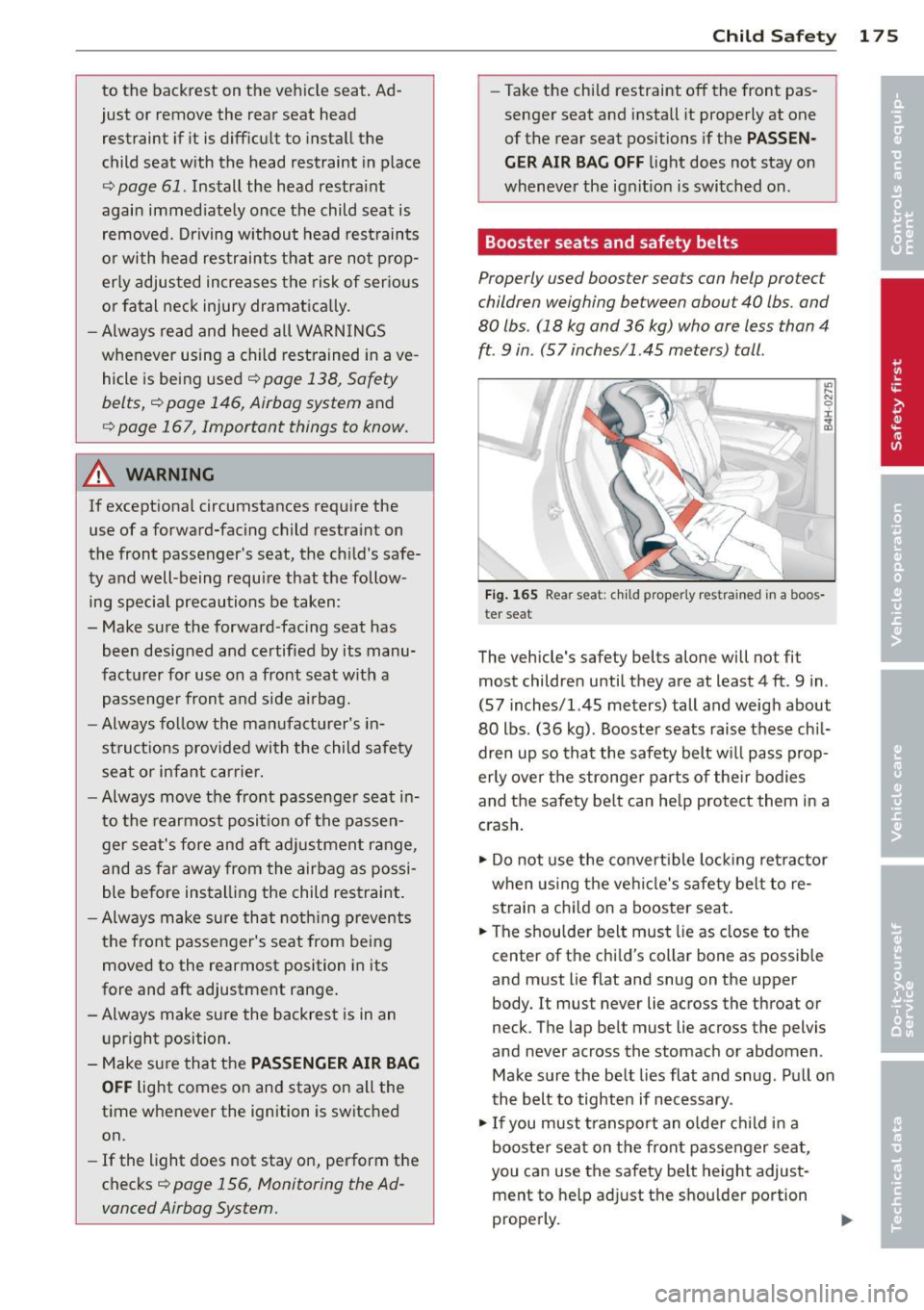
Fig . 165 Rea r seat: ch ild p roperly res trained in a boos
ter seat
The vehicle's safety belts alone will not fit most children until they are at least 4
ft. 9 in .
(57 inches/1.45 me ters) tall and weigh about
80 lbs . (36 kg) . Booster seats raise these chi l
dren up so tha t the safety belt w ill pass p rop
erly over the stronger parts of the ir bodies
and the safety be lt can he lp protect them in a
crash.
.,. Do not use the convert ible lock ing retractor
when using the ve hicl e's s afety be lt to re
s train a ch ild on a booster seat.
... The shoulde r belt must lie as close to the
center of the ch ild's collar bone as possible
and must lie flat and snug on the upper
body. It must never lie across the throat or
neck . The lap belt must lie across the pelvis
and never across the stomach or abdomen .
Make s ure the belt lies flat and snug . Pull on
th e belt to tighten if necessary.
.,. If you must transport an o lde r ch ild i n a
booster seat on the front passenger sea t,
you can use the safety be lt height adjust
ment to he lp ad just the shou lder portion
properly.