2014 AUDI S4 height
[x] Cancel search: heightPage 233 of 296
-Never mount used tires on yo ur vehicle if
yo u are not sure of their "previous histo
ry." Old used tires may have been dam
aged even though the damage cannot be
seen that can lead to sudden tire failure
and loss of vehicle control.
- If you notice unusual vibration or if the
vehicle pulls to one side when d riving, al
ways stop as soon as it is safe to do so
and check the wheels and tires for dam
age .
(D Note
-Please note that summer and winter
tires are designed for the cond itions that
are typ ic al in those seasons. Aud i recom
mends using w inter t ires du ring the win-
Glossary of tire and loading terminology
Accessory weight
means the comb ined weight (in excess of
those standard items which may be replaced)
of automatic tra nsmission, power steering,
power brakes, power windows, power seats,
radio, and heater, to the extent that these
items are availab le as factory-installed equip
ment (whether installed or not) .
Aspect ratio
means the ratio of the height to the width of
the tire in percent . Numbers of 55 or lower in
d icate a low sidewall for improved steering re
sponse and better overall handling on dry
pavement .
Bead
means the pa rt of the ti re that is made of
steel wires, wrapped or reinforced by ply cords
and that is shaped to fit the rim.
Bead s eparation
means a b reakdown of the bond between
components in the bead.
Cord
means the strands forming the plies in the
tire.
Tire s an d wheel s 231
ter months . Low temperatu res signifi
cantly decrease the elastic ity of summer
t ires, which affects traction and braking
ability. If summer tires are used in very
co ld temperatures, cracks can form on
the tread bars, res ulting in permanent
ti re damage that can cause loud drivi ng
noise and unbalanced tires. Aud i is not
responsib le for this type of damage.
- Burn ished, polished or chromed rims
must not be used in winter weather. Th e
surfa ce of the rims does not have suffi
c ien t cor rosion pro te cti on for this and
c o ul d be pe rmanen tly damaged by road
salt or similar substances. This damage
is not covered by warranty.
Cold tir e inflation pressure
me ans the t ire press ure re commended by the
vehicle manufacturer fo r a tire o f a des igna ted
size that has not bee n driven for more than a
couple of miles (k ilomete rs) at low speeds in
the three hour pe riod before the tire press ure
is measured or adjusted.
Curb weight
means the weight o f a motor vehicle with
standard equipment including the maximum
capacity of fuel, o il, and coolant, air cond i
tion ing and additional weight of optiona l
equipment.
E xtra load tire
means a tire design to operate at higher loads
and at higher inflation pressures than the cor
responding standard tire. Extra load tires may
be identified as "XL", "xl", "EXTRA LOAD", or
"RF" on the sidewall.
Gross Axle Weight Rating ("GAWR")
means the load-carrying capacity of a single
axle system, measured at the tire-ground in-
ter~ces .
~
•
•
Page 244 of 296
242 Tires and wheels
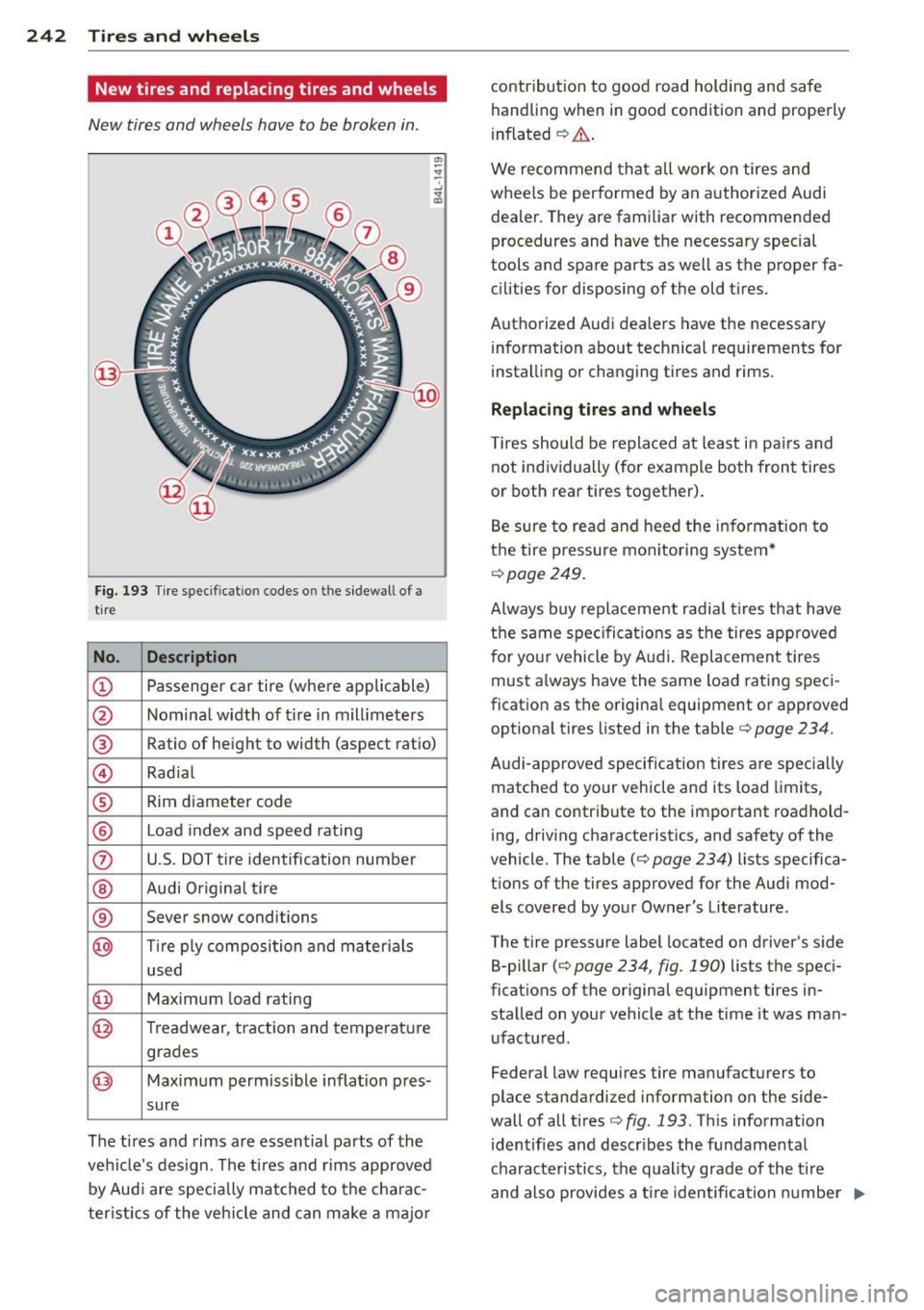
New tires and replacing tires and wheels
New tires and wheels have to be broken in .
Fig. 193 Tire speci fication codes o n the s idewal l of a
t ir e
No. Description
CD Passenger car tire (where applicable)
@ Nominal width of tire in millimeters
® Ratio of height to width (aspect ratio)
@ Radial
® Rim diameter code
® Load index and speed rating
0 U.S. DOT tire identification number
® Audi Original tire
® Sever snow conditions
@ Tire ply composition and materials
used
@ Maximum load rating
@ Treadwear, traction and temperature
grades
@ Maximum permissible inflation pres-
sure
The tires and rims are essential parts of the
vehicle's design . The tires and rims approved
by Audi are specially matched to the charac
ter istics of the vehicle and can make a major contribution to good road holding and safe
handling when in good condition and properly
inflated
¢
&..
We recommend that all work on tires and
whee ls be performed by an authorized Audi
dealer. They are familiar with recommended
procedures and have the necessary special
tools and spare parts as well as the proper fa
cilities for disposing of the old tires.
Authorized Audi dea lers have the necessary
information about technical requirements for
installing or changing tires and rims .
Replacing tires and wheels
Tires should be replaced at least in pairs and
not individually (for example both front tires
or both rear tires together).
Be sure to read and heed the information to
the tire pressure mon itor ing system *
co page 249 .
Always buy replacement radia l tires that have
the same spec ifications as the tires approved
for your vehicle by Audi. Replacement tires
must a lways have the same load rating speci
fication as the origina l equipment or approved
optiona l tires listed in the table¢
page 234 .
Audi-approved specification tires are specia lly
matched to your vehicle and its load limits,
and can contribute to the important roadhold
ing, driving characteristics, and safety of the
vehicle. The table
(c;, page 234) lists specifica
tions of the tires approved for the Audi mod els covered by your Owner's Literature .
The tire pressure label located on driver's side
B-pillar
(c;, page 234, fig. 190) lists the speci
ficat ions of the original equipment tires in
stalled on your vehicle at the time it was man
ufactured .
Federal law requires tire manufacturers to
place standardized information on the side
wall of all tires
co fig . 193. Th is information
identifies and descr ibes the fundamenta l
characteristics, the quality grade of the tir e
and also provides a tire identification number
II>-
Page 245 of 296

for safety standard certification and in case of
a recall.
Tire specifications
Knowledge of tire specifications makes it eas
i er to choose the correct tires. Radial tires
have the tire specifications marked on the
sidewall, for example :
P255 / 35 R19 96V XL
This contains the follow ing information:
P Indicates the tire is for passenger cars
(where applicable)
255 Nominal tire width in mm of the tire
from sidewa ll edge to sidewall edge. In
general, the larger the number, the wider
the tire
35 Height/width ratio in percent (aspect ra-
tio)
R Tire construction: Radial
19 Rim diameter code (in inches)
96 Load rating code
Y Speed rating letter code
XL (or "xl", "EXTRA LOAD", or "RF" Indicates
that the tire is a"Reinforced" or an "Extra L oad" tire
M+S (or "M/S") Indicates that the tire has
some mud and snow capability
The t ires could also have the information of
d ir ection of rotation~
page 230.
Tire manufacturing date
The manufacturing date is also indicated on
the tire sidewall (poss ibly only on the
inner
side of the wheel):
"DOT . .. 2213 . .. "means, for examp le, that
the tire was produced in the 22nd week of
2013.
Speed rating (letter code)
The speed rating letter code on the wheels in
dicates the maximum permissib le road speeds
~ &. in Winter tires on page 246.
ll For tires w it h a max imum spee d capa bility over
1 4 9 mp h (2 40 k m/h) , tire man ufact urers sometimes
u se t he le tte rs "ZR ."
Tires and wheels 243
P up to 93 mph (150 km/h)
Q up to 99 mph (158 km/h)
R up to 106 mph ( 170 km/h)
S up to 110 mph ( 180 km/h)
T up to 118 mph (190 km/h)
U up to 124 mph (200 km/h)
H up to 130 mph (210 km/h)
V up to 149 mph (240 km/h)1l
Z over 149 mph (240 km/h)1l
W up to 168 mph (270 km/h)1l
Y up to 186 mph (298 km/h)1l
Your vehicle is normally factory equ ipped w ith
tires, which possess excellent dr iving charac
teristics and give your Aud i optimum driving
comfort . An electron ic speed lim iter
~ page 31 will normally prevent your vehicle
from going faster than the tire speed rating
~&. -
U.S. DOT Tire Identification Number (TIN)
and tire manufacture date
T his is the tire's "se rial number". It begins
with the letters "DOT" and indicates that the
tire meets all federa l standards. The next two
numbers or letters indicate the plant where it
was manufactured, and the last four numbers
represent the week and year of manufacture.
For example, the numbers 2213 mean that
the tire was produced in the 22nd week of
2013 . The other numbers are marketing co
des that may or may not be used by the tire
manufacturer . T his information is used to con
tact consumers if a tire defect requ ires a re
call.
Audi Original tire
Tires with the identification "AO" or "RO" have
been specially matched with your Audi . We
recommend using only these tires because
they meet the highest standards regarding
safety and driving characterist ics w hen used
correct ly . Your authorized Audi dealer will
gladly provide you with more information . ...,
•
•
Page 250 of 296

248 Tires and wheels
diagonally. After changing a wheel, the
torque must be checked as soon as possi
ble with a torque wrench -preferably by an
authorized Audi dealer or qualified work
shop.
Low aspect ratio tires
Your Audi is factory-equipped with low aspect
ratio tires. These tires have been thoroughly
tested and been selected specifically for your
model for their superb performance, road feel
and handling under a variety of driving condi
tions. Ask your authorized Audi dealer for more details.
The low aspect ratio of these tires is indicated
by a numeral of
55 or less in the tire's size
designation. The numeral represents the ratio
of the tire's sidewall height in relation to its
tread width expressed in percentage. Conven
tional tires have a height/width ratio of 60 or
more.
The performance of low-aspect-ratio tires is
particularly sensitive to improper inflation
pressure. It is therefore important that low
aspect ratio tires are inflated to the specified pressure and that the inflation pressure is
regularly checked and maintained. Tire pres
sures should be checked at least once a
month and always before a long trip
~ page 23 7, Checking tire pressure.
What you can do to avoid tire and rim
damage
Low aspect ratio tires can be damaged more
easily by impact with potholes, curbs, gullies
or ridges on the road, particularly if the tire is
underinflated.
In order to minimize the occurrence of impact
damage to the tires of your vehicle, we recom
mend that you observe the following precau
tions:
- Always maintain recommended inflation
pressures. Check your tire pressure every
2,000 miles (3,000 km) and add air if neces
sary. -
Drive carefully on roads with potholes, deep
gullies or ridges. The impact from driving
through or over such obstacles can damage
your tires. Impact with a curb may also cause damage to your tires.
- After any impact, immediately inspect your
tires or have them inspected by the nearest
authorized Audi dealer. Replace a damaged
tire as soon as possible .
- Inspect your tires every 2,000 miles (3,000
km) for damage and wear. Damage is not al
ways easy to see . Damage can lead to loss of
air and underinflation, which could eventu
ally cause tire failure.
If you believe that a
tire may have been damaged, replace the
tire as soon as possible.
- These tires may wear more quickly than oth
ers.
- Please also remember that, while these tires
deliver responsive handling, they may ride
less comfortably and make more noise than
other choices.
Reduced performance in winter/cold
season conditions
All tires are designed for certain purposes.
The low aspect ratio, ultra high performance
tires originally installed on your vehicle are in
tended for maximum dry and wet road per
formance and handling. They are not suitable
for cold, snowy or icy weather conditions. If
you drive under those circumstances, you
should equip your vehicle with all-season or
winter tires, which offer better traction under
those conditions. We suggest you use the rec
ommended snow or all-season tires specified
for your vehicle , or their equivalent.
Refer to
~ page 246 for more detailed infor
mation regarding winter tires.
Page 291 of 296

Index 289 ____________________________ ...:.:..:.=.:::.::.:
Remote control key ............... .. .. 33
Personalizing ................ .. .... 33
unlocking/locking ............ .. .. .. 35
Remote rear lid release ............... 39
Repair manuals ..................... 275
Repairs
Airbag system .............. ... ...
159
Replacement key ................ .... 33
Replacing
Windshield wiper blades .............
56
Replacing bulbs .............. ... ... 264
Replacing tires and wheels ....... .. ... 242
Replacing wiper blades ............... 55
Reporting Safety Defects ....... ... .. . 136
Reset button .... .. .. ... ... .. .. .. .. .. 12
Retractor . . . . . . . . . . . . . . . . . . . . . . . . . . 141
Reversible floor . . . . . . . . . . . . . . . . . . . . . . 7 4
Reversible mat ................ .. ....
73
Right hand drive .............. ... .... 49
Rims
Cleaning . ............... ...... .. .
205
Roof rack . . . . . . . . . . . . . . . . . . . . . . . . . . . 67
Roof load . . . . . . . . . . . . . . . . . . . . . . . . . 68
Roof weight . . . . . . . . . . . . . . . . . . . . . . . 68
s
SAFE ..... ......................... 12
Safe driving habits ............ ... .. . 128
Safety belt position ................. 142
Safety belt height adjustment .. .. .. . 144
Safety belts worn by pregnant women . 143
Safety belt pretensioner . . . . . . . . . . . . . . 144
Service and disposal . . . . . . . . . . . . . . . 145
Safety belts . . . . . . . . . . . . . . . . . . . . . . . . 141
Cleaning . .. .. ........... .. .. .. ... 206
Danger to passengers who do not wear a
safety belt . .. .. ............ ... .. .
139
Fastening ........................ 141
Height adjustment . . . . . . . . . . . . . . . . . 144
Improperly worn .................. 144
Not worn .. ............. .... .. ... 139
Safety belt position . . . . . . . . . . . . . . . . 142
Safety instructions ................. 141
Securing child safety seats .......... 177
Special considerations for pregnant
women ..........................
143
Unfasten ing ..... ................. 143
Warning/indicator light ........... .. 138
w . 1· h arning 1g t .. .. .. ................ 16
Why YOU MUST wear them .......... 138
Worn properly . . . . . . . . . . . . . . . . . . . . 140
Safety belt warning light ........... .. 138
Safety compliance sticker ............ 272
Safety equipment ...... ............. 128
Safety features for occupant restraint and
protection ... ..... .................
128
Safety guidelines
Seats .............................
58
Safety instructions
Engine compartment ...............
214
for side curtain airbags ............. 166
for using child safety seats ........ .. 170
for using safety belts ............... 141
Monitoring the Advanced Airbag Sys-
tem .............................
158
Seat adjustment
Head restraints .............. .... .
132
Seat belts
refer to Safety belts ... ............. 138
Seat covers
Cleaning ... ..... .. . ..............
207
Seat heating . . . . . . . . . . . . . . . . . . . . . . . . 78
Seating capacity ... .. ........... .... 138
Seating position
Driver ...........................
129
Front passenger .... .............. . 130
How to adjust the front seats ....... . 130
Incorrect seat position . ............. 132
Occupants . .. .. .. ... ............ .. 129
Rear passengers .. ............. .... 131
Seat memory . . . . . . . . . . . . . . . . . . . . . . . 62
Seats
Ad '
t· JUS mg . . . . . . . . . . . . . . . . . . . . . 59, 60
D . , rivers seat . . . . . . . . . . . . . . . . . . . . . . . 58
Folding ..... .. .. ... ............ .. . 69
Front passenger's seat . . . . . . . . . . . . . . . 59
Head restraints .... .............. .. 61
Number of seats ... .............. . 138
Safety guidelines . .................. 58
Seat ventilation . . . . . . . . . . . . . . . . . . . . . 78
Securing attachments ................ 73
Selective unlock feature ............... 37
•
•