2014 AUDI S4 seats
[x] Cancel search: seatsPage 180 of 296
178 Child Safety
-The inflating airbag will hit the child
safety seat or infant carrier with great
force and will smash the child safety seat and child against the backrest, center
armrest, door or roof.
- Always install rearward-facing child safe
ty seats or infant carriers on the rear
seat.
- Forward-facing child safety seats or in
fant carriers installed on the front pas
senger's seat may interfere with the de
ployment of the airbag and cause serious
injury to the child.
-It is safer to install a forward-facing
child safety seat on the rear seat.
- Always read and heed all WARNINGS
whenever using a child restrained in ave
hicle is being used
¢page 167. Special
precautions apply when installing a child
safety seat on the front passenger seat
¢ page 147, Child restraints on the front
seat -some important things to know.
A WARNING
-
Always take special precautions if you
must install a forward or rearward -facing
child restraint on the front passenger's
seat in exceptional situations:
- Whenever a forward or rearward-facing
child restraint is installed on the front
passenger seat, the
PASSENGER AIR
BAG OFF
light must come on and stay on
whenever the ignition is switched on.
- If the PASSENGER AIR BAG OFF light
does not come on and stay on, perform
the checks described ¢
page 156, Moni
toring the Advanced Airbag System.
- Take the child restraint off the front pas
senger seat and install it properly at one
of the rear seat positions if the
PASSEN
GER AIR BAG OFF
light does not stay on
whenever the ignition is switched on.
- Improper installation of child restraints
can reduce their effectiveness or even
prevent them from providing any protec
tion. -
An improperly installed child restraint
can interfere with the airbag as it de
ploys and seriously injure or even kill the
child .
- Always carefully follow the manufactur
er's instructions provided with the child
safety seat or carrier.
- Never place additional items on the seat
that can increase the total weight regis
tered by the weight-sensing mat and can
cause injury in a crash .
A WARNING
-Forward-facing child restraints:
- Always make sure the forward -facing
seat has been designed and certified by its manufacturer for use on a front seat
with a passenger front and side airbag.
- Never put the forward-facing child re
straint up, against or very near the in
strument panel.
- Always move the passenger seat into its
rearmost position in the seat's fore and
aft adjustment range, as far away from
the airbag as possible before installing
the forward-facing child restraint. The backrest must be adjusted to an upright
position .
-Make sure that the PASSENGER AIR BAG
OFF
light comes on and stays on all the
time whenever the ignition is switched
on .
A WARNING
-
Rearward-facing child restraints:
- A child in a rearward-facing child safety
seat installed on the front passenger
seat will be seriously injured and can be killed if the front airbag inflates -even
with an Advanced Airbag System .
- The inflating airbag will hit the child
safety seat or infant carrier with great
force and will smash the child safety seat and child against the backrest, center
armrest, door or roof.
Page 182 of 296
180 Child Safety
Deactivating the convertible locking
retractor
The convertible locking retractor for child re
straints will be deactivated automatically when the belt is wound all the way back into the retractor .
.,. Press the red button on the safety belt buck
le. The belt tongue will pop out of the buck
le .
.. Guide the safety belt all the way back into
its stowed position.
Always let the safety belt retract completely into its stowed position. The safety belt can
now be used as an ordinary safety belt with
out the convertible locking retractor for child
restraints.
If the convertible locking retractor should be
activated inadvertently, the safety belt must
be unfastened and guided completely back in
to its stowed position to deactivate this fea
ture. If the convertible locking retractor is not
deactivated, the safety belt will gradually be
come tighter and uncomfortable to wear .
A WARNING
Improperly installed child safety seats in
crease the risk of serious personal injury
and death in a collision.
- Never unfasten the safety belt to deacti
vate the convertible locking retractor for
child restraints while the vehicle is mov
ing. You would not be restrained and
could be seriously injured in an accident.
- Always read and heed all WARNINGS
whenever using a child restrained in ave
hicle is being used¢
page 167. Special
precautions apply when installing a child
safety seat on the front passenger seat
¢ page 147, Child restraints on the front
seat -some important things to know.
Page 183 of 296
LATCH Lower
anchorages and tether
for children
Child Restraint System anchors and how
are they related to child safety
To provide a s impler and more pract icable way
to attach the child restraint on the vehicle
seat, Federal regu lations require special lower
anchorages in vehicles and dev ices on new
child restraints to attach to the vehicle ancho
rages.
The combination of the tether anchorages and
the lower anchorages is now generally called
the
LA TCH system for "Lower Anchorages and
Tethers for Children ."
F orward-facing child restraints manufactured
after September 1, 1999, are required by U.S.
federal regulations to comply with new ch ild
head movement performance requirements .
T hese new performance requirements make a
tether necessary on most new child seats.
I nstalling a chi ld restraint that requires a top
tether without one can seriously impair the
performance of the chi ld restraint and its ab il
ity to protect the child in a co llision . Installing
a child restraint that requires a top tether
without the top tether may be a v iolation of
state law.
Ch ild restraint manufacturers offer LATCH
lower anchorages on their ch ild seats with
hook -on or push-on connectors attached to
adj ustable straps.
In addition to the LATCH lower anchorages,
these child restraint systems usually require
the use of tether straps to help keep the child
restra int firmly in place .
A WARNING
Improper insta llation of chi ld restraints
w ill increase the risk of inju ry and death in
a crash.
- Always follow the instructions p rov ided
by the manufacturer of the ch ild re-
Child S afety 181
straint you intend to install in your vehi
cle.
- Never install a chi ld restraint without a
properly attached top tether strap if the
child restraint manufacturer's instruc
tions require the top tether strap to be
used.
- Improper use of child restraint LATC H
lower anchorage points can lead to injury
in a collision . The LATC H lowe r anchorage
points ar e designed to withstand on ly
those loads imposed by correctly fitted
child restraints.
- Never mo unt two ch ild restra int systems
on one LA T C H l ower anchorage point.
- Never secure or a ttach any luggage or
o ther item to the LATCH lower anchorag
es.
a) Tips
In Canada, the terms "top tether" with
"lower u niversal anchorages" (or "lower
universa l anchorage ba rs") are used to de
scribe the sys tem.
- In other countries, the t erm " ISOFIX" is
used to describe the lower a nch o rages.
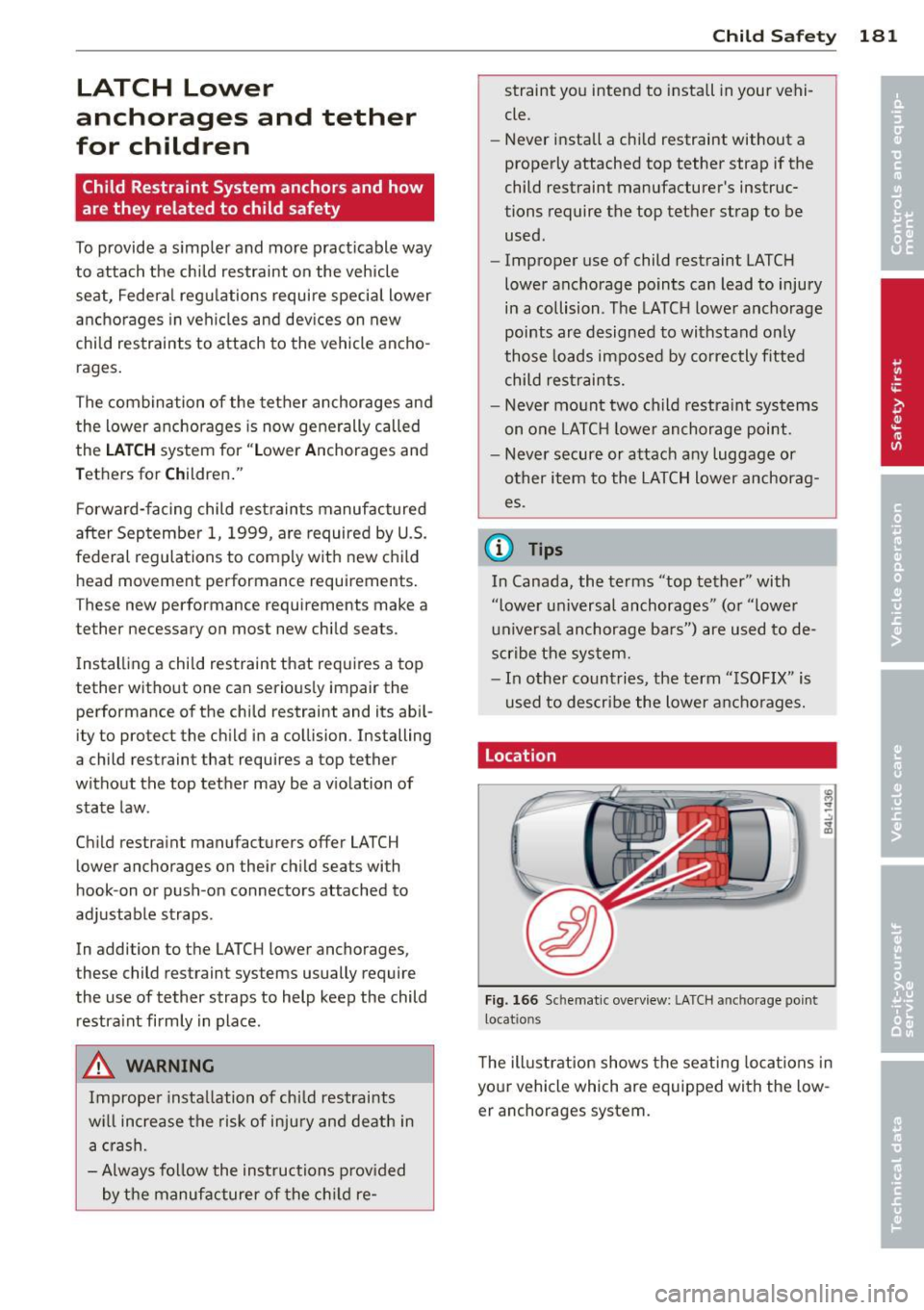
Location
Fi g. 16 6 Schema tic overv iew: LA TCH ancho rage point
l ocations
T he illust rat ion shows the seati ng loca tions in
yo ur vehicle which are equipped with the low
er anchorages system.
Page 185 of 296
.. Pull on the connector attachments to make
sure they are properly attached to the LATCH
lower anchorage .
.. Pull straps tight following the child restraint
manufacturer's instructions.
R elea sin g
.. Loosen the tension on the straps following
the chi ld restraint manufacturer's instr uc
tions .
.,. Depress the spring catches to release the
anchorage hooks from the lower anchorag
es .
Remember: Use tether straps to help keep the
child restraint firmly in place.
A WARNING
Improper use of the LATC H system can in
crease the risk of ser ious personal injury
and death in an acc ident.
- These anchors were developed only for child safety seats us ing the "LATCH" sys
tem.
- Never attach other child safety seats,
belts or othe r objects to these anchors.
- Always make sure that you hea r a click
when latching the seat in place. If you do not hea r a click the seat is not secure and
c ou ld fly forward and h it the inte rior of
the vehicle, or be ejected from the vehi
cl e.
A WARNING
Improper installation of chi ld restraints
w ill increase the risk of in jury in an acci
dent.
- Always fo llow the child rest raint system
manufacturer's instr uctions for proper
installation o f the child restraint system
and proper use of tether straps as we ll as
the lower anchorages or safety belts in
your vehicle.
-Always read and heed the important in
format io n and WARNINGS about child
safety and the installation of child re
st raint systems~
page 167, Child Safe
ty.
-
Child S afety 183
Tether anchors and tether straps
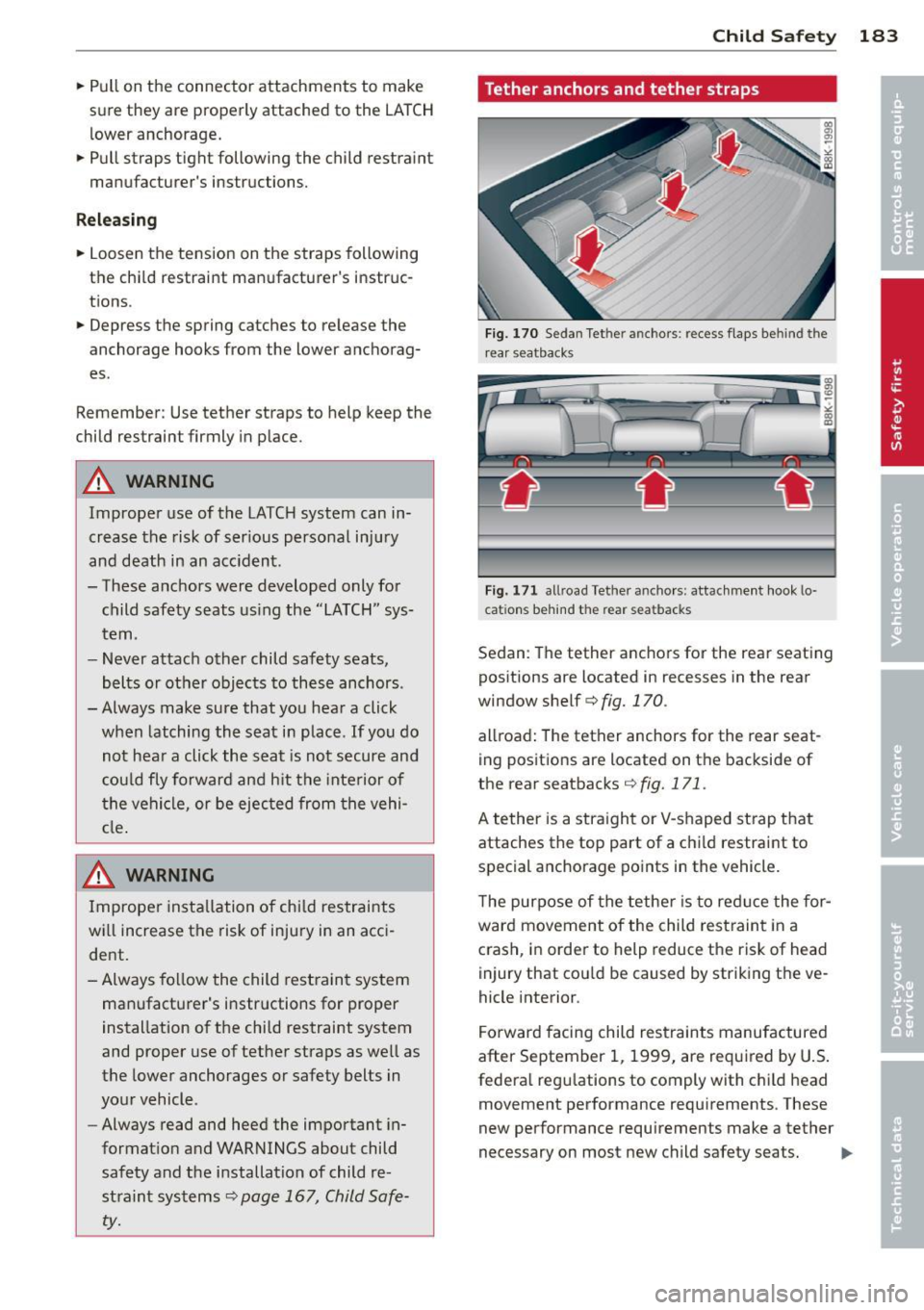
Fig. 170 Sedan Tether anchors: recess flaps behind the
r ea r seatbacks
Fig. 171 allroad Tether anchors: attac hme nt hook lo
cat io ns be hind the rear seatbacks
Sedan: The tether ancho rs for the rear seating
pos itions are located in recesses in the rear
window shelf
c> fig. 170.
allroad : The tether anchors for the rear seat
ing pos it ions are located on the backside of
the rear seatbacks
c>fig. 171.
A tether is a straight or V-shaped strap t hat
attaches the top part of a ch ild restraint to
special anchorage po ints in the vehicle .
T he purpose of the tethe r is to re duce the for
ward movement of the child rest raint in a
crash, in orde r to help reduce the risk of head
injury that cou ld be caused by striking the ve
hicle interior.
Forward facing child restraints manufactured
after September 1, 1999, are requ ired by U .S .
federal regulations to comply with c hild head
movement performance requirements. These
new performance requirements make a tether
necessary on most new child safety seats. ...,
Page 187 of 296
(D Note
If you leave the child restraint with the
tether strap firmly installed for severa l
days, this cou ld leave a mark on the up
holstery on the seat cushion and backrest
in the area where the tether strap was in
s t alled. The upho lstery would a lso be per
manently stretched around the tethe r
s tr ap. This applies especially to leat her
seats.
Using tether straps on rearward-facing
child restraints
Currently, few rearward-facing child restraint
systems come with a tether. Please read and h eed the child restraint system manufactur
er's instructions carefully to determ ine how to
p roperly install the tethe r.
A WARNING
-
A ch ild i n a rearward-facing child safety
s ea t insta lled on the front passenger sea t
w ill be seriously injured and can be killed if
t he fron t air bag inflates -even with an Ad
vanced Airbag System .
- T he inflating a irbag w ill hit the chi ld
sa fety seat or infa nt carrier w it h great
force and wi ll smash the ch ild safety seat
and child against the backrest, center
armrest, or door.
- A tight tether or other strap on a rear
ward-fac ing c hild restra int attached to
the front passenger seat can put too much pressure on the weight-mat in the
sea t and regis ter a heavier we igh t in the
Advanced Airbag System. The heav ie r
we ight registe red ca n make the system
wor k as th ough an adul t were on t he seat
and dep loy the A dvanced Airbag when i t
must be supp ressed ca using serious or
even fatal injury to the child.
- If you mus t insta ll a rearward facing
child safety seat o n the front passenger
seat beca use of exceptional circ umstan
ces and the
PASSENGER AIR BAG OFF
light does not come on and stay on, im-
Child Sa fet y 185
mediately insta ll th e rearward-fac ing
child safety seat in a rear seating posi
tion and have the airbag system inspect
ed by your authorized Audi dealer .
Additional Information
Sources of information about child
restraints and their use
There are a number of sources of additional
information about child restraint se lection, in
stallation and use:
NH TSA advises that the best chi ld safety seat
is the one that fits your chi ld and fits in your
vehicle, and that you w ill use correct ly and
consistently.
T ry before yo u buy!
U .S National Highway Traffi c Safety Admin
istration
Tel.: 1 -888 -3 27- 42 36 (TIY: 1-800 -42 4-9153)
www.n htsa.gov
National SAFE KIDS Campaign
Tel.: (2 02) 662- 0600
www.safe kids.o rg
Safety BeltSafe U .S .A
T el.: (8 00) 7 45-SAF E (English)
T el.: (8 00) 747 -SANO (Span ish)
www.carseat.org
Transport Canada Information C entr e
Tel.: 1 -800 -333-0371 or c all
1-6 13-99 8-8616 if yo u are in the Ottawa area
http://www.tc.gc.ca/eng/ roadsa fety/
menu .htm
Audi Cu stomer Relation s
Tel.: (800) 822-2834
•
•
Page 196 of 296
194 Intelligent technology
Plea se start the engin e soon or th e system
w ill be tu rned off.
The warning ind icates that the system will be
turned off automa tic ally after 3 m inu tes. If
you wish to continue using the functions , you
have to start the engine .
With the engine running
Although electrical e nergy is generated when
the vehicle is be ing driven , the battery can be
come d ischarged. This happens most ly when
little energy is being generated and a great
deal consumed and the battery 's state of
charge is not optimal.
To br ing the energy balance back into equili
brium, consumers which require especia lly
large amounts of energy are temporarily c ut
back or switched off. Heating systems in par·
ticular requ ire a great deal of energy. If you
notice, for example, that the heated seats* or
the heated rear window are not heating, they have been temporar ily cut back or switched
off. These systems will be ava ilable again as
soon as the energy ba lance has been restored.
You will also notice that engine idle speed has been increased slightly . This is norma l and not
a cause fo r concern . By increas ing engine idle
speed the add itiona l ene rgy required is gener
ated and the batte ry is charged.
Page 233 of 296
-Never mount used tires on yo ur vehicle if
yo u are not sure of their "previous histo
ry." Old used tires may have been dam
aged even though the damage cannot be
seen that can lead to sudden tire failure
and loss of vehicle control.
- If you notice unusual vibration or if the
vehicle pulls to one side when d riving, al
ways stop as soon as it is safe to do so
and check the wheels and tires for dam
age .
(D Note
-Please note that summer and winter
tires are designed for the cond itions that
are typ ic al in those seasons. Aud i recom
mends using w inter t ires du ring the win-
Glossary of tire and loading terminology
Accessory weight
means the comb ined weight (in excess of
those standard items which may be replaced)
of automatic tra nsmission, power steering,
power brakes, power windows, power seats,
radio, and heater, to the extent that these
items are availab le as factory-installed equip
ment (whether installed or not) .
Aspect ratio
means the ratio of the height to the width of
the tire in percent . Numbers of 55 or lower in
d icate a low sidewall for improved steering re
sponse and better overall handling on dry
pavement .
Bead
means the pa rt of the ti re that is made of
steel wires, wrapped or reinforced by ply cords
and that is shaped to fit the rim.
Bead s eparation
means a b reakdown of the bond between
components in the bead.
Cord
means the strands forming the plies in the
tire.
Tire s an d wheel s 231
ter months . Low temperatu res signifi
cantly decrease the elastic ity of summer
t ires, which affects traction and braking
ability. If summer tires are used in very
co ld temperatures, cracks can form on
the tread bars, res ulting in permanent
ti re damage that can cause loud drivi ng
noise and unbalanced tires. Aud i is not
responsib le for this type of damage.
- Burn ished, polished or chromed rims
must not be used in winter weather. Th e
surfa ce of the rims does not have suffi
c ien t cor rosion pro te cti on for this and
c o ul d be pe rmanen tly damaged by road
salt or similar substances. This damage
is not covered by warranty.
Cold tir e inflation pressure
me ans the t ire press ure re commended by the
vehicle manufacturer fo r a tire o f a des igna ted
size that has not bee n driven for more than a
couple of miles (k ilomete rs) at low speeds in
the three hour pe riod before the tire press ure
is measured or adjusted.
Curb weight
means the weight o f a motor vehicle with
standard equipment including the maximum
capacity of fuel, o il, and coolant, air cond i
tion ing and additional weight of optiona l
equipment.
E xtra load tire
means a tire design to operate at higher loads
and at higher inflation pressures than the cor
responding standard tire. Extra load tires may
be identified as "XL", "xl", "EXTRA LOAD", or
"RF" on the sidewall.
Gross Axle Weight Rating ("GAWR")
means the load-carrying capacity of a single
axle system, measured at the tire-ground in-
ter~ces .
~
•
•
Page 283 of 296

Automatic climate control Air vents ... .... .. .... ... .. .. .. .... 78
Operation . . . . . . . . . . . . . . . . . . . . . . . . . 77
Setup ... .. ................. .. .... 79
Automatic S hift Lock (ASL) . . . . . . . . . . . . 93
Automatic transmission ......... ... ... 91
Automatic S hift Lock (ASL) . . . . . . . . . . . 93
D riving .. .. ............. .... .. .. .. 9 3
E mergency mode . . . . . . . . . . . . . . . . . . . 97
E me rgency release . . . . . . . . . . . . . . . . . . 98
Kick -down . . . . . . . . . . . . . . . . . . . . . . . . . 96
M anual shift program .. ... .. .. .. .. .. 96
Remova l lock (ignition key) ... .. .. .. .. 80
Selector lever . . . . . . . . . . . . . . . . . . . . . . 92
Automatic wipe rs . . . . . . . . . . . . . . . . . . . . 53
Auto Safety Hotline ............. .... 136
Average speed . . . . . . . . . . . . . . . . . . . . . . . 25
Avoid damag ing the vehi cle .. .. .. .. .. . 195
B
Bag hooks . . . . . . . . . . . . . . . . . . . . . . . . . . 72
Battery . . . . . . . . . . . . . . . . . . . . . . . 17,225
Battery location inside the luggage com -
partment .. .. ........... .. .. .. ... 225
Charging . ................ ... ... .. 227
Important war nings when wo rking on
the battery . ................ ... ... 225
J ump starti ng ............ .... .. .. . 266
L ow . .. .. .. .. .. ........... .. .. ... 193
Replacing the ba ttery .. ... .. .. .. .. . 228
State of charge . ....... ... .. .. .. ... 193
Winter operation . ..... ... .. .. .. .. . 225
Working on the battery .... .. .. .. .. . 225
B efore dr iving ............. .... .. .. . 128
Bio-ethanol (Fuel) ..... ..... .. .. .. .. . 210
Blended gasoline ... .... ... .. .. .. .. . 209
B lower (automatic climate cont rol) . . . . . . 78
Booster seats ............. .... .. .. . 175
B rake fl uid
C hanging the brake fl uid ... .. .. .. .. . 224
Chec king the brake fluid level ... .. .. . 224
Reservoir .. ............. .... .. ... 224
What is the correct brake flu id leve l? . . 224
What should I do if the brake fluid warn-
i ng light comes o n? .. ..... .. .. .. .. . 224
Inde x 281
Brake system . ..... ... .. .. ..... ... .. 224
Anti- lock b raking system ..... ... .. .. . 19
B rake assist system .. .. ..... ... .. .. 186
Brake fluid .. .. .. ................. 224
Brake fluid specifications for refill and re-
placement ...... .. ............... 224
B rake light defective ... .. .. ... ... .. . 21
B ra ke powe r ass ist unit ............ . 189
Br akes .. .. .. .. .. .. . .............. 189
Ce ram ic bra kes . .. .... ........... .. 189
El ec tromechanica l parking brake ... .. . 85
Warning/indicator lights ..... ... .. .. . 15
Wor n brake pads symbo l . . . . . . . . . . . . . 20
B ra kin g
E mergency b ra ki ng f unction ..... .. .. . 87
braking guard . . . . . . . . . . . . . . . . . . . . . . . 99
Messages . . . . . . . . . . . . . . . . . . . . . . . . 107
Settings ........ .. ............... 106
Break -in per iod .. .. .... ............. 195
Tires ... .. .. .. .. .. ............... 195
Bul bs . ... .. .. .... .. . .. .. ..... ... .. 2 64
C
Califor nia Proposition 65 War ning . .. .. 215
B attery spec ifi c .. ............. .. .. 226
Capacities ........ .. ............... 273
Carbon pa rts
Cleaning . . . . . . . . . . . . . . . . . . . . 206, 207
Care ..... .. .. .. .... ... .......... .. 20 4
Cargo a rea
refer to L uggage compartment . . . 68, 134
Catalytic converter ... .. ...... ... .. .. 196
Cen te r armrest . . . . . . . . . . . . . . . . . . . . . . 60
Central lock ing .. .. ................. . 32
Cen tral lock ing switch ............. .. 36
Co nvenience key . . . . . . . . . . . . . . . . . . . . 36
Remote cont ro l key . ........... .... . 35
Ceram ic brake rotors
New brake pads .. ............. .... 189
Ce rtification . ... .... . ... ...... ... .. 278
Chang ing a flat t ire . .. ... ....... .... . 255
Chang ing a wheel .. ............. .... 255
Chang ing engine oil ............. .... 220
Checking Engine coolant level .... ....... .... . 221
Checking t ire pressure ............... 237
•
•