2014 AUDI S4 air condition
[x] Cancel search: air conditionPage 237 of 296

you have stored. The system does not recog
nize the load condition of your vehicle.
The effectiveness of the ti re pressu re monitor
ing sys tem* will be impaired if you store nor
mal load pressures but then operate the vehi
cle at its maximum load¢,& .
See the illustration ¢
fig. 189 for the location
of the label on dr iver's side B-pillar (color of
the actual labe l and exact location on the ve
hicle wi ll vary slig htly) .
Note that the fo llowing tab le is accurate at
the t ime o f go ing to press and is subject to
Model Tire designation
Engine
A4 Sedan: 225/55 Rl6 95H
2 .0 lit er All Se ason
4 -cy linder
245/45 Rl 7 95H
All Se ason
2 4 5/ 40 Rl8 93Y
Hi gh P erf or mance
2 25/5 0 Rl 7 94H
All Sea son
2 4 5/ 40 Rl 8 93H
All Se ason
2 55 /35 Rl9 96Y XL
Hig h Perf ormanc e
a llro ad: 225/55 Rl 7 97 H
2.0 l it e r All Season
4 -cy lind er
245 /45 Rl 8 l00H
All Sea so n
2 45 /45 Rl8 96 Y
Hig h Perf or mance
245 /40 Rl9 98Y XL
High P erf or mance
Tire s an d wheel s 235
change. In the event of discrepancies, the ti re
pressure label is located on the driver's side B
pillar always takes precedence .
T he table below lists the recommended cold
ti re inflation pressures for the Audi mode l
covered by your Owner's Literature at the vehi
cle's capacity weight and the t ire sizes instal
l ed on the respective models as orig inal
equipment, or as a factory option.
Tire pressure
normal load condition full load condition
( up to 3 occupants )
f r ont rear front rear
PSI kPA PSI kPA PSI kPA PSI kPA
32 220 29 200 33 230 35 240
32 220 29 200 33 230 35 240
32 220 29 200 33 230 35 240
33 230 30 210 35 240 36 250
33 230
32 220
36 250
38 260
32 220 30 210 35 240 35 240
30 2 10 30 2 10 33 230 36 250
32 220 32 220 33 230 36 250
30 210 30 2 10 33 230 36 250
32 220 29 200 35 240
38 260
•
•
Page 239 of 296

-Incorrect tire pressures and/or underin
flation can also lead to sudden tire fa il
ure, including a blowout and sudden de
flation, causing loss of vehicle control.
Checking tire pressure
The correct tire pressure for the tires original
ly installed on your vehicle is listed on the tire
pressure label located on driver's side 8-pil lar .
The recommended t ire pressures are on the
tire pressure label and in the table
c:> page 234, Cold tire inflation pressure . This
means that the pressure must be checked and
adjusted when the tire has not been driven for
mo re tha n a couple of m iles (k ilome ters) at
l ow speeds during t he p revious three hours.
A ir in the tires expands when the ti re heats up
as a result of inte rna l friction as it flexes in
use. The tire press ure is higher when the tire
has warmed up than when it is "cold."
It is the i nflat ion p ressu re in a "cold" tire that
counts . Therefore, you shou ld never let air ou t
of a warm tire to match "Cold tire inflation pressure" recommendations
c:> page 234. The
tires would then be under inflated and could
fa il suddenly.
The tire press ure labe l on yo ur Audi lists the
recommended cold t ire inflat ion pressures at
maximum capacity for the new, origina l
equ ipment tires that were on your vehicle at
the time it was manufactured. For the loca
tion of the label
<=> page 234, fig . 189 .
Most tires lose a ir naturally over time. They
can also lose some a ir if you drive
over a pot
hole or hit a curb while parking. It is usually
not possible to see whether the radial t ires
used today are underi nflated just by looking
at them.
Therefore, be sure to check tire pressures at
least o nce a month and always before going
on a long tr ip . Make sure to take the number
of people and the amount of luggage into ac
coun t when adjusting tire pressure for a t rip -
even one that you would not consider to be
Tire s an d wheel s 237
"long." See c:> page 2 38, Tires and vehicle
load limits
for more important information.
A lways use an acc ura te tire pressu re ga uge
when checking and ad justing infla tion pres
s ur es . Check all o f the tires and be sure not to
forget the spare tire. If the pressure in any t ire
is too h igh when the tire is "cold", let a ir o ut
of the t ire s low ly w ith the edge of the tire
gauge and keep checking the pressure until
you reach the pressure that is correct for the load (passengers and luggage) and k ind of
driv ing you plan to do.
If the pressure in any tire is too low, note the
difference between the pressure in the co ld
t ire a nd the pressure you need and add the air
that you need to reach the correct pressure for
t h e ve hicl e load (passenge rs and luggage) for
the tires on you r veh icle as l isted on the on
yo ur vehicle and in this ma nual and the kind
of driving you plan to do.
Never exc eed the maximum inflation pr es
sure li ste d on the tire sidewall for any re a
s o n.
Remember that the vehicl e manufacture r, not
t h e tire manufact urer, de termines t he cor re ct
t ir e p ress ure fo r th e tires on your ve hicl e.
It is important to check the t ire p ressu re whe n
the tires are co ld.
- Read the required tire pressure from the t ire
pressure labe l. The t ire pressure label is lo
cated o n the dr iver's side 8-pillar. The tire
pressure labe l lists the recommended co ld
tire infla tion pressures for t he vehi cle at its
maxim um capacity weigh t and t he tires that
were on your ve hicle a t the time i t was man
ufactured . For recommende d tire pressures
for normal load conditions, p lease see chap
ter
c:> page 2 34.
- Tu rn the va lve stem cap counter -clockwise
to remove it from the tire
va lve .
-Place t he ai r pressure gauge on the va lve.
- The tire pressu res should o nly be checked
and ad justed when the tires are co ld . The
slightly raised pressures of warm tires must
not be red uced.
Ill>-
•
•
Page 244 of 296
242 Tires and wheels
New tires and replacing tires and wheels
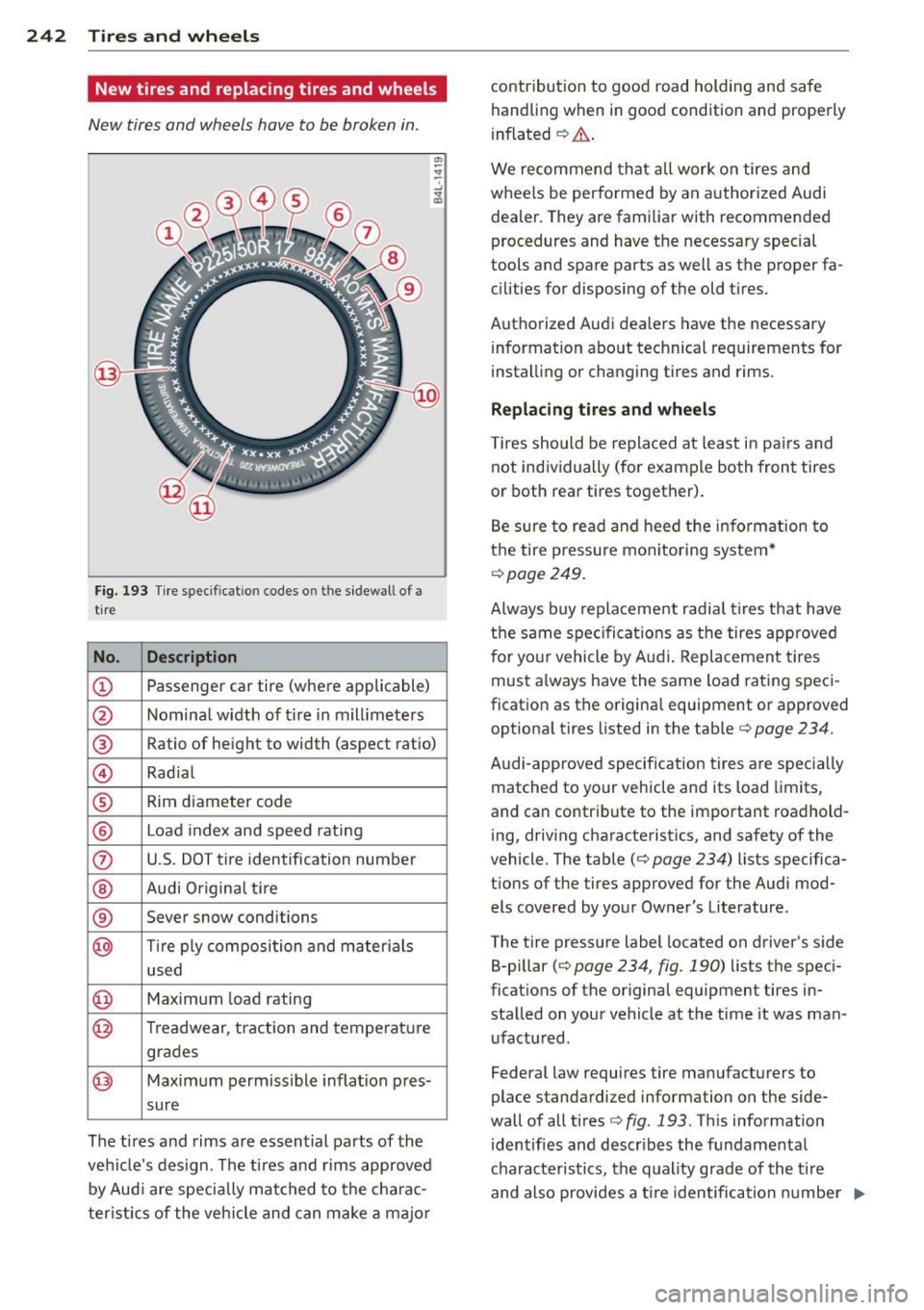
New tires and wheels have to be broken in .
Fig. 193 Tire speci fication codes o n the s idewal l of a
t ir e
No. Description
CD Passenger car tire (where applicable)
@ Nominal width of tire in millimeters
® Ratio of height to width (aspect ratio)
@ Radial
® Rim diameter code
® Load index and speed rating
0 U.S. DOT tire identification number
® Audi Original tire
® Sever snow conditions
@ Tire ply composition and materials
used
@ Maximum load rating
@ Treadwear, traction and temperature
grades
@ Maximum permissible inflation pres-
sure
The tires and rims are essential parts of the
vehicle's design . The tires and rims approved
by Audi are specially matched to the charac
ter istics of the vehicle and can make a major contribution to good road holding and safe
handling when in good condition and properly
inflated
¢
&..
We recommend that all work on tires and
whee ls be performed by an authorized Audi
dealer. They are familiar with recommended
procedures and have the necessary special
tools and spare parts as well as the proper fa
cilities for disposing of the old tires.
Authorized Audi dea lers have the necessary
information about technical requirements for
installing or changing tires and rims .
Replacing tires and wheels
Tires should be replaced at least in pairs and
not individually (for example both front tires
or both rear tires together).
Be sure to read and heed the information to
the tire pressure mon itor ing system *
co page 249 .
Always buy replacement radia l tires that have
the same spec ifications as the tires approved
for your vehicle by Audi. Replacement tires
must a lways have the same load rating speci
fication as the origina l equipment or approved
optiona l tires listed in the table¢
page 234 .
Audi-approved specification tires are specia lly
matched to your vehicle and its load limits,
and can contribute to the important roadhold
ing, driving characteristics, and safety of the
vehicle. The table
(c;, page 234) lists specifica
tions of the tires approved for the Audi mod els covered by your Owner's Literature .
The tire pressure label located on driver's side
B-pillar
(c;, page 234, fig. 190) lists the speci
ficat ions of the original equipment tires in
stalled on your vehicle at the time it was man
ufactured .
Federal law requires tire manufacturers to
place standardized information on the side
wall of all tires
co fig . 193. Th is information
identifies and descr ibes the fundamenta l
characteristics, the quality grade of the tir e
and also provides a tire identification number
II>-
Page 246 of 296

24 4 T ire s and wheel s
Tire pl y compo sit ion and materi als used
The numbe r of plies ind icates the n umber of
l ayers of rubber -coated fabric in the tire. In
general, the greater the number of p lies, the
more weight a tire can support . Tire manufac
turers also must indicate the materials in the
tire, wh ic h include steel, nylon, polyester, and
others.
M ax imum Load R ating
This number indicates the maximum load in
kilograms and pounds that can be carried by
the tire .
Tire quality grading for treadw ear ,
tr act ion, a nd t emper ature re sis tan ce
Tread wear, traction and temperature grades
c:> page245.
Max imum Permiss ibl e Inflation Pressur e
This numbe r is the greates t amo unt of air
p ress ure that sho uld ever be put in the ti re
under normal driving conditions .
A WARNING
-Us ing incorrect or unmatched tires and/
or wheels or improper tire and wheel
combinations can lead to loss of contro l,
co llision and serious persona l injury .
- Always use tires, rims and wheel bo lts
that meet the specifications of orig inal
factory-installed t ires or other combina
t ions that have been spec ifically ap
proved by the vehicle manufacturer.
- Tires age even if they are not be ing used
and can fail suddenly, especially at high
speeds. Tir es that are more than 6 years
o ld can only be used in an emergency
and then with special care and at lower
speeds.
- Never mount used ti res on yo ur vehicle if
yo u are not su re of their "previous histo
ry ." Old used tires may have been dam
aged even though the damage cannot be
seen that can lead to sudden tire failure and loss of vehicle control.
- All four wheels must be fitted with radia l
t ires of the same type, size (roll ing c ir- cumference) and the same tread pattern
.
Driving with different tires reduces vehi
cle handling and can lead to a loss of
control.
- If the spare tire is not the same as the
tires that are mounted on the vehicle -
for example with winter tires - only use
the spare t ire fo r a short pe riod of time
and d rive with extra care . Refit the nor
mal road wheel as soon as safely poss i
b le.
- Never d rive faster than the max imum
speed for which the tires on you r vehicle
are rated because tires that are dr iven
faster than their rated speed can fai l
suddenly .
- Overloading tires cause heat build-up,
sudden tire fa ilure, including a blowout
and sudden deflation and loss of cont ro l.
- Temperature grades apply to tires that are properly inflated and not over or un
de rinf lated .
- For technica l reasons it is not always
possible to use whee ls from other
veh icles -in some cases not even wheels
from the same veh icle model.
- If you install wheel trim discs on the ve
hicle wheels, make sure that the a ir flow
to the brakes is not blocked. Reduced air
f low to the brakes can them to overheat,
increas ing stopp ing distances and caus
ing a co llision.
- Run flat tires may only be used on veh icles that were equipped with them
at the factory. The veh icle must have a
chassis designed for run flat tires and a
f a ctory -inst alled tire pressure monitor
ing sys tem * that indicates a loss of tire
pressu re . I ncorrect use of run flat tires
can lead to vehicle damage or accidents.
Check with an authorized Audi dealer or
tire specialist to see if your vehicle can be
equ ipped w ith run flat t ires. If run flat
tires are used, they must be installed on
all fo ur wheels . Mix ing tire types is not
pe rm itted.
Page 248 of 296

24 6 T ire s and whee ls
Winter tires
Winter tires can improve vehicle handling on
snow and ice . At temperatures below 45 °F
(7 °C) we recommend changing to winter
tires.
In some heavy snow areas, local governments
may require true winter or "snow " tires, those
with
very deeply cut tread. These t ires shou ld
only be used in pairs and be installed on all
four wheels. Make sure you pu rchase snow
tires that are the same size and const ruction
type as the other tires on your vehicle.
Your veh icle is equipped with all whee l drive ,
this wi ll improve tract ion du ring w inter driv
ing,
even with the standard tires. However, we
strongly recommend that you a lways equip a ll
four wheels on you r vehicle with correctly fit
ted winter tires or all -se ason tires, when w in
t e r r oad conditions are expected . This also im
proves the vehicle's braking performance and
reduces stopping distances .
Summe r tires provide less grip on ice and
snow.
Winter tires (snow tires) must always be fitted
on all four wheels.
Ask your autho rized Aud i dea ler or qualified
workshop for permitted
wi nter tir e si zes . Use
only radia l winter tires.
W inter t ires lose the ir effectiveness when the
tread is worn down to a depth of
0.15 7 inch
(4 mm).
Only drive with winter tires unde r winter con
d itions . Summer tires hand le better when
there is no snow or ice on the roads and the
temperature is
above 45 °F (7 °C).
I f you have a flat tire, see notes on spare
wheel
9 page 242.
Please always remember that w inter t ires may
have a lower speed rating than the t ires origi
na lly installed on your vehicle at the t ime it
was manufactured. Please see
9 page 243,
Speed rating (letter code)
for a List ing of the
speed rating letter codes and the maxim um
speed at which the tires can be driven . The speed rating letter code
(
¢ page 233) is
on the side wall of the tire
9 poge 242.
A WARNING ,-
Winter t ires have maximum speed limits
that may be lower than your vehicle's max
i mum speed. Always know the max imum
speed before dr iv ing off . Never dr ive faster
than the speed permitted for yo ur specific
winter tires. This wi ll cause damage to the
tires leading to an accident and ser ious
personal injury to you and your passen
gers .
A WARNING ,..___ -
Driving faster than the maximum speed
for which the winter tires on your vehicle
were designed can cause tire failure in
cluding a blowout and sudden deflation, loss of control, crashes and ser ious per
sonal injuries. Have worn or damaged tires
replaced immediately .
- W inter tires have maximum speed rating
that may be lower than your vehicle's
maximum speed .
- Never drive faster than the speed for
which the winter or other tires installed on yo ur vehicle are rated .
A WARNING
-Always adjust your dr iv ing to the road and
traffic condit ions . Never let the good ac
celeration of the winter t ires and al l wheel
drive tempt yo u into taking ext ra risks. Al
ways remember:
- When braking, an all wheel drive vehicle
handles in the same way as a front drive
vehicle .
- Drive ca refully and reduce your speed on
icy and slippery roads,
even w inter tires
cannot help under black ice conditions .
@ For the sake of the environment
Use summer tires whe n weather condi
tions permi t. T hey are qu ieter, do not wear
as quickly and reduce fuel consumption .
Page 250 of 296

248 Tires and wheels
diagonally. After changing a wheel, the
torque must be checked as soon as possi
ble with a torque wrench -preferably by an
authorized Audi dealer or qualified work
shop.
Low aspect ratio tires
Your Audi is factory-equipped with low aspect
ratio tires. These tires have been thoroughly
tested and been selected specifically for your
model for their superb performance, road feel
and handling under a variety of driving condi
tions. Ask your authorized Audi dealer for more details.
The low aspect ratio of these tires is indicated
by a numeral of
55 or less in the tire's size
designation. The numeral represents the ratio
of the tire's sidewall height in relation to its
tread width expressed in percentage. Conven
tional tires have a height/width ratio of 60 or
more.
The performance of low-aspect-ratio tires is
particularly sensitive to improper inflation
pressure. It is therefore important that low
aspect ratio tires are inflated to the specified pressure and that the inflation pressure is
regularly checked and maintained. Tire pres
sures should be checked at least once a
month and always before a long trip
~ page 23 7, Checking tire pressure.
What you can do to avoid tire and rim
damage
Low aspect ratio tires can be damaged more
easily by impact with potholes, curbs, gullies
or ridges on the road, particularly if the tire is
underinflated.
In order to minimize the occurrence of impact
damage to the tires of your vehicle, we recom
mend that you observe the following precau
tions:
- Always maintain recommended inflation
pressures. Check your tire pressure every
2,000 miles (3,000 km) and add air if neces
sary. -
Drive carefully on roads with potholes, deep
gullies or ridges. The impact from driving
through or over such obstacles can damage
your tires. Impact with a curb may also cause damage to your tires.
- After any impact, immediately inspect your
tires or have them inspected by the nearest
authorized Audi dealer. Replace a damaged
tire as soon as possible .
- Inspect your tires every 2,000 miles (3,000
km) for damage and wear. Damage is not al
ways easy to see . Damage can lead to loss of
air and underinflation, which could eventu
ally cause tire failure.
If you believe that a
tire may have been damaged, replace the
tire as soon as possible.
- These tires may wear more quickly than oth
ers.
- Please also remember that, while these tires
deliver responsive handling, they may ride
less comfortably and make more noise than
other choices.
Reduced performance in winter/cold
season conditions
All tires are designed for certain purposes.
The low aspect ratio, ultra high performance
tires originally installed on your vehicle are in
tended for maximum dry and wet road per
formance and handling. They are not suitable
for cold, snowy or icy weather conditions. If
you drive under those circumstances, you
should equip your vehicle with all-season or
winter tires, which offer better traction under
those conditions. We suggest you use the rec
ommended snow or all-season tires specified
for your vehicle , or their equivalent.
Refer to
~ page 246 for more detailed infor
mation regarding winter tires.
Page 252 of 296

250 Tire s and wheel s
stored. You can find the recommended tire
pressures for your vehicle on the label on driv
er 's side 8-p illar ¢
page 234.
Tire tread c ircumference and vibration charac
teristics can change and ca use a tire pressure
warning if :
- the tire pressure in one or more t ires is too
low,
- the tire has st ructu ral damage,
- the tire pressure was changed, wheels rotat-
ed o r replaced but the TPMS was not reset
¢page 250.
Warning s ymbols
rD] Loss of pressure in at least one tire¢& .
Check the tire or tires and replace or repair if
n ecessary. The
rD] indicato r light in the instru
ment cluster also illuminates
¢ page 13.
Check/correc t the pressures of all four tires
and reset TPMS via radio or
MMI* .
Ill (T ire Pressu re M onitor ing System) Tire
pr essur e: Syst e m malfuncti on!.
Iflll appears after switching the ignit ion on
or while driving and the
rD] i ndicator light in
the instrument cluster blinks for approxi mately one mi nute and the n stays on, the re is
a system ma lfunction.
Attempt to store the correct tire pressure
¢ page 250. If the ind icator light does not
turn
off or if it tu rns o n short ly thereafter, im
mediately drive your veh icle to an autho riz ed
Aud i dea ler or autho rized repair facility to
have the ma lfunction corrected.
A WARNING
- If the tire pressure indicator appears in
the instrument cl uster d isplay, one or
more of your tires is s ignificantly under
inflated. Reduce your speed immediately
and avoid any hard steering or braki ng
maneuvers. Stop as soon as possible and
check the t ires and the ir pressures. In
flate the tire pres sure to the proper p res
s u re as in dic ated on the vehicle 's t ire
pressure label¢
page 234 . Driving on a
significantly under-inf lated tire ca uses the tire to overheat and can
lead to tire
fa ilure. Under-inflation also is likely to
impair the vehicle's handling and stop
ping ability.
- The driver is responsible for maintaining
the correct tire pressures. You must
check the tire pressures regu larly .
- Under certain conditions (such as a spor
ty driving style, winter conditions or un paved roads), the pressure monitor indi
cato r may be delayed .
-Ask your authorized Aud i dea ler if run
flat t ires may be used on you r vehicle.
Your vehicle registration becomes invalid
if you use these t ires when not perm it
ted. Damage to your vehicle or accidents
could a lso result.
(D Tips
- The tire pressure mon itoring system
stops work ing whe n there is an ESC/ABS
m alfu nction.
- Us ing snow chains may result in a system
ma lf u nction.
- The tire pressure mon itoring system on
your Audi was deve loped using tires with
t he "AO" or "R O" ident ifi cat ion on the
tire sidewa ll¢
page 242 . We recom
mend using these tires.
Reset tire pressure monitoring system
Appl ies to vehicles: wit h tire p ressu re mo nito rin g system
If the tire pressure is adjusted, wheels are ro
tated or changed, the TPM5 must be reset via
radio or MMI*.
" Before resetting t he TPM S, the c urrent pres
sures of a ll four tires must correspond to
the specified values . Ad just the tire p ressu re
and reset the pressure in the tire pressure
mon itoring system according to the load
you are carrying
¢ page 234.
"Turn on the ign ition.
" Select: the
I CAR I funct io n button > Tire pr es
sure monitoring
> Store now . Or
" Select: the
I CAR I funct ion button > Car sy s
tem s*
cont ro l button > Servi cing & che ck s > ..,..
Page 277 of 296
Consumer Information
Warranty coverages
Your Audi i s cove red b y th e following w ar
ranties :
- New Vehicle Limited Warranty
- Limited Warranty Against Corrosion Perfo-
ration
- Emissions Control System Warranty
- Emissions Performance Warranty
- California Emissions Control Warranty (USA
vehicles only)
- California Emissions Performance Warranty
(USA vehicles only)
Detailed information regard ing yo ur warran
ties can be found in your
War ra nty & M ainte
nance booklet .
Operating your vehicle
outside the U.S.A. or
Canada
Government regu lations in the United States
and Canada require that a utomobiles meet
specific emission reg ulations and safety
standards . Therefore, ve hicles built for the
U.S.A. and Canada differ from vehicles sold in
other countries .
I f you p lan to take your vehicle outside the
continental limits of the United States or Can
ada, there is the possibility that:
- u nleaded fue ls for vehicles with cata lytic
converter may not be available;
- f uel may have a considerably lowe r oc tane
ra ting . Improper fue l may cause engine
damage;
- service may be inadequate due to lack o f
proper service facilities, tools or testing
equipment;
- replacement parts may not be readily availa
ble.
- Nav igat io n systems for vehicles built for the
U.S.A . and Canada will not necessari ly work
in Europe, and may not work in other coun
tries outside of North America.
Con sumer In formation 275
@ Note
A udi cannot be responsible for mechanical
damage that could result from inadequate
fuel, serv ice or parts availab ility.
Audi Service Repair
Manuals and Literature
Audi Offic ial Factory Service Manuals and L it
erature are published as soon as possib le after
model int roduct ion. Service manuals and lit
erat ure are available to o rder from the Audi
T echnical Literature O rderi ng Cente r at:
www.audi .te chliterature .com
Maintenance
' General
Your vehicle has been designed to help keep
maintenance requirements to a m inimum.
However, a certain amount of regu lar mainte
nance is still necessary to assure your vehicle's
safety, economy and reliability . For detai led
vehicle maintenance consult your Warranty
&
Maintenance booklet.
Under difficult op erating conditions , for ex
amp le at extreme ly low outside temperatures,
i n ve ry dusty regions, when towing a tra iler
very frequently, etc., some se rv ice work
shou ld be pe rformed between the intervals
specified. This applies particularly to :
- oil changes, and
- cleaning or replacing the air fi lter.
® For the sake of the environment
By regu larly maintaining your veh icle, you
help make sure that emission standards
are maintained, thus min imiz ing adverse
effects o n the environment .
Important considerations for you and
your vehicle
The increasing use of electronics, sophistica t
ed fuel i njection and emission contro l sys-
tems, and the genera lly increasing techn ica l ..,_
•
•