2014 AUDI S4 sport mode
[x] Cancel search: sport modePage 172 of 296
1 70 Child Saf ety
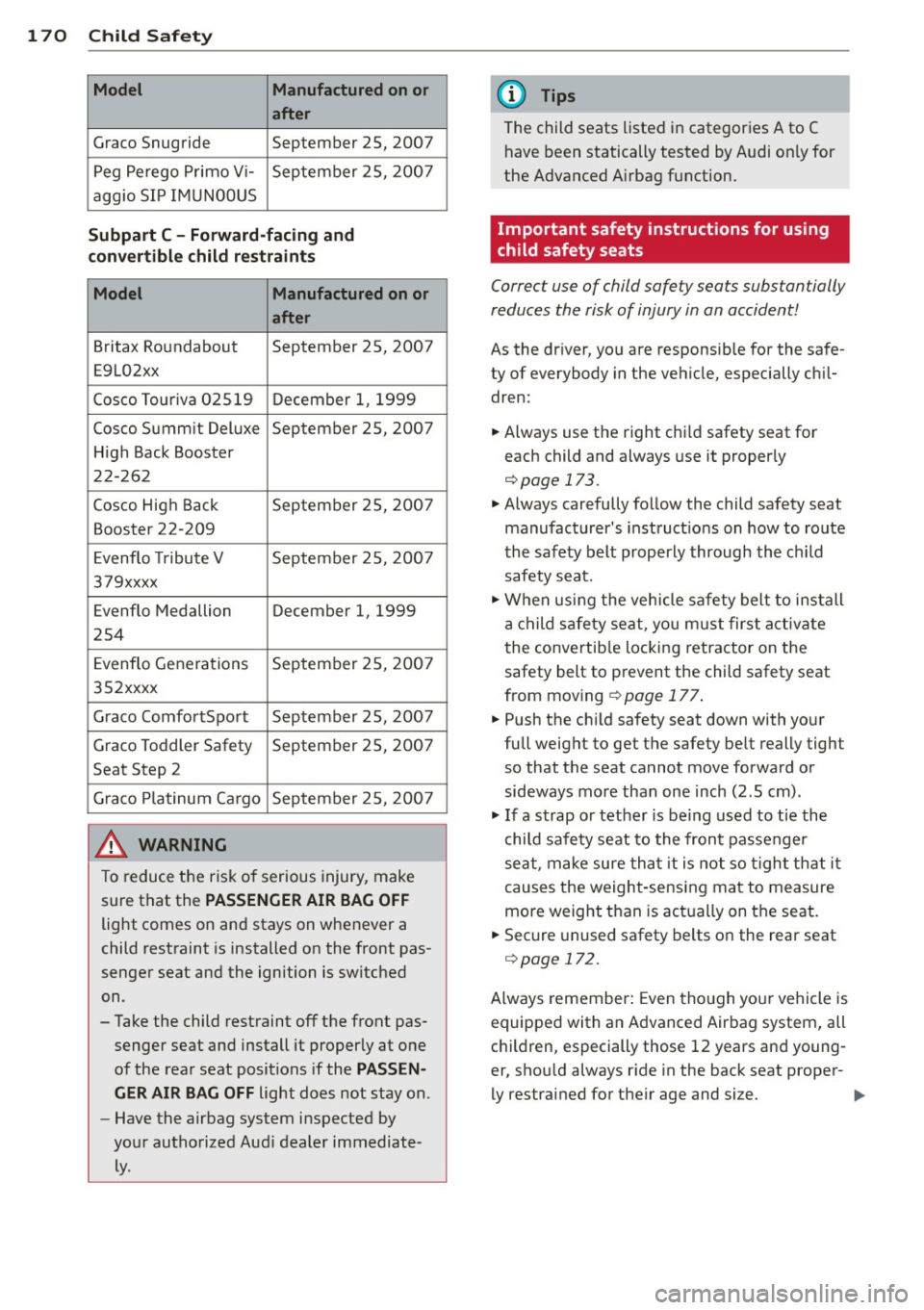
Model Manufactured on or
a fter
Graco Snugride September 2S, 2007
Peg Perego Primo V i- September 25, 2007
aggio SIP IMUN00US
Subpart C -Forward -facing and
con vertibl e child r estra in ts
Model Manufactured on or
after
Britax Roundabout September 25, 2007
E9L02xx
Cosco Tour iva 02519 December 1, 1999
Cosco Summit Deluxe September 2S, 2007
High Back Booster
22-262
Cosco Hig h Back September 25, 2007
Booster 22-209
Evenflo Tribute V September 25, 2007
379xxxx
Evenflo Medallion December 1, 1999
254
Evenflo Generations September 25, 200
7
352xxxx
Graco ComfortSport September 25, 2007
Graco Toddler Safety September 25, 2007
Seat Step 2
Graco P latinum Ca rgo September 25, 2007
_&. WARNING
T o reduce the risk of serious injury, make
sure that the
PASSENGER AIR BAG OFF
light comes on and stays on whenever a
child restraint is installed on the front pas
senger seat and the ignition is switched
on.
- Take the child restraint off the front pas senger seat and install it properly at one
of the rear seat positions if the
PASSEN
G ER AIR BAG OFF
light does not stay on.
- Have the airbag system inspected by
your authorized Aud i dealer immediate
ly.
(!) Tips
The child seats listed in categories A to C have been statically tested by Audi on ly for
the Advanced A irbag function.
Important safety instructions for using
child safety seats
Correct use of child safety seats substantially
reduces the risk of injury in an accident!
As the driver, you are responsib le for the safe
ty of everybody in the veh icle, especially ch il
dren:
... Always use the right ch ild safety seat for
each child and always use it properly
¢page 173 .
... Always carefully follow the child safety seat
manufacturer's instruct ions on how to route
the safety belt properly through the child
safety seat.
... When usi ng the veh icle safety belt to install
a child safety seat, you m ust first activate
the convertib le locking retractor on the
safety belt to prevent the child safety seat
from moving
¢ page 177.
... Push the ch ild safety seat down with your
full weight to get the safety belt really tight
so that the seat cannot move forwa rd or
sideways mo re than one inch (2.5 cm) .
... If a strap or tether is be ing used to t ie the
child safety seat to the front passenger
seat, make sure tha t it i s n ot so tight th at i t
causes the weight -sensing mat to measure
more weight than is act ually on the seat.
... Sec ure unused safety belts o n the rear seat
¢ page 172.
Always remember : Even tho ugh yo ur vehicle is
equipped with an Advanced Airbag system, all
chi ldren, especially those 12 years and young
er, shou ld always r ide in the back seat proper-
ly restrained for their age and size. .,.
Page 190 of 296

188 Intelligent technology
-Always accelerate with special care on
even, smooth surfaces such as those that
are wet or covered with ice and snow.
The drive wheels can spin even with
these assistance systems that cannot al
ways help to reduce the risk of loss of ve hicle control.
(i_) Tips
-ABS and ASR only work correctly when
all four wheels are equipped with identi-
Switching on/off
cal tires. Different tire sizes can lead to a
reduction in engine power.
- You may hear noises when the systems
described are working.
- If the indicator light
bl or t!lJ (USA
models)/[IJ (Canada models) appears,
there may be a malfunction
¢page 18,
¢page 19.
ESC turns on automatically when you start the engine.
Fig. 174 Version A: lower center console,~ OFF but·
ton
The ESC is designed to function in levels. De
pending on the level that is selected, the sta
bilization function of the ESC is limited or
switched off. The amount of stabilization con
trol will differ depending on the level.
The following situations are exceptions where
it may be useful to switch on sport mode (Se
dan) or offroad mode (allroad) to allow the
wheels to spin:
Fig. 175 Version B: upper center console,~ OFF but·
to n
-Rocking the vehicle to free it when it is stuck
- Driving in deep snow or on loose ground
- Driving with snow chains
- allroad: Driving on rough terrain when much
of the car's weight is lifted off the wheels
(axle articulation)
- allroad: Driving downhill while braking on
loose ground
Page 191 of 296
Intelligent technology 189
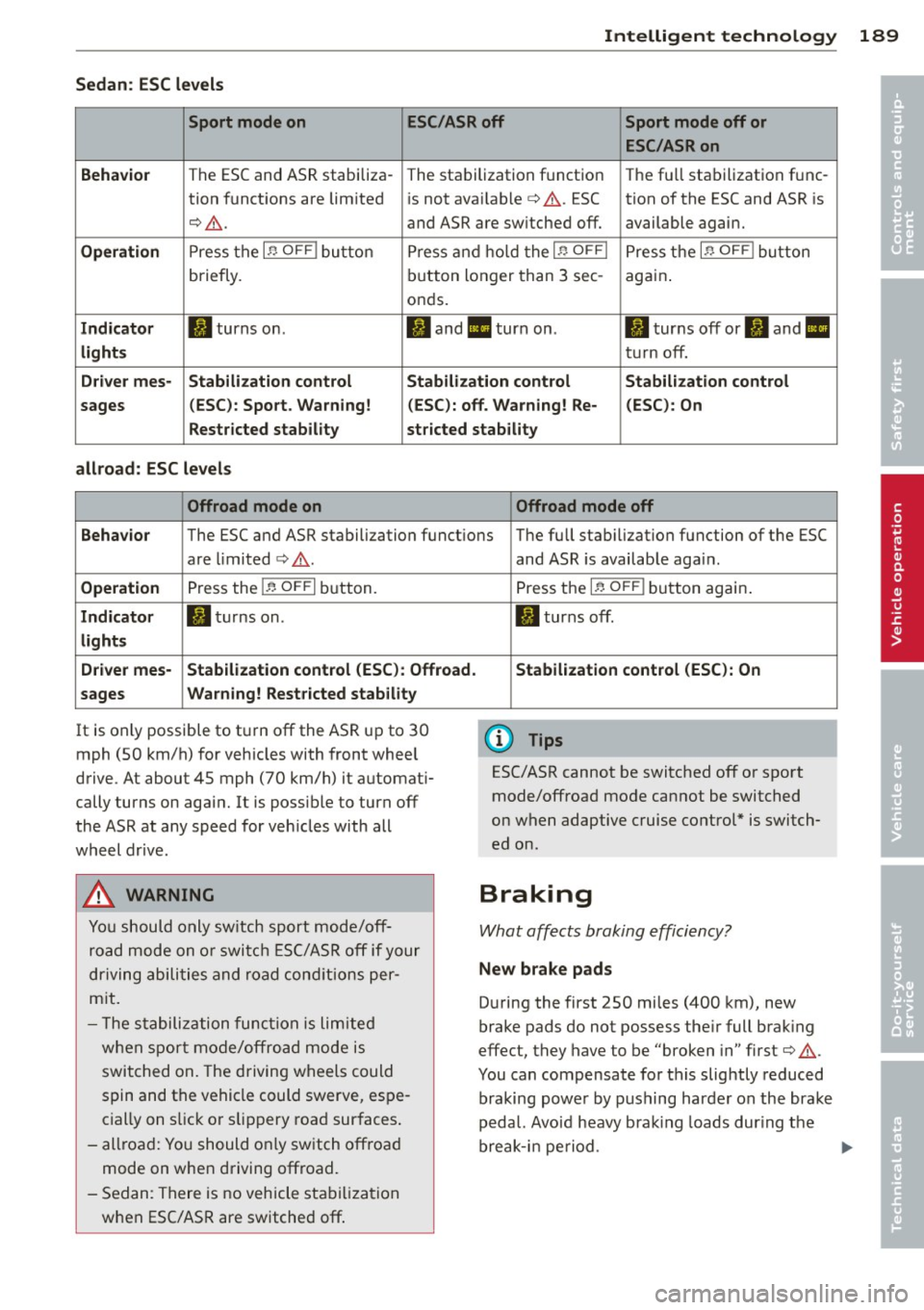
Sedan: ESC levels
Sport mode on ESC/ASR off Sport mode off or
ESC /ASR on
Behavior
The ESC and ASR stabiliza- The stalbilization f unct ion The fu ll sta bilization f unc-
tion funct ions are lim ited is not ava ilable
c:> A . ESC tion of the ESC and ASR is
c:, A . and ASR are sw itched off. available agai n.
Operation Press t he I~ OFF I button Pre ss and h old t he I~ OFFI Press t he i.i, OF FI bu tton
briefly. bu
tton longer than 3 sec -
aga in .
o nd s.
Indicator II turns on. II an d II turn on . II turns off or fl and II
lights tur n off.
Driv er mes· Stabilization control Stabilization control Stabilization control
sages (
ESC) : Sport . Warning! (ESC): off . Warning! Re- (ESC) : On
Restricted stability stricted stability
allroad: ESC level s
Offroad mode on Offroad mode off
Behavior
The ESC and ASR stabilization funct ions T he full stab ilizat ion function of the ESC
are limited
c:> A .
Operation Press the I~ OFFI bu tton.
Indicator II tur ns on.
light s
D river mes- Stabilization control (ESC ): Offroad.
sages Warning! Rest
ricted stability
It is on ly possible to t urn off the AS R up to 30
mph (SO km/h) f or veh icles with front whee l
drive. At about
45 mph (70 km/h) it a utomat i
cally turns on aga in. It is poss ible to turn off
the ASR at any speed for veh icles with all
wheel dr ive .
A WARNING
-
Yo u should o nly sw itch sport mode/off
r oa d m ode on or swi tch E SC/A SR off if your
d rivi ng abili ties a nd ro ad con ditio ns per
m it .
- T he stabili zation fu nction is limited
w he n sp ort m od e/off road mode is
switched on . The driving w heels could
s p in and t he vehicle c ould swerve, es pe
c ia lly on s lick or slipp ery roa d sur faces .
- all road: Yo u should o nly sw itc h off roa d
mode on when driving offroad .
- S edan: There is no vehicle sta biliz atio n
w hen ESC/AS R are switched off . and ASR
is availab le aga in.
Press t he
I~ OFF I button again .
II turns off.
Stabilization control (ESC ): On
(D Tips
ESC/ASR cannot be switched off o r sp o rt
mode/offroad mode ca nnot be switched
on when adaptive cruise control * is switch
ed o n.
Braking
What affects braking effic iency?
New brake pads
D uring the first 250 mi les (4 00 km), new
brake pads do not possess the ir full brak ing
effect, they have t o be "broken in" first
c:> A .
You can compensate for this slightly reduce d
braking powe r by pushing har der on the brake
p edal. Avo id heavy b ra ki ng loa ds dur ing t he
break-i n pe riod.
•
•
Page 199 of 296

-Have your vehicle maintained properly
and in accordance with the service rec
ommendations in your Warranty
&
Maintenance booklet.
- Lack of proper maintenance as well as
improper use of the vehicle will impair
the function of the emission control
system and could lead to damage.
@ For the sake of the environment
Even when the Emission Control System is
operating properly, the exhaust gas can
have a sulfur-like exhaust gas smell under
some operating states. This depends on
the sulfur content of the fuel being used .
Using a different brand of fuel may help,
or filling the tank with lead-free super
grade gaso line.
Shutting down vehicle
If you wou ld like your veh icle to remain inop
erat ive for a longer period of time, contact an
Aud i or other specialized dealer. They can ad
vise you on necessary precautions e .g. corro
sion prevention, maintenance and storage. Pay attention to add itional information con
cerning the battery. Refer to¢
page 225.
Operate your vehicle
economically and
minimize pollution
General
Your personal style of driving will determine
the economy of your vehicle , as well as ex
haust and noise levels .
Fuel economy, environmental impact, and
wear on your engine, brakes and tires largely
depend on three factors:
- your persona l driving style
- operating conditions
- technical limitat ions
If you anticipate what you need to do next and
drive economically, you can easily cut your
f u el cons umption by 10-15 percent. This sec-
Driving and environment 197
tion wi ll give you some tips on how you can
help the environment and your pocketbook .
(0 Tips
The consumption estimates as published
by ENVIRONMENTAL PROTECTION AGENCY
(EPA) and Transport Canada may not corre
spond to your actual consumption on the
road, which will vary depending upon vehi
cle load and speed, road and weather con
ditions, trip length, etc.
Drive smoothly and keep a lookout
ahead
Vehicles use the most fuel when they are ac
celerating .
.,. Avo id unnecessary accelerating and brak ing.
Vehicles use the most fue l when they are ac
ce lerat ing. If you ant icipate what is going to
happen next, you will need to brake less and,
thus, accelerate less . Let the vehicle coast
whenever possible -for example when you see
that the next traff ic light is red.
Avoid full throttle
Driving at moderate speeds saves fuel and
improves your mileage .
.,. Try and keep well below your car's maximum
speed.
Acce lerat ing gently red uces fue l cons ump
tion, eng ine wear, and does not disturb the
environment .
Fuel consumption, exhaust emiss ions and en
gine noise increase disproportionately at high
speeds. If you drive at approximately three quarters of top speed, fuel consumption w ill
be reduced by one half. Never drive faster
than the posted speed l imit and weather con
ditions permi t.
•
•
Page 238 of 296

236 Tires and wheels
Model Tire designation Tire pressure
Engine normal load condition full load condition
(up to 3 occupants)
front rear front rear
PSI kPA PSI kPA PSI kPA PSI kPA
S4 Sedan : 245/40 Rl8 93H
36 250 32 220 41
280 41
280 3.0 liter All Sea son
6-cylinder 245/40 Rl8 93V
High Performance
39 270 3 5 24 0 41 28 0 41 280
255/35 Rl9 96V XL
39 270
33 230 41
280 41 280 High Perfo rmance
XL= reinforced or extra load tire. It may al so appear a s xl , EXTRA LOAD, or RF on the tire side-
wall.
The correct tire pressure for the spare wheel i s
l o cated on a label on the dr ive r's side B-p illa r.
Because tec hnical cha nges may be made to
ve hicle equ ipment dur ing the model yea r, a l
ways compa re the tire size designation on the
tire pressure labe l o n you r ve hicl e w it h the
tires on your vehicle. M ake s ure that the t ire
size info rmation on the veh icle label is the
same as the size of the t ire s on the vehicle.
This is especially important if the vehicle be
l ongs to someone else or you bought the veh i
cle with different rims/tires or you boug ht the
ve hicle as a p reviously owned vehicle.
Remembe r, your safety and that of your pas
sengers also depends on mak ing s ure that
load limits are not exceeded. Vehicle load in
cludes everybody and everything in and on the
ve hicle . These load lim its are technically refer
red to as th e vehicle's G ross Vehicle We ight
Rati ng ("GVWR"). The G ross Ax le Weight Rat
i ng ("GA WR") is the ma ximum load tha t can
be applied at each o f the veh icle's two axles.
T he G ross Vehicle We ig ht Rating and the
Gross Axle Weight Rating a re listed on the
safety compliance st ic k er labe l located on the
driver's side B-p illar. The tire pressure label on
your Aud i lists the maximum combined
weight of all of the occupants and luggage or
o ther cargo tha t the vehicl e can carry. For the
l ocat io n of the ti re pressu re labe l~
fig . 189 .
A WARNING
Overloadin g a vehicle can cause loss of ve
hi cle cont ro l, a c rash or other accident, se
rious pe rsonal injury, and even death.
- Ca rrying more we ight tha n your ve hicle
was des igned to carry will prevent the
veh icle from handling properly and in
crease the risk of a loss of vehicle con
trol.
- The brakes on a vehicle that has been
overloaded may not be able to stop the
ve hicle w ith in a safe distanc e.
- Tires on a vehicle that has been overload
ed can fail s uddenly ca us ing loss of con
trol and a crash.
- Always make sure that the total load be
i n g transported -including t he weight of
a trailer hitch and t he tongue we igh t of a
loaded tr ail er -does not ma ke t he ve hi
cle he avier th an the vehicle' s Gro ss V ehi
cle Weigh t Ra tin g.
.8_ WARNING
- In co rrec t tire pressure s and /or u nderin
fl ation can lead to a serio us or fatal acci
dent .
- I nco rrec t tire pressures an d/or un derin
fla tion ca use increased ti re wear an d can
affect the handling of the vehicle. .,.
Page 264 of 296

262 Fuses and bulb s
No. Consumer Amps No. Consumer Amps
A/C system pressure sensor, Two-door models: rear left
electromechanical parking window regulator; Four-
brake, Homelink, automatic
11 door models:
rear left door
30
3 dimming interior rear view
5 (window regulator, central
m irror, air quality/outside locking, switch, lighting)
air sensor, Electronic Stab ili-
12 Rain
and light sensor
5
zation Control (button)
5 Sound actuator 5
Fuse panel© (red)
6 Headlight
range control/
5/7,5
head light (corner ing light)
No . Consumer Amps
3 Lumbar support 10
7 Headlight (cornering light) 7,5
4 Dynamic steering
35
Contro l modu les (electro-
5 Interior lighting (Cabriolet)
5
8 mechanical parking brake,
5
shock absorber, quattro
sport), DCDC converter
9 Adaptive cruise contro l 5 6
W
indshield washer system,
35
headlight washer system
7 Vehicle electrical system
20
control module 1
10 Shift gate/clutch
sensor
5
11 Side ass ist 5
8
Vehicle electr ica l system
30
control module 1
12 Headlight range control,
5
park ing system 9 Left rear window regulator
7,5/20
motor (Cabriolet)/sunroof
13 Airbag 5
14 Rear wiper (allroad) 15 10
Vehicle e
lectrica l system
30
control module 1
15 Auxiliary fuse (instrument
10
pane l) 11 Right
rear window regulator
7,5/20
(Cabriolet)/sun shade motor
16 Aux
iliary fuse terminal 15
40
(engine area) 12 Anti-theft
alarm warning
5
system
Fuse panel @ (brown)
No. Consumer Amps
2 Brake light sensor 5
3 Fuel pump 25
4 Clutc h sensor 5
5 Left
seat heating with/with-
15/30
out seat ventilation
6 Electronic
Stabilization Con-
5
trol (electric)
7 Horn 15
Front left door (window reg-
8 ulator, centra I locking, mi r-
30
ror, switch, lighting)
9 Windshield wiper motor 30
10 Electronic Stabi
lizat ion Con-
25
trol (valves)
Page 266 of 296

264 Fuses and bulbs
No. Consumer
5 Electromechanical parking
brake
6 Electronic damping control
7
Electromechanical parking
brake
8 Rear exterior lighting
9 quattro sport
10 Rear exterior lighting
11 Central locking
12 Terminal
30
Fuse panel © (brown)
No. Consumer
1 Luggage compartment lid
contro l module (allroad)
2 12-volt
socket, cigarette
lighter
3 DCDC converter path 1
4 DCDC
converter path 2,
so und amp lifier, radio
6
Right upper cab in heat ing
(Cabr iolet)
7
Electromechanical parking
brake
Right front door (w indow
9 regu lator, central locking,
mirror, switch, lighting)
1 0 Left upper cabin
heating
(Cabr iolet)
T wo -door models : rear right
window regu lator; Four-
11 door models: rear
right door
(window regulator, central
locking, sw itch, lighting)
12 Cell phone prep
Fuse panel © (black)
No. Consumer
1 Right front seat heating
4
MMI
5 Radio
6 Rear view camera
Amps
5
15
30
30
35
30
20 5
Amps
30
20
40
30
30
30
30
30
30
5
Amps
15
7,5
5
5
No . Consumer Amps
7 Rear window heater (all-
30
road)
8 Rear Seat Entertainment s
Bulbs
Replacing bulbs
For your safety, we recommend that you hove
your authorized Audi dealer replace any bulbs
for you.
It is becoming increasingly more and more
difficult to replace vehicle light bulbs since in
many cases, other parts of the car must first
be removed before you are able to get to the
bulb. This applies especially to the light bulbs
in the front of your car which you can only
reach through the engine compartment .
Sheet metal and bulb holders can have sharp
edges that can cause serious cuts, parts must
be correctly taken apart and then properly put
back together to help prevent breakage of
parts and long term damage from water that
can enter housings that have not been p roper
l y resea led.
For your safety, we recommend that you have
you r authorized Aud i dea ler replace any bulbs
for you, since yo ur dealer has the proper tools,
the correct bulbs and the expertise .
Gas discharge lamps (Xenon lights)*:
Due to the high electr ical voltage, have the
bulbs replaced by a qualif ied technician .
Headlights wit h Xenon light are identified by
the high voltage sticker .
_&. WARNING
Changing Xenon lamps witho ut the neces
sa ry equipment can cause serious personal
injury.
- Bulbs are pressurized and can explode
when being changed. Potential risk of in
jury!
-
Page 285 of 296

Index 283
-----------------------------------.......
Daytime running lights... ... .. .. .. 47, 48
Declaration of compliance Adapt ive cruise control .... .. .. .. .. . 278
Aud i side assist .......... .. .. .. ... 278
Cell phone pa ckage ....... .. .. .. .. . 278
Conve nience key ... .... ... .. .. .. ... 278
Elect ronic immobilizer .. ... .. .. .. .. . 278
Homelink universa l remote contro l .. . 278
Remote control key ....... .. .. .. .. . 278
D ecora tive parts/ trim
C lean ing ... .... ...... ... .. .. .. ... 206
Defective light bulb warning . . . . . . . . . . . 2 1
Defrosting (windows) ....... .. .. .. .. .. 78
D etermi ning correct load limi t ... .. .. . 239
Dig ita l clock ........... ...... .... ... 12
Dig ita l compass . .. ..... ... .. .. .. .... 56
D imensions .. ............. .... .. ... 273
Dimming the rearview mirror .. .. .. .. .. 51
D isp lays
C leaning ... .. .... .... ... .. .. .. ... 206
D oors
C hi ld safe ty loc ks ......... .. .. .. .. .. 4 2
emergency loc king ........ .. .. .. .. .. 38
Driver information system Enhanced sh ift indicato r .... ... ... ... 28
Open doo r or front lid warning . . . . . . . . 24
Outside temperat ure display .. .. .. .. .. 24
Sound system display . . . . . . . . . . . . . . . 24
Driver seat
refer to Seat ing pos ition 129
Driving off road ... ...... ... .. .. .. ... 199
D riving safe ly ............. .... .. ... 128
Driving through water . . . . . . . . . . . . . . . 195
D riving time . . . . . . . . . . . . . . . . . . . . . . . . 25
Dust filter
refer to Po llutant filte r (automatic AC
sys tem) .. .. ............. .... .. .. .. 76
Dynamic steering . . . . . . . . . . . . . . 113 ,191
E
E85 (Fue l) . . . . . . . . . . . . . . . . . . . . . . . . . 210
E ffi ciency program ......... .. .. .. .. .. 2 7
Fu el economy messages . . . . . . . . . . . . . 29
M emory leve ls . . . . . . . . . . . . . . . . . . . . . 25
Othe r equipment . . . . . . . . . . . . . . . . . . . 28
Shift indicator ........... .. .. .. .... 28 E
lectro -mechan ica l power ass ist ... .. .. 191
E lectromechanica l pa rk ing brake
E mergency bra king ................ . 87
Ind icator lig ht . .. .... ........... .. . 85
P arking ... .. .. .. ................. . 86
Re leas ing and closing ... .... ... .. .. . 85
Starting assist ...... .. .. ..... ... .. . 86
Starting from rest . ... .. .... ... .. .. . 86
Starting off w ith a trailer ........ .. .. . 87
Warning/ind icator lights .......... .. . 16
El ectronic differential lock
Warning/indicator lights ..... ... .. .. . 18
El ectronic d ifferential lock ( EDL) ... .. .. 186
Wa rning/ind icator lights ........ .. .. . 19
E lectronic immob ilizer . . . . . . . . . . . . 12, 38
E lectronic power con trol
(EPC) warning/indicator light . . . . . . . . . 20
El ectronic speed limi ter . . . . . . . . . . . . . . . 31
E lectronic stab ilizat ion contro l
offroad mode . . . . . . . . . . . . . . . . . . . . . 188
Sport mode . . . . . . . . . . . . . . . . . . . . . . 188
E lectronic Stabilization Cont ro l (ESC) ... 186
Warning/ind icator lights .......... .. . 18
Emergency ac tua tion
Doors . ... .. .... ... .. .. ..... ... .. . 38
Ignition key ..... .. . .. .. ..... ... .. . 35
Rea r lid . . . . . . . . . . . . . . . . . . . . . . . 41, 42
Slid ing/ti lting s unroof .............. . 45
E merge ncy br aking . .... ......... .. .. . 87
Emergency flasher ................. .. 49
w . /' d' l' h arnmg m 1cator 1g ts . . . . . . . . . . . . . 23
Emergency key .. ...... ............. . 33
Starting engine .. ............. .. .. . 82
Emergency operation Emergency bra king funct ion (parking
brake) . ... .. .... .. . .. .. ..... ... .. . 87
E mergency starti ng ............. .... 266
Emergency towing . ................. 268
Energy management .. .. ..... ... .. .. 193
Battery power . . . . . . . . . . . . . . . . . . . . . 17
Driver notification . . . . . . . . . . . . . . . . . . 17
En gine
Compartment .. ...... ........... .. 216
Coolant ... .. .. .... .. ... ..... ... .. 221
Data ... .. .. .... .. . .. .. ..... ... .. 274
Hood ... .. .. .... .. . .. .. ..... ... .. 214
Starting . . . . . . . . . . . . . . . . . . . . . . 80, 83
•
•