2014 AUDI RS7 SPORTBACK warning light
[x] Cancel search: warning lightPage 125 of 292
Driving Safely
General notes
Safe driving habits
Please remember -safety first!
This chapter contains important information,
tips, instructions and warnings that you need
to read and observe for your own safety, the
safety of your passengers and others. We have
summarized here what you need to know
about safety belts, airbags, child restraints as
well as child safety. Your safety is for us
priori
ty number 1.
Always observe the information
and warnings in this section - for your own
safety as well as that of your passengers.
The information in this section applies to all
model versions of your vehicle. Some of the
features described in this sections may be
standard equipment on some models, or may
be optional equipment on others. If you are
not sure, ask your authorized Audi dealer.
A WARNING
-Always make sure that you follow the in
structions and heed the WARNINGS in
this Manual. It is in your interest and in
the interest of your passengers.
- Always keep the complete Owner's Liter
ature in your Audi when you lend or sell
your vehicle so that this important infor
mation will always be available to the
driver and passengers.
- Always keep the Owner's literature handy
so that you can find it easily if you have
questions.
Safety equipment
The safety features are part of the occupant
restraint system and work together to help
reduce the risk of injury in a wide variety of
accident situations.
Your safety and the safety of your passengers
should not be left to chance. Advances in
technology have made a variety of features
available to help reduce the risk of injury in an
Driving Safely 123
accident. The following is a list of just a few of
the safety features in your Audi:
- sophisticated safety belts for driver and all
passenger seating positions,
- safety belt pretensioners,
- safety belt force limiters for the front seats,
- safety belt height adjustment systems for the front seats,
- front airbags,
- knee airbags for the front seats*
- side airbags in the front seats and outer rear
seats*,
- side curtain airbags,
- special LATCH anchorages for child re-
straints,
- head restraints for each seating position,
- adjustable steering column.
These individual safety features, can work to
gether as a system to help protect you and
your passengers in a wide range of accidents.
These features cannot work as a system if
they are not always correctly adjusted and cor
rectly used.
Safety is everybody's responsibility!
Important things to do before driving
Safety is everybody's job! Vehicle and occu
pant safety always depends on the informed and careful driver.
Fo r your safety and the safety of your passen
gers,
before driving always:
.. Make sure that all lights and signals are op
erating correctly.
.,. Make sure that the tire pressure is correct .
.. Make sure that all windows are clean and af
ford good visibility to the outside.
.,. Secure all luggage and other items carefully
I::!) page 64, I::!) page 61.
.. Make sure that nothing can interfere with
the pedals.
.. Adjust front seat, head restraint and mirrors
correctly for your height.
.. Instruct passengers to adjust the head re-
straints according to the ir height. .,.. •
•
Page 126 of 292
124 Driving Safel y
• Make sure to use the right child restraint
correct ly to protect children¢
page 168,
Child Safety .
• Sit properly in your seat and make sure that
your passengers do the same¢
page 53,
General recommendations.
• Fasten your safety belt and wear it properly .
Also instruct your passengers to fasten their
safety belts proper ly
r:::;, page 133 .
What impairs driving safety?
Safe driving is directly related to the condi
tion of the vehicle, the driver as well as the
driver 's ability to concentrate on the road
without being distracted.
The driver is respons ible for the safety of the
vehicle and all of its occupants.
If you r ability
to drive is impa ired, safety r isks for everybody
i n the vehicle increase and yo u also become a
hazard to everyone else on the road
r::::> .&_ .
Therefore:
• Do no t let yourself be distracted by passen
gers or by using a cellular telephone.
• NEV ER drive when your driving ability is im
paired (by medications, alcohol, drugs, etc.).
• Observe all traffic laws, rules of the road
and speed limits and plain common sense .
• ALWAYS adjust your speed to road, traffic
and weather condit ions .
• Take frequent breaks on long trips . Do not
dr ive for more than two hours at a stretch.
• Do NOT drive when you are t ired, under
pressure or when you are stressed.
_8. WARNING
Impaired driving safety increases the risk
of serious personal injury and death when
ever a vehicle is being used.
Proper occupant
seating positions
Proper seating position for the driver
The proper driver seating position is impor
tant for safe, relaxed driving.
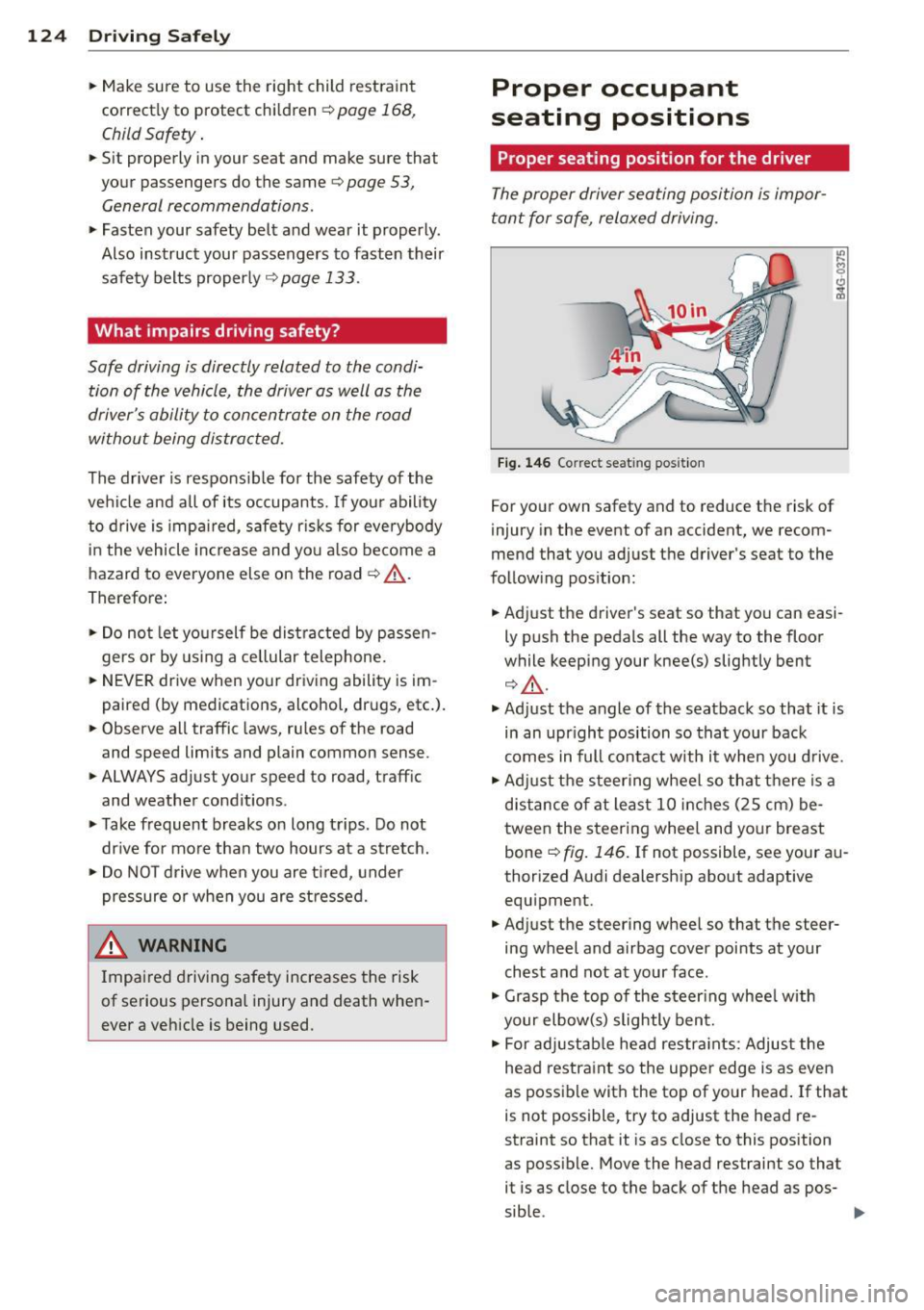
Fig. 146 Correct seat ing posit ion
For your own safety and to reduce the risk of
injury in the event of an accident, we recom
mend that you adjust the driver's seat to the
following position:
• Adjust the driver's seat so that you can easi
ly push the pedals all the way to the floor
while keeping your knee(s) slightly bent
r:::;, A.
• Adjust the angle of the seatback so that it is
in an upr ight position so that your back
comes in full contact with it when you drive.
• Adj ust the steering wheel so that there is a
distance of at least 10 inches (25 cm) be
tween the steering wheel and your breast
bone
r:::;, fig. 146. If not possible, see your au
thorized Audi dealership about adaptive equipment.
• Adjust the steering wheel so that the steer
ing wheel and airbag cover points at your
chest and not at your face .
• Grasp the top of the steer ing wheel with
your elbow(s) slightly bent.
• For adjustable head restra ints: Adjust the
head restraint so the upper edge is as even
as possible with the top of yo ur head . If that
is not possible, try to adjust the head re
straint so that it is as close to this position
as possible. Move the head restraint so that it is as close to the back of the head as pos-
sible . .,,.
Page 135 of 292
Safety belts
General notes
Always wear safety belts!
Wearing safety belts correctly saves lives!
This chapter explains why safety belts are nec
essary, how they work and how to adjust and
wear them correctly.
~ Read all the information that follows and
heed all of the instructions and WARNINGS.
A WARNING
Not wearing safety belts or wearing them
improperly increases the risk of serious
personal injury and death.
- Safety belts are the single most effective
means available to reduce the risk of se
rious injury and death in automobile acci
dents. For your protection and that of
your passengers, always correctly wear
safety belts when the vehicle is moving.
- Pregnant women, injured, or physically
impaired persons must also use safety
belts. Like all vehicle occupants, they are
more likely to be seriously injured if they
do not wear safety belts. The best way to
protect a fetus is to protect the mother -
throughout the entire pregnancy.
Number of seats
Your Audi has a total of four seating positions:
two in the front and two in the rear. Each seat ing position has a safety belt.
A WARNING
Not wearing safety belts or wearing them
improperly increases the risk of serious
personal injury and death.
- Never strap more than one person, in
cluding small children, into any belt. It is
especially dangerous to place a safety
belt over a child sitting on your lap.
- Never let more people ride in the vehicle
than there are safety belts available.
Safety belts 13 3
-Be sure everyone riding in the vehicle is
properly restrained with a separate safe
ty belt or child restraint.
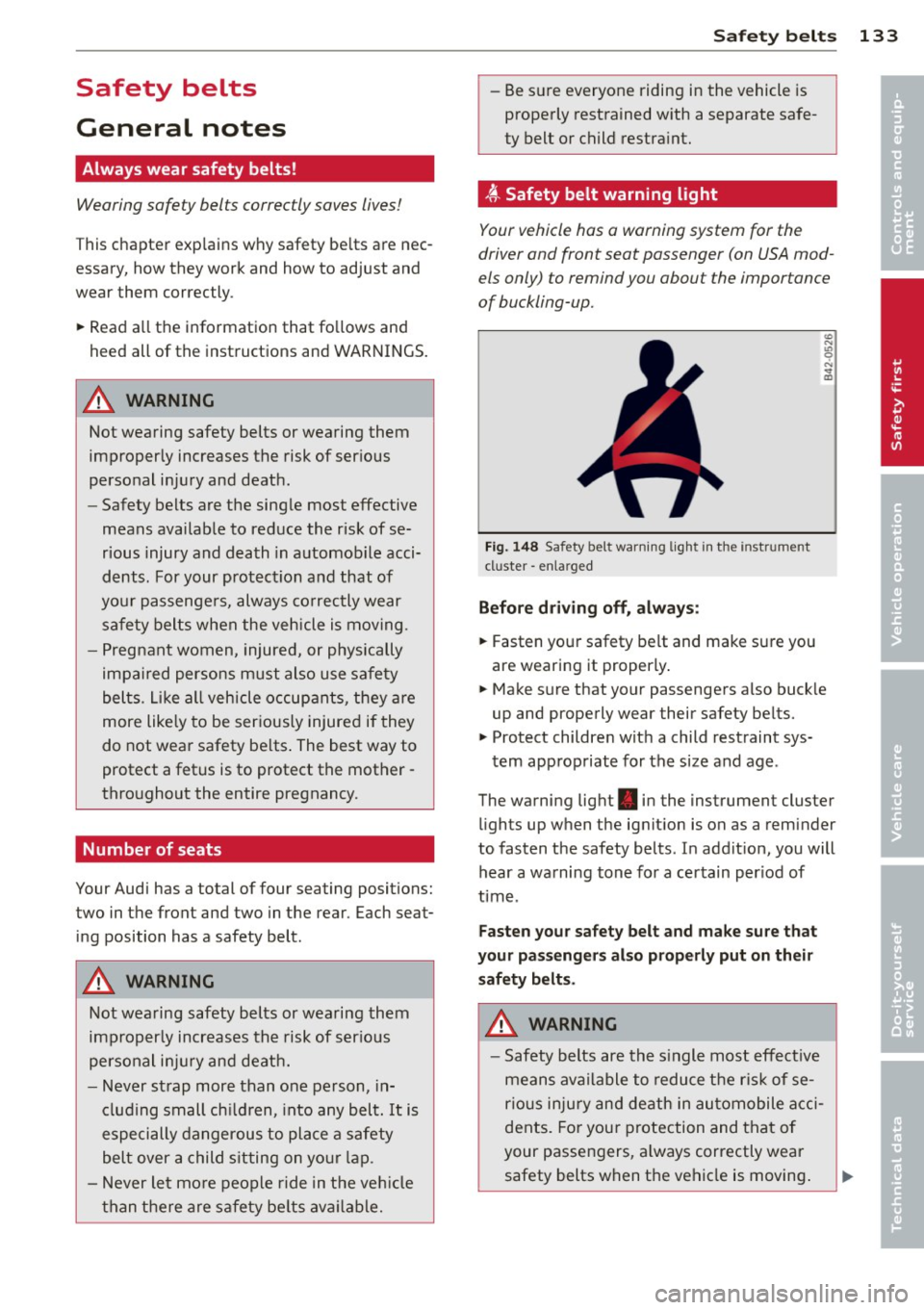
~ Safety belt warning light
Your vehicle has a warning system for the
driver and front seat passenger (on USA mod
els only) to remind you about the importance
of buckling-up.
Fig. 148 Safety belt warning light in the instr ument
cl uster -enla rged
Before driving off, always:
~ Fasten your safety belt and make sure you
are wearing it properly.
~ Make sure that your passengers also buckle
up and properly wear their safety belts.
~ Protect children with a child restraint sys-
tem appropriate for the size and age .
The warning light . in the instrument cluster
lights up when the ignition is on as a reminder
to fasten the safety belts. In addition, you will
hear a warning tone for a certain period of
time .
Fasten your safety belt and make sure that
your passengers also properly put on their
safety belts.
A WARNING
- Safety belts are the single most effective
means available to reduce the risk of se
rious injury and death in automobile acci
dents. For your protection and that of
your passengers, always correctly wear
safety belts when the vehicle is moving.
•
•
Page 136 of 292
134 Safety belts
-Failure to pay attention to the warning
light that come on, could lead to person
al injury.
Why safety belts?
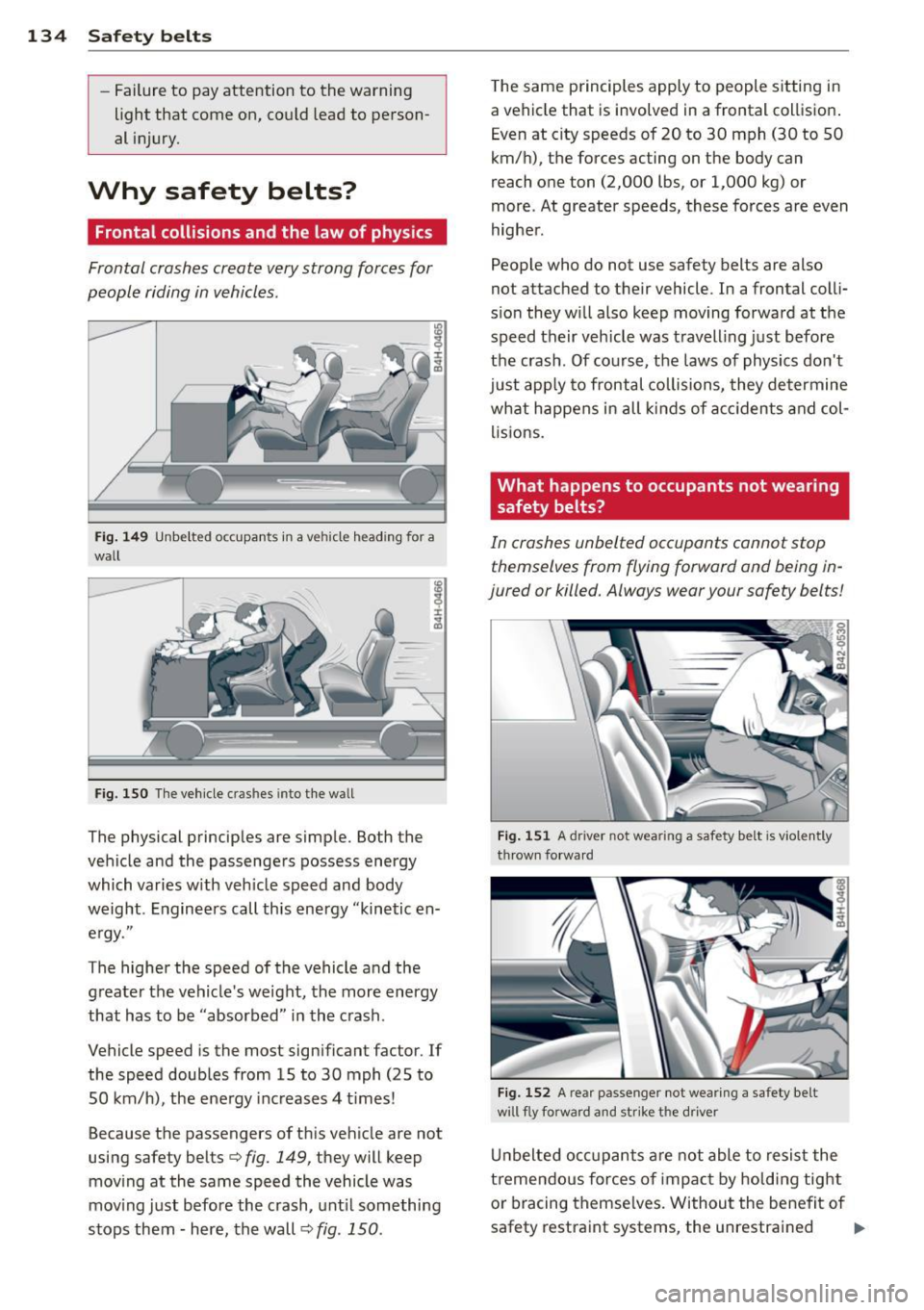
Frontal collisions and the law of physics
Frontal crashes create very strong forces for
people riding in vehicles.
Fig. 149 Unbe lted occupants in a vehicle heading for a
wall
Fig. 150 Th e vehicle crashes into the wall
The physical principles are simple. Both the
vehicle and the passengers possess energy
which varies w ith veh icle speed and body
weight . Engineers call this energy "kinetic en
e rgy."
The higher the speed of the vehicle and the
greater the vehicle's weight, the more energy
that has to be "absorbed" in the crash.
Vehicle speed is the most significant factor.
If
the speed doubles from 15 to 30 mph (25 to
50 km/h), the energy increases 4 times!
Because the passengers of this veh icle are not
using safety belts¢
fig. 149, they will keep
moving at the same speed the vehicle was
mov ing just before the crash, until something
stops them - here, the wall ¢
fig. 150.
The same principles apply to people sitting in
a vehicle that is involved in a frontal collision .
Even at city speeds of 20 to 30 mph (30 to 50
km/h), the forces acting on the body can
reach one ton (2,000 lbs, or 1,000 kg) or
more. At greater speeds, these forces are even
higher.
Peop le who do not use safety belts are also
not attached to their vehicle. In a frontal colli
s ion they will also keep moving forward at the
speed their vehicle was t ravell ing just before
the crash . Of course, the laws of physics don't
just apply to frontal collisions, they determine
what happens in all kinds of accidents and col
lisions .
What happens to occupants not wearing
safety belts?
In crashes unbelted occupants cannot stop
themselves from flying forward and being in
jured or killed. Always wear your safety belts!
Fig. 151 A driver not wearing a safety belt is violently
thrown fo rwa rd
Fig . 152 A rear passe nge r not wearing a safety belt
will fly forward and strike the driver
Unbelted occupants are not able to resist the
tremendous forces of i mpac t by holding tight
or bracing themselves. Without the benefit of
safety restraint systems, the unrestrained
ll-
Page 139 of 292
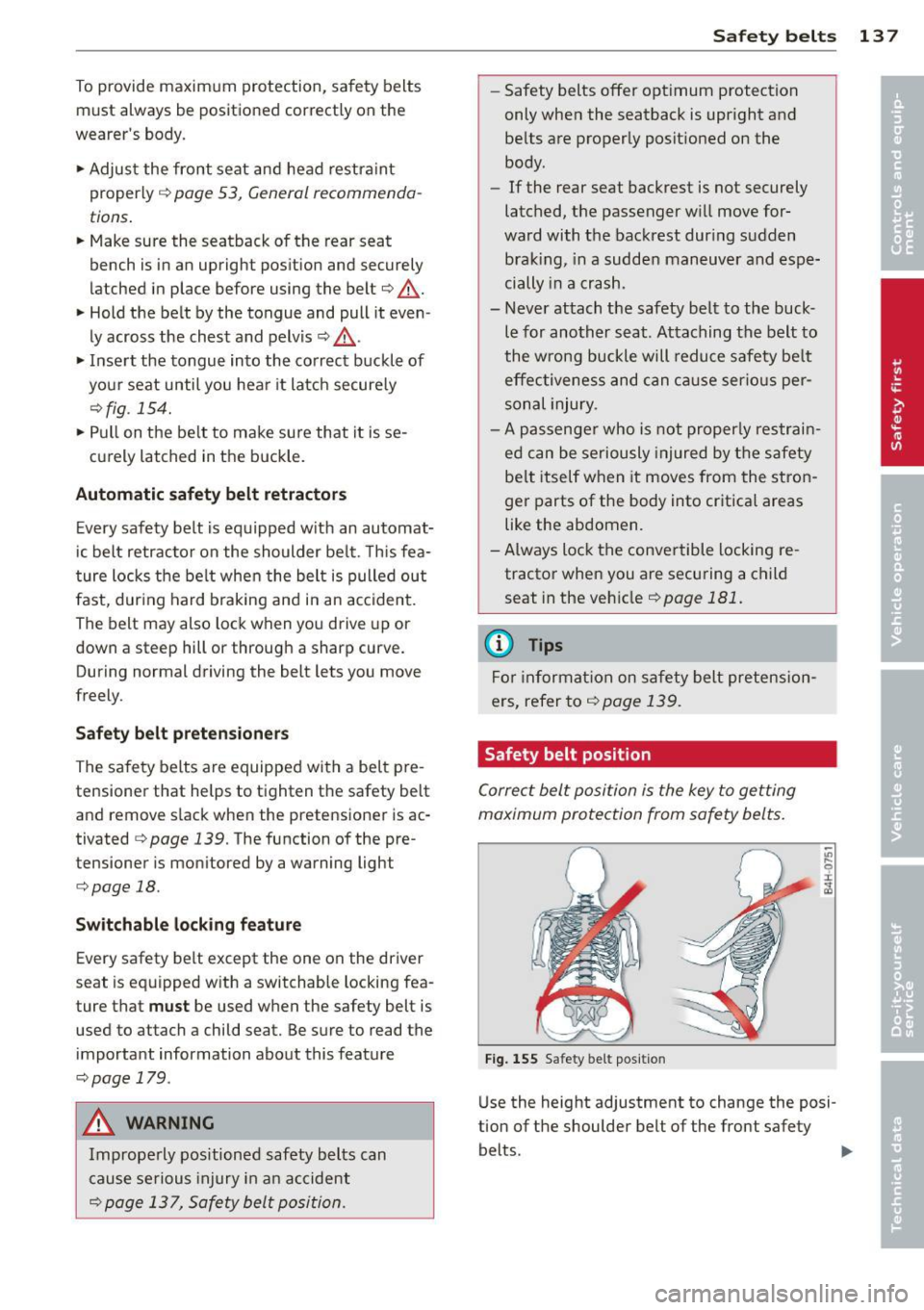
To provide maximum protection, safety belts
must always be positioned correctly on the
wearer's body .
... Adjus t the front seat and head restraint
properly
c::> page 53, General recommenda
tions .
... Make sure the seatback of the rear seat
bench is in an upright position and securely
latched in place before using the belt
c::> ,&. .
... Hold the be lt by the tongue and pull it even
ly across the chest and pelvis
c::> ,&..
... Insert the tongue into the co rrect buckl e of
your seat until you hea r it latch securely
c::>fig . 154.
... Pull on the belt to make sure that it is se-
curely latched in the buckle.
Automatic safety belt retractors
Every safety belt is equipped w ith an automat
i c belt retractor on the shoulder be lt. T his fea
ture locks the belt when the belt is pulled out
fast, dur ing hard braking and in an accident.
The belt may also lock when you drive up or
down a steep hill or through a sharp curve.
During normal driving the belt lets you move
freely.
Safety belt pretensioners
The safety belts are equipped with a belt pre
tensioner that helps to tighten the safety belt
and remove slack when the pretensioner is ac
tivated
c::> page 139. The function of the pre
tensioner is mon itored by a warning light
c::> page 18 .
Switchable locking feature
Every safety belt except the one on the driver
seat is equipped w ith a switchable locking fea
ture that
must be used when the safety belt is
used to attach a child seat. Be sure to read the
important information about this feature
c::> page 179.
A WARNING
Improperly positioned safety belts can
cause se rious injury in an accident
c::> page 13 7, Safety belt position.
Safety belts 13 7
-Safety belts offer optimum protection
only when the seatback is upright and
be lts are properly posit ioned on the
body .
- If the rear seat backrest is not securely
latched, the passenger will move for
ward with the backrest during sudden braking, in a sudde n maneuver and espe
cially in a crash.
- Never attach the safety belt to the buck
l e for another seat . Attaching the belt to
the wrong buckle will reduce safety be lt
effec tiveness and can cause serious per
sonal injury.
- A passenge r who is not properly restrain
ed can be seriously injured by the sa fety
be lt itself when it moves from the stron
ger parts of the body into critical areas
like the abdomen.
- Always lock the conve rtible locking re
tractor when you are securing a child seat in the veh icle
~ page 181.
(D Tips
For info rmat ion on safety belt pretension
e rs, refer to
c::> page 139.
Safety belt position
Correct belt position is the key to getting
maximum protection from safety belts .
Fig. 155 Safe ty belt posit ion
Use the height adjustment to change the posi
tion of the shoulder belt
of the front safety
belts.
~
Page 146 of 292
144 Airbag sys tem
Child restraints on the front seat - some
important things to know
• Be sure to read the important information
and heed the WARNINGS for important de
ta ils about ch ildren and Advanced Airbags
i=> page 168.
Even though your vehicle is equipped with an
Advanced Airbag System, make certain that
all children, especially those 12 years and
younger, always ride in the back seat properly
restra ined for their age and size. The airbag
on the passenger side makes the front seat a potentially dangerous place for a child to r ide .
The front seat is not the safest place fo r a
chi ld in a fo rward-facing chi ld seat.
It can be a
ve ry dangerous p lace for an infant or a c hild in
a rearward -facing seat.
The Advanced Airbag System i n your veh icle
has been certified to comply with the require
men ts of United States Federa l Mo to r Veh icle
Safety Standard 208 as applicable at the time
your ve hicle was manufact ured.
The Standa rd requires the fron t air bag on t he
passenger side to be turned off ("sup
p ressed") if a child up to about one yea r of
age restrained in one of the rear-facing or for
ward-facing infant restraints listed in Federal
Motor Vehicle Safety Standard 208 with which
the Advanced A irbag System in your vehicle
was certified has been installed on the front
passenger seat. For a listing of the child re
straints that we re used to certify compliance
with the US Safety Sta ndard
c> page 170.
The PASSENGER AIR BAG OFF light in the in
strument panel tells you when the front Ad
vanced A irbag on the passenger side has been
turned off by t he e lectronic control unit.
Each time you sw itch on the ignit ion, the
PAS
SENGER AIR BAG OFF
l ight will come on for a
few seconds a nd:
- will stay on if the front passenger seat is not
occupied,
- will stay on if the electrical capacitance
measured by the capacitive passenger de
tection system for the fro nt passenger seat equa
ls the combined capacitance of an in
fant up to about one year of age and one of
the rearwa rd-facing or forward-fac ing ch ild
restraints listed in Federal Motor Vehicle
Safety Standard 208 with which the Ad
vanced Airbag System in your vehicle was
cert ified. For a listing of the ch ild restraints
that w ere used to certify you r vehicle 's com
plia nce w it h the U.S. Safety Standard
i=>page 170.
- w ill stay on i f the re is a small c hild or child
restrai nt on the front passenge r seat,
- w ill go off if the front passenger seat is oc
cupied by an adult as registered by the ca pacitive passenge r de tection system
c> page 154, Monitoring the Advanced Air
bag System.
T he PASSENGER AIR BAG OFF light comes on
whe n electr ica l capacitance regis tered on the
front passenger seat is eq ua l to or less than
t h e comb ined capacitance of a typical 1 year
o ld infant and one of the rearward-facing or
forward-facing child restraints listed in Feder
al Motor Vehicle Safety Standard 208 with
which the Advanced Airbag System i n your ve
hicle was cert ified .
If the total e lectr ica l capacitance registered
on the front passenger seat is more than that
of a typical 1 year-old child but less than the
we ight of a small adu lt, the front airbag on
the passenger side can deploy (the
PASSEN
GER AIR BAG OFF
light does not come on).
If the
PASSENGER AIR BAG OFF light does
not come on, the front airbag on the passen
ger side has not been turned off by the e lec
t ron ic cont ro l unit and can deploy if the con
t ro l u nit se nses an impa ct that mee ts the con
di tions s to red in its memory.
For example, the airbag may deploy if:
- a small ch ild that is heav ier th an a typical 1
year-old child is on the front passenger seat
(regard less of whether the child is in one of
the ch ild seats listed
c::;, page 170), o r
- a child who has outgrown child restraints is
on the front passenger seat. ..,.
Page 147 of 292
If the fron t passenger airbag is turned off, the
PA SSENGER AIR BA G OF F light comes on in
the instrument cluster and stays on.
If the front passenger airbag deploys, the
F ederal Standard requires the airbag to meet
the " low risk" deployment criteria to reduce
the r isk of injury through interaction with the
airbag. "Low r isk" deployment occurs in those
crashes that take place at lower decelerations
as defined in the electronic control un it
c::> page 155, PASSENGER AIR BAG OFF light.
Always remember, a child seat or infant carri
er installed on the front seat may be struck
and knocked out of position by the rap idly in
flating passenger's a irbag i n a frontal colli
sion . The airbag could greatly reduce the ef
fectiveness of t he ch ild restraint and even se
r io usly inju re the child d uring inflat io n.
For this reason, and because the back seat is
the safest place for chi ldren - when properly
restra ined accord ing to their age and size - we
strongly recommend that children always sit in the back seat
c::> page 168, Child Safety.
A WARNING
-
A child in a rearward -facing child seat in
stalled on the front passenger seat will be
ser iously injured and can be killed if the
front airbag inflates - even with an Ad
vanced Airbag System.
- The inflating airbag w ill hit the child seat
or infant carrier w ith great force and w ill
smash the ch ild seat and child against
the backrest, center armrest, door or roof.
- Always install rear-facing child seats on the rear seat.
- If you must install a rearward facing
child seat on the front passenge r seat
because of exceptiona l circumstances
and the
PASSENGER AIR BAG OFF light
does not come on and stay on, immedi
a tely ins tall the rea r-facing chi ld seat in a
rear seating position and have the airbag
system inspected by your Audi dealer.
A irbag system 145
-Forwa rd-facing child seats installed on
the front passenger's seat may interfere
with the dep loyment of the airbag and
cause serious persona l injury to the
child.
A WARNING
If, in except ional circumstances, you must
install a forward-facing child restraint on
the front passenge r's seat:
- Always ma ke sure the forward-facing
seat has been designed and certified by its manufacture r for use on a front seat
with a passenger fron t and s ide a irbag.
- Never put the fo rward-facing child re
s tra int up against or ve ry near the instru
men t panel.
- Always move the passenge r seat into its
rea rmost pos ition in the se at's fore and
aft ad justment range, as fa r away from
the airbag as possible before installing
the forward-fac ing ch ild restra int . The
backrest must be adj usted to an upright
position.
- Make sure that the
PASSENGER AIR BAG
OFF
li ght comes on and stays on all the
time whenever the ignition is switched on .
A WARNING
To reduce the risk of ser ious injury, make
sure that the
PASSENGER AIR BAG OFF
light w ill be displayed whenever a child re
straint is insta lled on the front passenge r
se at and the ignition is sw itched on.
- If the
PASSENGER AIR BAG OFF light
does not s tay on, perform the checks de
scribed
c::> page 154, Monitoring the Ad
vanced Airbag System.
- T ake the chi ld restraint off t he front pas
senger seat and install it prope rly at one
of the rear seat positions i f the
PASSEN
GER AIR BAG OFF
light does not stay on.
- Have the airbag system inspected by
your Aud i dea ler immediately.
•
•
Page 151 of 292
If the total electrical capacitance registered
on the front passenger seat is more than that
of a typ ica l 1 year-old, but less than the
weight of a small adult, the front airbag on the passenger side may deploy (the
PA SSEN
G ER AIR BA G OFF
light does not come on) .
For example, th e air bag m ay depl oy if :
-a small child that is heavier than a typical 1
year-o ld child is on the front passenger seat
(regardless of whether the child is in one of
the chi ld seats listed
¢ page 170),
-a chi ld who has outgrown child restraints is
on the front passenger seat.
I f the front passenger airbag is turned
off, the
PA SSENGER AIR BA G OFF light in the center
of the instrument panel wi ll come on and stay
on.
If the front passenger airbag deploys, the
F ederal Standard requires the a irbag to meet
the " low risk" deployment criteria to help re
d uce the risk of injury through interaction
with the airbag. "Low risk" deployment occurs
in those crashes that take place at lower de
celerations as defined in the electronic control
un it
o page 154 .
Alwa ys rem ember: Even though your vehicle
is equipped with Advanced Airbags, the safest
place for children is properly restrained on the
back seat. Please be sure to read the impor
tant information in the sect ions that follow
and be sure to heed a ll of the WARNINGS.
A WARNING
To reduce the risk of injury when an airbag
inf lates, a lways wear safety belts properly.
- If you are unres trained, lean ing fo rward,
sitting sideways or out of position in any
way, your risk of inj ury is much highe r.
- You w ill also receive serio us inju ries and
cou ld even be killed if you are up against
the a irbag or too close to it when it in
flates -even with an Advanced Airbag
¢ page 142 .
Airbag system 149
A WARNING
A child in a rearward-fac ing ch ild seat in
stalled on the front passenger seat will be
seriously inju red and can be killed if the
front airbag inflates -even w ith an Ad
vanced A irbag System .
- Although the Advanced Airbag System in
your veh icle is designed to turn
off the
front airbag when a rearward-facing child res traint has been installe d on the
front passenger seat, nobody can abso
lutely guarantee that dep loyment is im
possible in all conceivable situations that
may happen dur ing the usefu l life of your
veh icle.
- The inflating airbag will h it the ch ild seat
or infant carrier with great force and will
smash the child seat and child against
the backrest, center armrest, door, or roof.
- Always install rearward-facing chi ld re
straints on the rear seat .
- If you must install a rearward fac ing
child seat on the front passenger seat because of exceptional circumstances
and the
PASSENGER AIR BAG OFF light
does not come on and stay on, immed i
ately in sta ll the rear-fa cing child seat in a
rea r seat ing pos ition and have the airbag
system inspected by your Audi dealer.
A WARNING ,-
If, in except iona l circumstances, you must
install a forward-facing child restraint on
the front passenger's seat:
- Always make sure the forward-facing
seat has been designed and certified by
its manufacturer for use on a front seat
with a passenger front and s ide a irbag.
- Never put the forward-facing child re
straint up against or very near the instru ment panel.
- Always move the passenger seat into its rearmost position in the seat's fore and
aft adjustment range, as far away from
the airbag as possible, before installing
the forward-fac ing ch ild restra int . Th e •
-
•