2014 AUDI RS7 SPORTBACK weight
[x] Cancel search: weightPage 176 of 292
17 4 Child Safety
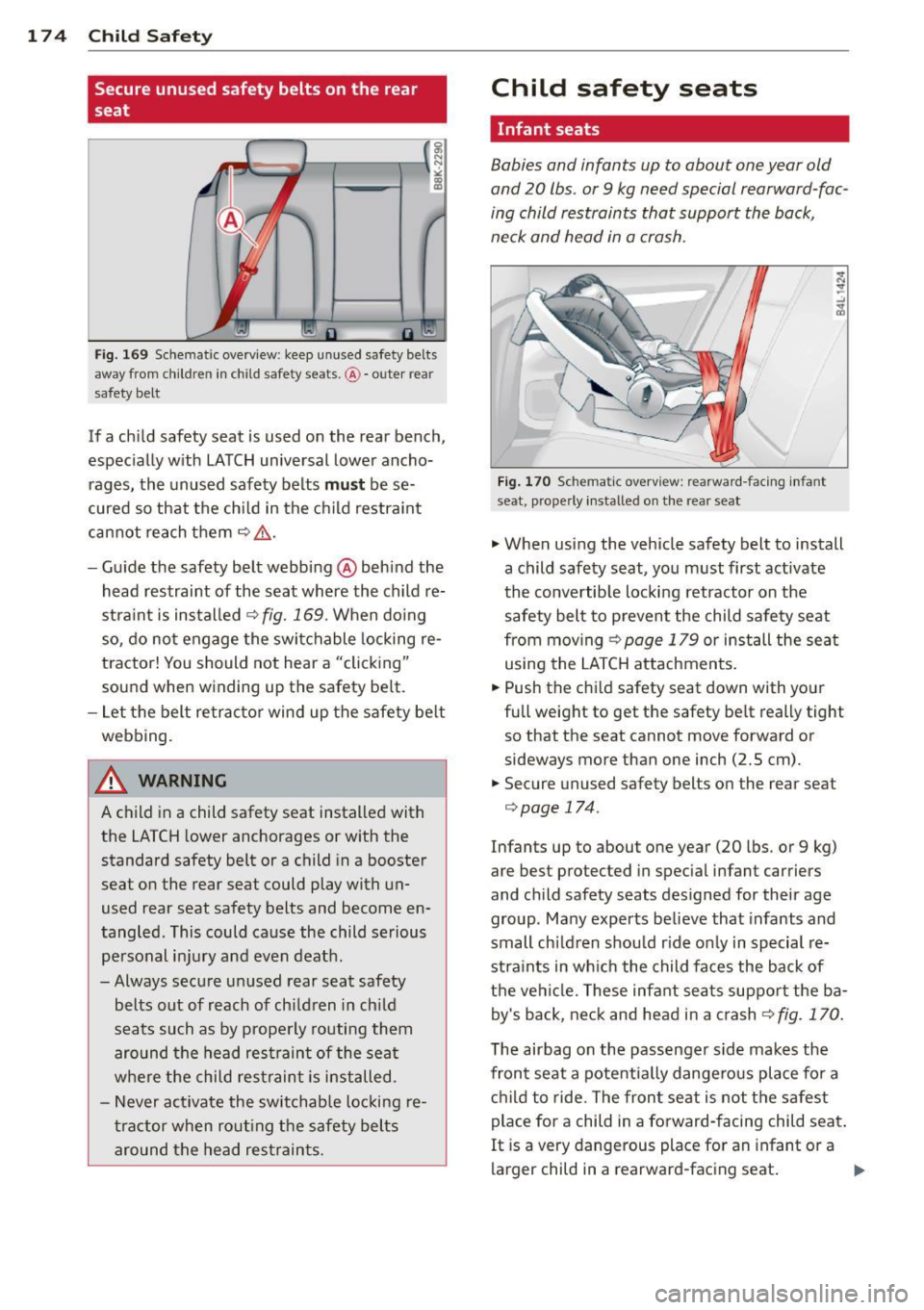
Secure unused safety belts on the rear
seat
F ig. 169 Schematic overview: keep unused safety belts
away from children in child safety seats.@-outer rear
safety belt
If a ch ild safety seat is used on the rear bench,
espec ially w ith LATCH unive rsal lower ancho
rages, the unused safety belts
mu st be se
cured so that the ch ild in the child restra in t
cannot reach them
r::;, ,&. .
-Gui de the safety belt webbing @behind the
head restraint of the seat where the child re
stra in t is ins talled
r::;, fig. 169 . When do ing
so, do not engage the switchable locking re
t ractor! You should not hear a "clicking"
sound when winding up the safety be lt.
- Let the belt re tracto r wind up the safety be lt
webbing .
~ WARNING
A child in a child safety seat installed with
the LATCH lower anchorages or w ith the
standard safety belt or a child in a booster
seat on the rear seat could play with un
used rear seat safety belts and become en
tangled . This could cause the child se rious
personal in jury and even deat h.
-Always secure unused rear seat safety belts out of reach of ch ildren in ch ild
seats such as by prope rly routing them
around the head res traint of the seat
where the child res traint is installed.
- N ever activate the sw itchab le lo cking re
tr actor when ro uting the safety belts
around the head rest raints.
Child safety seats
Infant seats
Babies and infants up to about one year old
and 20 lbs . or
9 kg need special rearward-fac
ing child restraints that support the back,
neck and head in a crash.
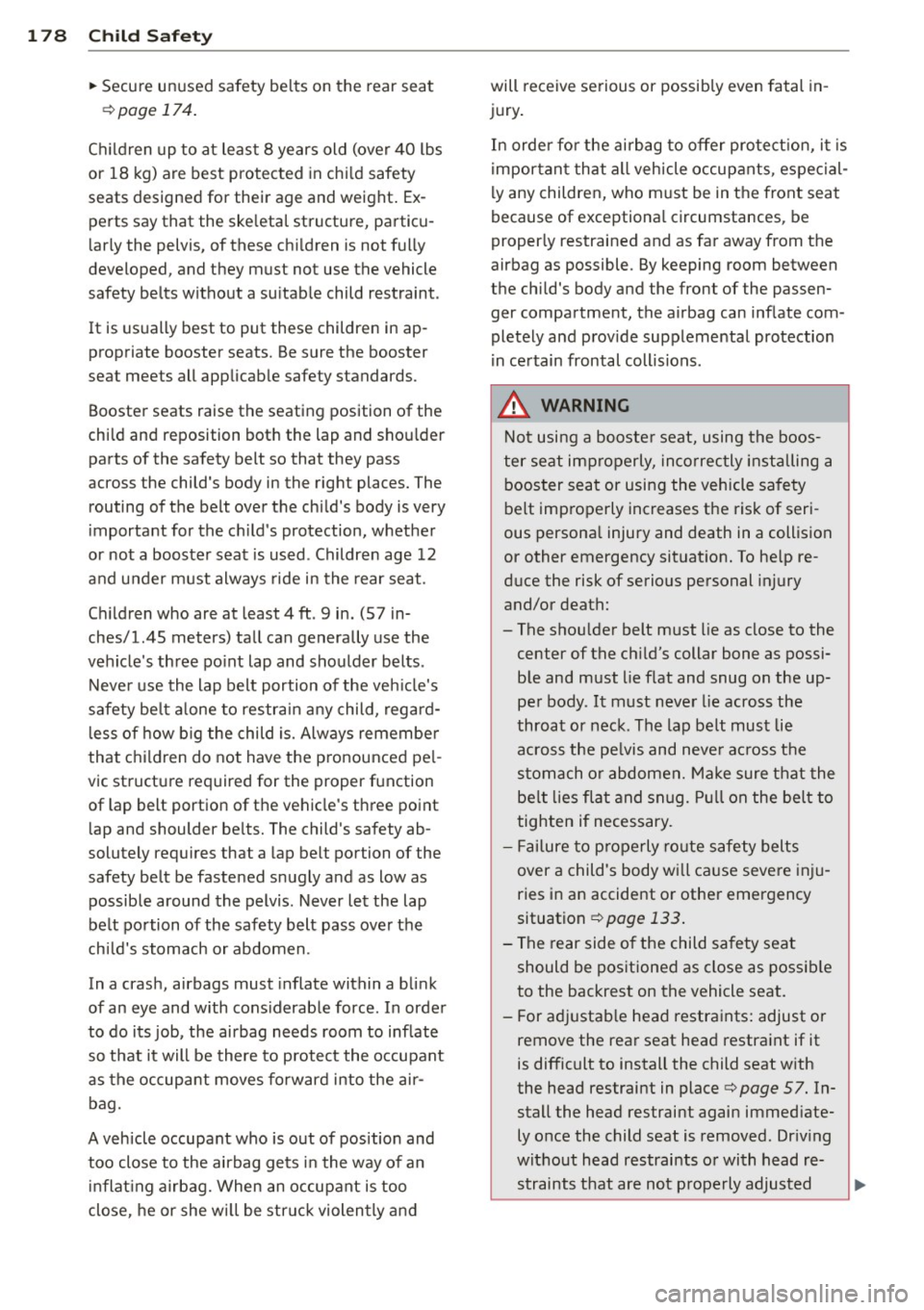
Fig . 1 70 Schem atic overview: rearward-fac ing infant
seat, properly installed on th e rear seat
.,. When using the vehicle safety belt to install
a child safety seat, you must first activate
the convertib le locking retractor on the
safety belt to p revent the child safety seat
from mov ing
c:;,page 179 or install the seat
using the LATCH attachmen ts .
.,.. Push the chi ld safety seat down with yo ur
full weight to get the safety belt really tight
so that the seat cannot move forward or
sideways more than one inch (2.5 cm).
.,. Secure unused safety belts on the rear seat
c:;,page 174.
Infants up to about one yea r (20 lbs. or 9 kg)
are best protected in spec ial infant carriers
and child safety seats designed for their age
group . Many experts be lieve that infants and
small ch ild ren shou ld ride on ly in sp ecial re
stra ints in wh ich the child faces the back of
t h e ve hicle. These infa nt sea ts sup port the ba
by 's back, ne ck and head in a c rash
r::;, fig. 1 70 .
The airbag on the passenger side makes the
fron t seat a pote ntia lly dange ro us place for a
c hi ld to ride. The fron t se at i s not the safest
place for a child in a forward-facing child sea t.
It is a very dange rous place fo r an infant or a
larger child in a rearward-fac ing seat .
llll>-
Page 178 of 292

176 Child Safety
the convertible locking feature on the safety
belt to prevent the child safety seat from
moving ¢
page 179 or install the seat using
the LATCH attachments .
.,. Push the child safe ty seat down with your
full weight to get the safety belt really tight so that the seat cannot move forward or
sideways more than one inch (2.5 cm)
¢ page 179.
.,. If the child safety seat is equipped with a
tether strap, attach it to the tether anchors
¢page 185.
.,. Secure unused safety belts on the rear seat
¢ page 174.
A toddler or child is usually too large for an in
fant restraint if it is more than one year old
and weighs more than 20 lbs. (9 kg).
Toddlers and children who are older than one
year up to about 4 years old and weigh more
than 20 lbs (9 kg) up to 40 lbs. (18 kg) must
always be properly restrained in a child safety
seat certified for their size and weight
¢fig. 171 and ¢fig. 172.
The airbag on the passenger side makes the
front seat a potentially dangerous place for a
child to ride . The front seat is not the safest
place for a child in a forward-facing child safe
ty seat. It is a very dangerous place for an in
fant or a larger child in a rearward-facing seat.
A WARNING
Not using a child safety seat, using the
wrong child safety seat or improperly in
stalling a child restraint increases the risk
of serious personal injury and death in a
collision or other emergency situation.
- Children on the front seat of any car,
even with Advanced Airbags, can be seri
ously injured or even killed when an air
bag inflates. A child in a rearward-facing
child safety seat installed on the front
passenger seat will be seriously injured
and can be killed if the front airbag in
flates -even with an Advanced Airbag
System . -
The inflating airbag will hit the child
safety seat or infant carrier with great
force and will smash the child safety seat and child against the backrest, center
arm rest, door or roof .
- Always install rear-facing child safety
seats on the rear seat .
- If you must install a rearward facing
child safety seat on the front passenger
seat because of exceptional circumstan
ces and the
PASSENGER AIR BAG OFF
light does not come on and stay on, im
mediately install the rear-facing child
safety seat in a rear seating position and
have the airbag system inspected by your
Audi dealer.
- The rear side of the child safety seat
should be positioned as close as possible
to the backrest on the vehicle seat.
- For adjustable head restraints: adjust or remove the rear seat head restraint if it
is difficult to install the child seat with
the head restraint in place
¢ page 57. In
stall the head restraint again immediate
ly once the child seat is removed. Driving
without head restraints or with head re straints that are not properly adjusted increases the risk of serious or fatal neck
injury dramatically.
- Always read and heed all WARNINGS
whenever using a child restrained in ave
hicle is being used
¢page 133, Safety
belts,
¢ page 142, Airbag system and
¢ page 168, Important things to know.
A WARNING ~ -
If exceptional circumstances require the
use of a forward-facing child restraint on
the front passenger's seat, the child's safe
ty and well-being require that the follow ing special precautions be taken:
- Make sure the forward-facing seat has
been designed and certified by its manu
facturer for use on a front seat with a passenger front and side airbag .
Page 180 of 292
178 Child Saf ety
• Secure unused safety belts on the rear seat
r::!;> page 174 .
Children up to at least 8 years old (over 40 lbs
or 18 kg) are best protected in chi ld safety
seats designed for their age and weight . Ex
perts say that the ske leta l structure, particu
larly the pelvis, of these chi ldren is not fully
developed, and they must not use the vehicle
safety belts w ithout a su itab le child restraint .
It is us ually best to put these children in ap
propriate booster seats. Be sure the booster
seat meets all applicab le safety standards.
Booster seats raise the seating position of the
child and reposition bot h the lap and sho ulder
parts of the safety belt so that they pass
across the child 's body in the right places. The
routing of the belt over the chi ld 's body is very
important for the ch ild's protection, whethe r
or not a booster seat is used . Children age 12
and under must always ride in the rear seat.
Ch ildren who are at least 4
ft . 9 in. (S7 in
ches/1.4S meters) tall can generally use the
vehicle's three po int lap and shoulder be lts .
Neve r use the lap belt portion of the veh icle's
safety be lt alone to restrain any child, rega rd
l ess of how b ig the child is. Always remembe r
that c hildren do not have the pronounced pe l
vic st ructure required for the proper function
of lap belt portion of the vehicle's three point lap and shoulder be lts. The child's safety ab
solutely requires that a lap be lt portion of the
safety belt be fastened snugly and as low as
possib le around the pelvis . Never let the lap
be lt po rtion of the safety belt pass over the
chi ld's stomach or abdomen.
In a crash, airbags must inflate within a blink
of an eye and with cons iderab le force . In order
to do its job, the airbag needs room to inflate
so t hat it will be there to p rotect the occupant
as the occupa nt moves forw ard into the air
bag.
A vehicle occupant who is out of position and
too close to the airbag gets in the way of an
i n flat ing a irb ag. When an occupant is too
close, he or she w ill be str uck violen tly and will
receive se rious or possib ly even fatal in
jury .
In orde r fo r the ai rb ag to offer protect ion, i t is
i mpor tan t t hat a ll vehicle occup ants, espe cial
ly any children, who m ust be in the front seat
because of exceptiona l circumstances , be
proper ly restrained and as fa r away from the
airbag as possible . By keeping room between
the child's body and the front of the passen
ger compartment, the airbag can inflate com
pletely and prov ide supplemental protection
in ce rtain frontal coll isions .
.8. WARNING
Not using a booste r seat, using the boos
ter seat imp roperly, in co rrectly installing a
b oos ter seat or using the vehicle sa fe ty
belt imp roperly increases the risk of seri
ous persona l injury and death in a collision
or other emergency situat ion. To he lp re
d uce the risk of serio us personal injury
and/or death:
- The shou lder belt must lie as close to the
center of the ch ild's collar bone as possi
b le and must lie flat and snug on the up
per body . It must neve r lie across the
throat or neck . The lap belt must lie
across the pe lvis and neve r acr oss t he
s tomach o r abdomen.
M ake sure t hat the
be lt lies flat and snug. P ull on the bel t to
tighten if necessary.
- Failure to p roperly ro ute s afe ty belts
over a child's body wi ll ca use seve re inj u
ries in an accident o r other emergency
situation
¢ page 133 .
-The rear side o f the child sa fety seat
should be pos itioned as close as possib le
to the backrest on the vehicle seat.
- For ad justab le head restraints: adjust or
remove the rea r seat head restra int if it
is difficult to install the child seat with
the head restraint in place
c:> page 57. In
stall the head restraint again immed iate
ly once the child seat is removed . Dr iv ing
without head restraints o r with head re-
.
straints that are not p roperly adjus ted Ii),
Page 183 of 292
-Make sure that the PA SSENGER AIR BA G
OFF
light comes on and stays on all the
t ime whenever the ignition is switched
on.
- If the
PA SS ENGER AIR BAG OFF light
does not come on and stay on, immedi
ately install the rear -facing child safety
seat in a rear seating position and have
the a irbag system inspected by your Audi
dealer.
Activating the convertible locking retractor
Use the convertible locking retractor to se
cure a child restraint .
Always heed the child safety seat manufactur
e r's instructions when install ing a ch ild re
straint in you r vehicle. To activate the conver
tible locking retractor:
.,. Place the child rest raint on a seat, prefera
bly on the rear seat.
.,. Slow ly pull the be lt
a ll th e wa y out .
.,. Route it around or through the chi ld re
straint be lt path ¢.&_ .
.,. Push the child safety seat down with your
full weight to get the safety belt rea lly tight.
.,. Insert the belt tongue into the buckle for
that seating position .
.,. Gu ide the safety belt back into the retractor
until the belt lies flat and snug on the child
safety seat .
.,. You should hear a "clicking " noise as the
belt w inds bac k into the ine rtia reel. Test the
convertible locking retractor by pulling on
the belt . You should no longer be able to
pull the belt out of the retractor . The con
vertib le locking retractor is now activated.
.,. Make sure that the red re lease button is fac
ing away from the chi ld restraint so that it
can be unbuckled qu ickly .
.,. Pull on the belt to make sure the safety belt
is p roperly t ight and fastened so t hat the
seat cannot move fo rward or sideways mo re
than one inch (2.5 cm).
Child Sa fet y 181
A WARNING
Using the wrong child restraint or an im
properly installed chi ld restraint can cause
serious pe rsonal injury or death in a c rash .
- Always make sure that the safety belt re-
tractor is loc ked when insta lling a child
safety seat. An unlocked safety belt re
tracto r cannot hold the child safety seat
in place dur ing no rma l dr iving o r in a
crash.
- Always buckle the child sa fety seat firmly
in place even if a ch ild is not si tt ing in it.
A loose child safe ty seat can fly around
during a s udden stop or in a crash .
- Always ma ke sure the seat backrest to
which the child res traint is installed is in
an upright position and securely latched
into place and cannot fold forward. Oth
erwise, the seatback with the child safety
seat attached to it could fly forward in
the event of an accident o r other emer
gency situation.
- Always read and heed all WARNINGS
whenever us ing a child restrained in ave
hicle is being used ¢
page 168. Special
precautions apply when insta lling a child
safety seat on the front passenger seat
¢ page 144, Child restraints on the front
seat -some important things to know.
-
Deactivating the convertible locking
retractor
The conv ertibl e locking retractor for child r e
straints will be deactivated automatically when the belt is wound all the way back into
the retractor.
.,. Press the red b utton on the safety belt buck
le . Th e belt tong ue will pop out of t he b uck
le .
.,. Guide the s afety belt all the way back into
i t s s towed position .
A lways let the safety be lt retract completely
into its stowed position. The safety belt can
now be used as an ordinary safety belt w ith
out the convertible locking retractor fo r child
restraints.
•
•
Page 230 of 292
228 Tire s and wheel s
Tires and wheels
Tires
General notes
Tires may be the least appreciated and most
abused parts of a motor vehicle .
Tires may be the least appreciated and most
abused parts of a motor vehicle . Tires are,
however, one of the most important parts of a
vehicle, particularly considering the compara
tive ly small patch of rubber on each tire that
assures that all -impo rtant contact between
you, your vehicle and the road.
Maintaining the correct tire pressure, mak ing
sure that your vehicle and its tires do not have
to carry mo re weight than they can safe ly han
d le, avoiding damage from road hazards and
reg ularly inspecting t ires for damage includ
ing cuts, slashes irregu la r wear and ove rall
condition are the most important things that
you can do to he lp avoid sudden tire failure in
cluding tread separation and blowouts.
A voidin g damage
I f you have to drive over a curb or similar ob
stacle, drive very s low ly and as close as possi
b le at a right angle to the curb.
A lways keep chem ica ls includ ing grease, o il,
gasoline and b rake fluid off the ti res.
Inspect the t ires regularly for damage (cuts,
cracks or b listers, etc.). Remove any fo reign
bod ies embedded in the treads.
St oring tires
Mark tires when you remove them to indicate
the direction of rotation . Th is ensures you to
be ab le to mount them correctly when you re
install t hem.
When removed, the wheels or t ires should be
stored in a cool, dry and preferably dark place .
Store tires in a vertical pos ition if they are not
mounted on rims, in a horizontal pos it ion if
they are mounted on rims. New tire
s
New t ires have to be broken in¢&,. .
T he tread depth of new t ires may vary, accord
ing to the type a nd make of t ire and the tread
pa tte rn .
Hidden damage
Damage to tires and r ims is often not readily
vis ible . If you notice unusual v ibrat ion or the
vehicle p ulls to one side, th is may ind icate
that one of the t ires has been damaged . Th e
t ir es m ust be checked immed iate ly by an au
tho rized Aud i dea le r or q uali fied wor kshop.
Unidirectional t ires
A un idirectional tire can be identified by ar
rows on the sidewa ll, that po int in the direc
t ion the t ire is designed to rotate. You must
fol low the specified d irection of rotation . This
is necessary so that these tires can develop
their optimum characteristics regarding grip, road no ise, wear and hydrop laning resistance.
For more information
¢page 259.
A WARNING
-New tires or tires that are old, worn or
damaged cannot provide maximum con
trol and braking ability .
-
-New tires tend to be slippery and must
be broken in . To reduce the risk of losing
control, a co llision and ser ious personal
in jur ies, d rive w ith special ca re fo r the
fi rst 350 m iles (560 km).
- Driving with worn or damaged tires can
lead to loss of control, sudden tire fail
ure, including a blowou t and sudden de
fl ation, c rashes and seriou s personal in
juries . Have wo rn or damaged t ires re
p laced immediate ly .
- T ires age even if they are not being used
and can fai l sudden ly, especially at high
speeds. Tires that are more than 6 years
old can only be used in an emergency
and then w ith specia l care and at low
speed.
Page 231 of 292
-Never mount used tires on yo ur vehicle if
yo u are not sure of their "previous histo
ry." Old used tires may have been dam
aged even though the damage cannot be
seen that can lead to sudden tire failure
and loss of vehicle control.
- If you notice unusual vibration or if the
vehicle pulls to one side when d riving, al
ways stop as soon as it is safe to do so
and check the wheels and tires for dam
age .
(D Note
Please note that summe r and wi nte r tires
are designed for the cond itions that are
Glossary of tire and loading terminology
Accessory weight means the comb ined weight (in excess of
those sta ndard items which may be rep laced)
of au toma tic transmission, power steer ing ,
power brakes, power windows, power seats,
radio, and heater, to the extent that these
items are availab le as factory-installed equip
ment (whether installed or not) .
Aspect ratio
means the rat io o f the height to the w idth of
the tire in percent . Numbers of 55 or lower in
dicate a low sidewall for improved steering re
sponse and better overa ll handling on dry
pavement .
Bead
means the part of the t ire t hat is made o f
steel wires, wrapped or reinforced by ply cords
and that is shaped to fit the r im.
Bead separation
means a b reakdown of the bond between
components in the bead .
Cord means the strands forming the plies in the
tire.
Tire s an d wheel s 229
typica l in those seasons . Aud i recommends
using winter tires during the winter
months . Low temperatures signif icant ly
dec rease the e lasticity of summer t ires,
which affects tract ion and brak ing ability.
If summer t ires are used i n very co ld tem
peratures, cracks ca n form o n the tread
bars , res ulting in perma nen t tire damage
that can cause loud driving noise and un
bala nced ti re s. Audi i s not respon sible for
th is type of damage .
Cold tire inflation pressure
means the t ire p ress ure recommended by t he
vehicle manufacture r fo r a tire o f a des ignated
s ize t hat has not bee n driven for more than a
coup le o f miles (k ilometers) at low speeds in
the three hour period before the tire press ure
is m easured or adjusted.
Curb weight
me ans the we ight of a motor ve hicle with
st andard equipmen t incl ud ing the max imum
capacity of fuel, oi l, and coolant, air condi
tioning and additional weig ht of optiona l
equipment.
Extra load tire
means a t ire design to oper ate a t higher load s
and at higher inflation pressures than the cor
responding standa rd tire . Extra load tires may
be identified as "XL", "x l", "EXTRA LOAD", o r
"RF" on the sidewal l.
Gross Axle Weight Rating ("GAWR")
me ans the load-ca rry ing capac ity of a single
axle system , measured at the tire -ground in
te rfaces.
Gross Vehicle Weight Rating ( "GVWR ")
mea ns the maximum total loaded we ight of
the ve hicl e. .,..
•
•
Page 232 of 292
230 Tires and wheels
Groove
means the space between two adjacent tread
ribs .
Load rating (code)
means the maximum load that a tire is rated
to carry for a given inflation pressure. You
may not find this informat ion on all tires be
cause it is not req uired by law.
Maximum load rating
means the load rating for a t ire at the max i
mum permissible inflation pressure for that
tire.
Maximum loaded vehicle weight
means the sum of:
(a) Curb weight
(b) Accessory weight
(c) Vehicle capacity we ight, and
(d) Production options weight
Maximum (permissible) inflation pressure
means the maximum cold inflation pressure
to which a tire may be inflated. Also called
"maximum inflation pressure ."
Normal occupant weight
means 150 lbs. (68 kilograms) times the
number of occupants seated in the vehicle up
to the total seating capacity of your vehicle .
Occupant distribution
means distribution of occupants in a vehicle.
Outer diameter
means the overa ll diameter of an inflated new
tire.
Overall width
means the linear distance between the exteri
ors of the sidewalls of an inflated tire, includ
ing elevations due to labeling, decorations, or
protective bands o r ribs .
Ply
means a layer of rubber-coated parallel cords.
Production options weight
means the combined weight of those insta lled
regular production options weighing over 5
lbs. (2.3 kg) in excess of those standard items
which they replace, not previously considered
in curb weight or accessory we ight, including
heavy duty brakes, ride levelers, roof rack,
heavy duty battery, and special tr im .
Radial ply tire
means a pneumat ic tire in which the ply cords
that extend to the beads are laid at substan
t ia lly 90 degrees to the center line of the
tread .
Recommended inflation pressure
see<=> page 229, Cold tire inflation pressure.
Reinforced tire
means a t ire design to operate at higher loads
and at h igher inflation pressures than the cor
responding standa rd tire. Reinforced tires
may be identified as "XL" "xl" "EXTRA LOAD"
' ' '
or "RF" on the sidewa ll.
Rim
means a metal support for a tire or a tire and
tube assembly upon which the tire beads are
seated.
Rim diameter
means nom inal diameter of the bead seat. If
you change your wheel s ize, you will have to
purchase new tires to match the new rim di
ameter.
Rim size designation
means r im diameter and width .
Rim width
means nominal distance between rim flanges.
Sidewall
means that portion of a tire between the
t read and bead.
Page 233 of 292
Speed rating (letter code)
means the speed at wh ich a tire is des igned to
be driven for extended periods of t ime . The
ratings range from 93 mph (150 km/h) to
186 mph (298 km/h) ¢
page 240 . You may
not find this information on all tires because
it is not required by law.
The speed rating letter code, where applica ble, is molded on the tire sidewall and indi
cates the maximum permissible road speeds
¢ &. in Winter tires on page 243.
Tire pressure monitoring system
means a system that detects when one or
more of a vehicle's tires are underinflated and
illuminates a low tire pressure warn ing te ll
tale .
Tread
means that portion of a tire that comes into
contact with the road.
Tread separation
means pulling away of the tread from the tire
carcass .
Treadwear indicators (TWI)
means the projections within the princ ipal
grooves designed to give a visual indication of
the degrees of wear of the tread. See
¢
page 237, Tread Wear Indicator (TWI) for
more informat ion on measuring tire wear.
Uniform Tire Quality Grading
is a tire information system developed by the
United States National Highway Traffic Safety
Admin istration (NHTSA) that is designed to
help buyers make relative comparisons among
tires . Th e U TQG is not a safety rating and not a
g ua ran tee that a tir e will las t for a prescribed
number of mi les (kilometers) or perform in a
certain way. It simply gives tire buyers addi
tional information to combine with other con-
Tires and wheels 231
siderations, such as price, brand loyalty and
dealer recommendations. Under UTQG, tires
are graded by the tire manufacturers in three
areas : treadwear, traction, and temperature
resistance. The UTQG informat ion on the tires,
molded into the sidewalls .
U.S. DOT Tire Identification Number (TIN)
This is the tire's "serial number". It begins
with the letters "DOT" and indicates that the
tire meets all federa l standards. The next two
numbers or letters ind icate the plant where it
was manufactured, and the last four numbers
represent the week and year of manufacture.
For example,
DOT ... 2213 ...
means that the tire was produced in the 22nd
week of 2013. The other numbers are market
ing codes that may or may not be used by the
tire manufacturer. This information is used to
contact consumers if a tire defect requires a
recall.
Vehicle capacity weight
means the rated cargo and luggage load p lus
150 lbs . (68 k ilograms) times the vehicle's to
tal seating capacity as listed on the label lo
cated on the driver's side B -pillar .
Vehicle maximum load on the tire
means that load on an individual tire that is
determined by distributing to each axle its
share of the maximum loaded vehicle weight
and dividing by two.
Vehicle normal load on the tire
means that load on an individual tire that is
determined by distributing to each ax le its
share of the curb weight, accessory weight,
and normal occupant weight (distr ibuted in
accordance with table below¢
page 232)
and dividing by two.
•
•