2014 AUDI RS7 SPORTBACK fuel
[x] Cancel search: fuelPage 204 of 292
202 Driving and en vir onm ent
You must drive your vehicle about 3,000 miles
(5,000 kilometers) before you can properly
assess o il consumption.
This a lso applies to fuel consumption and en
gine output.
0 Note
- Have yo ur vehicle maintained properly
and in accordance with the service rec
ommendations in your Warranty
& Main
tenance booklet. Lack of proper mainte
nance as well as improper use of the ve
hicle will impair the funct ion of the
emission control system and could lead
to damage .
- Do not alter or remove any component of
the Emi ssion Control System unless ap
proved by the manufacturer .
- Do not alter or remove any dev ice, such
as heat shields, switches, ignition wires,
valves, wh ich are designed to protect
your vehicle's Emiss ion Control System
and othe r important veh icle compo
nen ts.
Fewer short trips
Fuel consumption will always be relatively
high on short trips .
.. Try to avo id driving short d istances with a
co ld eng ine .
The engine and ca talytic conver ter have to
reach their optimal
op erating temp eratur e to
reduce fuel consumption and noxious emis
sions effect ively.
Jus t after s tarting, a cold engine in a mid-size
car only achieves a fuel economy of 6 -8 miles
per gallon (30-40 l/100 km) . After about a
ha lf a m ile, fue l economy climbs to 12 mpg
(20 l/100 km). Afte r abo ut
2 .5 m iles (4 km),
the eng ine is at its proper ope rat ing tempera
ture and fue l economy has reached a norma l
l eve l. So you can see that you should avoid
short trips whenever possib le . T
he
ou tsid e tempe rature is also critical in this
regard . Your car consumes more fue l in the
winter than in the summer.
Page 207 of 292
Vehicle care and cleaning 205
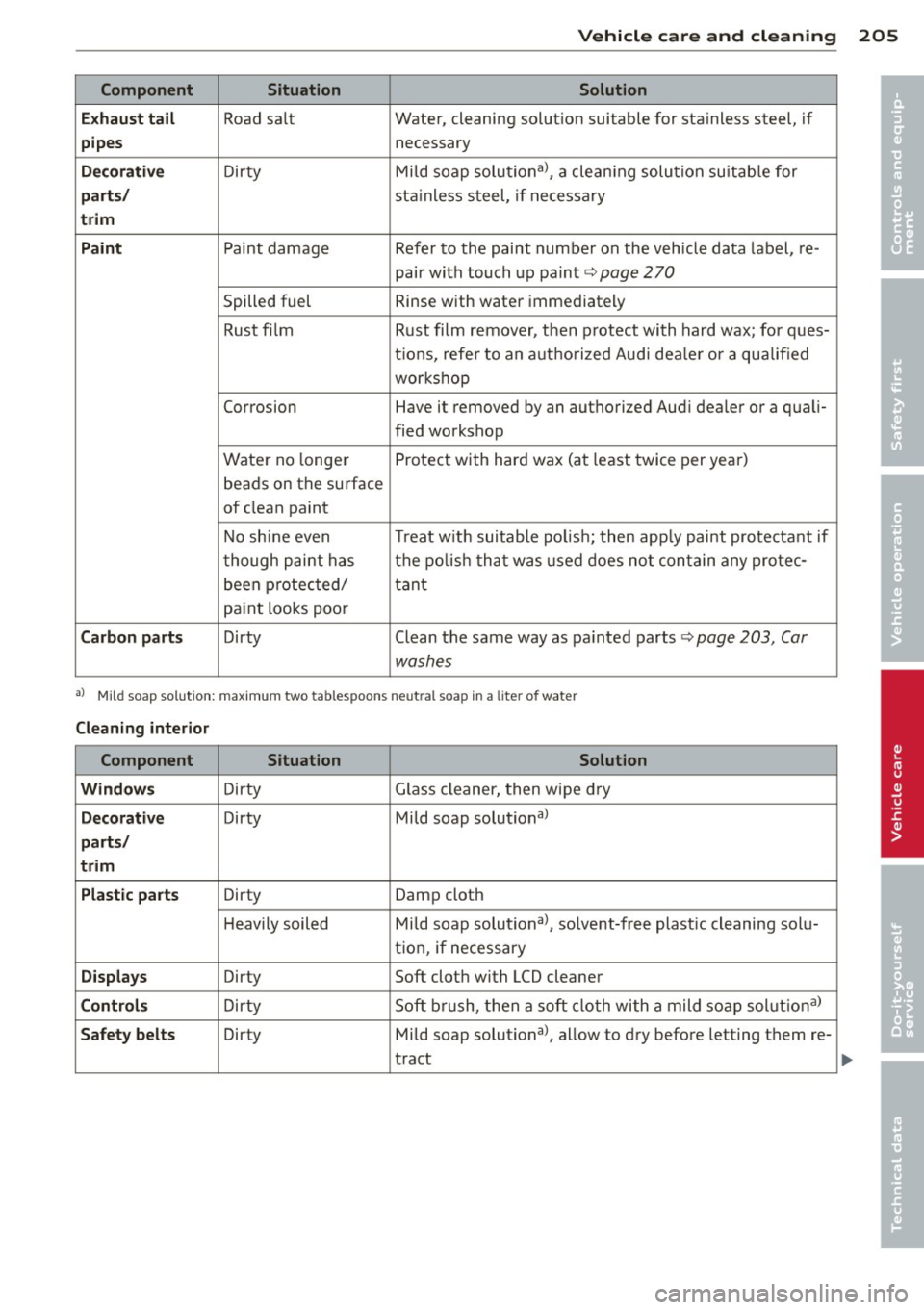
Component Situation Solution
E x haust ta il
Road sa lt Water, cleaning solut
ion suitable for sta inless steel, i f
pipes necessary
Decorative D ir ty Mild soap solutional, a clean ing solu tion suitab le for
parts / stainless s teel, if ne cessa ry
trim
Pa int
Paint damage Refer to the paint numbe r on the veh icle da ta label, re-
pair with touch up pa int
c::> page 270
Spilled fuel Rinse with water
immediately
Rust fi lm Rust film1 remover, t hen p rotect with hard wax; for ques-
ti ons, refe r to an a uth o riz ed Audi dea le r o r a qualified
wor kshop
Corrosion Have it removed by an authorized Aud i dealer o r a qua li-
fied workshop
Wate r no longe r Protect with hard wax (at
least twice per year)
beads on the su rface
of clean paint
N o sh ine even Treat w it h suitable po lis h ; then app ly pai nt pro te cta nt if
t hough p aint h as the polish t hat was use d do es not co ntain any prote c-
been p rotec ted/ tant
pa int looks poo r
Carbon part s Dirty Clean the same way as pa inted parts c::> page 203, Car
washes
al M ild soap sol utio n: max imum two tablespoons neutral soap in a liter of water
Cleaning interior
Component Situation Solution
Windows
D irty Glass cleaner, then wipe dry
Decorative Dirty Mild soap solutional
parts/
trim
Plastic parts
Dirty Damp cloth
H eavily soiled Mi ld soap solutional, solvent-free plast ic cleaning sol u-
t io n, if necessary
Displays Dirty Soft cloth with LCD cleaner
Controls Dir ty Soft
brus.h, then a so ft cloth with a mild so ap sol utio nal
Safety belts Dirty Mild soap solutional, allow to dry before letting them re-
tract
•
•
Page 210 of 292
208 Fuel supply and filling your fuel tank
Fuel supply and filling
your fuel tank
Gasoline
Fuel supply
Appl ies to vehicles: with gasoline engine
Using the right fuel helps keep the environ
ment clean and prevents engine damage .
Fuel recommendation
The fuel recommended for yo ur vehicle is un
l e aded premium
grade gasoline . Audi recom
mends using TO P TI ER D ete rgent Gaso line
wi th a m inimum octane ra ting o f 91 A KI ( 95
RO N). Fo r more informa tio n o n TOP TIER De
tergent Gasoline, p lease go to the o fficia l
websi te (www. topt iergas .com) .
The re commended gasoline octane rati ng for
your engine can a lso be fo und o n a label loc at
ed on the ins ide of the fuel filler flap . This ra t
ing may be specif ied as AK I or RO N.
Your veh icle may also be operated using un
l eaded regular gasoline with a minimum oc
tane rating of 87 AKI/91 RO N. However, using
87 A KI/91 RON octa ne fue l wi ll slightly re
d uce eng ine perfo rmance .
Use unleaded ga soline only. U nleaded g aso
l ine is available th rougho ut the USA, Canada,
a nd i n most E uropean countries . We recom
mend that you do not ta ke yo ur vehicle to
areas or co untries where unleaded gasoline
may not be ava ilable.
F or mo re informat io n on refue ling your ve hi
cle, see
~ page 209.
Octane rating
Octane rating ind icates a gaso line's abili ty to
res ist eng ine dam ag ing "knoc k" ca use d by
premature ign ition and detona tion. Therefore,
buy ing the correct grade of gaso line is very
important to he lp prevent possible engine
damage and a loss of engine performance.
Gasoline mos t commonly used in the Unite d
States and Canada has the following octane r
atings t hat can usu a lly be found on the fi ller
pump:
- Premium Gra de: 91 -96 A KI
- Regular Grade : 87 -90 AKI
Explanation of the abbreviations:
AKI = Anti K nock In d ex = (R+M )/2 = (RON
+ MON)/2
R ON= Resear ch Octane Numb er
MON = Motor Octane Num ber .
(D Note
-Do not use a ny fue l w it h o ctane rat ings
lower tha n 87 A KI or 91 RO N othe rwise
expensive engi ne damage w ill occur.
- Do
not use leaded gasoli ne. The use of
leaded gasoline w ill severely damage
yo ur v ehicle's cata lytic co nve rter and its
ability to co ntrol exha ust em issions .
Blended gasoline
Applies to vehicles: with gasoline engine
Use of gasoline containing alcohol or
MTBE (methyl tertiary butyl ether )
You may use unleaded g asoline blende d wi th
alcohol o r MTBE (commonly referred to as
oxygenates) if the blende d mixture meets t he
f o llow ing criteria:
Blend of gasoline methanol (wood alcohol or
methyl alcohol)
- Anti -kno ck index must be 87 A KI or higher.
- Blend must contain no more t han 3% meth-
anol.
- Blend must contain more than 2% co -sol -
vents.
Blend of gasoline and ethanol (grain alcohol
or ethyl alcohol)
- Anti -knock index must be 87 AKI or higher .
- Blend must not conta in mo re tha n 10%
ethanol.
Blend of ga soline and MTBE
- Anti-knock index must be 87 AKI or higher. IJll,
Page 211 of 292
-Blend must contain not more than 15%
MTBE.
Seasonally adjusted gasoline
Many gasoline grades are blended to perform
espec ially we ll for winter or summer driving.
During seasonal change-over, we suggest that
you fill up at busy gas stat ions where the sea
sonal adjustment is more likely to be made in
time .
(D Note
-Methanol fuels which do not meet these
requirements may cause corrosion and
damage to plastic and rubber compo
nents in the fuel system .
- Do not use fue ls that fail to meet the
specified criter ia in this chapter.
- If you are unable to determine whether
or not a particular fue l blend meets the
specifications, ask your service station or
its fuel supp lier.
- Do not use fuel for which the contents
cannot be identified.
- Fuel system damage and performance
problems resulting from the use of fuels
different from those specified are not
the responsibility of Audi and are not
covered under the New Vehicle or the Emission Control System Warranties.
- If you experience a loss of fuel economy
or driveability and performance prob l ems due to the use of one of these fuel
blends, we recommend that you switch
to unblended fuel.
Gasoline additives
A major concern among many auto manufac
turers is carbon deposit build- up caused by
the type of gasoline you use.
Although gasoline grades differ from one manufacturer to another , they have certain
things in common. All gasoline grades contain
substances that can cause deposits to collect
on vital engine parts, such as fuel injectors
and intake valves. Although most gasoline brands include additives to keep engine and
Fuel supply and filling your fuel tank 209
fuel systems clean, they are not equally effec
tive .
A udi recommends using TOP TIER Detergent
Gasoline. For more info rmation on TOP TIER
Detergent Gasoline, please go to the official
website (www.toptiergas.com).
After an extended period of using inadeq uate
fuels, carbon deposit build-ups can rob your
engine of peak performance.
Q) Note
Damage or malf unct ion due to poor fue l
quality is not covered by the Aud i New Ve
hicle Limited Warranty.
Fuel tank
Fuel filler neck
The fuel filler neck is located on the right rear
side panel behind the fuel fille r flap.
If the power locking system should fail, you
can still open the flap manually -for deta iled
instruct ions see
c::;, page 211 .
You can find the fuel tank capacity of your ve
hicle in
c::;,page271.
The label on the inside of the fuel fi ller flap
tells you the correct fue l for your vehicle. For
more information about fuel specifications,
see
c::;, page 208.
Your vehicle fue l tank has an on board refuel
li ng vapor recovery system. This feature helps
to prevent fuel vapors from escaping from the
tank and polluting the environment while you refuel your vehicle . In order to fill the tank
properly while protecting the environment,
please fo llow this refueling procedure careful
ly.
_&. WARNING
Under normal operating conditions, never
carry additional fuel containers in your car.
Gas canisters and other containers used to
transport f uel can be dangero us. Such con
tainers, full or empty, may leak and could
cause a fire in a collision. If you must
•
•
Page 212 of 292
210 Fuel supply and filling your fuel tank
transport fuel to use for your lawn mower,
snow blower, etc., be very careful and al
ways observe local and state laws regard
ing the use, transportat ion and storage of
such fuel containers. Make certain the con
tainer meets industry standards (ANSI/
AS TM F852 -86) .
(D Note
Never drive your vehicle until the fuel tank
is completely empty. The irregular supply
of fuel can cause misfiring. Gasoline could
enter the exhaust system and damage the
catalyt ic converter.
Refuelling
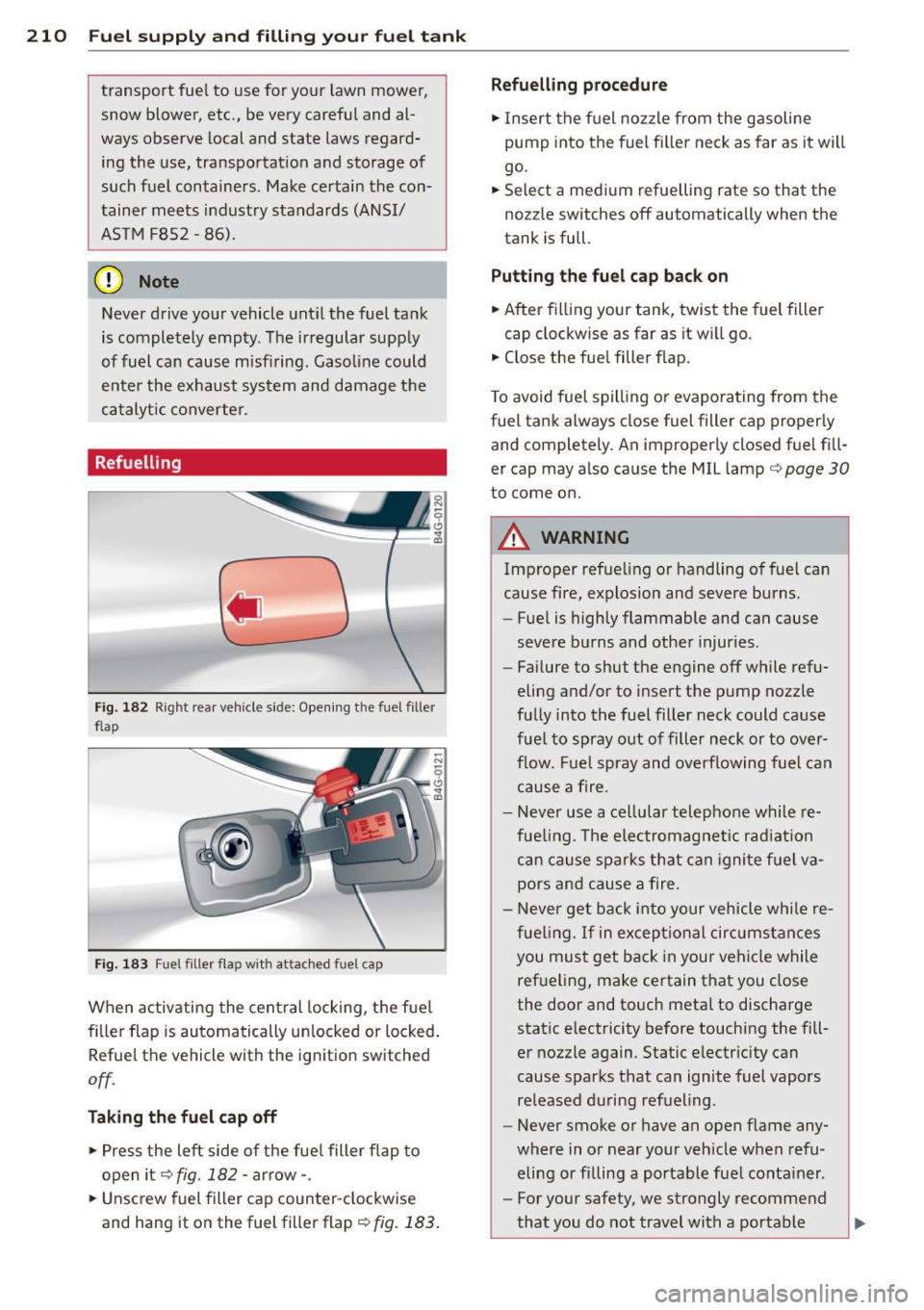
Fig. 182 Right rear vehicle side: Opening the fuel filler
flap
Fig . 183 Fuel filler flap with attached fuel cap
When activating the central locking, the fuel
fi ller flap is automatically un locked or locked.
Refuel the vehicle with the ignition switched
off.
Taking the fuel cap off
• Press the left side of the fuel filler flap to
open it
q fig. 182 -arrow-.
• Unscrew fuel filler cap counter-clockwise
and hang it on the fuel filler flap
¢ fig. 183.
Refuelling procedure
• Insert the fuel nozzle from the gasoline
pump into the fuel filler neck as far as it will
go .
• Select a med ium refuelling rate so that the
nozzle switches off automatically when the
tank is full.
Putting the fuel cap back on
• After filling your tank, twist the fuel filter
cap clockwise as far as it w ill go.
• Close the fue l filler flap.
T o avoid fuel spilling or evaporating from the
fuel tank always close fuel filter cap properly
and completely. An improperly closed fuel fill
er cap may also cause the MIL lamp¢
page 30
to come on.
A WARNING
Improper refue ling or handling of fuel can
cause fire, explosion and severe burns.
- Fuel is highly flammable and can cause
severe burns and other injuries.
- Fai lure to shut the engine off while refu
eling and/or to insert the pump nozzle
fully into the fuel filter neck could cause
fuel to spray out of filler neck or to over
flow. Fuel spray and overflowing fuel can
cause a fire.
- Never use a ce llular telephone while re
fue ling. Th e electromagnet ic rad iat ion
can cause sparks that can ignite fuel va
pors and cause a fire.
- Never get back into your vehicle whi le re
fueling.
If in exceptional circumstan ces
you must get back in your vehicle while
refueling, make certain that you close
the door and touch metal to discharge
static electricity before touching the fill
er nozzle again. Static electricity can
cause sparks that can ignite fuel vapors
released during refueling.
- Never smoke or have an open flame any
where in or near your veh icle when refu
eling or filling a portable fuel conta iner.
- For your safety, we strongly recommend
that you do not travel with a portable
Page 213 of 292
fuel container in your vehicle. The con
tainer, full or empty may leak and could
cause a fire, especially in a crash.
- If, under exceptional circumstances, you
must transport a portable fuel container,
please observe the following:
- Never fill a portable fuel container
while it is anywhere in or on the vehicle
(for example, in the lugga ge compart
ment, or on the tr unk). Static electrici
ty can bui ld up while fi lling and can ig
nite fuel vapors causing a fire .
- Always place a portable fuel container
on the ground before filling.
- Always keep the fi ller nozzle complete
ly inside the portable container before
and during filling.
- If filling a portable container made of
metal, the filler nozz le must always be
in contact with the container. Th is w ill
help prevent static electricity from dis
charging and cause a fire .
- Never sp ill fuel inside the vehicle or
luggage compartment. Fuel vapors are
h ighly flammable .
- Always observe local and state/provin
cial laws regarding the use, storage
and transportation of fuel containers .
- Make certain the fuel container meets
industry standards (ANSI/ ASTM
F852 -86) .
(D Note
If any fuel has spilled onto the car, it
should be removed immediately to prevent
damage to the paint.
~ For the sake of the environment
As soon as the correctly operated nozzle
sw itches off automatically for the first
time, the tank is full. Do not try to add
more fue l because fuel may spill out . In
add it ion, the expans ion space in the fuel
tank will be fi lled -causing the fuel to
overflow when it becomes warm and pol
lute the environment.
Fuel supply and filling your fuel tank 211
@ Tips
-Running your engine while refue lling
may cause vapors to escape or even
cause fuel to spill out of the tank. This
would then shut off the fuel nozzle be
fore the tank is full.
- Do not refuel your vehicle with the igni
tion switched on. The fuel gauge may
otherwise not ind icate the correct fuel
level after refuell ing .
- The fuel filler flap of your vehicle is not
locked when you lock the vehicle from
the inside.
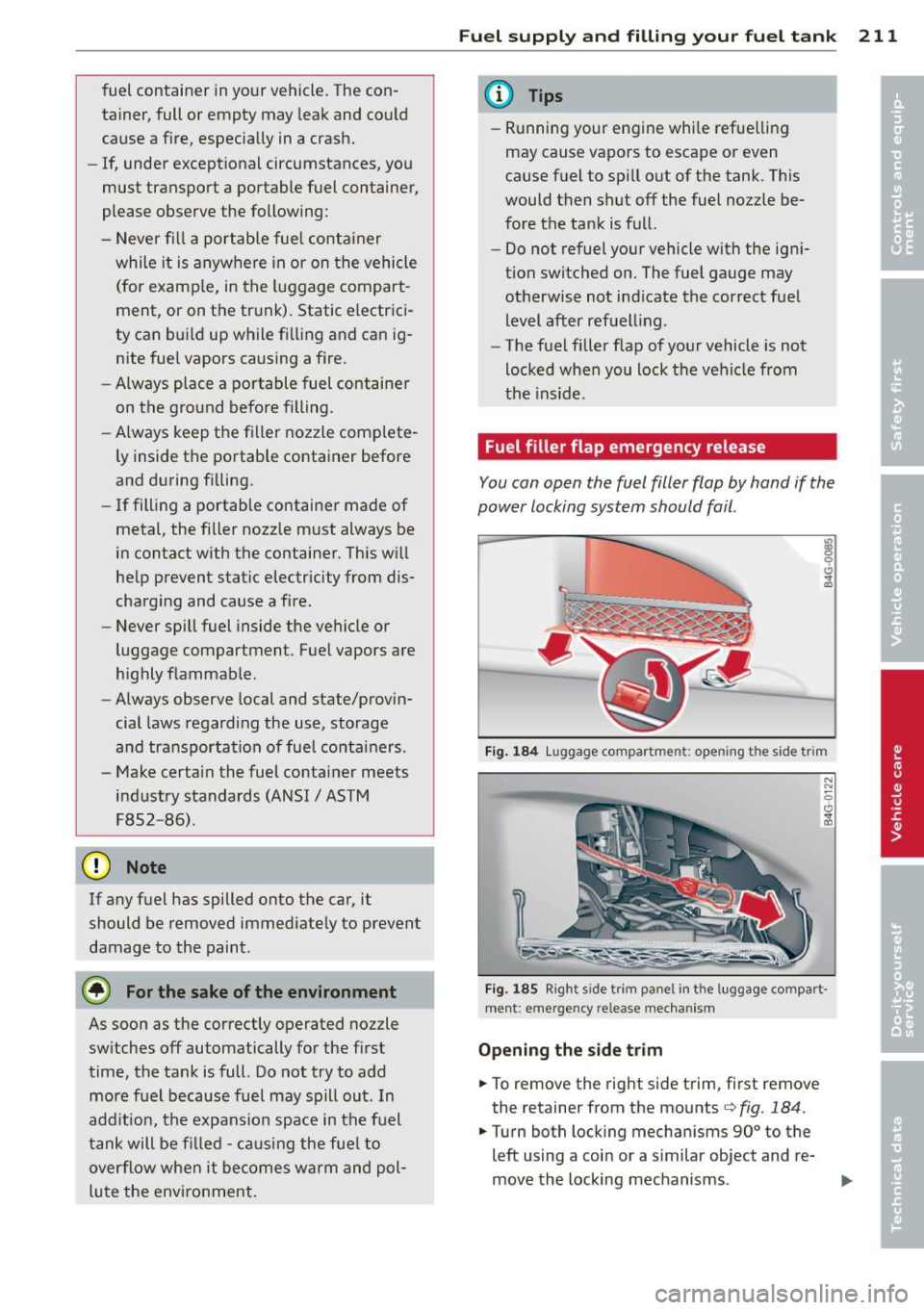
Fuel filler flap emergency release
You can open the fuel filler flap by hand if the
power locking system should fail .
Fig. 184 Lug gage compart ment: ope ning th e side trim
N
"' 0
~
Fig . 185 Right s ide tri m pane l in t he luggage com part ·
ment : eme rge ncy re lease mechanis m
Opening the side trim
.. To remove the right side trim, first remove
the retainer from the mounts¢
fig. 184.
.. Turn both locking mechanisms 90° to the
left using a coin or a s imilar object and re-
move the locking mechanisms .
11J,,
Page 214 of 292
212 Fuel supply and filling your fuel tank
• Tilt the retainer upward and pu ll the trim
o ut. Lay the trim down on its side, because
there is an e lectrical wire on the bac k.
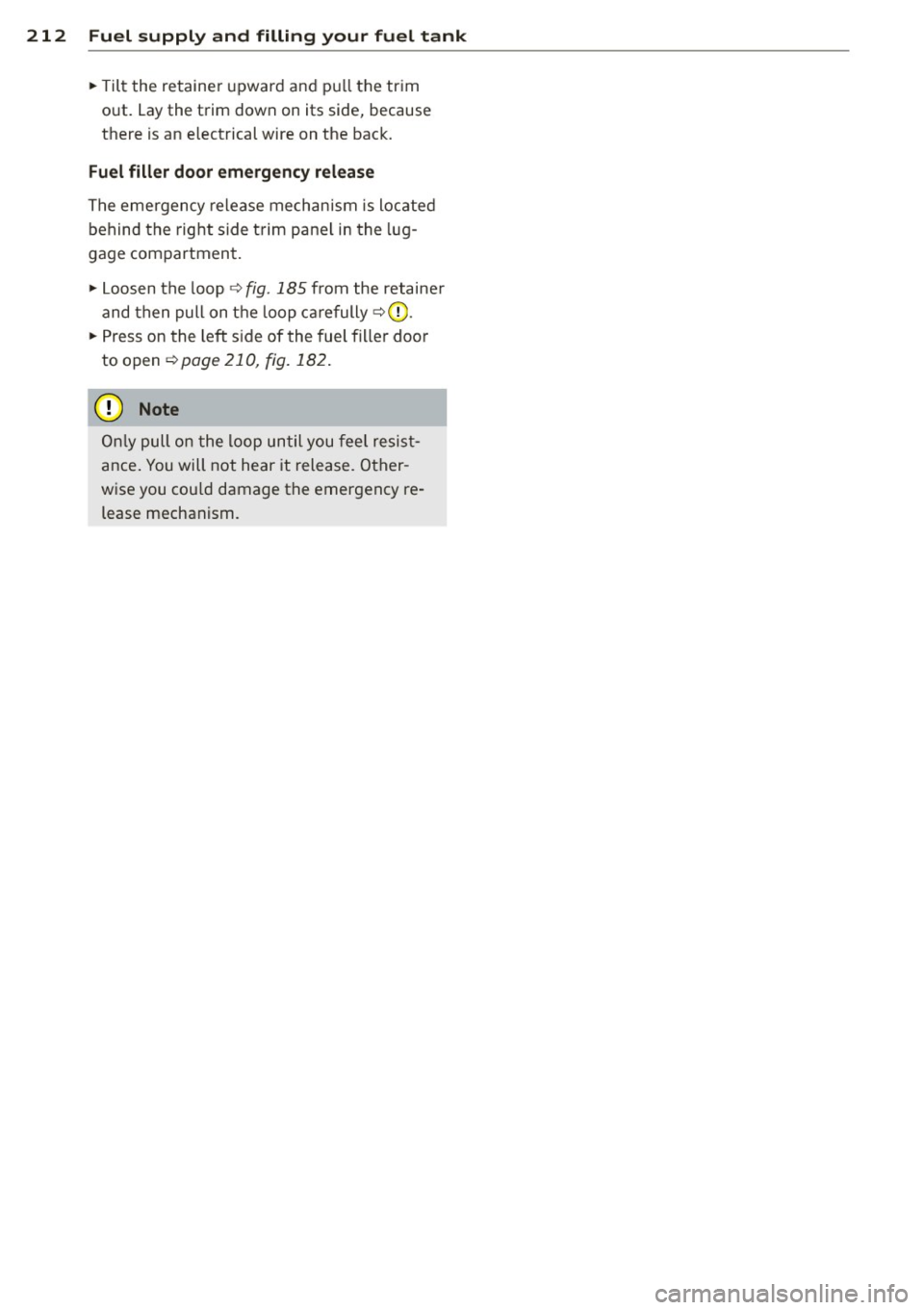
Fuel filler door emergency rel ease
The eme rgency re lease me chan ism is loc ated
behind the right side t rim pa ne l in the lug
gage compartment.
• Loosen the loop¢
fig. 185 from the retaine r
and then pull on the loop ca re fully ¢(D.
• Press on the le ft side of the fuel fille r doo r
to open ¢
page 210, fig. 182.
(D Note
On ly pull o n the loop un til you fee l resis t
a nce . You will not hear it release. Other
w ise you cou ld damage the emergency re
lease mechanism.
Page 219 of 292
temperatures stay below freezing point for l ong periods.
Detergent add itives in the o il w il l make fresh
oil look dark after the eng ine has been run
ning fo r a short time . This is norma l and is not
a reason to change the oi l more often than
recommended.
D am ag e or m alfun ction s due to lack of
ma intenanc e
It is essential that you change your oil at the
r ecommended inte rva ls using only engine o il
t hat complies wi th A udi oi l standard
VW 502 00 . Your Limited New Vehicle War
ranty does not cover damage or malfunctions
d ue to fa ilure to fo llow recommended mainte
nance and use requ irements as set forth in
the Audi Owner's Manua l and Warranty
&
Maintenance book let . Your dea ler will have to
deny warranty coverage u nless you present to
the dea ler p roof in the fo rm of Serv ice or Re
pa ir Orde rs that all s chedu led maintenance
wa s pe rformed in a t imely manner .
Engine oil consumption
The engine in your vehicle dep ends on an ade
quate amount of oil to lubricate and cool all
of its moving parts.
In o rder to provide effective lubrication and
cool ing of i nternal engine components, a ll in
ternal comb ustion eng ines consume a cert ain
amo unt of o il. Oil cons umption varies from
engine to engine and may change significantly
over the life of the engine. Typ ica lly, engines
with a specified break-in per iod (see
¢
page 198) consume more oil during the
break-in per iod than they consume after oil
consumption has stabilized .
Under norma l conditions, the rate of oil con
sumpt ion depends on the quality and viscosity
of the oil, the RPM (revo lutions per m inute) at
which the engine is operated, the amb ient
temperature and road condit ions. Furthe r fac
tors ar e the amount of o il d ilution from wate r
condensation or fuel residue and the ox ida
tion level of the oi l. As any engine is s ubje ct to
Checkin g and fillin g 217
wear as m ileage builds up, the oil consump
tion may increase over time until replacement
of worn components may become necessary.
Wi th a ll these variab les coming into p lay, no
standard rate of oil consumpt ion can be es
tablished or specified. There is no alternative
to regular and frequent check ing of the o il lev
el, see
Note .
If the yellow engine oil leve l warning symbo l
in the instrument cluster
II li ghts up, you
sho uld check the oil leve l as soon as possib le
¢
page 218. Top off the oil at your earliest
convenience
¢ page 218.
A WARNING
Before you c heck anythi ng i n the engine
com partment, always read a nd heed all
WARNINGS¢ .&.
in Working in th e engine
c ompartment on page 213.
(D Note
D riving w ith an insufficient o il level is like
ly to cause sever e damage to the engine .
(D Tips
- The oil pressure warning display. is
not an indicator of the oil le vel. Do not
rely on it . Instead, check the oil level in
your engine at regu lar intervals, pref
erably ea ch time you refuel, and always
before going on a long trip .
-If you have the impression yo ur engi ne
c ons umes ex ce ss ive amoun ts of o il, we
recommend that you consul t your Au di
de aler to have the cause of your concern
properly diagnosed . Keep in mind that
the accurate meas urement of o il con
sumption requires great care and may
take some t ime. Y our Audi dea ler has in
struct ions about how to measure oil con
sumption accurately.
-
•
•