2014 AUDI RS7 SPORTBACK maintenance
[x] Cancel search: maintenancePage 218 of 292
216 Check ing and filling
Modern engine lubrication has taken a quan
tum leap in the last few years. Many synthetic
oils ava ilable today provide better engine lu
brication that can outlast traditional petrole
um-based oils, making them a smart choice
for use throughout the life of your Audi .
Whether you use synthetic or petroleum
based engine oil, the oil that you use must
conform to Audi 's oil quality standard
VW 502 00 to he lp keep your vehicle's engine
running smoothly and help prevent the for
mat ion of harmfu l deposits, sometimes called
"s ludge ," that ove r time can lead to expensive
repairs .
At the time of pr int ing , engine o ils available in
the U .S . and Canada that meet the exacting
specifi cations of A udi oi l standard VW 502 00
a re synthetic engine oils. This does not mean,
however, that every syn thetic engine oi l wi ll
meet Audi oil standard VW 502 00. So always
be sure that you use an approved oil.
To help prevent the format ion of harmful de
posi ts use only oi l with the fo llow ing specifi
cations printed on the oil container :
Audi oil standard VW 502 00
O il container labe ls may carry the specif ica
tion s ingly or in comb inat ion with other des ig
nations and oil qua lity standards .
Viscosity
Engine oi ls are graded according to their vis
cosity. The proper viscosity grade oil for your
engine depends on cl imactic or seasonal con
d itions where you drive. You can use oil with a
viscosity grade of SA E SW40 across all tem
pe ratu re ranges for normal driving conditions .
However, if eng ine o il viscos ity grade
SAE SW40 is no t ava ilable, you can a lso use
viscosity grade SAE SW-30 or SAE OW -40 as
long as it meets Audi o il quality standard
VW 502 00 specifications .
Because engine oil that meets the Audi oil
standard may not be available everywhere
when you need it, we strongly recommend
that you always carry with you an ext ra quart (
li te r) of oil that exp ress ly con forms to the
VW 502 00 spec ification, in case you have to
top
off the oil while on the road.
Only if the level of the o il is a t or be low the
min imum mark on the o il dipstick - and no oi l
that expressly conforms to Aud i oi l standard
VW 502 00 spec ificat ions is ava ilable -may
you top
off with a high quality engine oi l, pref
erably syn thet ic-based, that meets ACEA A3
or AP I SM spec ificat ions, but even then, only
in v iscosity grades SAE SW-40, SAE SW-30, o r
SAE OW- 40. However, during the ent ire time
be twee n oil change intervals, never top
off
with more than a total of 0.5 q t/lite r engine
o il that does no t conform to Audi o il specifica
tion VW 502 00.
For more informa tion about eng ine oi l tha t
has been approved for your veh icle, ple ase
contac t either yo ur authorized Aud i deale r or
Audi C ustome r Re lations at 1 (800) 82 2-2834
or visit o ur web site at www .audiusa.com or
www.aud icanada .ca. Here you w ill also find a
current list of oils (manufacturers, brand
names e tc.) tha t conform to Audi oil s tanda rd
vw 502 00 .
Changing the engine oil
The eng ine oi l and oil fi lter m ust be changed
according to the mileage (kilometers) and
time intervals specified in your ve hicle's War
ranty
& Maintenance booklet. Do not exceed
these intervals -harmful deposits from old
engine oil ca n reduce eng ine performance and
can lead to expensive engine repa irs .
Changi ng the oil at the recommended inter
vals is so very important because the lubricat ing proper ties of oil decrease gradually during
norma l veh icle use . If you are not sure when
you have your oil changed, ask your author ized Audi Serv ice Adv isor.
Under some circumstances the engine oil
shou ld even be cha nged more frequent ly .
Change oil more often if you drive mostly
sho rt distances, operate the ve hicle in dusty
areas o r most ly unde r stop-and-go t raff ic con-
di tions, o r when you use your vehi cle where .,..
Page 219 of 292
temperatures stay below freezing point for l ong periods.
Detergent add itives in the o il w il l make fresh
oil look dark after the eng ine has been run
ning fo r a short time . This is norma l and is not
a reason to change the oi l more often than
recommended.
D am ag e or m alfun ction s due to lack of
ma intenanc e
It is essential that you change your oil at the
r ecommended inte rva ls using only engine o il
t hat complies wi th A udi oi l standard
VW 502 00 . Your Limited New Vehicle War
ranty does not cover damage or malfunctions
d ue to fa ilure to fo llow recommended mainte
nance and use requ irements as set forth in
the Audi Owner's Manua l and Warranty
&
Maintenance book let . Your dea ler will have to
deny warranty coverage u nless you present to
the dea ler p roof in the fo rm of Serv ice or Re
pa ir Orde rs that all s chedu led maintenance
wa s pe rformed in a t imely manner .
Engine oil consumption
The engine in your vehicle dep ends on an ade
quate amount of oil to lubricate and cool all
of its moving parts.
In o rder to provide effective lubrication and
cool ing of i nternal engine components, a ll in
ternal comb ustion eng ines consume a cert ain
amo unt of o il. Oil cons umption varies from
engine to engine and may change significantly
over the life of the engine. Typ ica lly, engines
with a specified break-in per iod (see
¢
page 198) consume more oil during the
break-in per iod than they consume after oil
consumption has stabilized .
Under norma l conditions, the rate of oil con
sumpt ion depends on the quality and viscosity
of the oil, the RPM (revo lutions per m inute) at
which the engine is operated, the amb ient
temperature and road condit ions. Furthe r fac
tors ar e the amount of o il d ilution from wate r
condensation or fuel residue and the ox ida
tion level of the oi l. As any engine is s ubje ct to
Checkin g and fillin g 217
wear as m ileage builds up, the oil consump
tion may increase over time until replacement
of worn components may become necessary.
Wi th a ll these variab les coming into p lay, no
standard rate of oil consumpt ion can be es
tablished or specified. There is no alternative
to regular and frequent check ing of the o il lev
el, see
Note .
If the yellow engine oil leve l warning symbo l
in the instrument cluster
II li ghts up, you
sho uld check the oil leve l as soon as possib le
¢
page 218. Top off the oil at your earliest
convenience
¢ page 218.
A WARNING
Before you c heck anythi ng i n the engine
com partment, always read a nd heed all
WARNINGS¢ .&.
in Working in th e engine
c ompartment on page 213.
(D Note
D riving w ith an insufficient o il level is like
ly to cause sever e damage to the engine .
(D Tips
- The oil pressure warning display. is
not an indicator of the oil le vel. Do not
rely on it . Instead, check the oil level in
your engine at regu lar intervals, pref
erably ea ch time you refuel, and always
before going on a long trip .
-If you have the impression yo ur engi ne
c ons umes ex ce ss ive amoun ts of o il, we
recommend that you consul t your Au di
de aler to have the cause of your concern
properly diagnosed . Keep in mind that
the accurate meas urement of o il con
sumption requires great care and may
take some t ime. Y our Audi dea ler has in
struct ions about how to measure oil con
sumption accurately.
-
•
•
Page 221 of 292
and adve rsely affect you r New V ehicle
Wa rrant y.
@) For the sake of the environment
-Under no ci rc u mstances can the o il come
in contact with the sewage network or
the soil.
- Observe and follow lega l regu lations
when disposing of empty oil containers .
Changing the engine oil
We recommend that have your oil changed by
an authorized Audi dealer or a qualified serv
ice station.
Before you check anything in the engine com
partment,
a lways rea d and he ed all WARN
INGS
~ &. in Working in the engine compart
ment on page 213.
The engine oil must be changed according to
the intervals specified in your Warranty
&
Maintenance book let. This is very important
because the lubricating properties of oil di
minish gradually during normal vehicle use.
Under some circumstances the engine oil
should be changed more frequently. Change
oil more often if you drive most ly short dis
tances, operate the vehicle in dusty areas or
under predominantly stop-and-go traffic con
ditions, or have your vehicle where tempera
tures remain below freezing for extended pe
riods.
Detergent additives in the oil w ill make fresh
oil look dark after the engine has been run
n ing for a short time. This is normal and is not
a reason to change the oil more often than recommended.
Because of the problem of proper disposa l,
along with the special tools and necessary ex
pertise required, we strongly recommend that
you have your oi l changed by an authorized
Au di de ale r or a qual ified servi ce station.
If y ou c hoose to c ha ng e y our o il yo urse lf,
please note the following important informa
tion :
Checkin g and fillin g 219
A WARNING
To reduce the risk of personal injury if you
must change the eng ine oil in your vehicle
yourself:
- Wear eye protect ion.
- To reduce the risk of burns from hot en-
gine oil, let the engine cool down to the
touch.
- When removing the o il dra in p lug with
your fingers, stay as far away as possible.
Always keep your forearm parallel to the
ground to help p revent hot oil from run
ning down you r arm.
- Dra in the oil into a container designed
for this purpose, one large enough to hold at least the tota l amount of oi l in
your eng ine .
- Engine oil is poisonous. Keep it well out
of the reach of children.
- Continuous contact wit h used eng ine o il
is harmful to your s kin. A lways protect
your skin by washing oil off tho ro ughly
with soap and water.
@ Note
Never mix oil additives with your engine
oil. These additives can damage your en
g ine and adversely affec t your Aud i Lim it
ed New Vehicle Warranty.
@ For the sake of the environment
- Before changing your oil, first make su re
you know where you can properly dispose
o f the used oil.
- Always dispose of used eng ine oi l proper
ly. Do not dump it on garden soil, wood
ed areas, into open streams or down
sewage drains .
- Recycle used engine oil by taking it to a
used engine oil collect ion facility in your
area, or contact a service station.
•
•
Page 240 of 292
238 Tires and wheels
symbols) indicate the positions of the tread
wear indicators. Worn tires must be replaced. Different figures may apply in other countries
c::> & .
Tire pressure
Incorrect tire p ressure causes premature wear
and can cause sudden tire blow-out. For this
reason, tire pressure must be checked at least
once a month
c::> page 234.
Driving style
Driving fast around curves, heavy acceleration
and hard braking increase tire wear.
Rotating tires for more even wear
For all four tir es on your vehicle to have the
same se rv ice life, we recommend that the
front and rear tires are rotated according to
the tire manufacturer's suggested tire rota
tion intervals. Please remember the follow
ing:
- T ire rotation inte rva ls may differ from the
vehicle serv ice intervals outlined in your
Warranty
& Maintenance booklet.
- T he longer one tire is used in one location
on the vehicle, the more it wears at certa in
points; therefore, we recommend that you
follow the tire manufacturer's suggested
tire rotation intervals.
- Vehicles with front-wheel drive experience
more tread wear on the front whee ls com
pared to all-whee l drive (quattro).
- Please rotate ti res as shown
c::> fig. 198.
-Extra care must be taken when rotating di-
rection-specific tires
c::> page 2 59.
Wheel balancing
The wheels on new vehicles are balanced .
Ho wever, various situations during everyday
driving can cause them to become unbal
anced, resu lting in vibrations you can usually
feel through the steering wheel.
Unba lanced wheels must be rebalanced to
avoid excessive wea r on steering, suspension
and tires . A wheel must a lso be rebalanced
when a new tire is installed. Incorrect wheel alignment
Incorrect
wheel alignment can cause exces
sive tire wear, impairing the safety of the vehi
cle. If tires show excessive wear, have the
wheel alignment checked by an a uthorized
Audi dealer or qualified workshop.
All-wheel drive
Vehicles with quattro must always have tires
of the same size, construction and tread type.
For details see
c::>page 195.
_8 WARNING
-Sudden tire fa ilure can lead to loss of con-
trol, a crash and serious personal injury!
- Never drive a vehicle when the tread on
any tire is worn down to the wear indica
tors.
- Worn t ires are a safety hazard, they do
not grip well on wet roads and increase
your risk of "hydroplaning" and loss of
control.
- Always keep chemicals that can cause
tire damage, such as grease, o il, gasoline
and brake fluid away from tires.
- Tires age even if they are not being used
and can fai l suddenly, especially at high
speeds. Tires that are more than 6 yea rs
old can only be used in an emergency
and then w ith specia l care and at lower
speeds.
- Never mount used tires on your veh icle if
you are not sure of their "previous histo
ry." O ld used tires may have been dam
aged even though the damage cannot be
seen that can lead to sudden tire fai lure
and loss of vehicle control.
Page 248 of 292

246 Tires and wheels
Refer to ¢page 243 for mo re detailed infor
mation regarding winter tires .
Tire pressure
monitoring system
(D General notes
Each tire, including the spare (if provided) ,
should be checked monthly when cold and in
flated to the inflation pressure recommended by the vehicle manufacturer on the vehicle
placard or tire inflation pressure label. (If your
vehicle has tires of a different size than the
size indicated on the vehicle placard or tire in
flation pressure label, you shou ld determine
the proper tire inflation pressure for those
tires).
As an added safety feature, your vehicle has
been equipped with a tire pressure monitor ing
system (TPMS) that illuminates a low tire
p ressure telltale when one or more of your
tires is significantly under-inflated. According
ly, when the low tire pressure telltale illumi
nates, you should stop and check your tires as
soon as possible, and inflate them to the proper pressure. Driving on a significantly un
der-inflated tire causes the tire to overheat
and can lead to tire failure . Under -inflation al
so reduces fuel efficiency and tire tread life,
and may affect the vehicle's handling and
stopping ab ility.
Please note that the TPMS is not a subst itute
for proper tire maintenance, and it is the driv
e r's responsib ility to ma inta in correct tire
pressure, even if under-inflation has not
reached the level to trigger illumination of the
TPMS low tire pressure telltale.
Your veh icle has also been equ ipped w ith a
TPMS malfunction indicator to indicate when
the system is not operating properly. The
TPMS malfunction indicator is combined with
the low tire pressure telltale . When the sys
tem detects a malfunction, the te lltale will
flash for approximately one minute and then remain continuously illuminated. This se- quence will continue upon subsequent vehicle
start-ups as
long as the malfunction exists.
When the malfunction indicator is illum inat
ed, the system may not be ab le to detect or
signal low tire pressure as intended . TPMS
malfunctions may occur for a variety of rea
sons, including the installation of replace
ment or alternate tires or wheels on the vehi
cle that prevent the TPMS from functioning
properly. Always check the TPMS malfunction
telltale after replacing one or more tires or
wheels on your vehicle to ensure that the re
placement o r alternate ti res and wheels allow
the TPM S to cont inue to function properly.
Description
The tire pressure monitoring system monitors
the pressure in the four tires when driving.
The system uses sensors that measure the
temperature and pressure in the tires. Theda
ta is sent from these sensors to the control
module by radio frequency.
The tire pressure monitoring system shows
the current pressures and temperatures of the
tires in the Infotainment system
¢page 247.
It also compares the current tire pressures
with the stored pressures and gives a warning in the driver information system if the tire
pressure is different from what is stored
¢ page 247.
The system does not detect if the stored tire
pressures match the recommended tire pres
sures. You must resave the tire pressures
¢page 248:
- eve ry time the tire p ressu res change, for ex
ample when the load in the vehicle changes,
- after replacing a t ire, or
- if wheels w ith new wheel sensors are used .
_&. WARNING
-The tire pressu re monitoring sys tem as
sists the driver in monitoring tire pres
sures. The driver is responsible for having
the tires inflated to the correct pressure. ..,.
Page 265 of 292
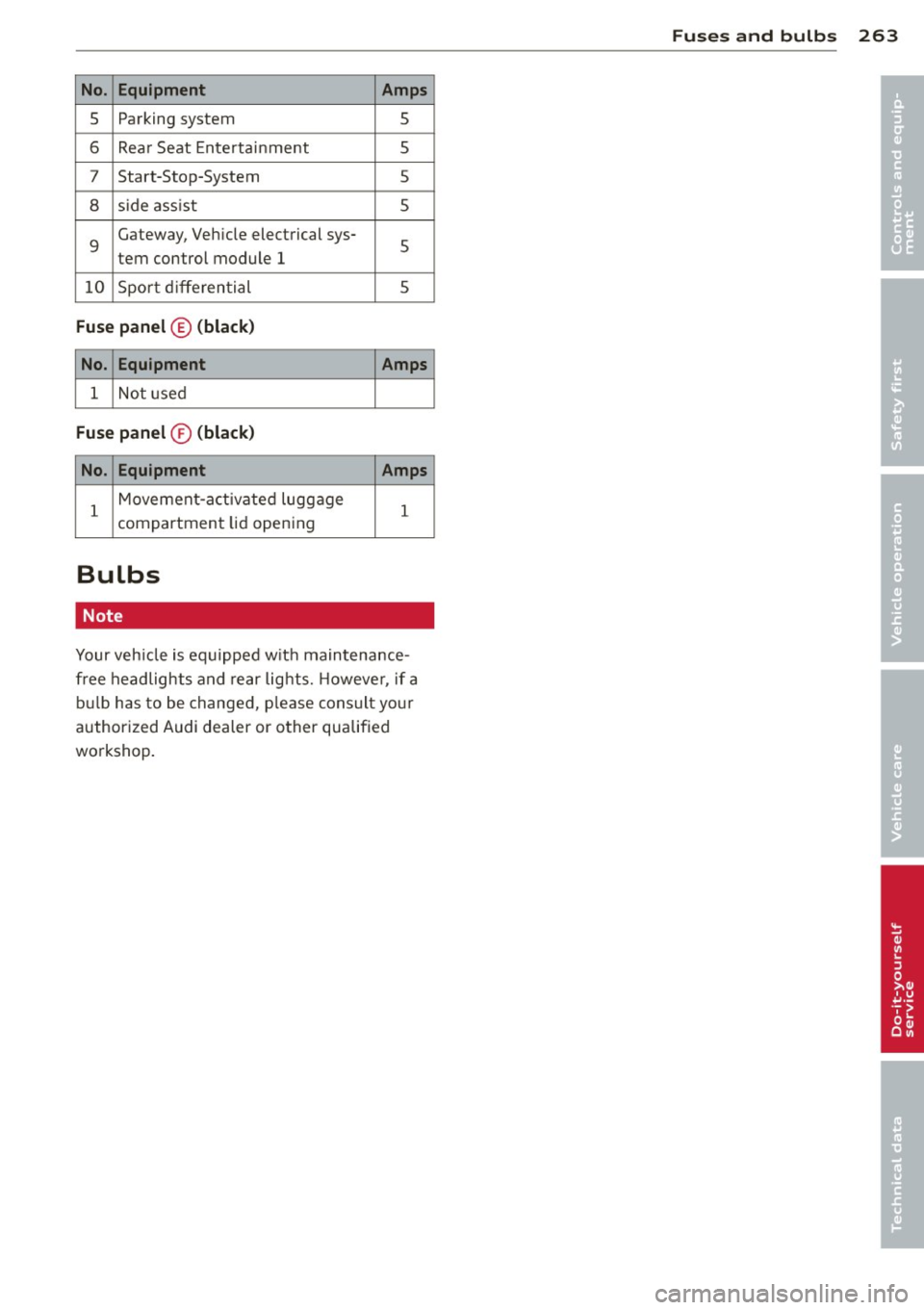
No. Equipment Amps
5 Parking system 5
6 Rear Seat Entertainment 5
7 Start-Stop-System 5
8 side ass ist 5
9
Gateway, Vehicle electrical sys-
5 tern control module 1
10 Sport d ifferen tial
5
Fu se p anel © (black )
No. Equipment Amps
1 Not used
Fu se p anel ® (black )
No. Equipment Amps
1 Movement-activated luggage
1
compartment lid opening
Bulbs
Note
Your veh icle is equipped with maintenance
free headlights and rear lights. Howeve r, if a
bu lb has to be changed, p lease consult yo ur
authorized Audi dealer or other qualified
workshop.
Fu ses and bulb s 263
•
•
Page 272 of 292

2 70 Technical data
Technical data
Vehicle identification
Fig . 228 Vehicle Ident ification Number (VlN) plate: lo·
cat ion on driver 's s ide dash panel
XXXXX XX · X -XXXX XXX xx
r,"\__l f~ -11!111 · NII. ~ V!Hlll -llllll . NO.
IYP IT'fl'E
XXXXXXXX XX X XXXXXXXX
XXX XXX
XX XXXXXXX XX X X XX
XXX
KW XXX
®i ~~:f :l~~ XXXX XXX XXX
@+ ~~r= XXXX I XXXX XXX I XX M ,. AIIISl./ lflllllS
EOA 7D5 4 UB 6XM SSG 5RW
2E H JDZ llB l AS lBA
3FC 5MU 7Xl
FO A
9G3 OG7 O
YH OJF
TL6 J
KA BEH
UlA X9B QZ 7
l XW
8Q3 9Q8 82 4 020
7T6 CV 7 7KO 4X3 2K2
3L4 4 KC 3YO 4I3 502
lS A 7GB Q1A 4GQ
XX X XX X XX X XXXX
Fig. 229 Th e vehicle identificat ion label -inside the
l uggag e compa rtmen t
Vehicle Identification Number (VlN)
The Vehicle Identification Number is located
in different p laces:
- under the w indshield on the driver's side
~fig . 228.
-in the MMI: Select: Function button ICARI >
(Car)* systems> VIN number .
-on the veh icle identification label.
Vehicle identification label
The vehicle identification label is located in
the luggage compartment in the spare wheel
well. T
he label ~
fig. 229 shows the following vehi
cle data:
(D Vehicle Ident ificat ion Number (VIN )
@ . Vehicle type, engine output, transmission
® Engine and transmission code
@ Paint number and interior
® Optional equipment numbers
Th e information of the vehicle identification
lab el can also be found in your Warranty
&
Maintenance booklet.
Safety compliance sticker
The safety compliance sticker is your assur
ance that your new veh icle complies with all
applicable Federal Motor Vehicle Safety
Standards which were in effect at the time the
vehicle was manufactured. You can find this
sticker on the door jamb on the driver's side.
It shows the month and year of production
and the vehicle ident ificat ion number of your
vehicle (perfo rat ion) as well as the Gross Vehi
cl e Weight Rating (GVWR) and the Gross Axle
Weight Rating (GAWR) .
High voltage warning label
The high voltage warning label is located in
the engine compartment next to the engine
hood re lease . The spark ign ition sys tem com·
plies with the Canadian standard IC ES-002.
Weights
Gross Vehicle Weight Rating
The Gross Vehicle Weight Rating (GVWR), and
the Gross Axle Weight Rat ing (GAWR) for
front and rear are listed on a sticker on the
doo r jamb on the driver' s side .
The Gross Vehicle Weight Rating includes the
weight of the bas ic vehicle plus fu ll fuel tank,
oil and coolant, plus maximum load, which in
cl udes passenger weight (150 lbs/68 kg per
designated seating position) and luggage
weight ~&. - .,.
Page 275 of 292
Consumer Information
Warranty coverages
Your Audi is covered by the following war
ranties :
-New Vehicle Limited Warranty
- Limited Warranty Against Corrosion Perfo-
ration
- Emissions Control System Warranty
- Emissions Performance Warranty
- California Emissions Control Warranty (USA
vehicles only)
- California Emissions Performance Warranty
(USA vehicles only)
Detailed information regarding yo ur warran
ties can be found in your
Warranty & Mainte
nance booklet .
Operating your vehicle
outside the U.S.A. or
Canada
Government regulations in the United States
and Canada require that automobiles meet
specific emission regulations and safety
standards. Therefore, veh icles built for the
U.S.A. and Canada differ from vehicles sold in
other countries .
I f you p lan to take your vehicle outside the
continental limits of the United States or Can
ada, there is the possibility that:
- unleaded fuels for vehicles with cata lytic
converter may not be available;
- fuel may have a considerably lower octane
rating . Improper fuel may cause engine
damage;
- service may be inadequate due to lack of
proper service facilities, tools or testing
equipment;
- replacement parts may not be readily availa
ble.
- Navigation systems for vehicles built for the
U.S.A. and Canada will not necessari ly work
in Europe, and may not work in other coun
tries outside North America .
Consumer Information 273
@ Note
Audi cannot be responsible for mechanical
damage that could result from inadequate
fuel, serv ice or parts availab ility.
Audi Service Repair
Manuals and Literature
Audi Offic ial Factory Service Manuals and Lit
erature are published as soon as possible after
model introduct ion. Service manuals and lit
erat ure are available to order from the Audi
T echnical Literature Ordering Center at:
www.audi.techliterature.com
Maintenance
' General
Your vehicle has been designed to help keep
maintenance requirements to a m inimum.
However, a certain amount of regular mainte
nance is still necessary to assure your vehicle's
safety, economy and reliability . For detailed
vehicle maintenance consult your Warranty &
Maintenance booklet.
Under difficult operating conditions , for ex
ample at extremely low outside temperatures,
in very dusty regions, etc., some service work
shou ld be pe rformed between the intervals
specified. This applies particularly to:
- oil changes, and
- cleaning or replacing the air fi lter.
@ For the sake of the environment
By regu larly maintaining your veh icle, you
help make sure that emission standards
are maintained, thus min imizing adverse
effects on the environment.
Important considerations for you and
your vehicle
T he increasing use of electron ics, soph isticat
ed fuel injection and emission control sys
tems, and the genera lly increasing technica l
complexity of today's automobiles, have ..,_
•
•