2014 AUDI R8 SPYDER lock
[x] Cancel search: lockPage 206 of 244
204 Tire s and wheel s
This also improves the vehicle's braking
performance and reduces stopping distances .
Summer tires provide less g rip on ice and
snow.
W inter t ires (snow t ires) must always be fitted
on all four wheels.
Compat ible tire pressure mon itoring sensors
must be installed on all four winter tires for
the tire pressure monitor ing system to func
tion properly ~
page 201 .
Ask your authorized Aud i dea le r or qualified
workshop for permitted
wint er tire sizes. Use
on ly radia l wi nte r tires .
W inter t ires lose the ir effectiveness when the
tread is worn down to a depth of 0 .157 inch
(4 mm).
Only drive with winter tires under winter con
d itions. Summer tires handle better when
there is no snow or ice on the roads and the
temperature is above 45 °F (7 °C).
Please always remember that w inter t ires may
have a lower speed rating than the t ires origi
na lly installed on your vehicle at the t ime it
was manufactured. Please see~
page 200,
Speed rating (letter code)
for a List ing of the
speed rat ing letter codes and the maximum
speed at wh ic h t he t ires ca n be dr iven .
The speed rating letter code
( ~ page 192) is
on the s ide wall of the tire~
page 199 .
A WARNING
Winter tires have maximum s peed limits
th at may be lowe r than you r vehi cle's m ax
im um speed. Always know the maxim um
speed befo re d riving off . Never d rive faster
than the speed permitted for your specific
w inte r tires. This will cause damage to the
tires leading to an accident and serious
personal in jury to you and yo ur passen
gers.
A WARNING
Dr iv ing faster than the maximum speed
for which the w inter t ires on your vehicle
-
were designed can cause t ire fail ure in
cluding a blowout and sudden deflation,
l oss of contro l, crashes and ser ious per
sona l injuries. Have worn o r damaged tires
r eplaced immediately .
- W inter tires have maximum speed rating
that may be lower than yo ur vehicle 's
maximum speed.
- Never d rive faster than the speed for
which the w in ter or othe r tires installed
on yo ur vehicle a re rated .
A WARNING
-Always ad just your dr iv ing to the road and
traffic condit ions . Never let the good ac
ce ler ation o f the w in ter t ires and a ll-wheel
d rive tempt yo u into t aking extra risks. Al
ways remember:
- W hen braking, an all-wheel drive veh icle
handles in the same way as a front drive
vehicle .
- D rive c arefully and redu ce your spee d on
icy and slippery roads, even w inter t ires
cannot help under black ice conditions .
@ For the sake of the environment
Use summer tires when weather condi
tions permi t. T hey are qu iete r, do no t wear
as quickly and reduce fuel consumpt ion .
Snow chains
Snow chains may be fitted only to the rear
whee ls, and on ly to certain tire sizes . Ask your
authori zed Aud i dea ler on which tire si zes
snow chains ca n be used .
The snow chains must have low -profi le links
and must not be th icker than 0.53 inch
(13 .5 mm), includ ing the lock.
Remove whee l center covers before putt ing
snow c hains on your vehicle
~ CD . For safety
reasons cover caps must then be f itted over
the wheel bolts. These are available from au
thorized Audi dea le rs.
Page 214 of 244

212 What do I do now?
Preliminary steps
Applies to vehicles: with T ire Mobility System
Some preliminary steps are necessary for tire
repair .
Fig. 155 Tire Mobili ty System under luggage co mpart
ment f loor
.,. If you have a flat tire, park the vehicle as far
as possible from mov ing traffic .
.,. Apply the
park ing brake firmly .
.,. Shift to
1st gear (manual transmission) . In
vehicles with a utomat ic transm iss ions,
make sure the automatic parking lock is set
as well
c::> page 78 .
.,. Check whether a repair using the Tire Mobili
ty System is possible
c::> page 210, General
and safety pointers .
.,. Have all passengers leave the vehicle and
stay away from the danger zone
c::> .&, .
.,. Take the sealant bottle and the electric air
pump from the luggage compartment un
der the floor
c::> fig. 155.
.,. Remove the "max. 50 mph" (80 km/h) stick
er from the sealant bottle and affix it to the
instrument cluster in the driver 's view.
A WARNING
- Turn the hazard flashers on and set up
the warning triangle if you have a flat
tire in moving traff ic. In this way you pro
tect you rs elf and other road users.
- Make sure that all passengers are in a
safe place, out of the danger zone (for
example, behind a guard ra il).
(D Note
Particular care is necessary if you are mak
ing a tire repair on a steep incline.
-
(D Tips
Obey all laws.
Making a tire repair
Applies to vehicles: with Tire Mobility System
Tire repair consists of the following sections.
Fig. 156 Parts of the Ti re Mobility System
Fig. 157 Conn ector for the Tire Mob i,lity System
Assembling Tire Mobility System
.,. Open the lid @of the electric air pump
c::> fig. 156 .
.,. Pull the plug© and the pressure hose ®
w ith the gauge out of the housing.
.,. Screw the pressure hose ® of the electric
air pump onto the flange @ of the sealant
bottle @.
.,. Push the sealant bott le w ith the flange
down into the recess @ on the lid of the
electric air pump.
.. Remove the dust cap from the valve of the
defective tire.
.. Screw the hose @onto the valve
(j)
c::>fig. 157.
.,. Insert the plug© c::> fig. 156 into the socket
for the cigarette lighter. .,,_
Page 216 of 244

214 What do I do now ?
@ Tips
After a tire repair, have the sealant bottle
rep laced at a dealership. This restores full
functionality to the Tire Mob ility System.
What should I be
aware of when
changing a tire?
Tires with unidirectional tread design
Tires with unidirectional tread design must be
mounted with their tread pattern pointed the
right direction .
A unidirectiona l tire can be ident ified by ar
row s on the sidewall,
which point in the direc
tion of the rotation. You must follow the
specified direction of rotat ion. This is necessa
ry in order for these t ires to develop the ir op·
timum characteristics regarding grip, road noise, wear, and hydroplani ng.
Anti-theft wheel bolts
A special adapter is needed to turn the anti· theft wheel bolts.
Fi g. 1 58 Anti-theft wheel bolts with adapter
., Install the adapter @as far as it wi ll go on
to the ant i-theft wheel bolt(!).
., Push the wheel wrench over the adapter @
as far as it wi ll go.
., Loosen or tighten the wheel bo lt
r=> page 216.
We recommend a lways keeping the wheel
bolt adapter w ith you i n the vehicle. It should
be stored in the veh icle tool k it. T
he re is a
c ode number for the wheel bo lt
locking device , stamped on the face of the
adapter . You can use this n umber to obta in a
replacement adapter at an authorized A udi
dealers hip, if necessary.
(0 Tips
Wr ite down the wheel bolt lock ing device
code number and store it in a safe place,
away from t he vehicle.
Raising the vehicle
Applies to vehicles: with orig inal Audi jack
The vehicle must be lifted with the jack* first
before the wheel can be removed.
•
F ig. 159 Sill panels: ma rk in gs
Fi g. 16 0 Sill: pos it io nin g th e ve hicle jack
The descr ip ti on for using the vehicle jack only
applies to the origina l jack* (not a vehicle
component; contact your author ized A udi
dealer if nee ded) .
., App ly the
parking brake firmly to prevent
your veh icle from rolling unintentionally.
., Shift to
1st gear (manual transmission). In
veh icles with au toma tic tra nsmissions,
make sure t he au tomatic par king lock is se t
as well
r=> page 78 . ..,
Page 218 of 244

216 What do I do now?
Removing the wheel
.. Use the hexagonal socket in the screwdriv
er handle
to comp letely turn out the top
most wheel bolt and set it aside on a
clean
sur face .
.. Screw the threaded end of the
alignment
pin
from the tool kit hand-tight into the
now vacant bolt hole
o fig. 162.
.. Then completely unscrew the other wheel
bolts as described above .
.. Take off the wheel leav ing the alignment pin
in the bolt hole
o(D .
Putting on the wheel
.. Lift the spare wheel and carefully slide it
over the alignment pin to guide it in place
o@.
.. Use the hexagonal socket in the screwdr iver
handle to screw in and tighten all wheel
bolts
slightly .
.. Unscrew the alignment pin and insert and
tighten the remaining whee l bolt slig htly
like the rest.
.. Turn the jack handle counter-clockw ise to
lower the vehicle until the jack is fully re
leased .
The wheel bolts must be clean and turn easily.
Check the contact surfaces of wheel and hub. Remove contaminants on these surfaces be
fore installing the wheel.
The hexagonal socket in the screwdriver han
dle makes it easier to handle the wheel bolts.
The reversible blade should be removed.
When mounting
unidirectional tires, observe
the direction of rotation
o page 214.
«I) Note
When removing or installing the wheel,
the rim could hit the brake rotor/ceramic
brake rotor* and damage the rotor. Work
carefully an have a second perso n he lp
you .
1l You need the appropriate adapte r to tigh ten the anti
theft whee l bo lts
c:> page 214.
(D Tips
Never use the hexagonal socket in the han
dle of the screwdriver to loosen or tighten
the wheel bo lts.
Tightening wheel bolts
.. Fit the wheel bolt wrench over the wheel
bolt and push it down as far as it will go
ll.
.. Close your grip around the end of the
w rench handle for maximum torque and
turn each wheel bolt
clockwise until it sits
tight .
Have the
tightening torque of the wheel bolts
checked as soon as possible with a to rque
wrench. It should be 120 Nm .
Check the
tire pressure as soon as possible.
Return the veh icle tool k it to its proper place.
A WARNING ..,___
Loosening the wheel bolts is prohibited;
danger of an acc ident!
(D Tips
- Never try and use the hexagonal socket
in the handle of the screwdriver to loos
en or t ighten the wheel bo lts.
- If you have determined that wheel bolts are corroded and difficult to turn, the
bolts must be replaced before check ing
the torque .
- Until the t ightening torque is checked,
dr ive at reduced speeds as a precaution.
Notes on wheel change
-
Please read the information o page 199, New
tires and replacing tires and wheels,
if you are
go ing to use a spa re tire wh ich is different
from the tires on your vehicle.
After you change a tire:
Page 221 of 244

4. Secure the other end to the jump start pin
© for the discharged battery@.
Starting the engine
.,. Start the eng ine of the vehicle providing as
s istance and allow it to run at id le.
.,. Now start the engine of the vehicle with the
discharged battery .
.,. If the engine does not start: Stop trying af
ter 10 seconds and then try again after
about 30 seconds .
.,. Disconnect the cable while the engine is
running in exactly
reverse order to that de
scribed.
The battery is vented to the outside to prevent
gases from entering the vehicle interior. Make
sure that the jumper clamps are well connect
ed with their
metal ports in full contact with
the battery termina ls.
A WARNING
To avoid serious personal i njury and dam
age to the vehicle, heed all warnings and
instructions of the jumper cable manufac
turer.
If in doubt, ca ll for road service .
- Jumper cables must be long enough so
that the vehicles do not touch.
- When connecting jumper cables, make
sure that they cannot get caught in any
moving parts in the engine compart
ment.
- Before you check anything in the engine
compartment, always read and heed all
WARNINGS
c:> page 172, Working in the
engine comportment.
Improper hook-up of jumper cables can ru
in the generator.
- Always connect POSITIVE( +) to POSI
TIVE(+), and NEGATIVE(-) to NEGATIVE
( - ) ground post of the battery manager
control unit.
- Check that all screw plugs on the battery
ce lls are screwed in firmly. If not, tighten
plugs prior to connecting clamp on nega
tive battery terminal.
-
What do I do now? 219
- Please note that the procedure for con
necting a jumper cable as described
above applies specifically to the case of
your vehicle being jump started. When
you are giving a jump start to another ve
hicle, do
not connect the negative(-) ca
ble to the negative(-) terminal on the
discharged battery@. Instead, securely
connect the negative(-) cable to eithe r a
solid metal component that is firmly
bolted to the engine block or to the en
gine block itself. If the battery that is be
ing charged does not vent to the outside,
escaping battery gas could ignite and ex
plode!
Emergency towing
with commercial tow
truck
' General hints
Your Audi requires special handling for tow
ing.
The following information is to be used by commercial tow truck operators who know
how to operate their equipment safely.
- Never tow your Audi, towing will cause dam
age to the engine and transmission.
- Never wrap the safety chains or winch cables around the brake lines.
- To prevent unnecessary damage, your Audi
must be transported w ith a car carrier (flat
bed truck) .
- To load the vehicle on to the flat bed, use
the towing loop found in the vehicle tools
and attach to the front anchorage
c:> page 220 .
A WARNING
A vehicle being towed is not safe for pas
sengers . Never allow anyone to ride in a
vehicle be ing towed, for any reason.
•
•
Page 224 of 244

222 Fuses and bulbs
Fuse panel @
Consumer Amps
Automatically dimming in-
side mirror, garage door
8 opener (Homel
ink), washer
10
pump relay, power outlets
relay
10
[ru button 10
11 Pressure sensor, climate
5
controls
12 Airbag 5
Fuse panel@
No . II Consumer
II Amps
1 Radiator fan (1)
40
2 Radia
tor fan (2)
40
3 Exterior lighting
40
4 Exterior lighting 40
6 Blower regulator 40
Fuse panel@
No . II Consumer
II Amps
1 Rear view camera
5
2
Tire pressure monitoring
system 10
4 Cell phone package, te
le-
7.5
phone antenna amplifier
5 Instrument cluster 5
6 Networking gateway
5
7 Steering column lever 5
8 Diagnostic interface, brake
10
pedal switch, selector lever
9 Rain/light sensor 5
10 Light switch 5
11 Special functions control
5
module
15 Sound amplifier 30
Radio 20
Fuse panel E
No. Consumer Amps
3 Auxiliary water pump 10
5 Supply terminal 15, starter 30
Fuse panel @
No. Consumer Amps
6 Pump for brake booster 15
7 Horn
20
8 Wiper motor 30
9 Wiper motor
30
10 Headlight washer system 30
12 Power outlets and cigarette
20
lighter
Fuse panel ®
No. !!Consumer
ll Amps ,
1 E
lectronic Stabilization Pro -
10
gram
2 Electronic
Stabilization Pro-
25
gram
3 Partition window
defogger
15
Rear window defogger/RB
4 Spyder: Rear window defog- 30/20
ger
5 Power lock
ing system 20
6
Interior Lights, washer noz-20
zles
7 Anti-theft alarm system 5
8 Climate controls 10
9 Heated seats 25
10 Lumbar support 10
11 Control module for doors 30
12 Control module for doors
10
Bulbs
Note
Your vehicle is equipped with maintenance
free headlights and rear lights. However, if a
bulb has to be changed, please consult your
authorized Audi dealer or other qualified
workshop.
Page 225 of 244
General information Explanation of
technical data
Som e of t he technical data listed in this man
ual require further explanation.
The technical data for your vehicle are listed in
the charts starting on
Q page 225. This chap
t e r p rovides general informa tion, notes and
r estr ictions wh ich app ly to these data .
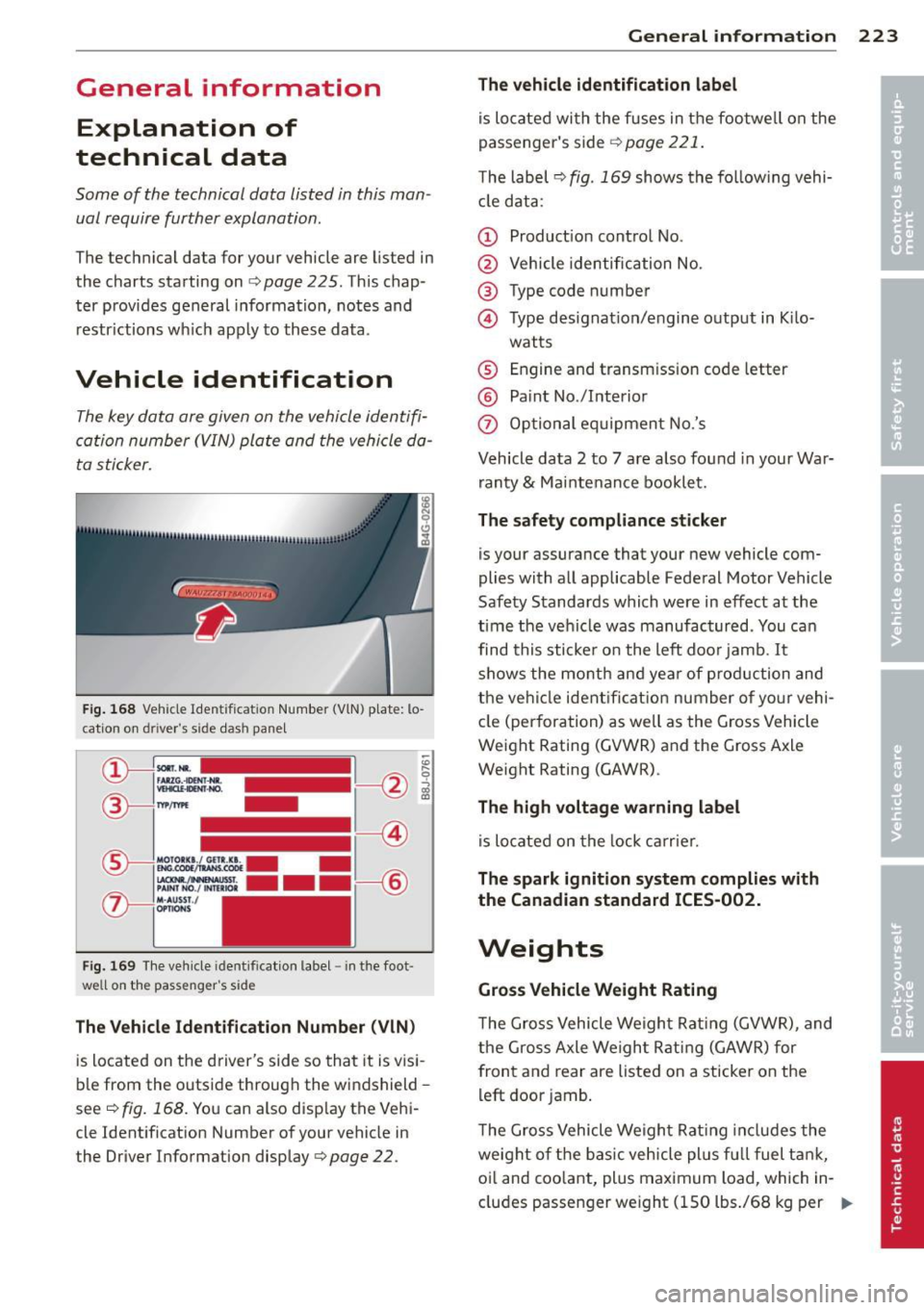
Vehicle identification
The key data are given on the vehicle identifi
cat io n number
(V IN) pla te and the vehicle da
ta sticker.
Fig. 1 68 Vehicle I dent ificat ion Num ber {VlN) p la te: lo
cation o n driver's side dash pa nel
Fi g. 1 69 The ve hicle identificat ion label -in the foot
well on the passenger's side
The Vehicle Identification Number (VlN)
is located on the d river's side so tha t it is v is i
b le from the outsi de throug h the windshield -
see
c!) fig. 168. You can also disp lay the Vehi
cle Ident ificat ion Number of your vehicle in
the Driver Information display
Q page 22.
General inform ation 223
The vehicle identification label
is lo cated wi th the fuses in t he footwe ll on the
passenger 's side
Q page 221 .
The label c!) fig. 169 shows th e fo llow ing vehi
cl e data :
(D Product ion cont ro l No .
@ Vehicle identific ation No.
@ Type code number
© Type designat ion/engine o utput in K ilo-
wat ts
® Engine and transm ission code letter
® Pa int No./lnterior
0 Option al eq uipment No.'s
Vehicle data 2 to 7 are a lso fo und in your War
ranty
& Mai nte nance bookle t.
The safety compliance sticker is your assurance that your new vehicle com
plies with a ll applicable Federal Motor Vehicle
Safety Standa rds which were in effect at the
time the ve hicle was manufactur ed . You can
find this sticke r o n the left doo r jamb.
It
sh ows the month an d ye ar of pro duction and
t he ve hicl e ident ifi cat io n number of yo ur vehi
cle (perfora tion) as well as the G ross Vehicle
Weight Rating (GVW R) and the Gross Axle
Weight Rating (GAWR) .
The high voltage warning label i s lo cated on the lock ca rrie r.
The spark ignition system complies with
the Canadian standard ICES-002.
Weights
Gross Vehicle Weight Rating
T he Gro ss Vehicle Weigh t Rat ing (GVWR), and
the Gross Axle We igh t Rati ng (GAWR) for
fron t and rear are lis ted on a sticker on the
l eft door jamb .
T he Gro ss Vehicle Weigh t Rat ing incl udes the
weight o f the bas ic ve hicle plus f ull fuel t ank,
oi l and coo lant, plus maximum load, which in
cludes passenger we ight (150 lbs./68 kg per ..,.
Page 230 of 244

228 Con sum er Inf ormation
steadi ly reduced the scope of maintenance
and repairs which can be carried out by vehicle
owners.
Als o, sa fe ty a nd en vir onm ent al con
cerns place very strict limits on the nature of
repairs and adjustments to engine and trans
miss ion parts which an owner can perform .
Maintenance, adjustments and repa irs usua lly
require special tools, testing devices and oth
er equipment available to specially trained
workshop personnel in order to assure proper pe rformance, reliab ility and safety of the vehi
cle and its many systems.
Improper maintenance, adjustments and re
pa irs can impair the operation and reliab ility
of your vehicle and even void your vehicle war
ranty. Therefore, proof of servic ing in accord
ance w ith the ma intenance schedule may be a
condition for upholding a poss ible warranty
claim made within the warranty period.
Above all, operational safety can be adversely
affected, c reating unnecessary risks for you
and your passengers.
If in doubt about any se rv icing, have it done
by your author ized Audi dealer or any other
p roperly equipped and qualified workshop.
We strong ly urge you to give yo ur autho rized
Audi dealer the opportunity to perfo rm all
schedu led maintenance and necessary repairs.
Your dea ler has the facilities, original parts
and trained specialists to keep your vehicle
running properly.
Performing limit ed m aint enance yours elf
The following pages describe a limited num
ber of proced ures which can be performed on
your vehicle with ordinary too ls, shou ld the
need arise and trained personnel be unavaila
ble. Before performing any of these proce
dures, always thoroughly read all of the app li
cable text and carefully follow the instruc
tions given . Always rigorously observe the
WARNINGS p rovided.
Before you ch eck anything in th e eng ine
co mpartm ent , alway s re ad and h eed all
WA RNINGS
c::> .&. and c::> ..&. in Working in the
engine compartment on page 173.
A WARNING
- Serious personal injury may occur as a re
sult of improperly performed mainte
nance, adjustments or repa irs.
- Always be extremely careful when work
ing on the vehicle. Always follow com
monly accepted safety pract ices and gen
eral common sense. Never r is k personal
injury.
- Do not attempt any of the maintenance,
checks or repairs descr ibed on the fol
lowing pages if you are not fu lly fam iliar
with these or other procedures with re
spect to the vehicle, or are uncertain how
to proceed .
- Do not do any work without the proper
too ls and equipment. Have the necessa ry
work done by your authorized A udi deal
er or another proper ly equipped and
qualified workshop.
- Always remove the ignition key before
anyone gets under the vehicle.
- Always support your veh icle with safety
stands if it is necessary to work under
neath the vehicle. The jack* is not ade
quate for this purpose and cou ld collapse
causing ser ious personal inju ry.
- If you must work underneath the vehicle
with the wheels on the ground, a lways
make sure the vehicle is on level ground,
that the wheels a re a lways secure ly
b locked and that t he engine cannot be
started.
- Always make sure the transmission se
lec to r l ever is in
"N" (Neut ral) (R t ron ic)
or Neutral (manual transmission) and
the hand bra ke is f irmly app lied.
@ For the sake of the environment
- Changing the engine sett ings will ad
verse ly affect emission leve ls. Th is is det
r imental to the environment and increas
es fuel consumpt ion .
- Always observe environmenta l regu la
tions when disposing of old eng ine oil,
used brake flu id, dirty engine coo lant,
spent batteries or worn out tires.