2014 AUDI Q5 weight
[x] Cancel search: weightPage 197 of 316

Installing the upper tether strap on the
anchorage
Fig. 183 Tether strap: proper routing and mounting
Fig. 184 Tether strap: proper rout ing and mounting
In sta ll in g th e tether strap
• Release or deploy the tether strap on the
child restraint according to the child re
straint manufacturer's instructions .
• Gu ide the upper tether strap
under the rear
head restraint and into the rear cargo area
Q fig. 184 (raise the head rest raint if neces
sary) .
• Slide the tether strap hook over the anchor
bracket.
• Pull on the tether strap hook so that the
spring catch of the hook engages.
• Tighten the tether strap firmly following the
child restra int manufacturer's instruct ions .
Attaching to th e center se ating po sit ion
• Slide the rear seat forward Q page 64.
• Pull the anchor bracket forward and connect
the tether strap hook.
• Tighten the tether strap and move the seat
backward .
Releasing th e te th er stra p
• Loosen the tension following the child re
straint manufacturer's instructions.
Child S afety 195
• Depress the spring catch on the hook and re
lease it from the anchorage .
(D Note
If you leave the child restra int w ith the
tether strap firmly installed fo r several
days, this could leave a mark on the up
holstery on the seat cushion and backrest
i n the area where the tether strap was in
stalled. The upholstery would also be per
manently stretched around the tether
strap . This applies especia lly to leather
seats.
Using tether straps on rearward-facing
child restraints
Cu rrently, few rear-facing child restraint sys
tems come with a tether. Please read and
heed the child restraint system manufactur
er's instructions carefully to determine how to
properly install the tether.
&, WARNING
A child in a rearward-fac ing ch ild safety
seat installed on the front passenger seat
will be ser ious ly injured and ca n be killed if
the front airbag inflates -even with an Ad
vanced Airbag System.
- The infla ting airbag will h it the ch ild
safety sea t or i nfan t carrie r with great
force and will smash the child safety seat and child against the backrest, center
armrest, o r door .
- A t ight tether or other strap on a rear
ward-facing child rest raint attached to
the front passenger seat can p ut too
muc h pressure on the weight-mat in the
seat and register a heavier weight in the
Advanced A irbag System . The heavier
weight registered can make the system
wo rk as tho ugh an adult we re on th e seat
a nd deploy the Advanced Airbag when it
m ust be s uppressed causing ser ious or
even fatal injury to the ch ild .
- If you must insta ll a rearwa rd fa cing
child safety seat on t he front passenger
seat because of exceptional
Page 201 of 316

The following situations are exceptions where it may be useful to switch on offroad mode to
allow the whee ls to spin :
- Rocking the vehicle to free it when it is stuck
- Driv ing in deep snow or on loose ground
- Driving with snow cha ins
Offroad mode on
Intelligen t technolog y 199
- Driving downh ill wh ile braking on loose
ground
- Dr iving on roug h ter rain when much of the
car's weight is lifted
off the whee ls (axle ar
tic ulation)
Offroad mode off
Beha vior
The ESC and ASR stabilization funct ions The full stab ilizat ion function of the ESC
are limited ~,&. .
Operation Press the I~ OF FI button.
Ind icat or II tu rns on.
li g ht s
Dri ver me s- Stabilizat ion cont rol (ESC ): Offroad.
s age s War
nin g ! Rest ricted stab ility
A WARNING
You should only sw itch offroad mode on if
your dr iving abili ties and road cond itions
pe rmit .
- T he stabilization function is limited
when offroad mode is swi tched on. The
dr iv ing whee ls co uld spin and the vehicle
cou ld swe rve, especially on slick or slip
pery road surfaces.
- Yo u should o nly switch offroad mode o n
when driving offroad.
@ Tips
Offroad mode cannot be swit ched o n when
a dapt ive cr uise control* is sw itched o n.
Hill descent assist
The hill descent assist makes it possible to
drive down an incline at a constant speed.
F ig . 187 Top o f the ce nter conso le : hi ll d es cent ass ist
b utto n
and ASR is available again .
Press the
I ~ OFF I button again .
MJ tu rns off .
Stabil ization control (ESC ): On
Fi g. 18 8 Disp lay: hil l de sce nt ass is t
"' Press the~ button in the cen ter conso le
~ fig. 187 or on the sh ift ga te. Th e but ton
wi ll ill uminate.
"' Press the b utton again to sw itch it
off . The
diode in the button wi ll go out .
Hill descent assist brakes all four whee ls auto
matically in order to limit speed when driving
either forwa rd or reverse on hill s with a grade
up to approximate ly 50% .
When the hill descent assist is on, the current
driv ing speed, when your vehicle entered the
incline is maintained. It is on ly possible to
switch on the assist when driving slower than
37 mph (60 km/h). The assist works between
approximately 2 and 19 mp h (4 and 30 km/
h) . The driver can inc rease or decrease the ve
hicle speed within these limits by depress ing
the accelerator or brake pedal In addition, ve hicle steerab ility is increased due to the brak-
i ng distribution when driving i n reve rse . ..,.
Page 215 of 316

Trailer towing Driving with a trailer
General information
Your Audi was designed primarily for passen
ger transportation .
If you plan to tow a trailer, please remember
that the additional load will affect durability,
economy and performance .
T railer towing not only places more stress on
the vehicle, it also calls for more concentra
tion from the driver.
For this reason, always follow the operating
and driving instructions provided and use
common sense.
Technical requirements
Trailer hitch
Use a weight-carrying hitch conforming to the
gross trailer weight. The hitch must be suita
ble for your vehicle and trailer and must be
mounted securely on the vehicle's chassis at a
technically sound location. Use only a trailer
hitch with a removable ball mount. Always
check with the trailer hitch manufacturer to
make sure that you are using the correct
hitch.
Do not use a bumper hitch.
T he hitch must be installed in such a way that
it does not interfere with the impact-absorb
ing bumper system. No modifications should
be made to the vehicle exhaust and brake sys
tems . From time to time, check that all hitch
mounting bolts remain securely fastened.
When you are not towing a trailer, remove the
trailer hitch ball mount. This prevents the
hitch from causing damage should your vehi
cle be struck from behind
¢ &. .
Trailer brakes
If your trailer is equipped with a braking sys
tem, check to be sure that it conforms to all
regulations .
Trailer towing 213
The trailer hydraulic brake system must not be
directly connected to the vehicle's hydraulic
brake system
¢ &. .
Safety chains
Always use safety chains between your vehicle
and the trailer.
Trailer lights
Trailer lights must meet all regulations . Be
sure to check with your authorized Audi dealer
for correct wiring, switches, and relays.
Mirrors
If you are unable to see the traffic behind you
using the regular outside mirrors, then you
must install extended mirrors.
It is important
that you always have clear vision to the rear .
.8, WARNING
- If a trailer has electrical brakes please
note that these brakes are not activated
by the factory-fitted control unit -risk of
accident!
- After removing the trailer hitch, do not
store it in your vehicle. In case of sudden
braking, the hitch could fly forward and
injure you or your passengers.
- Never install a "weight distributing" or
"load equalizing" trailer hitch on your ve
hicle. The vehicle was not designed for
these kinds of trailer hitches . The hitch
attachment can fail, causing the trailer
to tear loose from the vehicle .
- The Gross Vehicle Weight Rating for your
vehicle, found on the safety compliance
label on the driver's side B-pillar, must
never be exceeded under any circumstan
ces. Exceeding the Gross Vehicle Weight
Rating of your vehicle is likely to damage
your vehicle, and such damage will not
be covered by your Limited New Vehicle
Warranty. Exceeding the Gross Vehicle
Weight Rating will also change the per
formance and handling characteristics of
your vehicle, which could cause a crash resulting in serious injury or death.
-
•
•
Page 216 of 316
214 Trailer towing
Operating instructions
6"
i ~
I 1,2 ..
{ ~
~
,,
-
2
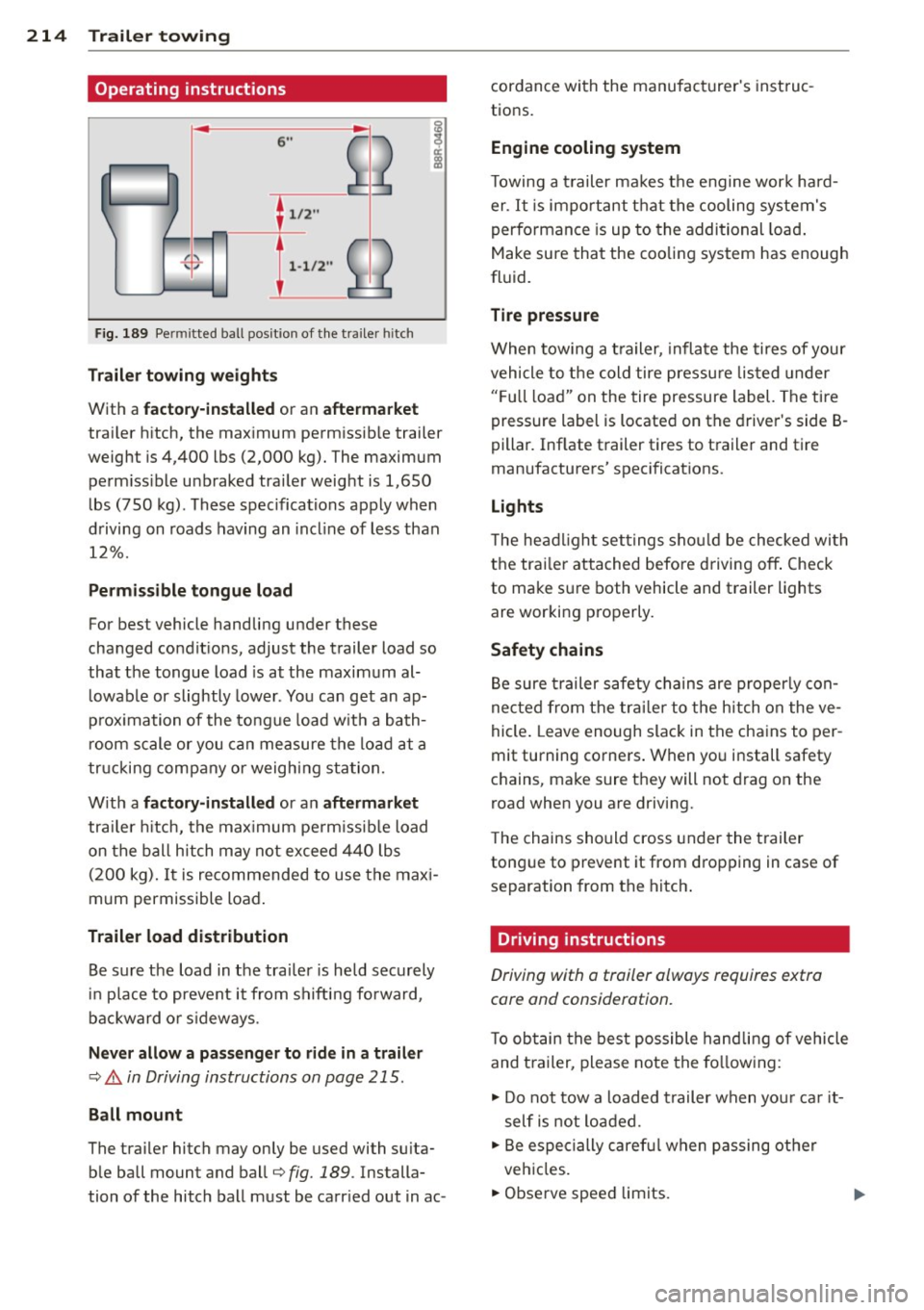
Fig. 189 Pe rmi tted ball posit ion of the tra iler h itch
T ra ile r tow ing weight s
With a factor y-insta lled or an afte rm arket
trailer h itch, the max imum permissib le trailer
weight is 4,400 lbs (2,000 kg). The maximum perm iss ible unbraked trailer weight is 1,650
lbs (750 kg). These spec ifications apply when
driving on roads hav ing an incl ine of less than
12%.
P erm is s ible tongue load
For best vehicle handling under these
changed condit ions, adjust the trailer load so
that the tongue load is at the maximum al
l owable or slightly lower . You can get an ap
p rox imation of the tongue load w ith a bath
room scale or you can measure the load at a
tr ucking company or weighing sta tion.
W ith a
fact ory -in stall ed or an aftermarket
trailer h itch, the max imum pe rm issible load
on the ball hitch may not exceed 440 lbs (200 kg).
It is recommended to use the maxi
mum permissible load .
Trailer lo ad distribut ion
Be sure the load in the trai ler is held securely
in place to prevent it from shifting fo rward,
backward or s ideways.
N eve r allow a p assenger to rid e in a trail er
¢ .&. in Driving instructions on page 215.
Ball mount
The trailer hitch may only be used with su ita
ble ball mount and ball¢
fig. 189. Installa
tion of the hitch ball must be carr ied out in ac- cordance with the manufacturer's instruc
tions.
Eng ine cooling system
T owing a t railer makes the engine work hard
er . It is important that the cooling system's
performance is up to the additional load .
Make sure that the cooling system has enough
fluid.
Tire pressur e
When towing a trailer, inflate the tires of your
vehicle to the cold tire pressu re listed under
" F u ll load" on the tire pressure label. The tire
pressure label is located on the driver's side B·
pillar. Inflate trailer tires to trailer and tire
manufacturers' spec ificat ions.
Lights
T he headlight settings shou ld be checked wi th
the trai ler attached before driving off . Check
to make sure both vehicle and trailer lights
are working properly.
Safety chains
Be sure trailer safety chains are properly con
nected from the tra iler to the hitch on the ve
hicle . Leave enough slack in the chains to per
mit turning corners . When you install safety
chains, make sure they will not drag on the
road when you are driving.
T he chains should cross under the trailer
tongue to prevent it from dropping in case of separation from the hitch .
Driving instructions
Driving with a trailer always requires extra
core and consideration.
T o obtain the best possible handling of vehicle
and t railer, please note the fo llowing :
.,. Do not tow a loaded t railer when you r ca r it
self is not loaded .
.. Be especially caref ul when passing ot her
vehicles.
.. Observe speed limits.
Page 217 of 316

~ Do not drive at the maximum permissible
speed.
~ Always apply brakes early.
~ Monitor the temperature gauge.
Weight distribution
Towing a loaded tra iler with an empty ca r re
sults in a high ly unstable distribution of
weight. If this cannot be avoided, drive at very low speeds only to avoid the risk of losing
steering control.
A "balanced" rig is easier to operate and con
trol. This means that the tow vehicle should
be loaded to the extent possible and permiss i
ble, while keeping the trailer as light as possi
ble under the circumstances. Whenever possi
ble, transfer some cargo to the luggage com
partment of the tow vehicle wh ile observing
tongue load requirements and vehicle loading
considerations .
Speed
The higher the speed, the more difficult it be
comes for the driver to control the rig . Do not
drive at the maximum permissible speed. Re
duce your speed even more if load, weather or
wind conditions are unfavorable -part icularly
when going downhill.
Reduce vehicle speed
immediately if the trail
er shows the slightest sign of swaying.
Do not
try to stop the swaying by accelerating.
Observe speed limits. In some areas, speeds
for veh icles towing trailers are lower than for
regular vehicles.
Always apply brakes early . When driving
downhill, shift into a lower gear to use the en
g ine braking effect to slow the vehicle . Use of
the brakes alone can cause them to ove rheat
and fail.
Coolant temperature
T he coolant temperature gauge c:> page 10
must be observed carefully . If the needle
moves close to the upper end of the scale, re
duce speed immed iate ly and/or turn off the
air cond itioner.
Trailertowin g 215
If the coolant temperature warning light in
the instr ument cluster starts flashing., pull
off the road, stop and let the engine
idle for
about two minutes to prevent heat build -up.
A WARNING
Anyone not properly restrained in a mov
ing vehicle is at a much greater risk in an
accident. Never let anyone ride in your car
who is not properly wearing the restraints
prov ided by Audi .
Trailer towing tips
Important to know
Your vehicle handles differently when towing
-
a trailer because of the additional weight and
different weight distr ibut ion. Safety, perform
ance and economy will greatly depend on how
carefully you load your trailer and operate
your rig.
Before you actually tow your tra iler, practice
turning, stopping and backing up in an area
away from traffic. Keep practicing until you
have become completely familiar w ith the way
your vehicle-tra ile r combination behaves and
responds.
Backing up is difficult and requires practice .
Backing up with a trailer generally requires
steering action opposite to that when backing
u p you r vehicle without a trailer.
Maintain a greater d ista nce between your ve
hicle and the one in front of you. You w ill need
more room to stop. To compensate fo r the
trailer, you w ill need a larger than normal
turning radius.
When passing, remember that you cannot ac
celerate as fast as you normally would be
cause of the added load. Make sure yo u have
enough room to pass. After passing, a llow
plenty of room for your trailer before chang
ing lanes again.
Avoid jerky starts , sharp t urns or rapid lane
changes.
•
•
Page 249 of 316

Tires and wheels
Tires
General notes
Tires may be the least appreciated and most
abused parts of a motor vehicle .
Tires may be the least appreciated and most
abused parts of a motor vehicle . Tires are,
however, one of the most important parts of a
vehicle, particularly considering the compara
tively small patch of rubber on each tire that
assures that a ll- important contact between
you, your vehicle and the road.
Maintaining the correct tire pressure, mak ing
sure that your vehicle and its tires do not have
to carry mo re weight than they can safely han
d le, avoiding damage from road hazards and
r eg ularly inspect ing t ires for damage i nclud
ing cuts, slashes irregu la r wear and ove rall
condition are the most important things that
you can do to he lp avoid sudden tire failure in
cluding tread separat ion and blowouts.
A voidin g damage
If you have to d rive over a curb or similar ob
stacle, drive very slow ly and as close as possi
b le at a right angle to the curb.
A lways keep chemicals includ ing grease, o il ,
gasoline and brake fluid off the t ires .
I nspect the t ires regularly for damage (cuts,
cracks or b listers, etc.). Remove any fo reign
bod ies embedde d in the treads.
Storing tires Mark tires when you remove them to indicate
the direction of rotation . T his ensures you to
be ab le to mount them correctly when you re
i nstall them .
When removed, the wheels or t ires should be
sto red in a cool, d ry and preferably dark place .
Store tires in a vertical pos ition if they are not
mounted on rims, in a horizontal pos it ion if
they are mounted on rims .
Tires an d wheel s 24 7
New tires
New ti res have to be broken in¢& .
The tread depth of new t ires may vary, accord
ing to the type a nd make of t ire and the tread
patte rn.
H idden damage
Damage to tires and r ims is ofte n not readily
visible . If you notice unusual v ib rat ion or the
vehicle pulls to one s ide, th is may ind icate
that one of the t ires has been damaged . T he
ti res m ust be chec ked immed iate ly by an au
thorized Audi dea le r or q ua lified wor kshop .
Unidirectional tires
A un idirectional tire can be identified by ar
rows on the sidewa ll, that po int in the direc
tion the t ire is designed to rotate. You mus t
f ol low the specified di rection o f rotation . T his
is necessary so that these tires can develop
their optimum characteristics regarding grip, road noise, wear and hydrop laning resistance.
For more information
¢ page 277.
A WARNING
New tires or t ires that are o ld, worn or
damaged cannot provide maximum con
trol and braking ability .
-
-New tires tend to be slippery and must
also be b roken-in. To reduce the risk of
losing control, a collision and serious
pe rsonal injuries, drive w it h special care
for the first 350 miles (560 km).
- Driving with worn or damaged tires can
lead to loss of control, sudden tire fail
ure, including a blowout and sudden de
fl ation, cras hes and se riou s personal in
juries . Have worn or damaged t ires re
placed immediate ly.
- Ti res age even if they are not being used
and can fai l sudden ly, especially at hig h
speeds. Tires that are more than 6 years
old can only be used in an emergency
and then w ith special care and at low
speed.
•
•
Page 250 of 316

248 Tire s and whee ls
- Never mount used tires on yo ur vehicle if
you are not sure of their "previous histo
ry." Old used tires may have been dam
aged even though the damage cannot be
seen that can lead to sudden tire failure
and loss of vehicle control.
- If you notice unusual vibration or if the
vehicle pulls to one side when driving, al
ways stop as soon as it is safe to do so and check the wheels and tires for dam
age.
(D Note
Please note that summer and winter tires
are designed for the cond itions that are
Glossary of tire and loading terminology
Acces sory weight
means the comb ined we ight (in excess of
those standard items which may be rep laced)
of au toma tic tra nsmission, power steer ing,
power brakes, power windows, power seats,
radio, and heater, to the extent that these
items are availab le as factory -installed equip
ment (whether installed or not) .
Aspect ratio
means the ratio of the he ight to the w idth of
the tire in percent . Numbers of 55 or lower in
dicate a low sidewall for improved steering re
sponse and better overall handling on dry pavement .
Bead
means the part of the ti re that is made of
steel wires, wrapped or reinforced by ply cords
and that is shaped to fit the rim.
Bead s eparation
means a b reakdown of the bond between
components in the bead.
Cord
means the strands forming the plies in the
tire . typica
l in those seasons. Audi recommends
using winter tires during the winter
months. Low temperatures signif icant ly
decrease the e lasticity of summer tires,
which affects tract ion and brak ing ability.
If summer tires are used in very cold tem peratures, cracks ca n form on the tread
bars, resulting in permanent tire damage
that can cause loud driving no ise and un
balanced t ires. Audi is not responsible for
th is type of damage .
Cold tire inflation pre ssure
means the t ire p ressure recommended by the
vehicle manufacturer fo r a tire of a des ignated
s ize that has not bee n driven for more than a
coup le of miles (k ilometers) at low speeds in
the three hour period before the tire pressure
is measured or adjusted.
Curb weight
means the we ight of a motor ve hicle w ith
standard equipment including the max imum
capacity of fuel, oil, and coolant, air condi
tioning and additional weight of optiona l
equipment.
Extra load tire
means a t ire design to operate at higher loads
and at h igher inflation pressures than the cor
responding standard tire . Extra load tires may
be identified as "XL", "x l" , "EXTRA LOAD", or
"RF" on the sidewall.
Gross A xle Weight Rating ("GAWR ")
means the lo ad -carry ing capacity of a s ingle
axle system , measured at the tire-ground in
terfaces.
Gr oss Vehicle Weight Rating ("GVWR ")
means the maximum total loaded we ight of
t h e vehi cle. .,.
Page 251 of 316

Groove
means the space between two adjacent tread
ribs.
Load rating (code)
means the maximum load that a tire is rated
to carry for a given inflation pressure. You
may not find this information on all tires be
cause it is no t req uired by law.
Maximum load rating
means the load rating for a t ire at the max i
mum permissible inflation pressure for that
tire.
Maximum loaded vehicle weight
means the sum of:
(a) Curb weight
(b) Accessory weight
(c) Vehicle capacity weight, and
(d) Production options weight
Maximum (permissible) inflation pressure
means the maximum cold inflation pressure
to which a tire may be inflated. Also called "maximum inflation pressure."
Normal occupant weight
means 150 lbs. (68 kilograms) times the
number of occupants seated in the vehicle up
to the total seating capacity of your vehicle.
Occupant distribution
means distribution of occupants in a vehicle.
Outer diameter
means the overa ll diamete r of an inflated new
tire.
Overall width
means the linear distance between the exteri
ors of the sidewalls of an inflated tire, includ
in g elevations due to labeling, decorations, or
protective bands or ribs.
Ply
means a layer of rubber-coated parallel cords.
Tires and wheels 249
Production options weight
means the combined weight of those installed
regular production options we ighing over 5
lbs. (2.3 kg) in excess of those standard items
which they replace, not previously considered
in curb weight or accessory weight, including
heavy duty brakes, ride levelers, roof rack,
heavy duty battery, and spec ial tr im .
Radial ply tire
means a pneumatic tire in which the ply cords
that extend to the beads are laid at substan
tia lly 90 degrees to the center line of the
tread .
Recommended inflation pressure
see ¢ page 248, Cold tire inflation pressure.
Reinforced tire
means a t ire design to operate at higher loads
and at h igher inflation pressures than the cor
re sp onding standard tire. Reinforced tires
may be identified as "XL", "xl", "EXTRA LOAD",
or "RF" on the sidewa ll.
Rim
means a metal support for a tire or a t ire and
tube assembly upon which the tire beads are
seated.
Rim diameter
means nom inal diameter of the bead seat. If
you change your wheel s ize, you will have to
purchase new tires to match the new rim di
ameter.
Rim size designation
means r im diameter and width .
Rim width
means nominal distance between rim flanges .
Sidewall
means that portion of a tire between the
tread and bead.
•
•