2014 AUDI Q5 warning
[x] Cancel search: warningPage 285 of 316

Emergency situations
General
This chapter i s intended for trained emer
gency crews and working personnel who have the necessary tools and equipment to
perform these operations.
Starting by pushing or
towing
(D Note
Vehicles with an automatic tran smission
cannot be started by pu shing or towing .
Starting with jumper
cables
If necessary, the engine can be started by
connecting it to the battery of another vehi
cle.
If the engine sho uld fail to start because of a
discha rged o r weak battery, the battery can be
connected to the battery o f
another vehicle,
using a
pair of jumper cables to start the en
g ine.
Jumper cables
Use only jumper cables of sufficiently la rge
c ross section to carry the starter c urrent safe
l y. Refer to the man ufacturer's specifications.
Use o nly jumper cables with
insulated te rm i
na l clamps w hich are d istinctly mar ked:
plus (+) cable in mos t cases co lore d red
minus (-) cab le
in most cases colored black .
A WARNING
Batterie s contai n elec tricity, ac id, an d gas.
Any of these c an cause ve ry ser io us or fatal
injury. Foll ow the instr uctions bel ow fo r
safe han dling of your veh icle's b attery .
- Alw ays s hield you r eye s and avoid lean
ing over the bat te ry whenever p ossib le.
- A dis ch arged b attery c an free ze at te m
pera tures ju st be low 3 2 °F ( 0 °C ). Befo re
Emergency situations 283
connecting a jumpe r cab le, you must
thaw the fr ozen battery c omp lete ly, ot h
erwise it could explode.
- Do not allow battery acid to contact eyes
or skin. Fl ush any contacted area with
wate r immediately.
- Improper use of a booster battery to start a vehicle may cause an explosion.
- Vehicle batter ies genera te exp losive gas
es. Keep spar ks, flame and lighted c iga
rettes away from batte ries.
- Do not try to jump start any ve hicle w ith
a low ac id leve l in the battery.
- The vo ltage of the booste r batte ry m ust
a lso have a 12-Vol t rating. T he capacity
(Ah) of the booster battery sho uld not be
lowe r tha n that of the discharged bat
tery . U se of batte rie s of d iffe ren t voltage
or substan tially diffe rent "Ah" rat ing
may c au se a n exp losion and persona l in
JU ry.
- N ever cha rge a fro zen batte ry. Gas tr ap
pe d in t he ice may c ause an explosion.
- Never cha rge or use a batte ry tha t h as
been fr ozen. T he battery case may have
be weakened.
- Us e of b atter ies of differe nt voltage or
sub stant ia lly diff eren t ca pa city (Ah) ra t
i ng may c ause an ex plosion an d injury .
Th e capac ity (Ah) of the booster bat tery
should not be lower than that of the dis
charged batte ry .
- Before you chec k any thing in the engine
compa rtment, always read and hee d all
WARNINGS
¢page 231.
(D Note
-App lyin g a higher vo ltage booster ba t
t ery w ill cause expens ive damage to se n
sit ive e lectronic com ponents, such as
cont ro l units, relays, rad io, etc.
- The re must be no electrical contact be
tween the vehicles as ot herwise c urrent
co uld a lready start to f low as soon as the
p o sit ive(+) term inals a re connected. ..,. •
•
Page 287 of 316
& WARNING
To avoid serious personal injury and dam
age to the vehicle, heed all warnings and
instructions of the jumper cable manufac
turer. If in doubt, call for road serv ice.
- Jumper cables must be long enough so
that the vehicles do not touch.
- When connecting jumper cables, make
sure that they cannot get caught in any
moving parts in the engine compart
ment.
- Do not bend over the batteries -danger
of chemical burns!
- The battery ce ll locking screws must be
t ightened securely .
- Before you check anything in the engine
compartment, always read and heed all
WARNINGS
~ page 231.
{[) Note
Improper hook-up of jumper cables can ru
in the generator.
- Always connect POSITIVE(+) to POSI
TIVE(+), and NEGATIVE(-) to NEGATIVE
(-) ground post of the battery manager
control unit.
- Check that all screw plugs on the battery
ce lls are screwed in firmly .
If not, tighten
plugs prior to connecting clamp on nega
tive battery terminal.
- Please note that the procedure for con
necting a jumper cable as described
above applies spec ifically to the case of
your vehicle be ing jump started. When
you are giving a jump start to another ve
hicle, do
not connect the negative(-) ca
ble to the negative(-) terminal on the
discharged battery©
c::> fig. 230. In
stead, securely connect the negative(-)
cable to either a solid metal component
that is firmly bolted to the engine block
or to the engine block itself. If the bat
tery that is being charged does not vent
to the outside, escaping battery gas
could ignite and explode!
-
Emergency situations 285
Emergency towing
with commercial tow
truck
General hints
Your Audi requires special handling for tow
ing.
T he following information is to be used by
commercial tow truck operators who know
how to operate their equipment safely.
- Never tow your Audi, towing will cause
damage to the engine and transmission.
- Never wrap the safety chains or winch ca
ble s around the brake lines .
- To prevent unnecessary damage, your Audi
must be transported with a flat bed truck.
- To load the vehicle on to the flat bed , use
the towing loop found in the vehicle tools
and attach to the front or rear anchorage
i::>page 286 and ~page 286.
A WARNING
A vehicle being towed is not safe for pas
sengers. Never allow anyone to ride in a
vehicle be ing towed, for any reason.
-
•
•
Page 288 of 316
286 Emergency situations
Front towing loop
Do not install the front towing loop until it is
needed.
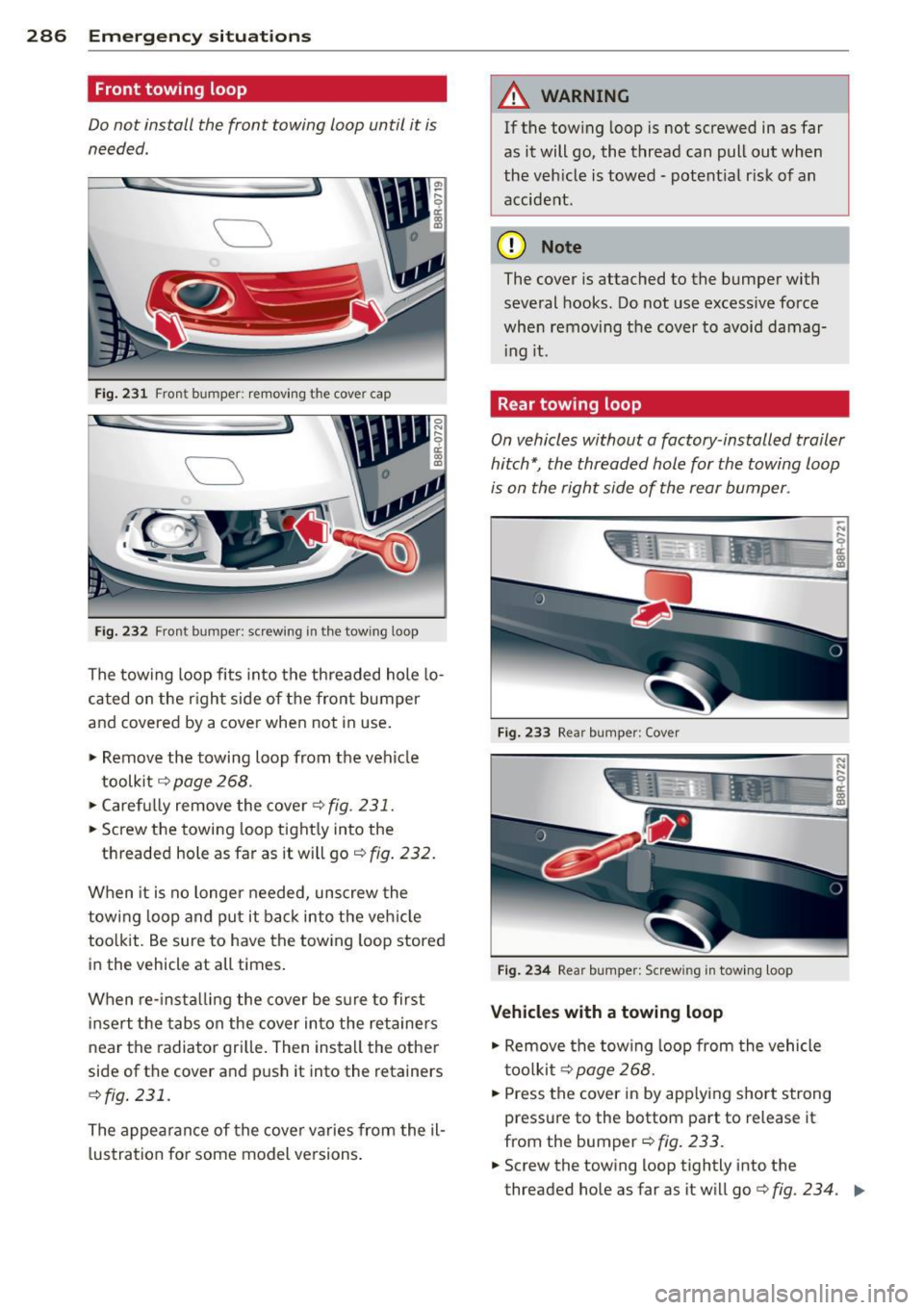
Fig. 231 Front bumper: removing th e cove r cap
Fig. 232 Fron t bumper: screw ing in t he tow ing loop
The towing loop fits into the threaded hole lo
cated on the right side of the front bumper
and covered by a cover when not in use.
• Remove the towing loop from the vehicle
toolkit
c::> page 268 .
• Carefully remove the cover c::> fig. 2 31.
• Screw the towing loop tight ly into the
threaded hole as far as it will go
c::> fig. 232.
When it is no longer needed, unscrew the
towing loop and put it back into the vehicle
too lkit . Be sure to have the towing loop stored
in the vehicle at all times.
When re-installing the cover be s ure to first
insert the tabs on the cover into the retaine rs
near the radiator grille. Then install the other
side of the cover and push it into the retainers
c::> fig . 231 .
The appearance of the cove r varies from the il
lustration for some model versions .
A WARNING
-If the towing loop is not screwed in as far
as it will go, the thread can pull out when
the veh icle is towed - potent ial r isk of an
accident.
(D Note
The cover is attached to the bumper with
several hooks. Do not use excess ive force
when removing the cover to avoid damag
i ng it.
Rear towing loop
On vehicles without a factory -installed trailer
hitch* , the threaded hole for the towing loop
is on the right side of the rear bumper.
Fig. 233 Rear bump er: Cov er
Fig. 234 Rea r bumper : Screw ing in towing loop
Vehicles with a towing loop
• Remove the tow ing loop from the vehicle
toolkit
c:> page 268.
• Press the cover in by app lying short strong
pressure to the bottom part to release it
from the bumper
c::> fig. 233.
• Screw the towing loop tightly into the
threaded hole as far as it will go
c:> fig. 234. ""
Page 289 of 316

Vehicles with a trailer hitch *
• Install the trailer h itch .
• Attach the towing bar or the towing cab le to
the trai le r hitch.
Unscrew the towing loop aga in after use and
i nstall the cover in the bumper. Return the
t owing loop to the vehicle too lkit. Be sure to
have the towing Loop stored in the vehicle at
all times.
A WARNING
- If the towing Loop is not screwed in as far
as it will go, the thread can pull out when
the vehicle is towed -potential risk of an
accident.
- If your veh icle has a
trailer h itch * only
use a special towing bar to prevent dam
aging the ball h itch . These towing bars
have been specially designed for trailer
towing hi tches.
- If your veh icle has a
trailer hi tch* use on
ly specia l towing cables.
Loading the vehicle onto a flat bed truck
Fig. 235 Veh icle on fla t bed tru ck
Front hook up
• Align the vehicle w ith the centerline of the
car carr ier ramp.
• Att ach the winch hook to the front towline
eye previously installed .
Rear hook up
• Align the vehicle with the centerline of the
car car rier ramp.
• Attach the winch hook to the rear towline
eye previously installed .
Emergency situ ation s 287
@ Tips
Check caref ully to make sure the hook-up
i s secure before moving the car up the flat
bed truck ramp.
Lifting vehicle
Lift ing w ith workshop hoist and with
floor jack
The vehicle may only be lifted at the lifting
points illustrated.
F ig . 236 Fro nt li fting point
F ig . 237
Rea r liftin g po int
• Read and heed WARNING ¢ ,&. .
• Locate lifting points ¢ fig. 236 and
¢fig. 237.
• Adjust li fting arms of workshop ho is t or
floor jack to match veh icle lifting points .
• Insert a rubber pad between the floor jack/
workshop hoist and the lift ing poin ts .
If you must l ift your vehicle with a floor jack
t o work und erneath, b e sure the vehi cle i s
saf ely s upported on stands int ended for thi s
purpo se.
Fron t lifting point
The lifting poin t is located on the floor pan re-
inforcement about at the same level as the
Ill>
Page 290 of 316

288 Emergency situations
jack mounting point¢ fig. 236 . Do not lift
the vehicle at the vertical sill reinforcement.
Rear lifting point
T he lifting point is lo cate d on t he ve rtical rein
fo rceme nt of the lower s ill fo r th e on bo ard
j ack *¢
fig . 23 7.
Lifting with vehicle jack*
Refe r to ¢ page 2 75 .
..&, WARNING
- T o redu ce t he r is k of se rious injury and
vehicle dam ag e.
- Always lift the vehicle on ly at the spe
cial wor kshop h oist and floor jack lift
points illustrated
¢ fig. 236 and
¢ fig. 237 .
-Fa ilure to lift the vehicle at these
points cou ld cause the veh icle to tilt or
fa ll from a lift if the re is a change in ve
h icle we igh t di stribu tion a nd ba lance .
This might happen, for exa mple, w hen
h eavy co mpo ne nts su ch as the engi ne
bl oc k or tra ns mis sion ar e removed .
- W hen re mov ing heavy co mpo nents like
t h ese , a nch or vehicle to hoist or add cor
res pond ing weig hts to maintain t he cen
te r of gravity . Othe rwise, the vehicle
mi gh t tilt o r slip off t he hoist , ca usi ng
serious persona l injury .
CJ) Note
- Be aw ar e of t he fo llow ing poin ts be fo re
lift ing t he vehicle:
- The vehicle should never be lifted or
jacked up from underneath the engine oil pan, the transmission housing, the
front or rear axle or the body side members. Thi s could lead to serious
damage.
- To avoid damage to the underbody or
chassis frame , a rubber pad must be
inserted between the floor jack and
the lift points.
- Before driving over a workshop hoist,
check that the vehicle weight does not
-
exceed the permissible lifting capacity
of the hoist .
- Before driving over a workshop hoist,
ensure that there is sufficient clear
ance between the hoist and low parts
of the vehicle.
Page 291 of 316

Technical Data
Vehicle identification
F ig. 238 Veh ide Identificat ion Numbe r (VlN) plate: lo ·
c ation on dri ver 's s ide das h pane l
XXXXX XX · X -XXXX XXX
~ fAllftlli. -llllll · NR. ~ W!ru -IIOO -NO.
xx
XXXX XXXX XX X XXXXXXXX
XXX XXX
IYP /TYPE
XX XXXXXXX XX X X XX
XXX KW XXX
®i ~W.::·f :l~~ XXXX XXX XXX
©+ ::rw= xxxx I xxxx XXX I xx
M. · AUSSt I IJ'IIDIIS
~--
EOA 7D 5 4UB 6XM SSG SRW
2E H JDZ 1LB lA S 1BA
3FC SMU 7X l
FD A 9G3 OG7 OYH OJF
TL6 3 KA 8EH UlA X98 027
lXW 803 908 824 D2D
7T6 CV7 7KO 4X3 2K2
3L4 4KC 3YO 413 502
1S A 7GB 01A 4GO
XX. X XX X XX X XXXX
Fig. 239 Vehicle identificat io n label: ins ide t he lug
ga ge compar tmen t
Vehicle Id entification Numb er (VlN )
The Veh icle Iden tifica tion Number is located
in different p laces :
- under the w indshield on the driver's side
¢fig. 238.
- i n the radio or in the MM!*: Select:
ICAR I
function button > Vehicle ID numb er (VIN )
or select I CAR I func tion button > Car sys·
tem s* control button > Servicin g & check s >
VIN numbe r.
-on the vehicle identification label.
Te chni cal Data 289
Vehicle id ent ification label
T he vehicle identification label is located in
the luggage compartment above the com
partment fo r th e ve hicle tools.
T he label¢
fig. 239 shows the fol low ing vehi
cle data :
(D Vehicle Ident ificat ion Number (VIN)
@ Vehicle type, engine o utp ut, transmission
® Engine and transmission code
© Paint number and inte rior
® Optional equipment numbers
T he information of the vehicle identification
label can also be found in your Warranty
&
Maintenance booklet .
Safety compliance sticker
T he safety compliance sticker is your assur
ance that your new veh icle complies with all
applicable Fede ra l Motor Vehi cle Safety
Standards which were in effect at the time the
vehicle was manufactured . You can find this
sticker on the door jamb on the driver 's side.
It shows the month and year of production
and the vehicle ident ificat ion number of your
vehicle (perforation) as well as the Gross Veh i
cle Weight Rating (GVWR) and the Gross Axle
Weight Rating (GAWR) .
High voltage warning label
The high voltage warning label is located in
the engine compartment next to the engine
hood release. The spark ign ition system com
plies with the Ca nadian standard ICES-002 .
Weights
Gross Vehicle Weight Rating
The Gross Vehicle Weight Rat ing (GVWR), and
the Gross Axle Weight Rati ng (GAWR) for
front and rear are listed on a sticker on the
doo r jamb on the driver's side.
The Gross Vehicle Weight Rat ing includes the
weight of the basic vehicle plus full fuel tank,
o il and coolant, plus maximum load, which in
cludes passe nger we ight (150 lbs/68 kg per
II>--
Page 292 of 316

29 0 Techni cal Dat a
designated seating position) and luggage
weight ¢.&, .
Gross Axle W eight Rating
The Gross Axle Weight Rating is the maximum
l oad that can be applied at each axle of the
vehicle ¢Lr!, .
Vehicle cap acit y weight
The vehicle capac ity we ight (max. load) is list
ed on the driver's side 8-p illar.
A WARNING .
- T he actual Gross Axle Weight Rat ing at
the front and rear axles sho uld not ex
ceed the permissible weights, and their
combination must not exceed the Gross
Vehicle Weight Rating.
Dimensions
Leng th in (mm)
Width in (mm)
Width (across mir rors) in (mm)
He ight (unloaded)a ) in (mm)
T urning circle diameter
ft (m) -
Exceeding permissible weight ratings can
result in veh icle damage, acc idents and
personal injury.
(D Note
- The vehicle capacity weight figures apply
when the load is distributed evenly in the
vehicle (passengers and luggage). When
transport ing a heavy load in the luggage
compartment, carry the load as near to
the rear axle as poss ible so that the vehi
cle's handling is not impaired.
- Do not exceed the maximum permissible
axle loads or the maximum gross veh icle
we ight. Always remember that the vehi
cle's handling w il l be affected by the ex
tra load. Therefo re, adj ust your speed ac
cordingly.
- Always observe local regulat ions.
QS /QS hybrid SQS
182.6 (4639) 183 .0 (4647)
74 .7 (1898) 75 .2 (1911)
82.2 (2089) 82 .2 (2089)
65 .2 (1655) 65 .3 (1658)
38.1 (1 1.6) 38. 1 (1 1.6)
a) The he ight of the vehicle depen ds on the tires and the suspension.
When driving up steep ramps, on rough roads,
over curbs, etc . it is important to remember
that some parts of your ve hicle, such as spoil-
Capacities
ers or exhaust system components, may be
close to the ground. Be carefu l not to damage
them.
QS /SQS QS hybrid
Fuel tank: tota l capacity gal (liters) approx. 19 .8 (75) approx. 19.0 (72)
Winds hield and headlight* quarts ( liters) approx. 4
.9 (4.6)
approx. 4.9 (4.6)
washer fluid container
Page 296 of 316
29 4 Con sum er Inf ormation
comp lexity of today's automobi les, have
steadi ly reduced the scope of maintenance
and repairs which can be carried out by vehicle
owners.
Also, s afety an d e nvir onm ent al con
cerns place very strict limits on the nature of
repairs and adjustments to engine and trans
miss ion pa rts which an owner can perform .
Maintenance, adjustments and repa irs usua lly
require special tools, testing devices and oth
er equipment avai lab le to specially trained
workshop personnel in order to assure proper
performance, reliab ility and safety of the vehi
cle and its many systems .
Improper ma intenance, adjustments and re
pa irs can impair the operation and reliab ility
of your vehicle and even void your vehicle war ranty. Therefo re , proof of servic ing in accord
ance w it h the ma intenance sched ule may be a
condition for upholding a poss ible warranty
claim made within the warran ty period.
Above all, operational safety can be adve rsely
affected, c reating unnecessary risks for you
and your passengers.
If in doubt about any serv icing, have it done
by your author ized Audi dealer or any other
p roperly equipped and qualified workshop .
We strong ly urge you to give your authorized
Audi dealer the opportunity to perform all
schedu led maintenance and necessary repairs .
Your dea ler has the facilities, or iginal parts
and tra ined spec ialists to keep your vehicle
running properly .
Performing lim it e d m aint en anc e y ourself
The fo llowing pages describe a limited num
ber of procedures which can be performed on
you r vehicle with ordinary too ls, shou ld the
need arise and trained personnel be unavaila
ble. Before performing any of these proce
dures, always thoroughly read all of the app li
cable text and ca refully follow the instruc
tions given. Always rigorously obse rve the
WARNINGS p rovided .
Before you ch eck anything in th e engin e
compartme nt, alway s read an d heed all WARNINGS
¢.&. and
¢ .&. in Working in the
engine comportment on page 231 .
A WARNING
--Serious personal in jury may occur as a re-
sult of improperly performed mainte
nance, adjustments or repa irs.
- Always be extremely careful when work
ing on the vehicle. Always follow com
monly accepted safety pract ices and gen
eral common sense. Never r isk personal
in jur y.
- Do not attempt any of the maintenance,
checks or repairs descr ibed o n the fol
lowing pages if you are not fu lly fam iliar
with these or other procedures with re
spect to the ve hicl e, or are uncerta in how
to proceed .
- Do not do any work withou t the proper
too ls and equipment . Have the necessary
work done by your authorized A udi deal
er or anothe r properly equipped and
qualified workshop.
- The engine compar tment o f any motor
vehicle is a potentially hazardous area. Never reach into the area around or
touch the rad iator fan. It is temperature
control led and can sw itch on suddenly -
even when the engine is off and the igni
tion key has been removed. The rad iator
fan switches on automatically when the coo lant reaches a certai n tempera ture
and will cont inue to run until the coo lant
temperature drops .
- Always remove the ign ition key befo re
a nyone gets under the veh icle.
- Always suppor t your veh icle with safety
s tands if it is necessary to work under
neath the vehicle. The jack* s upplied
with the vehicle is not adequate for this purpose and could co llapse causing seri
ous personal injury .
- If you must work unde rneath the vehicle
with the wheels on the ground, a lways
make sure the vehicle is on leve l ground,
that the wheels are always securely blocked and that the engine cannot be
started.