2014 AUDI Q5 remove seats
[x] Cancel search: remove seatsPage 155 of 316

To provide maximum protection, sa fety belts
must always be positioned correctly on the
wearer's body.
... Adjus t the front seat and head restraint
properly
c::> page 61, General recommenda
tions .
... Make sure the seatback of the rear seat
bench is in an upright position and securely
latched in place before using the belt
c::> ,&. .
... Hold the be lt by the tongue and pull it even
ly across the chest and pelvis
c::> ,&..
... Insert the tongue into the co rrect buckl e of
your seat until you hea r it latch securely
c::>fig. 160.
... Pull on the belt to make sure that it is se-
curely latched in the buckle.
Automatic safety belt retractors
Every safety belt is equipped w ith an automat
i c belt retractor on the shoulder be lt. T his fea
ture locks the belt when the belt is pulled out
fast, dur ing hard braking and in an accident.
The belt may also lock when you drive up or
down a steep hill or through a sharp curve. During normal driving the belt lets you move
freely.
Safety belt pretensioners
The safety belts are equipped with a belt pre
tensioner that helps to tighten the safety belt
and remove slack when the pretensioner is ac
tivated. The funct ion of the pretensioner is
monitored by a warning light
c::>page 16.
Sw itchable locking feature
E very sa fety belt except the one on the driver
seat is equipped with a switchable locking fea
ture that
must be used when the safety belt is
used to attach a child safety seat. Be sure to read the important information about this
feature
c::> page 188.
A WARNING
Imprope rly positioned safety belts can
cause serious injury in an accident
o::> page 153, Safety belt position.
-Safety belts offer optimum protection
only when the seatback is upright and
Safety belts 153
belts are properly positioned on the
body.
- Always make sure that the rear seat
backrest to which the center rear safety
be lt is attached is securely latched when
ever the rear center safety belt is being
used. If the backrest is not securely
latched, the passenger w ill move for
ward with the backrest during sudden
braking, in a sudden maneuver and espe
cially in a crash .
- Never attach th e safety belt to the buck
le for another seat . Atta ching the belt to
the wrong buckle will reduce s afety be lt
effectiveness and can cause ser ious per
sonal injury.
- A passenger who is not proper ly restrain
ed can be seriously injured by the safety
be lt itself when it moves from the stron
ger parts of the body into cr itical areas
like the abdomen.
- Always lock the convertible locking re
tractor when you are securing a child safety seat in the vehicle
c::>page 190.
Safety belt position
Correct belt position is the key to getting
maximum protection from safety belts.
Fig . 161 Safety belt position
Standa rd features on your veh icle help you ad
just the position of the safety belt to match you r body size.
- belt height adjustment for the front seats,
- height-adjustable front seats.
Page 167 of 316

-Improper repair or disassembly of the
front passenger and driver seat will pre
vent the Advanced Airbag System from
functioning properly .
- Repairs to the front passenger seat must
be performed by qualified and properly
trained workshop personnel.
- Never remove the front passenger or
driver seat from the vehicle .
- Never remove the upholstery from the
front passenger seat .
- Never disassemble or remove parts from
the seat or disconnect wires from it.
- Never carry sharp objects in your pockets
or place them on the seat. If the weight
sensing mat in the passenger seat is
punctured it cannot work properly.
- Never carry things on your lap or carry
objects on the passenger seat . Such
items can increase the weight registered
by the weight-sensing mat and send the
wrong information to the airbag control
unit.
- Never store items under the front pas
senger seat. Parts of the Advanced Air
bag System under the passenger seat
could be damaged, preventing them and
the airbag system from working proper
ly.
- Never place seat covers or replacement
upholstery that have not been specifical
ly approved by Audi on the front seats.
- Seat covers can prevent the Advanced
Airbag System from recognizing child re
straints or occupants on the front pas
senger seat and prevent the side airbag in the seat backrest from deploying prop
erly.
- Never use cushions, pillows, blankets or
similar items on the front passenger
seat . The additional padding will prevent
the weight-sensing mat in the seat from
accurately registering the child restraint
or person on the seat and prevent the
Advanced Airbag System from function
ing properly.
- If you must use a child restraint on the
front passenger seat and the child re-
Airbag system 165
straint manufacturer's instructions re
quire the use of a towel, foam cushion or
something else to properly position the
child restraint, make certain that the
PASSENGER AIR BAG OFF light comes
on and stays on whenever the child re
straint is installed on the front passen
ger seat.
- If the
PASSENGER AIR BAG OFF light
does not come on and stay on, immedi
ately install child restraint in a rear seat
ing position and have the airbag system
inspected by your authorized Audi dealer .
How the Advanced Airbag System
components work together
The front Advanced Airbag System and the
side airbags supplement the protection of
fered by the front three-point safety belts
with pretensioners and load limiters and the
adjustable head restraints to help reduce the
risk of injury in a wide range of accident and
crash situations. Be sure to read the impor
tant information about safety and heed the
WARNINGS in this chapter.
Deployment of the Adv a need Airbag System
and the activation of the safety belt preten
sioners depend on the deceleration measured
by the crash sensors and registered by the
electronic control unit. The amount of infla
tion of the front airbags can also be adapted
to the front sea t position, depending on the
distance between the respective front seat
and the steering wheel or instrument panel as registered by sensors in the seats. Crash se
verity depends on speed and deceleration as
well as the mass and stiffness of the vehicle
or object involved in the crash.
On the passenger side, regardless of safety
belt use, the airbag will be turned off if the
weight on the passenger seat is less than the
amount programmed in the electronic control
unit. The front airbag on the passenger side
will also be turned off if one of the child safe-
ty seats that has been certified under Federal
Motor Vehicle Safety Standard 208 has been
recogni zed on the seat . The
PASSENGER AIR .,,.
•
•
Page 188 of 316
186 Child Safety
to the backrest on the vehicle seat. Ad
just or remove the rear seat head restraint if it is difficult to install the
child seat with the head restraint in place
<=> page 65 . Install the head restraint
again immediately once the child seat is
removed. Driving without head restraints
or with head restraints that are not prop
erly adjusted increases the risk of serious
or fatal neck injury dramatically.
- Always read and heed all WARNINGS
whenever using a child restrained in ave
hicle is being used
<=> page 149, Safety
belts,¢ page 157, Airbag system
and
i=> page 178, Important things to know.
A WARNING
If exceptional circumstances require the
use of a forward-facing child restraint on
the front passenger's seat, the child's safe
ty and well-being require that the follow
ing special precautions be taken:
- Make sure the forward-facing seat has been designed and certified by its manu
facturer for use on a front seat with a passenger front and side airbag.
-Always follow the manufacturer's in
structions provided with the child safety
seat or infant carrier.
- Always move the front passenger seat in
to the rearmost position of the passen
ger seat's fore and aft adjustment range,
and as far away from the airbag as possi
ble before installing the child restraint.
- Always make sure that nothing prevents
the front passenger's seat from being
moved to the rearmost position in its
fore and aft adjustment range.
- Always make sure the backrest is in an
upright position.
- Make sure that the
PASSENGER AIR BAG
OFF
light comes on and stays on all the
time whenever the ignition is switched
on.
- If the light does not stay on, perform the
checks
¢ page 168, Monitoring the Ad
vanced Airbag System.
-
- Take the child restraint off the front pas
senger seat and install it properly at one
of the rear seat positions if the
PASSEN
GER AIR BAG OFF
light does not stay on
whenever the ignition is switched on.
Booster seats and safety belts
Properly used booster seats can help protect
children weighing between about 40 lbs. and
80 lbs. (18 kg and 36 kg) who are less than 4
ft. 9 in . (57 inches/1 .45 meters) tall .
"' ....
"' 0 ±
o5
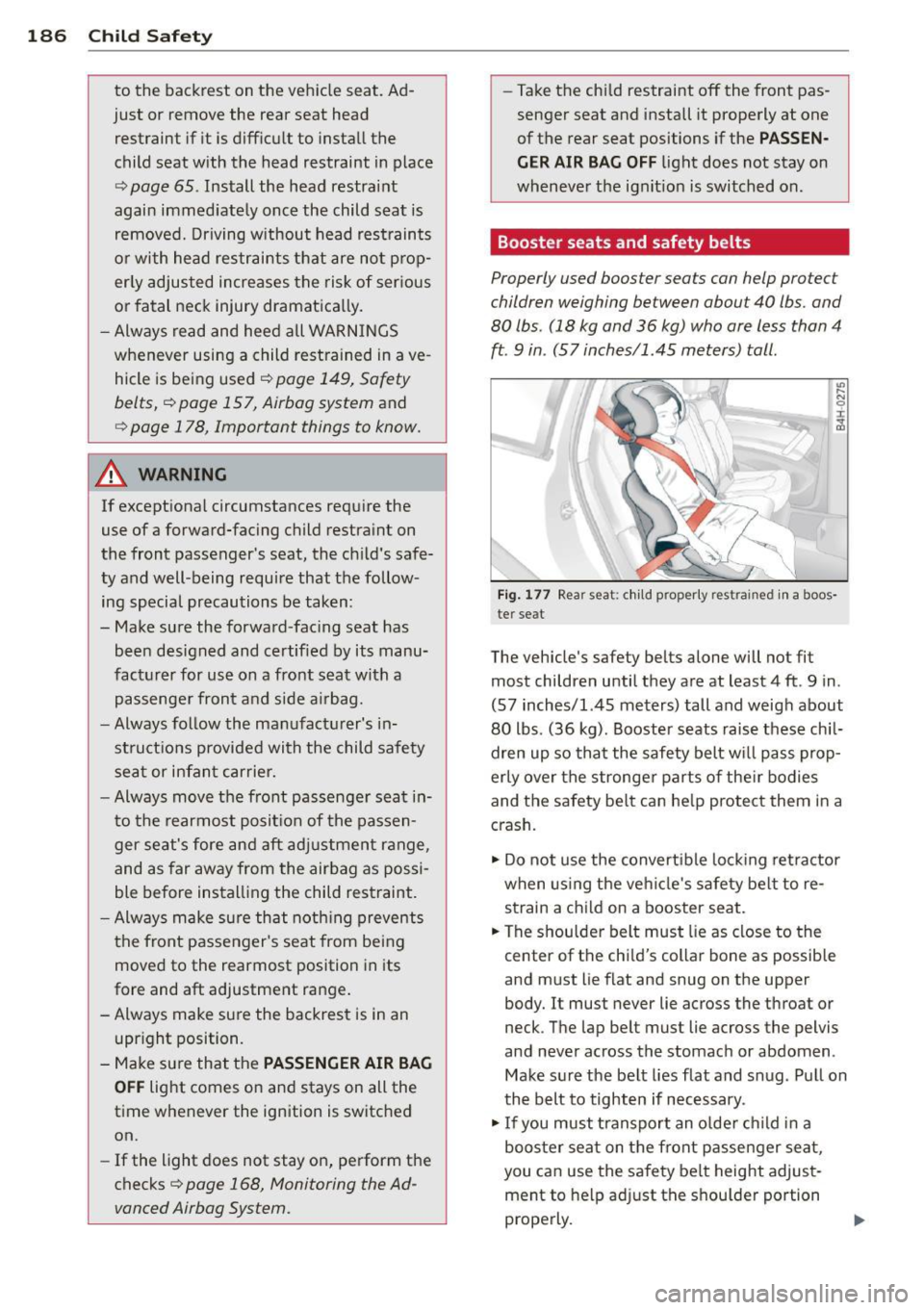
Fig. 177 Rear seat: ch ild properly rest rai ned in a boos
te r seat
The vehicle 's safety belts alone will not fit
most children until they are at least 4 ft . 9 in .
(57 inches/1.45 meters) tall and weigh about
80 lbs. (36 kg). Booster seats raise these chil
dren up so that the safety belt wil l pass prop
erly over the stronger parts of their bodies
and the safety belt can he lp protect them in a
crash.
"' Do not use the convertible locking retractor
when using the vehicle's safety belt to re
strain a child on a booster seat.
"'The shoulder belt must lie as close to the
center of the child's collar bone as possible
and must lie flat and snug on the upper
body. It must never lie across the throat or
neck . The lap belt must lie across the pelvis
and never across the stomach or abdomen .
Make sure the belt lies flat and snug . Pull on
the belt to tighten if necessary .
"'If you must transport an older child in a
booster seat on the front passenger seat,
you can use the safety belt height adjust
ment to help adjust the shoulder portion
properly.
Page 189 of 316

~ Secure unused safety belts on the rear seat
¢page 183.
Children up to at least 8 years old (over 40
lbs. or 18 kg) are best protected in child safe
ty seats designed for their age and weight. Ex perts say that the skeletal structure, particu
larly the pelvis, of these children is not fully
developed, and they must not use the vehicle
safety belts without a suitable child restraint .
It is usually best to put these children in ap
propriate booster seats. Be sure the booster
seat meets all applicable safety standards .
Booster seats raise the seating position of the
child and reposition both the lap and shoulder
parts of the safety belt so that they pass
across the child 's body in the right places. The
routing of the belt over the child's body is very
important for the child's protection, whether
or not a booster seat is used . Children age 12
and under must always ride in the rear seat.
Children who are at least 4
ft . 9 in. (57 in
ches/1.45 meters) tall can generally use the
vehicle's three point lap and shoulder belts .
Never use the lap belt portion of the vehicle's
safety belt alone to restrain any child, regard
less of how big the child is. Always remember
that children do not have the pronounced pel
vic structure required for the proper function
of lap belt portion of the vehicle's three point
lap and shoulder belts. The child's safety ab
solutely requires that a lap belt portion of the
safety belt be fastened snugly and as low as
possible around the pelvis. Never let the lap
belt portion of the safety belt pass over the
child's stomach or abdomen.
In a crash, airbags must inflate within a blink
of an eye and with considerable force. In order
to do its job, the airbag needs room to inflate
so that it will be there to protect the occupant
as the occupant moves forward into the air bag.
A vehicle occupant who is out of position and
too close to the airbag gets in the way of an inflating airbag. When an occupant is too
close, he or she will be struck violently and
Child Safety 187
will receive serious or possibly even fatal in
jury.
In order for the airbag to offer protection, it is
important that all vehicle occupants, especial
ly any children, who must be in the front seat
because of exceptional circumstances, be
properly restrained and as far away from the
airbag as possible . By keeping room between
the child's body and the front of the passen
ger compartment, the airbag can inflate com
pletely and provide supplemental protection
in certain frontal collisions .
_&. WARNING
Not using a booster seat, using the boos
ter seat improperly, incorrectly installing a booster seat or using the vehicle safety
belt improperly increases the risk of seri
ous personal injury and death in a collision
or other emergency situation. To help re
duce the risk of serious personal injury
and/or death:
- The shoulder belt must lie as close to the
center of the child's collar bone as possi
ble and must lie flat and snug on the up
per body . It must never lie across the
throat or neck . The lap belt must lie
across the pelvis and never across the
stomach or abdomen. Make sure the belt lies flat and snug. Pull on the belt to
tighten if necessary.
- Failure to properly route safety belts
over a child's body will cause severe inju
ries in an accident or other emergency
situation
¢page 149.
- The rear side of the child safety seat
should be positioned as close as possible
to the backrest on the vehicle seat. Ad
just or remove the rear seat head re straint if it is difficult to install the child
seat with the head restraint in place
¢ page 65. Install the head restraint
again immediately once the child seat is
removed . Driving without head restraints
or with head restraints that are not prop
erly adjusted increases the risk of serious
-
or fatal neck injury dramatically. ~
•
•
Page 194 of 316

192 Child Safety
-Always follow the instructions provided
by the manufacturer of the child re
straint you intend to install in your vehi
cle.
- Never install a child restraint without a
properly attached top tether strap if the
child restraint manufacturer's instruc
tions require the top tether strap to be
used.
- Improper use of child restraint LATCH
lower anchorage points can lead to injury
in a collision. The LATCH lower anchorage
points are designed to withstand only
those loads imposed by correctly fitted
child restraints.
- Never mount two child restraint systems
on one LATCH lower anchorage point.
- Never secure or attach any luggage or
other item to the LATCH lower anchorag
es .
(j) Tips
-In Canada, the terms "top tether" with
"lowe r universal anchorages" (or "lower
universal anchorage bars") are used to
describe the system.
- In other countries, the term "ISOFIX" is
used to describe the lower anchorages.
Location
Fig. 178 Schematic overview: LATCH a nch orage point
locations
The illustration shows the seating locations in
your vehicle which are equipped with the low
er anchorages system.
Description
The lower anchorage positions are marked
for quick locating.
Fig. 179 Lower anchorages, covers marked
Fig. 180 Rear seats: lower anc horage bracket locations
Lower anchorages
The lower anchorage attachment points are
located between the rear seatback and rear
seat cushion.
Remove the covers ¢
fig. 179 to access the
lower anchorage attachment points.
The lower anchorage attachment points are
visible <=>
fig. 180 .
Lower anchorages secure the chi ld restraint in
the seat without using the vehicle's safety
belts. Anchorages provide a secure and easy
to-use attachment and minimize the possibili
ty of improper child restraint installation .
All child restraints manufactured after Sep
tember 1, 2002, must have lower anchorage
attachments for the
LATCH system.
Remember that the lower anchorage points
are only intended for installation and attach
ment of child restraints specifically certified
for use with
LATCH lower anchorages. Child ..,_