2014 AUDI A5 COUPE wheel
[x] Cancel search: wheelPage 115 of 286
the blue area should be o n the curb. The en
tire b lue area must fit into the parking spot.
~ While the vehicle is stationary, t urn the
steering wheel to the right as far as it will go.
~ Back into the park ing spot . Stop the vehicle
as soon a s the blue curve touches the curb
¢ fig . 115.
~ While the vehicle is stationary, tu rn the
steering wheel to the left as far as it w ill go.
~ Continue to back up into the park ing spot
until the vehicle is parked paralle l to the
curb .@ marks the rear bumper . You should
stop dr iving in reverse as soon as and no lat
er than when the red orientation line@
abuts an object¢,& ! Keep an eye on the
front of your vehicle wh ile doing this ¢(D .
Par kin g ne xt to obst acles
When there is an obstacle (such as a wall)
next to the parking spot, choose a spot with
more space on the sides. Position the long
side of the blue area so that there i s sufficien t
space from the curb . The area must not be on
the curb . You w ill also need to start turning
the steeri ng whee l much ear lie r. T he re should
be a suffic ien t amo unt of space between the
curb and the b lue curve, and the blue c urve
¢
fig . 115 mus t not touch the curb .
&_ WARNING
-The rear view came ra does not show the
entire area behind the vehicle
¢ page 109, fig. 110. Watch out espe
c ially for small children and an imals. The
rear view camera cannot a lways detect
them, posing risk of an accident!
- Please note that objects not touch ing the
ground can appear to be further away
than they really are (for example, the bumper of a pa rked vehicle, a t railer
hi tc h, or the rear of a tru ck) . In this case,
yo u should not use the help lines to he lp
with park ing, which poses danger of an
accident!
P ark a ssis t 113
@ Note
In the MMI display, the direction of travel
of the vehicle rear is represented depend
i ng on the steering wheel angle . The vehi
cle front swings out more than the vehicle
rear. Maintain p lenty of d istance from an
obstacle so that your outs ide mirror or a
corner of you r vehicle does not coll ide with
any obstacles - dange r of accident!
(D Tips
The left o r right orie ntation lines and su r
faces will be displayed, depending on the
turn s ignal being used .
Adjusting the display and warning tones
Applies to vehicles: with parking system (rear, with rear
view camera)
The display and warning tones are adjus ted in
the radio or MM!*.
~ Select: !CAR ! function button > Par king sys
tem .
Or
--~ Select: !C AR ! function but ton> Car systems *
contro l butto n > Driver ass ist > Parking aid .
Di splay
- Off -when the parking system is switched
off, only a udible s ignals a re g iv en .
- On -when the parking system is switched
on, the picture from the rear view camera is
disp layed.
Warning tones
- Rear volum e -
rear sensor vo lume
- Rear frequency -rear senso r frequency
- Music volume while parking -when the
park ing system is sw itched on, the volume
of t he active audio sour ce is lowered.
The newly adjusted value is briefly heard from
the sig nal generato r. Th e settings are auto
matically stored and assigned to the remote
control key. ..,.
Page 122 of 286

120 Driving Safel y
• Sit properly in your seat and make sure that
yo ur passengers do the same¢
page 53,
Seats and storage.
• Fasten your safety belt and wear it properly.
Also instruct your passenge rs to fasten their
safety belts properly¢
page 129 .
What impairs driving safety?
Safe driving is directly related to the condi
tion of the vehicle, the driver as well as the
driver's ability to concentrate on the road
without being distracted .
The driver is responsible for the safety of the
vehicle and all of its occupants . If your ability
to drive is impa ired, safety r isks for everybody
in the vehicle increase and you also become a
hazard to everyone else on the road
9 .&,.
Therefore:
• Do not let yourself be distracted by passen
gers or by us ing a cellular telephone.
• NEV ER dr ive when your dr iv in g ability is im
paired (by medicat ions, alcohol, drugs, etc.).
• Observe all traffic laws, rules of the road
and speed limits and plain common sense.
• ALWAYS adjust your speed to road, traffic
and weather conditions .
• Take frequent breaks on long trips. Do not
drive for more than two hours at a stretch.
> Do NOT drive when you are t ired, under
pressure or when you are stressed .
A WARNING
Impaired driving safety increases the risk
of serious personal injury and death when
ever a veh icle is being used.
Proper occupant
seating positions
Proper seating position for the driver
The proper driver seating position is impor
tant for safe, relaxed driving.
Fig. 119 Correc t seat ing posit ion
For your own safety and to reduce the risk of
injury in the event of an accident, we recom
mend that you adjust the driver's seat to the
following position:
• Adjust the driver's seat so that you can easi
ly push the pedals all the way to the floor
while keeping your knee(s) slightly bent
¢.&_ .
• Adjust the angle of the seatback so that it is
in an upr ight position so that your back
comes in full contact with it when you drive.
• Adj ust the steering wheel so that there is a
distance of at least 10 inches (25 cm) be
tween the steering wheel and your breast
bone ¢
fig. 119. If not possible, see your au
thorized Audi dealer about adaptive equip ment.
• Adjust the steering wheel so that the steer
ing wheel and airbag cover points at your
chest and not at your face .
• Grasp the top of the steer ing wheel with
your elbow(s) slightly bent.
• Applies to veh icles w ith adjustab le head re
straints: Adjust the head restraint so the up
per edge is as even as possible with the top
of your head. If that is not possible, try to
adjust the head restraint so that it is as
close to this posit ion as possible.
• Fasten and wear safety belts correctly
¢page 132.
Page 123 of 286

~ Always keep both feet in the footwell so
that you are in control of the vehicle at all
times.
F or de tai led information on how to adjust the
driver's seat, see
c:;, page 54.
A WARNING
Drivers who are unbelted, out of position
or too close to the airbag can be ser iously
injured by an airbag as it unfolds. To help
reduce the risk of serious personal injury :
- Always adjust the dr iver's seat and the
steering wheel so that there are at least 10 inches (25 cm) between your breast
bone and the steering wheel.
- Always hold the steering wheel on the
outside of the steering wheel rim with
your hands at the 9 o'clock and 3 o'clock posit ions to he lp red uce the risk of pe r
sonal in jury if the drive r's airbag inflates.
- Never hold the steer ing whee l at the
12 o 'clock posit ion or w it h your hands at
other pos it ions inside the steering wheel
rim or on the stee ring wheel h ub. Hold
ing the steering wheel the wrong way
can cause serious injuries to the hands,
arms and head i f the driver 's airbag de
ploys.
- Pointing the steering whee l toward your
face decreases the ab ility o f the supp le
menta l dr iver's airbag to protect you in a
co llision .
- Always s it in an upright position and nev
er lean against or place any part of your
body too close to the a rea where the air
bags are located.
- Before driv ing, a lways ad just the front
seats and head restra ints properly and
make s ure that all passengers are prop
er ly restrained.
- Never adjust the seats while the vehicle
is moving . Your seat may move unexpect
edly and you could lose control of the ve
hicle.
- Never drive with the backrest recl ined o r
t il ted far ba ck! T he farther the ba ck rests
are t ilted back, the greate r the ris k of in-
Dr iving S afel y 121
jury due to incorrect pos itioning of the
safety belt and improper seating posi
tion .
- Ch ildren must a lways ride in ch ild safety
seats
c:;, page 161. Special precaut ions
apply when installing a child safety seat
on the front passenger seat
c:;, page 137 .
Proper seating position for the front
passenger
The proper front passenger seating position
is important for safe, relaxed driving .
For your own safety and to reduce the risk of
injury in the event of an accident, we recom
mend that you adjust the seat for the front
passenger to the following position :
~ Move the front passenger seat back as far as
possible . There must be a m inimum of
1 0 inches (25 cm) between the breastbone
and the ins trument panel
c:;, &, .
~ Adjust the a ngle of the seatbac k so that it is
in an upr igh t position and yo ur back comes
in full contact wit h it whenever the vehicle is
moving.
~ Applies to vehicles with adjustab le head re
stra ints: Adjust the head restraint so the up
per edge is as even as possible wit h the top
of your head. If that is not possib le, try to
adjust the head restraint so that it is as
close to this pos it ion as poss ible .
~ Keep both feet flat on the floor in front of
t he fron t passenger seat .
~ Fasten and we ar safe ty be lts cor re ctly
c:;, page 132.
Fo r detailed information on how to adj ust the
fron t passenger's seat, see
c:;, page 53.
A WARNING
-
Front seat passengers w ho are unbelted,
out of posi tion or too close to the airbag
can be ser iously injured or killed by the air
bag as it unfolds. To help reduce the risk of
serious personal injury:
•
•
Page 139 of 286

Airbag system Important things to know
Importance of wearing safety belts and
sitting properly
Airbags are only supplemental restraints. For
airbags to do their job , occupants must al
ways properly wear their safety belts and be
in a proper seating position.
For your safety and the safety of your passen
gers, before driving off, always:
"" Adjust the driver's seat and steering wheel
properly ¢
page 120,
"" Adjust the front passenger's seat properly
¢page 54,
""Wear safety be lts properly ¢ page 132,
"" Always properly use the proper child re-
straint to protect chi ldren
r::::> page 161.
In a collision airbags must inflate within th e
blink of an eye and with considerable force.
The supplemental airbags can cause injuries if
the driver or the front seat passenger is not
seated properly . Th erefore in order to help the
a ir bag to do its job, it is important, both as a
driver and as a passenge r to s it properly at all
times.
By keeping room between your body and the
steer ing whee l and the front of the passenger
compartment, the airbag can inflate fully and
comp lete ly and provide supplemental protec
tion in certain frontal collisions
r::::> page 120,
Proper occupant seating positions.
F or details
on the operation of the seat adjustment con
trols
¢ page 54.
It's especially important that children are
properly restrained
r::::> page 161.
There is a lot that the driver and the passen
gers can and must do to help the individua l
safety features installed in your Aud i work to
gether as a system.
Proper seating pos ition is important so that
the front airbag on the driver side can do its
job. If you have a physical impairment or con-
Airbag system 137
dition that prevents you from sitting properly
on the driver seat with the safety belt properly
fastened and reaching the pedals, spec ial
modifications to yo ur vehicle may be necessa
ry.
Contact your authorized Audi dea ler, or call
Audi Customer Re lations at 1-800-822-2834.
When the airbag system dep loys, a gas gener
ator will fi ll the airbags, break open the pad
ded covers, and inf late between the steering
whee l and the driver and between the instru
ment panel and the front passenger. The air
bags will deflate immediately after deploy
ment so that the front occupants can see
through the windshield aga in without inter
ruption .
All of th is takes place in the blink of an eye, so
fast that many people don't even realize that
the air bags have deployed . The airbags also
inflate with a great deal of force and noth ing
shou ld be in their way when they deploy.
Front airbags in combination with properly
worn safety belts slow down and limit the oc
cupant's forward movement. Together they
help to prevent the driver and front seat pas
senge r from hitting parts of the inside the ve
hicle while reducing the forces acting on the
occupant dur ing the crash. In this way they
help to reduce t he risk of injury to the head
and upper body in the crash . A irbags do not
protect the arms or the lower parts of the
body .
Both front air bags w ill not inflate in all frontal
collisions . The triggering of the airbag system
depends on the vehicle deceleration rate
caused by the collision and registered by the
electron ic control unit. If this rate is below
the reference value programmed into the con
trol unit, the airbags will not be triggered,
ev en though the car may be bad ly damaged as
a resu lt of the co llision . Vehicle damage, re
pair costs or even the lack of ve hicle damage
is no t necessarily an indication of whether an
airbag should inflate o r not .
It is not possib le to define a range of vehicle
speeds that w ill cover every possible kind and ..,.
•
•
Page 140 of 286

138 Airbag sys te m
angle of im pact that will always trig ger the
airbags, since the circumstances wi ll vary con
siderably between one collision and another.
Important factors include, for example, the
nature (hard or s oft) of the object which the
car h its, the angle of impact, vehicle speed,
etc. The front airbags will also not inflate in
side or re ar collisions, or in roll-overs .
Always remember : Airbags will deploy only
once, and only in certa in kinds of collisions .
Your safety belts are always there to offe r pro
tection in those s ituations in which airbags
a re not supposed to deploy , or when they have
a lready deployed; for example , when yo ur ve
h icle strikes or is st ruck by another after the
first collision .
This is just one of the reaso ns why an a irbag is
a supplementary restra int and is not a s ubst i
tute for a safety be lt. The airbag system
works most effective ly when used with the
safety be lts. Therefore, always properly wear
you r safety belts ¢
page 129 .
A WARNING
Sitting too close to the steer ing wheel or
instrument panel will decrease the effec
tiveness of the airbags and will increase
the risk of pe rsonal injury in a collision .
- Never sit closer than 10 inches (25 cm)
to the stee ring wheel or instr ument pan
el.
- If you cannot sit more than 10 inches
(25 cm) from t he steer ing wheel, investi
gate whethe r adaptive equipment may
be available to help you reach the pedals
and incre ase your sea ting dis tance from
the steering wheel.
- If you are unrestr ained, lean ing fo rward,
s itting sideways or out of posi tion in any
way, your risk of injury is much higher.
- Yo u w il l a lso receive serio us in juries and
co uld even be killed if you are up against
the airbag or too close to it when it in
flates -even with an Advanced Airbag.
- To reduce the r is k of i njury when an air
bag inf lates, a lways wear safety belts
properly
c::> page 132, Safety belts .
-Always make certain that ch ild ren age 12
or younger always ride in the rear seat. If
children are not properly restrained, they
may be severe ly injured or killed when an
airbag inflates .
- Never let c hildren ride unrestrained or
improperly restrained in the vehicle . Ad
just the front seats prope rly .
- Never ride with the back rest reclined.
- Always sit as far as possible from the
steer ing whee l or the instrument pane l
¢page 120.
-Always sit upright with your back against
the backrest of your seat.
- Never p lace your feet on the instrument
panel or on the seat. Always keep both
feet on the floor in front of the seat to
he lp prevent serious in ju ries to the legs
and h ips if the airbag inflates .
- Never recline the front passenger 's seat
to transport objects . Items can a lso
move i nto the a rea of the s ide airbag or
the front a irbag d uring br akin g or in a
sudden maneuve r. Obje cts ne ar the air
bags can become projec tiles and cause
inj ury when an airbag inflates.
.&, WARNING
A irbags that have deployed in a crash must
be replaced.
- Use on ly original eq uipment airbags ap
proved by Audi and installed by a trained
technician who has the necessary too ls
and d iagnost ic equipment to properly re
p lace any airbag in your vehicle and as
sure system effectiveness i n a crash .
- Never permit salvaged or recycled air
bags to be installed in your vehicle .
Child restraints on the front seat - some
important things to know
.,. Be s ure to read the importa nt information
and head the WAR NINGS for important de
t ails about children and Advanced A irbags
c::> page 161. ..,.
Page 143 of 286
-Never place additional items on the seat
that can increase the total weight regis
tered by the weight-sensing mat and can
cause injury in a crash.
Front airbags
Description of front airbags
The airbag system can provide supplemental
protection to properly restrained front seat o ccupan ts.
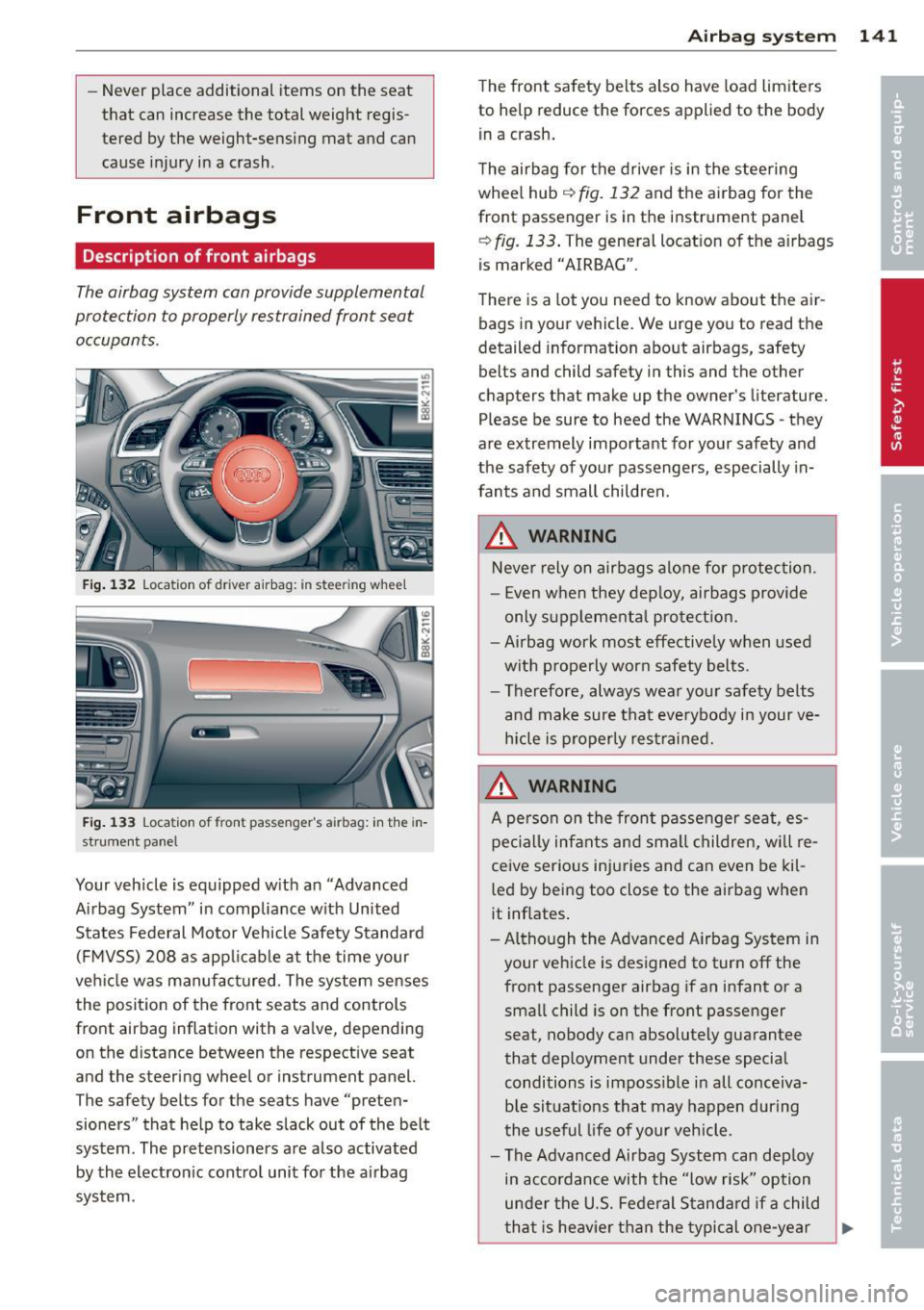
F ig . 13 2 Location of driver airbag: in steer ing whee l
Fig. 133 Location of front passenger's airbag: in the in
st rument panel
Your veh icle is equipped w ith an "Advanced
Ai rbag System" in compliance with United
States Federal Motor Vehicle Safety Standard (F MVSS) 208 as app licab le at the time your
ve hicle w as manufac tured. The system senses
the position of the front seats and controls
front airbag inflation with a va lve, depending
on the distance between the respect ive seat
and the steering wheel or instrument panel.
The safety belts for the seats have "preten
sioners" that he lp to take slack out of the belt
system . The pretensioners are also activated
by the electron ic contro l unit for the airbag
sys tem.
A irba g sy stem 141
The front sa fety belts also have load limiters
to help reduce the forces applied to the body
in a crash .
T he airbag for the drive r is in the stee ring
whee l hub
q fig. 132 and the airbag for the
front passenger is in the instrument panel
~ fig. 133 . The general locat ion of the a irbags
is marked "AIRBAG".
There is a lot you need to know about the ai r
bags in your vehicle . We urge you to read t he
detailed information about airbags, safety
belts and child safety i n this and the other
chapters that make up the owner's literature. Please be sure to heed the WARNINGS -they
are extremely important for your safety and
the safety of yo ur passengers, especially in
fants and small children.
_&. WARNING
N ever rely on airbags alone for protec tion.
- E ven w hen they deploy, airbags provide
only s uppleme nta l pro tect ion .
- Airbag work most effective ly when used
wit h properly wor n safety belts.
- Therefore, always wea r you r safe ty belts
and make sure that eve rybody i n your ve
hicle is p rope rly res trained.
_&. WARNING
A pe rson on the fron t passe nger seat, es
pe cial ly infants and sma ll children, will re
ceive serious injuries and can even be kil l ed by being too close to the airbag when
it inflates .
- Altho ugh the Advanced Airbag System in
your veh icle is designed to tur n off the
front passenge r airbag if an infant or a
small child is on the front passenger
seat, nobody can absolutely guarantee
that deployment under these specia l
conditions is imposs ible i n all conceiva
b le sit uat ions that may happen during
t he u seful life of your vehicle.
- The Advanced Airbag System can dep loy
in acco rdance with t he "low risk" option
un der the U.S. Fede ral Standa rd if a child
that is he avie r than the typical one-year
-
..
Page 144 of 286

142 Airbag system
old child is on the front passenger seat
and the other conditions for airbag de
ployment are met .
- Accident statistics have shown that chil
dren are generally safer in the rear seat
area than in the front seating position.
- For their own safety, all children, espe cially 12 years and younger, should al
ways ride in the back properly restrained
for their age and size.
Advanced front airbag system
Your vehicle is equipped with a front Advanced
Airbag System in compliance with United
States Federal Motor Vehicle Safety Standard
208 as applicable at the time your vehicle was
manufactured.
The front Advanced Airbag System supple ments the safety belts to provide additional
protection for the driver's and front passeng
er's heads and upper bodies in frontal crashes .
The airbags inflate only in frontal impacts
when the vehicle deceleration is high enough.
The front Advanced Airbag System for the
front seat occupants is not a substitute for
your safety belts. Rather, it is part of the over
all occupant restraint system in your vehicle.
Always remember that the airbag system can
only help to protect you , if you are sitting up
right, wearing your safety belt and wearing it
properly . This is why you and your passengers
must always be properly restrained, not just
because the law requires you to be.
The Advanced Airbag System in your vehicle has been certified to meet the "low risk" re
quirements for 3 and 6 year-old children on
the passenger side and very small adults on
the driver side . The low risk deployment crite
ria are intended to help reduce the risk of in
jury through interaction with the front airbag
that can occur, for example , by being too
close to the steering wheel and instrument panel when the airbag inflates.
In addition, the system has been certified to
comply with the "suppression" requirements of the Safety Standard
, to turn
off the front
airbag for infants 12 months old and younger
who are restrained on the front passenger
seat in child restraints that are listed in the
Standard ¢
page 163, Child restraints and
Advanced Airbags .
"Suppression" requires the front airbag on the
passenger side to be turned
off if:
- a child up to about one year of age is re
strained on the front passenger seat in one
of the rear-facing or forward-facing infant restraints listed in Federal Motor Vehicle
Safety Standard 208 with which the Ad
vanced Airbag System in your vehicle was
certified . For a listing of the child restraints
that were used to certify your vehicle's com pliance with the US Safety Standard
¢page 163,
-weight less than a threshold level stored in
the control unit is detected on the front pas
senger seat.
When a person is detected on the front pas
senger seat, weighing more than the total
weight of a child that is about 1 year old re
strained in one of the rear-facing or forward
facing infant restraints (listed in Federal Mo
tor Vehicle Safety Standard 208 with which
the Advanced Airbag System in your vehicle
was certified), the front airbag on the passen ger side may or may not deploy.
The
PASSENGER AIR BAG OFF light comes on
when the electronic control unit detects a to
tal weight on the front passenger seat that re
quires the front airbag to be turned
off. If the
PASSENGER AIR BAG OFF light does not
come on, the front airbag on the passenger
side has not been turned
off by the control
unit and can deploy if the control unit senses
an impact that meets the conditions stored in
its memory.
If the total weight on the front passenger
seat is more than that of a typical 1 year-old ,
but less than the weight of a small adult, the
front airbag on the passenger side may deploy
(the
PASSENGER AIR BAG OFF light does not
come on).
ll-
Page 146 of 286
144 Airbag sys tem
-Always move the passenger seat into its
rearmost position in the seat's fore and
aft adjustment range, as far away from
the a irbag as poss ible, before insta lling
the forward-facing child restraint. The backrest must be adjusted to an upr ight
posit io n.
- Make sure that the
PASSENGER AIR BAG
OFF
light comes on and stays on all the
t ime w henever the ignition is switched
on.
Advanced Airbag System components
The fron t passenger sea t in your vehicle h as a
lot of very important par ts of the Advanced
Airbag System in it. These parts include t he
weight -sensing mat, sensors, wiring, brack
ets, and more. The function of the system in
the front passenger seat is checked by the
e lectronic control u nit when the ignit ion is on.
The control unit mo nitors the Advanced Air
bag System and turns the airbag indicator
l ight on when a ma lfunction in t he system
components is detected. The func tion of the
a ir bag ind icator light is described in greater
detai l be low . Because the front passenger
seat contains important parts of the Ad
vanced A irbag System, you m ust take care to
prevent it from be ing damaged. Damage to
the seat may prevent the Advanced Airbag for
the front passenger seat from doing its job in
a crash .
The front Advanced Airb ag Sy stem
consists of the following:
- Crash sensors in the front of the veh icle that
measure veh icle acceleration/deceleration
to provide information to the Advanced Air
bag System abou t the seve rity of the crash.
- An electron ic co ntrol unit, with integ rated
crash sensors for front and side impacts .
T he cont ro l unit "dec ides " w het her to fire
the front airbags based on the information
received from the crash senso rs . The contro l
unit a lso "decides" whethe r the safety be lt
pretensioners should be activated . -
An Advanced A irbag w ith gas generator and
cont ro l valve for the d river inside the steer
ing wheel h ub.
- An Advanced A irbag with gas ge nerator and
contro l valve inside the instrument pane l for
the front passenger.
- A weight-sensing mat under the up ho lstery
pad ding of the front passenger seat cushion
that measures the total weight on the seat.
The informat ion registered is sent continu
ously to the electronic contro l unit to regu
late deployment of the front Advanced Air bag on the passenger side .
- An airbag monitor ing system and i ndicator
light in the i nstr ument cluster ~
page 147 .
-A sensor in each front seat registers the dis
tance between the respective seat a nd the
steer ing whee l o r i ns trument panel. The i n
formation registered is sent cont inuo usly to
t he ele ctr onic cont ro l uni t to regula te de
p loyment o f the front Advance d Airbags .
- The
PASSENGER AIR BAG OFF ligh t comes
on and st ays on in the cen ter o f the instr u
ment panel~
page 148, fig . 135 and tells
you whe n the front Advanced Airbag on the
passenger side has been tu rned off .
- A sensor below the safety be lt latch for the
front seat passenger to measure the tension on the safety be lt . The tension on the safety
be lt and the weight registered by the
weight-sensing mat he lp the control unit
"decide" whether the front airbag for the
front passenger seat should be turned off or
not
~ pag e 138, Child restraints on the
front seat -some important things to
know.
- A senso r in the safety belt latch fo r th e d riv
er and fo r the front sea t passenger tha t
senses w het he r th at safety bel t is latched or
not and transmi ts this information to the
electronic control unit.
A WARNING
Damage to the front passenger seat can
p revent the front airbag from work ing
properly.
-