2014 AUDI A5 CABRIOLET height
[x] Cancel search: heightPage 62 of 286

60 Seats and stor age
Seats and storage
General recommen
dations
Why is your seat adjustment so
important?
The safety belts and the airbag system can
only provide maximum protection if the front
seats are correctly adjusted.
There are various ways of adjusting the front
seats to provide safe and comfortable support
for the driver and the front passenger. Adjust
you r seat prope rly so that :
- you can easily and quickly reach all the
switches and controls in the instrument
panel
-your body is properly supported thus reduc
ing physical stress and fatigue
- the safety be lts and airbag system can offer
maximum protection ¢
page 140.
In the following sections, you will see exactly
how you can best adjust your seats .
There are special regulations and instructions
for installing a child safety seat on the front
passenger's seat. Always follow the informa
tion regarding child safety provided in
¢ page 161, Child Safety.
WARNING
Refer to¢ page 121, Driving Safely for
important information, tips, suggestions
and warnings that you should read and fol
low for your own safety and the safety of
your passengers.
A WARNING
, -
Incorrect seating position of the driver and
all other passengers can result in serious
personal injury .
- Always keep your feet on the floor when
the vehicle is in motion -never put your
feet on top of the instrument panel, out of the w indow or on top of the seat cush
ion. This applies especially to the passen- gers
. If your seating position is incorrect,
you increase the risk of injury in the case
of sudden braking or an accident. If the
airbag inflates and the seating position is incorrect, this could result in personal
injury or even death.
- It is important for both the driver and front passenger to keep a distance of at
least 10 inches (25 cm) between them
selves and the steering wheel and/or in
strument panel.
If you're sitting any
closer than this, the airbag system can
not protect you properly. In addition, the
front seats and head restraints must be
adjusted to your body height so that they
can give you maximum protection.
- Always try to keep as much distance as
possible between yourself and the steer
ing wheel or instrument panel.
- Do not adjust the driver's or front pas
senger 's seat while the vehicle is moving.
Your seat may move unexpectedly, caus
ing sudden loss of veh icle control and
personal injury. If you adjust your seat
while the veh icle is moving, you are out
of posit ion.
Driver's seat
The correct seat position is important for safe
and relaxed driving .
We recommend that you adjust the driver's
seat in the following manner :
.. Adjust the seat in fore and aft direction so
that you can easily push the pedals to the
floor wh ile keeping your knees slightly bent
o &. in Why is your seat adjustment so im
portant? on page 60 .
.,. Adjust the seatback so that when you sit
w ith your back against the seatback , you can
still grasp the top of the steering wheel.
.. Applies to vehicles with adjustable head re
straints: Adjust the head restraint so the up
per edge is as even as possible with the top
of your head. If that is not possible, try to
adjust the head restraint so that it is as .,.
Page 64 of 286

62 Seats and storage
Power easy entry function
Applies to vehicles: with power adjustable seats
The easy entry function makes it easier for
the rear passengers to enter and leave the ve
hicle.
Fig. 68 Comfort seat s•: easy entry contro ls
Fi g. 69 Spor t sea ts•: easy e ntry co ntrols
• To fold the front seat backrests forward/
back,
lift the latch @¢ fig. 68 or¢ fig. 69
and fold the backrest forward.
• To move the front seats forward/back, press
and hold the @ button until the seat has
reached the desired position.
When the front seats are moved forward,
their origina l position is stored . When it is
moved back, the seat automatically stops in
this position. To move the seat even further
back, you have to release the switch @ and re
activate it .
Applies to vehicles w ith adjustab le head re
straints : The head restraints from the front
seats, depending on the seat height that has
been set, are automat ically retracted when
the seatbacks are folded down . They return to
the ir original position again when the seat
backs for the front seats are raised .
(D Tips
With the driver's or passenger's door
closed, the corresponding switch to move
the seat is inoperat ive.
Seat adjustments in MMI
Appl ies to vehicles: with seat memory and MMI
The passenger 's seat can be adjusted to vari
ous positions by the driver.
Convenience side view
• Select: !CAR I function button > Seat adjust
ment > Passenger's seat > Convenience side
view.
O r
- -• Select: I CAR I function button > Car systems*
control button > Vehicle settings > Seats >
Passenger's seat > Convenience side view.
• Continue to press the control knob until the
adjustment process is complete.
Seat symmetry
• Select: Function button !CAR !> Seat adjust
ment > Passenger's seat > Seat symmetry.
Or
• Select: !CARI function button> Car systems*
control button > Vehicle settings > Seats >
Passenger's seat> Align with driver's seat.
• Continue to press the control knob until the
adjustment process is comp lete.
U sing the
Convenience side view function, the
passenger's seat is adjusted so that the driver
has the best possible view to the right. Whe n
the Convenience side view is set, the specific
position of the driver's seat is taken into con
sideration .
Using the
Seat symmetry function, the pas
senger's seat can be moved to the same posi
tion as the driver's seat. The settings for the
driver's seat are imported and set automati
ca lly.
Page 65 of 286

Center armrest
The center armrest can be adjusted to several
levels .
Fig. 70 Arm rest between t he driver 's/front passenger's
seats .
Adjusting the center armrest
.. To adjust the angle, raise the armrest from
the starting position
r=:> fig. 70 detent by de
tent .
.. To bring the armrest back into the starting
pos ition, raise it out of the top detent and
fold it back down .
The armrest can slide forward and back .
Head restraints
Front head restraints
Applies to vehicles: with ad justable head restraints
Head restraints that are adjusted according
to body size, along with the seat belt, offer
effective protection.
F ig . 71 Fro nt seat: adjusting the man ual head re
st raint s
Seats and storage 63
Fig. 72 Front seat: adjusting the power head restraint
Adjust the head restraint so the upper edge is
as even as possible with the top of your head .
If that is not possib le, t ry to adjust the head
restraint so that it is as close to this position
as possible
r=:> page 63 .
.,. To adjust the height of the manual head re
straint*, grip the head restraint on the sides
with both hands and slide it up/down until it
locks into pla cer=:>
fig. 71 .
.. To adjust the height of the power head re
straint *, press the button up/down
<=:> fig. 72.
Refer tor=:> page 124, Proper adjustment of
head restraints
for guidelines on how to ad
j ust the height of the front head restraints to
suit the occupant 's body size.
A WARNING
-Driving without head restraints or with
head restraints that are not properly ad
justed increases the risk of serious or fa
tal neck injury dramatica lly.
- Read and heed all WARNINGS
<=:> page 124, Proper adjustment of head
restraints .
@ Tips
-To prevent the head restraints from run
ning into the headliner, they retract au
tomatically when moving the seat for
ward or upward .
- Correctly adjusted head restraints and
safety belts are an extremely effective
combination of safety featu res.
Page 123 of 286

Driving Safely
General notes
Safe driving habits
Please remember -safety first!
This chapter contains important information,
tips, instructions and warnings that you need
to read and observe for your own safety, the
safety of your passengers and others . We have
summarized here what you need to know
about safety belts, airbags, child restraints as
well as child safety. Your safety is for us
priori
ty number 1.
Always observe the information
and warnings in this section - for your own
safety as well as that of your passengers.
The information in this section applies to all
model versions of your vehicle . Some of the
features described in this sections may be
standard equipment on some models, or may
be optional equipment on others. If you are
not sure, ask your authorized Audi dealer.
A WARNING
- Always make sure that you follow the in
structions and heed the WARNINGS in
this Manual. It is in your interest and in
the interest of your passengers.
- Always keep the complete Owner's Liter
ature in your Audi when you lend or sell
your vehicle so that this important infor
mation will always be available to the
driver and passengers.
- Always keep the Owner's literature handy
so that you can find it easily if you have
questions.
Safety equipment
The safety features are part of the occupant
restraint system and work together to help
reduce the risk of injury in a wide variety of
accident situations .
Your safety and the safety of your passengers
should not be left to chance. Advances in
technology have made a variety of features
available to help reduce the risk of injury in an
Driving Safely 121
accident. The following is a list of just a few of
the safety features in your Audi :
- sophisticated safety belts for driver and all
passenger seating positions,
- belt force limiters for the front seats,
- belt pretensioners for the seats,
- head restraints for each seating position,
- front airbags,
- side airbags in the front seats,
- special LATCH anchorages for child re-
straints,
- adjustable steering column.
These individual safety features, can work to
gether as a system to help protect you and
your passengers in a wide range of accidents.
These features cannot work as a system if
they are not always correctly adjusted and cor
rectly used.
Safety is everybody's responsibility!
Important things to do before driving
Safety is everybody's job! Vehide and occv
pant safety always depends on the informed
and careful driver.
For your safety and the safety of your passen
gers,
before driving always:
"'Make sure that all lights and signals are op
erating correctly .
"'Make sure that the tire pressure is correct.
"'Make sure that all windows are clean and af
ford good visibility to the outside.
"'Secure all luggage and other items carefully
c::>page 65.
"'Make sure that nothing can interfere with
the pedals.
"'Adjust front seat, head restraint and mirrors
correctly for your height .
"' Instruct passengers to adjust the head re
straints according to their height .
"'Make sure to use the right child restraint
correctly to protect children
c::, page 161,
Child Safety.
"'Sit properly in your seat and make sure that
your passengers do the same
c::, page 60,
Seats and storage.
ll>
•
•
Page 139 of 286

belt itself when it moves from the stron
ger parts of the body into critical areas
like the abdomen.
- Always lock the convertible locking re
tractor when you are securing a child safety seat in the vehicle ¢
page 173.
Safety belt position
Correct belt position is the key to getting
maximum protection from safety belts .
Fig. 147 Safety belt pos it io n
"' ,-. 0 ±
just the position of the safety belt to match your body size .
- height -adjustable front seats.
A WARNING
Improperly positioned safety belts can
cause serious personal injury in an acci
dent .
- The shoulder belt should lie as close to
the center of the collar bone as possible
and should fit well on the body. Hold the
belt above the latch tongue and pull it
evenly across the chest so that it sits as
low as possible on the pelvis and there is
no pressure on the abdomen. The belt
should always fit snugly
¢ fig. 147. Pull
on the belt to tighten if necessary.
- The lap belt portion of the safety belt
must be positioned as Low as possible
across pelvis and never over the abdo
men. Make sure the belt lies flat and
snug
¢ fig . 147 . Pull on the belt to tight
en if necessary.
Safety belts 13 7
-A loose-fitting safety belt can cause seri
ous injuries by shifting its position on
your body from the strong bones to more
vulnerable, soft tissue and cause serious injury.
- Always read and heed all WARNINGS and
other important information
¢page 135.
Pregnant women must also be correctly
restrained
The best way to protect the fetus is to make
sure that expectant mothers always wear
safety belts correctly -throughout the preg
nancy.
Fig. 148 Safety bel t position during pregnancy
To provide maximum protect ion, safety belts
must always be positioned correctly on the
wearer's body¢
page 13 7.
.,. Adjust the front seat and head restraint cor
rectly
¢ page 60, Seats and storage.
.,. Make sure the seatback of the rear seat
bench is in an upright position and securely
latched in place before using the belt .
.,. Hold the belt by the tongue and pull it even
ly across the chest and pelvis~
fig. 148,
¢ _& .
.,. Insert the tongue into the correct buckle of
your seat until you hear it latch securely
¢page 136, fig. 146 .
.,. Pull on the belt to make sure that it is se
curely latched in the buckle.
Page 157 of 286
example, increase the force levels measured by the sensors and make the airbag system
deploy in crashes in which it would not deploy if the changes had not been made. Other
kinds of changes may reduce the force levels
measured by the sensors and prevent the air
bag from deploying when it should.
The sensors in the safety belt buckle for the
driver and front passenger seat tell the elec
tronic control module if the safety belt is
latched or not. If the safety belt is being used,
the front airbag will deploy at a slightly high
er rate of vehicle deceleration than if the safe
ty belt is not being used. Therefore, in a par
ticular collision, it is possible that an airbag
will not deploy at a seating position where the
safety belt is being used but will inflate at the position where the safety belt is not being
used.
It is important that nothing interfere
with the safety belt buckles so that the sen
sors can send the correct information about
safety belt use to the electronic control unit .
& WARNING
Changing the vehicle's suspension includ
ing use of unapproved tire-rim combina
tions can change Advanced Airbag per
formance and increase the risk of serious personal injury in a crash.
- Never install suspens ion components
that do not have the same performance characteristics as the components origi
nally installed on your vehicle.
- Never use tire-rim combinations that
have not been approved by Audi.
A WARNING 1= -
Items stored between the safety belt
buckle and the center console can cause
the sensors in the buckle to send the
wrong information to the electronic con
trol module and prevent the Advanced Air
bag System from working properly.
- Always make sure that nothing can inter-
fere with the safety belt buckles and that
they are not obstructed.
Airbag system 155
Knee airbags
Description of knee airbags
Applies to vehicles: with knee airbags
The knee airbag system can provide supple
mental protection to properly restrained
front seat occupants .
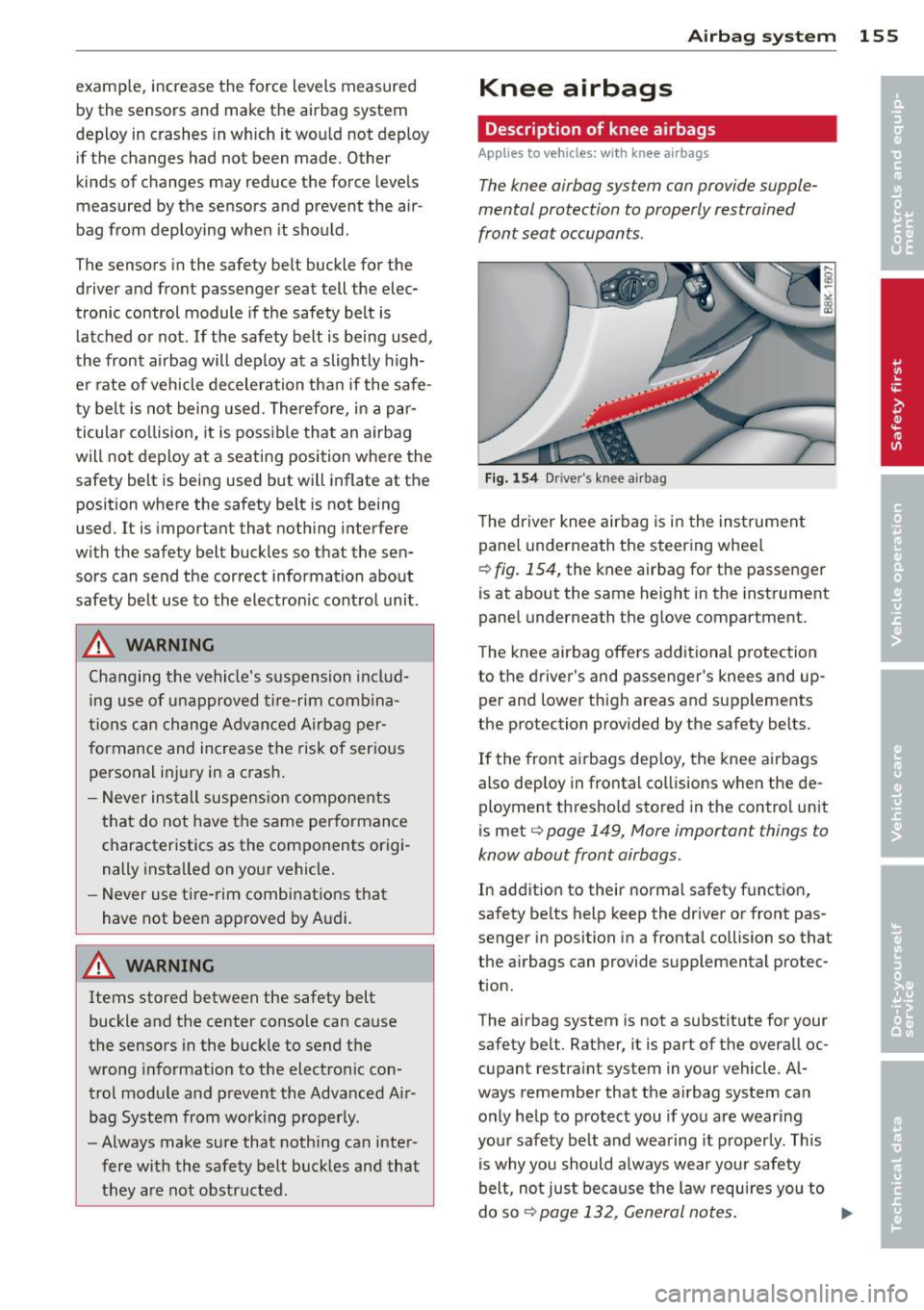
Fig. 154 Driver 's knee airbag
The dr iver knee airbag is in the instrument
panel underneath the steering wheel
¢ fig. 154, the knee airbag for the passenger
is at about the same height in the instrument
panel underneath the glove compartment.
The knee airbag offers additional protection
to the driver's and passenger's knees and up
per and lower thigh areas and supplements
the protection provided by the safety belts.
If the front airbags deploy, the knee airbags
also dep loy in frontal collisions when the de
ployment threshold stored in the control unit
is met
¢ page 149, More impor tant things to
know abou t front airbags .
In addition to their normal safety function,
safety belts help keep the driver or front pas
senger in position in a frontal collision so that
the airbags can provide supplemental pro tec
tion.
The airbag system is not a substitute for your
safety belt . Rather, it is part of the overall oc
cupant restraint system in your vehicle. Al
ways remember that the airbag system can
only help to protect you if you are wearing
your safety be lt and wearing it properly. This
is why you should always wear your safety
belt, not just because the law requires you to
do so
¢ page 132, General notes. ..,_
Page 225 of 286

-Never mount used tires on yo ur vehicle if
yo u are not sure of their "previous histo
ry." Old used tires may have been dam
aged even though the damage cannot be
seen that can lead to sudden tire failure
and loss of vehicle control.
- If you notice unusual vibration or if the
vehicle pulls to one side when d riving, al
ways stop as soon as it is safe to do so
and check the wheels and tires for dam
age .
(D Note
-Please note that summer and winter
tires are designed for the cond itions that
are typ ic al in those seasons. Aud i recom
mends using w inter t ires du ring the win-
Glossary of tire and loading terminology
Accessory weight
means the comb ined weight (in excess of
those standard items which may be replaced)
of automatic tra nsmission, power steering,
power brakes, power windows, power seats,
radio, and heater, to the extent that these
items are availab le as factory-installed equip
ment (whether installed or not) .
Aspect ratio
means the ratio of the height to the width of
the tire in percent . Numbers of 55 or lower in
d icate a low sidewall for improved steering re
sponse and better overall handling on dry
pavement .
Bead
means the pa rt of the ti re that is made of
steel wires, wrapped or reinforced by ply cords
and that is shaped to fit the rim.
Bead s eparation
means a b reakdown of the bond between
components in the bead.
Cord
means the strands forming the plies in the
tire.
Tire s an d wheel s 223
ter months . Low temperatu res signifi
cantly decrease the elastic ity of summer
t ires, which affects traction and braking
ability. If summer tires are used in very
co ld temperatures, cracks can form on
the tread bars, res ulting in permanent
ti re damage that can cause loud drivi ng
noise and unbalanced tires. Aud i is not
responsib le for this type of damage.
- Burn ished, polished or chromed rims
must not be used in winter weather. Th e
surfa ce of the rims does not have suffi
c ien t cor rosion pro te cti on for this and
c o ul d be pe rmanen tly damaged by road
salt or similar substances. This damage
is not covered by warranty.
Cold tir e inflation pressure
me ans the t ire press ure re commended by the
vehicle manufacturer fo r a tire o f a des igna ted
size that has not bee n driven for more than a
couple of miles (k ilomete rs) at low speeds in
the three hour pe riod before the tire p ress ure
is measured or adjusted.
Curb weight
means the weight o f a motor vehicle with
standard equipment including the maximum
capacity of fuel, o il, and coolant, air cond i
tion ing and additional weight of optiona l
equipment.
E xtra load tire
means a tire design to operate at higher loads
and at higher inflation pressures than the cor
responding standard tire. Extra load tires may
be identified as "XL", "xl", "EXTRA LOAD", or
"RF" on the sidewall.
Gross Axle Weight Rating ("GAWR")
means the load-carrying capacity of a single
axle system, measured at the tire-ground in-
ter~ces .
~
•
•
Page 235 of 286

Incorrect wheel alignment
Incorrect wheel alignment can cause exces
sive tire wear, impairing the safety of the vehi
cle. If tires show excessive wear, have the
wheel alignment checked by an authorized
Audi dealer or qualified workshop .
All wheel drive
Vehicles with quattro must always have tires
of the same size, construction and tread type.
For details see~
page 184 .
.8_ WARNING
Sudden tire failure can lead to loss of con
trol, a crash and serious personal injury!
- Never drive a vehicle when the tread on
any tire is worn down to the wear indica
tors.
- Worn tires are a safety hazard, they do
not grip well on wet roads and increase
your risk of "hydroplaning" and toss of
control.
- Always keep chemicals that can cause
tire damage, such as grease, oil, gasoline
and brake fluid away from tires.
- Tires age even if they are not being used
and can fail suddenly, especially at high
speeds. Tires that are more than 6 years
old can only be used in an emergency
and then with special care and at lower
speeds .
- Never mount used tires on your vehicle if
you are not sure of their "previous histo
ry." Old used tires may have been dam
aged even though the damage cannot be
seen that can lead to sudden tire failure
and loss of vehicle control.
Tires and wheels 233
New tires and replacing tires and wheels
New tires and wheels have to be broken in .
Fig. 186 Tir e specificat ion codes on t he s idewall o f a
tire
No. Description
@ Passenger car tire (where applicable)
@ Nominal width of tire in millimeters
@ Ratio of height to width (aspect ratio)
© Radial
® Rim diameter code
® Load index and speed rating
0 U.S. DOT tire identification number
® Audi Original tire
® Sever snow conditions
@ Tire ply composition and materials
used
@ Maximum load rating
@ Treadwear, traction and temperature
grades
@ Maximum permissible inflation pres-
sure
The tires and rims are essential parts of the
vehicle's design . The tires and rims approved
by Audi are specialty matched to the charac
teristics of the vehicle and can make a major .,.