2014 AUDI A5 CABRIOLET ABS
[x] Cancel search: ABSPage 196 of 286

194 Trailer towing
Trailer towing tips
Important to know
Your vehicle hand les different ly w hen tow ing
a tr ailer because of the addit ional weight and
different weight distribution . Safety, perform
ance and economy wi ll greatly depend on how
carefully you load your trailer and operate
your rig.
Before you actually tow your trailer, practice
turning, stopp ing and backing up in an area
away from traffic. Keep practicing until you have become comp letely familiar with the way
your veh icle-trailer combination behaves and
responds.
Backing up is difficult and requires practice.
Backing up with a trai ler genera lly requires
steering action opposite to that when backing
up your veh icle without a trailer.
Maintain a greater distance between your ve
hicle and the one in front of you . You will need
more room to stop. To compensate for the
trailer, you will need a larger than normal
turning radius .
When passing, remember that you cannot ac
celerate as fast as you normally would be
cause of the added load. Make sure you have
enough room to pass . After passing, allow
plenty of room for your tra iler before chang
in g lanes again.
Avoid jerky starts, sharp turns or rapid lane
changes.
{Dl Tips
- Do not tow a tra iler dur ing the break-in
period of your vehicle.
- If you tow a trailer, your A udi may re
quire more frequent maintenance due to
the extra load
q page 264.
Parking on a slope
Do not park on a slope with a trailer . If it can
not be avoided, do so only after doing the fol lowing :
When parking:
.. App ly the foot brake.
.. Have someone place chocks under both the
veh icle and the trailer wheels .
.,. With chocks in place, slowly release the
brakes until the wheel chocks absorb the
load.
.. Turn the whee ls towards the curb.
.. App ly the parking brake.
.. Move the selector lever to P.
When restarting after parking:
.. App ly the foot brake .
.. Start the engine.
.. Move the selector lever to D/S .
.. Release the parking brake and s lowly pull
out and away from the wheel chocks .
.. Stop and have someone retrieve the wheel
chocks .
(D Tips
If you move the selector lever of the auto
matic transmission to P before applying
the parking brake and before blocking the
whee ls, you may have to use more force
later to move the lever out of the P posi
tion.
Page 200 of 286

198 Vehicle care and cleaning
Component Situation Solution
T ex tile s,
Stains adhering to Vacuum cleaner
Vin yl, the surface
Alcan ta ra Water -based stains Absorbent cloth and mild soap solutiona>
such as coffee, tea,
blood, etc.
O il-based stains Apply a mild soap solutiona>, blot away the d issolved oil
such as oil, make- or dye, treat afte rward w ith water, if necessary
up, etc.
Special stains such Special stain remover, b lot with absorbent material,
as ballpoint pen, treat afterward with mild soap solutiona>, if necessary
na il polish, latex
pa int, shoe po lish,
etc.
Natu ral leather Fresh stains Cotton cloth with a mild soap solutiona>
Wate r-based stains Fresh s tains: absorbent cloth
such as coffee, tea, Dr ied stains: sta in remover sui table for leather
blood, etc.
Oi l-based stains Fresh stains: absorbent cloth and sta in remover suitable
such as oil, make- for leather
up, etc. dried stains: Oil cleaning spray
Special stains such Stain remover suitable for leather
as ballpo int pen,
na il polish, latex
pa int, shoe polish,
etc.
Care Regular
ly apply condit ion ing c ream that protec ts from
light a nd penetrates into the materia l. Use specially-col-
ored conditioning cream, if necessary.
Carbon part s Dirty Clean tlhe same way as plastic parts
a) Mi ld soap solut ion : maximum two tablespoons neut ra l soap in a lite r of wate r
& WARNING
The windshie ld may not be treated with
water -repe lling windshield coating agents .
Unfavorab le conditions such as wetness,
darkness, or low sun can result in in
creased glare. W iper blade chatter is a lso
possible .
(V Note
-Headlights /tail lights
- Never clean headlights or tail lights
w it h a dry cloth or sponge. -
Do not us e any cleaning product that
contains alcohol, because they could
cause cracks to form.
-Wheels
- Never use any paint polish or other
abrasive mater ials.
- Damage to the protective layer on the
rims such as stone chips or scratc hes
must be repa ired immediately.
- Sensor s/camera lenses
- Never use warm or hot water to re-
move snow or ice from the camera
le ns. Th is could cause th e lens to crack . ""
Page 218 of 286

216 Checking and filling
Brake fluid
Checking brake fluid level
The brake fluid level can be checked with a
quick glance .
N N ~ N
" (X) (0
Fig. 179 Engine compartme nt: Cover on the brake flu ·
id reservo ir
Before you check anything in the engine com
partment,
always read and heed all WARN·
INGS ¢ .&._ in Working in the engine compart
ment on page 206 .
.. Read the brake fluid level from the brake
fluid reservoir ¢
fig. 179 , ¢ page 208,
fig. 175.
The brake fluid level must be be ·
tween the "MIN" and
"MAX" markings.
The brake fluid reservoir is located at the rear
partition of the engine compartment on the
left side ¢
page 208 .
The fluid level may drop slightly after some
time due to the automatic adjustment of the
brake pads . This is not cause for alarm.
If the brake fluid level falls
considerably be
low the "MIN" mark, the brake warning/indi
cator light (U.S. models: ., Canadian mod
els: .) will come on¢
page 15. Do not con
tinue to operate the vehicle . The complete
brake system should be thoroughly checked
by an authorized Audi dealer or qualified
workshop and the cause corrected.
If the
brake fluid level is too low, the brake warning/
indicator light will illuminate. Contact an au
thorized Audi dealer
immediately .
@ Tips
The brake fluid reservoir is located under
neath the cover.
Changing brake fluid
Have the brake fluid changed by an experi
enced technician .
Brake fluid absorbs moisture from the air. If
t he water content in the brake fluid is too
high, corrosion in the brake system may result
after a period of time . The boiling point of the
brake fluid will also decrease considerably and
decrease braking performance.
Therefore, the brake fluid must be changed
every two years . Always use new brake fluid
which conforms to Federal Motor Vehicle
Standard "FMVSS 116 DOT 4".
The brake fluid reservoir can be difficult to reach, therefore, we recommend that you
have the brake fluid changed by your author
ized
Audi dealer. Your dealer has the correct
tools, the right brake fluid and the know-how
to do this for you .
A WARNING
- Brake fluid is poisonous. It must be stor
ed only in the closed original container
out of the reach of children!
- Brake failure can result from old or inap
propriate brake fluid. Observe these pre
cautions:
- Use only brake fluid that meets SAE
specification
J 1703 and conforms to
Federal Motor Vehicle Standard 116.
Always check with your authorized Audi
dealer to make sure you are using the
correct brake fluid. The correct type of
brake fluid is also indicated on the
brake fluid reservoir.
- The brake fluid must be new. Heavy use
of the brakes can cause a vapor lock if
the brake fluid is left in the system too
long . This can seriously affect the effi
ciency of the brakes as well as your
safety. This could result in an accident.
(D Note
Brake fluid will damage the paint of your
vehicle.
Page 219 of 286

@ For the sake of the environment
Because of the pr oblem of proper d isposa l
of brake flu id as we ll as the special tools
requ ired and the necessary expert ise, we
recommend that you have the brake fluid
changed by your author ized Audi dealer .
Battery
General information
Under normal operating conditions, the bat
tery in your Audi does not need any mainte
nance. With
high outside temperatures or
long daily dr ives we recommend that you have
the electro lyte level checked by an authorized
Aud i dealer or qualified workshop . The elec
trolyte leve l should also be checked each time
the battery is charged ¢
page 219.
Have the battery checked when you take your
ve hicle in for service . Yo u are well adv ised to
replace a battery that is older than 5 yea rs .
W ith certa in types of a irbag deployment, t he
b attery is d isconnected from the vehicle elec
tr ica l system for safety reasons¢.&.
in Re
pair, care and disposal of the airbags on
page 1 53.
Disconnecting the battery terminals
Some vehicle functions (power w indow regu
lators , for example) are lost if the battery ter
m inals a re d isconnected. These func tions have
to be re lea rned after the batte ry term inals a re
connected agai n. T o prevent this , the bat tery
should only be d isconnec ted from the vehicle
e lec tric al system when absolu tely necessa ry
for repairs .
Vehicles not driven for long periods
If you do not drive you r vehicle over a period
of severa l days or weeks, elec trical compo
nen ts are gr adually cut b ack o r swi tched off .
This redu ces energy cons umption and main
tains starting capab ility over a longer per io d
¢ page 185.
Some o f the conven ience f unctions m ay not
ope rate, su ch as the in ter ior lig hts or t he
Checkin g and fillin g 217
power seat adjus tment. The convenience
funct io ns w ill be available again when yo u
turn o n the ign ition and start the engine.
Winter operation
D ur ing the w inte r mon ths, bat tery capa city
tends to dec rease as tempera tures drop . This
is beca use more power is a lso consumed wh ile
starting, and the headlights, rear window de
fogge r, etc., are used more often.
Avoid unnecessary powe r consumpt ion, pa r
ticular ly in city traffic or when traveling only
sho rt distances. Let yo ur autho rized A udi
dealer check the capacity of the vehicle bat
tery before w inter sets in
¢ page 219. A well
charged battery will no t on ly prevent star tin g
problems w hen the weather is cold, but w ill
also last longer .
@ Tips
If your vehicle is left standing for seve ral
weeks at extremely low temperatures, the
vehicle battery s hou ld be removed and
stored where it will not freeze . This will
p revent it from be ing damaged and having
to be repla ced .
Working on the battery
Be especially careful when working on or near
the bat tery.
The battery is located in the luggage compar t
ment under the floor . B efo re you che ck any
thi ng in the luggage compartment,
read and
heed all WARNINGS
¢ ,&. .
Always heed the safety warnings , when work
i ng on the veh icle batte ry or t he vehicle e lec
t rical sys tem to p reven t inju ry.
The following WARNINGS are very
important when working on the battery:
Always heed the following WARNING SYM· BO LS and safety precautions when working
on the battery .
®
Always wear eye protection.
•
•
Page 243 of 286

When the malfunction indicator is illuminat
ed, the system may not be able to detect or
signal low tire pressure as intended. TPMS
malfunctions may occur for a variety of rea
sons, including the installation of replace
ment or alternate tires or whee ls on the veh i
cle that prevent the TPMS from funct io ni ng
p roperly . Always check the T PMS malfunct ion
tellta le afte r replacing one o r more t ires or
wheels on your veh icle to ensure that the re
p lacemen t or a lternate tires and wheels allow
the TPMS to continue to function properly .
Tire pressure indicator appears
Applies to vehicles: with tire pressure monitoring system
The tire pressure indicator in the instrument
cluster informs you if the tire pressure is too
low or if there is a system malfunction.
Fig. 187 Display: underinflatio n warning
Using the ABS sensors, the tire pressure moni
toring system compares the t ire tread circum
ference and vibration characteristics of the in
d iv idual tires . If the pressure decreases in one
or mo re tires, th is is indica ted in the instru
ment clus ter with a
RE wa rning symbol and a
message¢
fig. 187 . The driver message in the
disp lay goes out after 5 seconds . The driver
message can be displayed again by pressing
the
! SET ! button. If only one tire is affected,
the display will indicate its pos ition.
The ti re pressu re monitoring system must be
reset via radio or MMI* each time the pres
sures are adjusted (e.g . when switching be
tween partia l and full load pressure) or after
changing or replacing a t ire on your vehicle
¢
page 242 . The TPMS indicator only moni
tors the tire pressure that you have prev iously
Tire s an d wheel s 241
stored . You can find the recommended t ire
pressures for yo ur vehicle on the label on driv
er's side 8-pillar ¢
page 226.
T ire tread circum ference and vibration charac
teristics can change and cause a tire pressure
warning if:
- t he t ire p ress ure in one or more tires is too
low,
- t he t ire has s tructural damage,
- the t ire pressure was changed, wheels rotat-
ed or replaced but the TPMS was not reset
¢ page 242.
Warning symbo ls
RE Loss of pressure in at least one tire c> & .
Check the tire or tires and replace or repa ir if
necessary. The
RE ind icator light in the instru
ment cluster a lso illuminates
c::!;> page 13.
Check/correct the press ures of all fou r tires
and reset TPMS via radio or MMI*.
Ill (T ir e Pre ssure Monitor ing System) Tire
press ure: Syst em malfun ction!.
If II! appears after switching the ignition on
o r while dr iv ing and the
RE i ndicator light in
the instr ume nt cluster blinks for app rox i
mately o ne minute and t hen stays o n, there is
a system malf unct ion.
Attempt to store the co rrect tire pressure
¢ page 242 . If the ind icator light does not
tu rn off o r if it turns on sho rtly the reafter, im
med iate ly dr ive your vehicle to a n author ized
Audi dealer or au thorized repair faci lity to
have the malfunc tion corrected .
A WARNING
-=
-If the tire pressure indicator appears in
the instrument cluster display, one or
more of your t ires is significant ly under
inflated. Reduce your speed immediately
and avoid any hard steer ing or b raking
maneuvers. Stop as soon as possib le and
check the tires and their pressures. In
flate the tire p ressure to the prope r pres
sure as indica ted on the vehicle's tire
pressu re labe l
¢page 226. Driving on a
significantly under-inflated tire causes
•
•
Page 244 of 286

24 2 T ire s and wheel s
the tire to overheat and can lead to tire
failure. Under-inflation also is likely to
impair the vehicle's handling and stop
ping ability .
- The driver is responsible for ma inta ining
the correct tire pressures. You must
check the t ire pressures regularly .
- Under certain cond itions (such as a spor
ty driving style, winter condit ions or un
paved roads), the pressure monitor ind i
cator may be de layed .
-Ask your author ized Audi dealer if run
flat tires may be used on your veh icle.
Your vehicle registrat ion becomes invalid
if you use these tires when not permit
ted. Damage to your veh icle or acc idents
cou ld also resu lt.
@ Tips
- The tire pressure monitoring system
stops working when there is an ESC/ABS
malfunction.
- Using snow chains may resul t in a system
malfunction.
- The tire pressure monitoring system on
you r Audi was developed using t ires with
the "AO" or "RO" identification on the
tire sidewall¢
page 233 . We recom
mend using these t ires .
Reset tire pressure monitoring system
Applies to vehicles: with tire pressure monitoring system
If the tire pressure is adjusted, wheels are ro
tated or changed, the TPMS must be reset via
radio or MMI*.
11> Before resett ing the TPMS, the cu rrent pres
sures of all fou r tires m ust correspond to
the specified val ues . Adjust the tire pressure
and reset the pressure i n the tire press ure
monitoring system according to the load
you are carry ing
¢ page 226.
11> Turn on the ignition .
11> Select : the ICAR I function button > Tire pre s
sure monitoring
> Stor e now . Or
i,. Se lect : the ICA RI function button > Ca r sys
tem s*
control button > Servicing & check s >
Tire pre ssure m onito ring > St or e tire pre s
s ure s.
@ Tips
Do not store the tire pressure if there are
snow chains on the tire .
Page 253 of 286
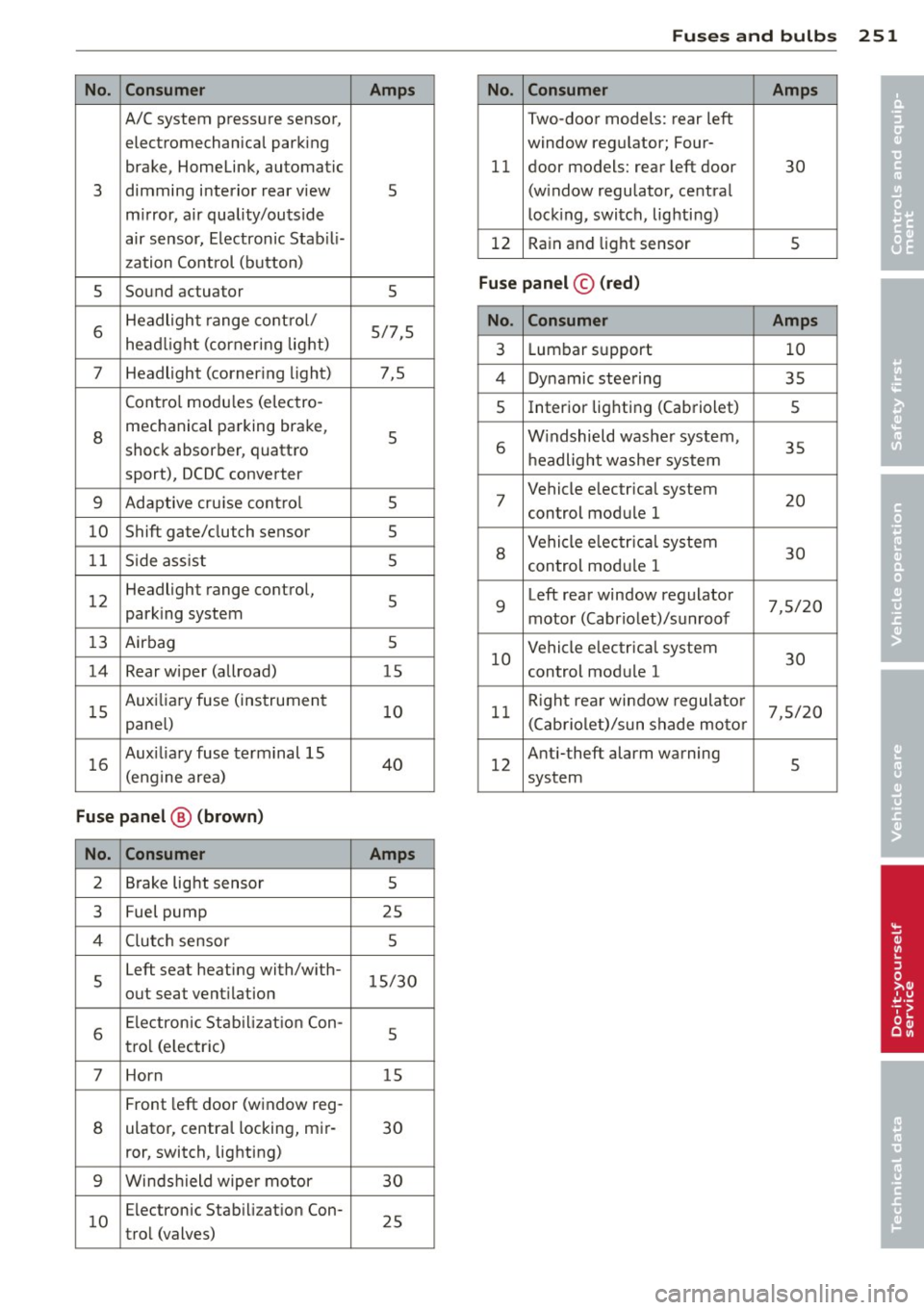
Fuses and bulb s 251
No. Con sumer Amps No. Consumer Amps
•
A/C system pressure sensor, Two-door models: rear left
• electromechanical parking window regulator; Four-
brake, Homelink, automatic 11 door models:
rear left door
30
3 dimming interior rear view
5 (window regulator, central
m irror, air quality/outside locking, switch, lighting)
air sensor, Electronic Stab ili-
12 Rain and light sensor
5
zation Control (button)
5 Sound
actuator
5
Fuse panel© (r e d )
6 Headlight
range cont rol/
5/7,5
head light (cornering light)
No. Consumer Amps
3 Lumbar support 10
7 Headlight (corner
ing light) 7,5
4 Dynamic steering 35
Contro l modu les (e lectro-
s Inter ior lighting (Cabriolet)
5
8 mechanical parking brake,
5
shock absorber, quattro
sport), DCDC converter
9 Adaptive cru ise contro l 5 6
W
indshield washer system,
35
h eadlight washe r system
7 Vehicle electrical
system
20
control module 1
10 Shift gate/clutch
sensor
5
1 1 Side ass ist 5
8
Vehicle electr ica l system
30
control module 1
1 2 Headlight range
control,
5
park ing system 9 Left rear window regulator
7,5/20
motor (Cabriolet)/sunroof
13 Airbag 5
14 Rear wiper (allroad) 15 10 Vehicle e
lectrical system
30
control module 1
1 5 Auxi
liary fuse (instrument
10
pane l) 11 R
ight rea r window regulato r
7,5/20
(Cabriolet)/sun shade motor
16 Aux
iliary fuse terminal 15
40
(engine area) 12 Anti-theft
alarm warning
5
system
Fuse p anel @ (brown )
No. Con sumer Amps
2 Brake light sensor 5
3 Fuel
pump
25
4 Clutc h sensor 5
5 Left
seat heating with/w ith-
15/30
out seat vent ilation
6 Electronic Stab
il iz at ion Con-
5
tro l (e lectric)
7 Horn 15
Front left door (window reg-
8 ulator, centra
l locking, mir-
30
ror, switch, lighting)
9 Winds hield wipe r motor 30
1 0 Electronic
Stabilizat ion Con-
25
trol (valves)
Page 282 of 286

28 0 Index
Trip odometer . . . . . . . . . . . . . . . . . . . . . . . 12
Trunk
refer to Luggage compa rtme nt .. . 67, 127
Trunk escape handle .......... .. .... .. 38
Trunk lid
refer to Rear lid .. ..... ... .. .. .... .. 37
Turn signa ls .. .......... ........ ... .. 52
Warn ing/ indicato r lights ... .. .. .... .. 23
u
Unfasten ing safety belts 138
Unid irect iona l tires .................. 222
Uniform tire quali ty g rading . .. .. .. .. . 236
Unlock ing
Rear lid .............. ........ ... .. 37
Unlocking/ locking
at the lock cylinder ............ .... .. 36
by remote control . . . . . . . . . . . . . . . . . . 34
with the central locking switch .. .... .. 35
with the convenience key ............. 35
Upper cabin heating . . . . . . . . . . . . . . . . . . 72
Use of jumper cab les 256
V
Valet parking .... .... ...... .. .. .. .. .. 40
Vanity mirrors . . . . . . . . . . . . . . . . . . . . . . . 56
Vehicle care/cleaning .. .. ..... ... .. .. .... . 19 5
Vehicle electrical system ......... ..... 17
Vehicle identificat ion labe l ... .. .. .. .. . 26 1
Vehicle Identification N umber (VIN) . ... 26 1
Vehicle jack ....................... . 247
Vehicle key .
. ... .. ..... ... .. .. .... .. 32
Vehicle literature
Vehicle shut-down
Vehicle too l ki t
Vent ilation
Viny l
C leaning
w
5
189
243
69
198
War ning/indicato r lights . . . . . . . . . . 1 0, 13
A irbag system . ..... ... .. .. .. .... .. 20
Anti-lock braking system (ABS) .. .... .. 19
Brake system ............ .. .. .. .. .. 15 El
ectromechanical pa rking brake ... .. . 16
E lectronic power contro l . . . . . . . . . . . . . 20
E lectronic Stabilizat ion Contro l (ESC) . .. 18
Generator . . . . . . . . . . . . . . . . . . . . . . . . . 17
Malfunction Indicator Lamp (MIL) .... . 20
Safety be lt ... ... ................ .. 16
Safety systems . . . . . . . . . . . . . . . . . . . . . 20
Turn signals . .. ............ ........ 23
Warranty coverages 264
Washer reservo ir ................... 220
Wear indicator .. ............ ....... 232
Weights . ... .... .. .. ... ..... ... .. .. 261
W ha t happe ns if you wear your safety belt
too loose? .. .... .. ... .......... .... 13 7
What happens to unbelted occupants? .. 133
What impairs driving safety? . ... .. .. .. 122
What shou ld I do after changing a
whee l? . .. .. .. .. .. .. ........... .. .. 22 9
What shou ld I do after replac ing whee ls? 229
Wheel bolts Torque . ... .... .. .. ... ..... ... .. .. 239
Whee ls .... .... .. ............. .... 222
Checking t ire press ure ........ .. .. .. 22 8
Cleaning . ... .. .. ... .. ..... ... .. .. 196
Co ld tire inflation pressure . ... .. .. .. 2 26
Genera l notes .... ... .. ..... ... .. .. 222
G lossary of tire and loading terminolo -
gy ....... .. .. .. .. ............... 223
New tires and wheels ............. .. 233
Tires and veh icle load limits . .. ...... 230
When must a safety be lt be replaced? . . 135
When must t he a irbag system be inspect-
ed? ............................... 150
When should I adjust the tire pressures? 229
When should I check the tire p ress ures? . 229
Where can I find the t ire p ressures fo r my
ca r? .............................. 228
Why safety belts? . . . . . . . . . . . . . . 132, 133
Wind deflector .... .. ... ..... ... .. .. . 45
Cleaning 197
Windows Cleaning/ removing ice ........ ...... 19 7
defros ting . .. .. .. ... .......... .... . 71
Windsh ield
Cleaning . . . . . . . . . . . . . . . . . . . . . . . . . . 56
defrosting . .. .. .. ............. .. ... 71