2014.5 Citroen C4 tow
[x] Cancel search: towPage 129 of 494

127
Operating fault
If an automatic rain sensitive wiper malfunction occurs, the wipers will operate in intermittent
m
ode.
Contact
a CITROËN dealer or a qualified
w
orkshop.
Windscreen and headlamp
wash
Low screenwash / headlamp
wash fluid level
On vehicle fitted with headlamp washers, the low level of this fluid is indicated by gauge in
t
he reservoir filler neck under the bonnet.
Checking
and topping up this fluid can should
b
e done with the engine off.
The
level of this fluid should be checked
r
egularly,
par
ticularly
d
uring
w
inter.
Refer
to "Checks - Screenwash / headlamp
w
ash level" section for the procedure on
c
hecking the level.
F
P
ull
the
windscreen
wiper
stalk
towards
y
ou.
The
windscreen
wash
then
the
w
indscreen
wipers
operate
for
a
fixed
p
eriod.
The
headlamp
washers
only
operate
when
the
dipped or main beam headlamps are on, with
the vehicle moving .
Do
not
cover
the
rain
sensor,
linked
with
t
he
sunshine
sensor
and
located
in
the
c
entre
of
the
windscreen
behind
the
rear
v
iew
mirror.
Switch
off
the
automatic
rain
sensitive
w
ipers
when
using
an
automatic
car
wash.
In
winter,
it
is
advisable
to
wait
until
the
w
indscreen
is
completely
clear
of
ice
b
efore
activating
the
automatic
rain
sen
sitive
w
ipers. To
reduce
the
consumption
of
the
fluid
b
y
the
headlamp
washers,
they
operate
o
nly with every seventh use of the
screenwash
or
every
25
miles
(40
km)
d
uring
a
given
journey.
6
Visibility
Page 142 of 494
140
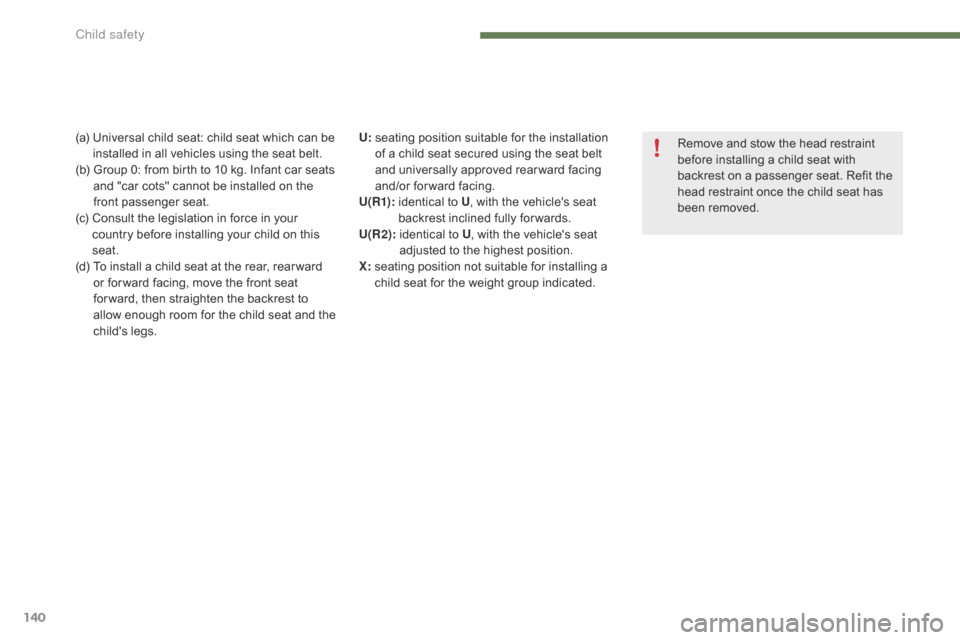
(a) Universal child seat: child seat which can be i
nstalled in all vehicles using the seat belt.
(b)
G
roup 0: from birth to 10 kg. Infant car seats
a
nd "car cots" cannot be installed on the
f
ront
p
assenger
sea
t.
(c)
C
onsult the legislation in force in your
c
ountry before installing your child on this
sea
t.
(d)
T
o install a child seat at the rear, rear ward
o
r for ward facing, move the front seat
f
or ward, then straighten the backrest to
a
llow enough room for the child seat and the
c
hild's legs. U:
s eating position suitable for the installation o
f a child seat secured using the seat belt
a
nd universally approved rear ward facing
a
nd/or for ward facing.
U(R1) :
i
dentical to U,
with the vehicle's seat
b
ackrest inclined fully for wards.
U(R2) :
i
dentical to U,
with the vehicle's seat
a
djusted to the highest position.
X:
s
eating position not suitable for installing a
c
hild seat for the weight group indicated.Remove
and stow the head restraint
b
efore installing a child seat with
b
ackrest on a passenger seat. Refit the
h
ead restraint once the child seat has
b
een removed.
Child safety
Page 143 of 494

141
"ISOFIX" mountings
There are three rings for each seat:
-
t
wo rings A,
located between the vehicle
s
eat back and cushion, indicated by a
m
arking, This
ISOFIX mounting system provides fast,
r
eliable and safe fitting of the child seat in
y
our vehicle.
The ISOFIX child seats
are fitted with
t
wo latches which are secured on the
t
wo rings A.
Some
seats also have an upper strap,
which
is attached to ring B.
Your
vehicle has been approved in accordance with the latest
IS
oFI
X regulation
.
The seats, represented below, are fitted with regulation ISOFIX mountings:
To secure the child seat to the TOP TETHER
:
-
r
emove and stow the head restraint before
i
nstalling the child seat on the seat (refit it
o
nce the child seat has been removed),
-
r
aise the carpet cover on the TOP
T
ETHER,
-
p
ass the upper strap of the child seat
b
ehind the seat backrest, between the a
pertures for the head restraint rods,
- f ix the hook of the upper strap to the ring B,
-
t
ighten the upper strap.
-
a
ring B,
behind the seat and identified by
a
marking, referred to as the TOP TETHER
for
fixing the upper strap.
The
incorrect installation of a child seat
i
n a vehicle compromises the child's
p
rotection in the event of an accident.
Follow
strictly the fitting instructions
p
rovided by with the child seat.
When
fitting an ISOFIX child seat to
t
he left hand rear seat, before fitting the
s
eat, first move the centre rear seat belt
t
owards the middle of the vehicle, so
a
s to avoid the seat inter fering with the
o
peration of the seat belt.
For
information on the possibilities for
i
nstalling ISOFIX child seats in your
v
ehicle, refer to the summary table.
7
Child safety
Page 146 of 494

144
* Infant car seats and "car cots" cannot be installed on the front passenger seat.
* * The ISOFIX infant car seat, secured on the lower rings of a vehicle ISOFIX seat, occupies two rear seats.
Locations for ISOFIX child seatsIn accordance with European Regulations, this table indicates the options for installing ISOFIX child seats on seats in the vehicle fitted with ISOFIX mountings.
In
the case of universal and semi-universal ISOFIX child seats, the ISOFIX size category, determined by a letter from A to G ,
is indicated on the child seat
n
ext to the ISOFIX logo.
I UF:
s
eat suitable for the installation of an I sofix
Universal seat, " For ward
facing" secured using the
u
pper strap.
IL- SU: seat suitable for the installation of an I sofix
Semi- Universal
sea
t
ei
ther:
-
r
ear ward facing fitted with an upper strap or a support leg,
-
f
or ward facing fitted with a support leg,
-
a
n infant car seat fitted with an upper strap or a support leg.
For
advice on securing of the upper strap, refer to the "ISOFIX mountings" section.Weight of the child
/indicative
age
Less than 10
kg
(group 0)
Up
to approx.
6
monthsLess than 10 kg
(group 0)
Less than 13 kg (group 0+)
Up
to approx. 1 yearFrom 9 to 18 kg (group 1)
From
approx. 1 to 3 years
Type of ISOFIX child seat Infant car seat*rearward facing rearward facing forward facing
ISOFIX size categor y F G C D E C D A B B1
ISOFIX child seats universal and
semi-universal which can be installed
on the rear outer seats IL- SU
** IL- SU IL- SU IUF
IL- SU
Remove
and stow the head restraint
b
efore installing a child seat with a
b
ackrest on a passenger seat. Refit the
h
ead restraint once the child seat has
b
een removed.
Child safety
Page 149 of 494

147
Direction indicators
F Left: lower the lighting stalk passing the p
oint of resistance.
F
R
ight: raise the lighting stalk passing the
p
oint of resistance.
Hazard warning lam ps
A visual warning by means of the direction i
ndicators to alert other road users to a vehicle
b
reakdown, towing or accident.
F
P
ress this button, the direction indicators
f
lash.
They
can operate with the ignition off.
Automatic operation of
hazard warning lamps
When braking in an emergency, depending on the deceleration, the hazard warning lamps
c
ome on automatically.
They
switch off automatically the first time you
a
ccelerate.
F
Y
ou can also switch them off by pressing
t
he button.
Horn
Three flashes of the direction indicators
F Press briefly upwards or downwards, w
ithout going beyond the point of
r
esistance; the direction indicators will
f
lash 3 times. Audible
warning system to alert other road
u
sers to an imminent danger.
F
P
ress the central part of the multifunction
s
teering
w
heel.
Use the horn moderately and only in
s
ituations allowed by the motoring
r
egulations in the country you are
d
riving in.
If you forget to cancel the direction
i
ndicators for more than twenty
s
econds, the volume of the audible
s
ignal will increase if the speed is above
4
0 mph (60 km/h).
8
Safety
Page 156 of 494

154
The driver must ensure that passengers use the seat belts correctly and that they are all
r
estrained securely before setting off.
Wherever
you are seated in the vehicle,
a
lways fasten your seat belt, even for short
journeys.
Do
not interchange the seat belt buckles as
t
hey will not fulfil their role fully.
The
seat belts are fitted with an inertia reel
p
ermitting automatic adjustment of the length
o
f the strap to your size. The seat belt is
s
towed automatically when not in use.
Before
and after use, ensure that the seat belt
i
s reeled in correctly.
The
lower part of the strap must be positioned
a
s low as possible on the pelvis.
The
upper part must be positioned in the
h
ollow of the shoulder.
The
inertia reels are fitted with an automatic
l
ocking device which comes into operation in
t
he event of a collision, emergency braking
o
r if the vehicle rolls over. You can release
t
he device by pulling the strap firmly and then
r
eleasing it so that it reels in slightly.In
order to be effective, a seat belt must:
- b e tightened as close to the body as
p
ossible,
-
b
e pulled in front of you with a smooth
m
ovement, checking that it does not
t
wist,
-
b
e used to restrain only one person,
-
n
ot bear any trace of cuts or fraying,
-
n
ot be converted or modified to avoid
a
ffecting
it
s
p
erformance.
In
accordance with current safety
r
egulations, for all repairs on your vehicle's
s
eat belts, go to a qualified workshop with
t
he skills and equipment needed, which a
C
ITROËN dealer is able to provide.
Have
your seat belts checked regularly by
a
CITROËN dealer or a qualified workshop,
p
articularly if the straps show signs of
d
amage.
Clean the seat belt straps with soapy
water
or a textile cleaning product, sold by
C
ITROËN dealers.
After
folding or moving a seat or rear bench
s
eat, ensure that the seat belt is positioned
a
nd reeled in correctly.Recommendations for children
Use a suitable child seat if the passenger is less than 12 years old or shorter than one
a
nd a half metres.
Never
use the same seat belt to secure more
t
han one person.
Never
allow a child to travel on your lap.
For
more information, refer to the "Child
sea
ts"
se
ction.
In the event of an impact
Depending on the nature and seriousness
of the impact ,
the pretensioning device may
b
e deployed before and independently of the
a
irbags. Deployment of the pretensioners
i
s accompanied by a slight discharge of
h
armless smoke and a noise, due to the
a
ctivation of the pyrotechnic cartridge
i
ncorporated in the system.
In
all cases, the airbag warning lamp
comes
on.
Following
an impact, have the seat belts
s
ystem checked, and if necessary replaced,
b
y a CITROËN dealer or a qualified
w
orkshop.
Safety
Page 157 of 494

155
Airbags
System designed to contribute towards improving the safety of the occupants (with
t
he exception of the rear centre passenger)
i
n the event of violent collisions. The airbags
s
upplement the action of the force-limiting
s
eat belts (with the exception of the centre rear
p
assenger).
If
a collision occurs, the electronic detectors
r
ecord and analyse the front and side impacts
s
ustained in the impact detection zones:
-
i
n the case of a serious impact, the airbags
a
re deployed instantly and contribute
t
owards better protection of the occupants
o
f the vehicle (with the exception of the
r
ear centre passenger); immediately after
t
he impact, the airbags deflate rapidly so
t
hat they do not hinder visibility or the exit
o
f the occupants,
-
i
n the case of a minor or rear impact or in
c
ertain roll-over conditions, the airbags
m
ay not be deployed; the seat belt
a
lone contributes towards ensuring your
p
rotection in these situations.
Impact detection zones
A. Front impact zone.
B. S ide impact zone.
The airbags do not operate when
the
ignition is switched off.
This
equipment
will
only
deploy
once.
I
f
a
second
impact
occurs
(during
the
s
ame
or
a
subsequent
accident),
the
a
irbag
will
not
be
deployed
again.
Deployment of one or more of the
a
irbags is accompanied by a slight
e
mission of smoke and a noise, due
t
o the activation of the pyrotechnic
cartridge
incorporated in the system.
This
smoke is not harmful, but sensitive
i
ndividuals may experience slight
ir
ritation.
The
noise of detonation related to the
d
eployment of one or more airbags may
r
esult in a slight loss of hearing for a
s
hort time.
8
Safety
Page 159 of 494

157
Lateral airbags
Deployment
A lateral airbag is deployed unilaterally in the event of a serious side impact applied to all or p
art of the side impact zone B,
p
erpendicular
t
o the longitudinal centreline of the vehicle on a
h
orizontal plane and directed from the outside
t
owards the inside of the vehicle.
The
lateral airbag inflates between the hip and
s
houlder of the front occupant of the vehicle
a
nd the corresponding door trim panel.
Impact detection zones
A. Front impact zone.
B. S ide impact zone.
Curtain airbags
System which contributes towards improving the protection of the driver and passengers
(
with the exception of the rear centre
p
assenger) in the event of a serious side
i
mpact in order to limit the risk of injury to the
s
ide of the head.
Each
curtain airbag is built into the pillars and
t
he upper passenger compartment area.
Deployment
The curtain airbag is deployed at the same time as the corresponding lateral airbag in the
e
vent of a serious side impact applied to all or
p
art of the side impact zone B, perpendicular
t
o the longitudinal centreline of the vehicle on a
h
orizontal plane and directed from the outside
t
owards the inside of the vehicle.
The
curtain airbag inflates between the front or
r
ear occupant of the vehicle and the windows.
System
which
protects
the
driver
and
front
p
assenger
in
the
event
of
a
serious
side
impact
i
n
order
to
limit
the
risk
of
injury
to
the
chest,
b
etween
the
hip
and
the
shoulder.
Each
lateral
airbag
is
fitted
in
the
seat
backrest
f
rame,
door
side.
8
Safety