2013 YAMAHA YZ125LC engine
[x] Cancel search: enginePage 36 of 168
2-12
TIGHTENING TORQUES
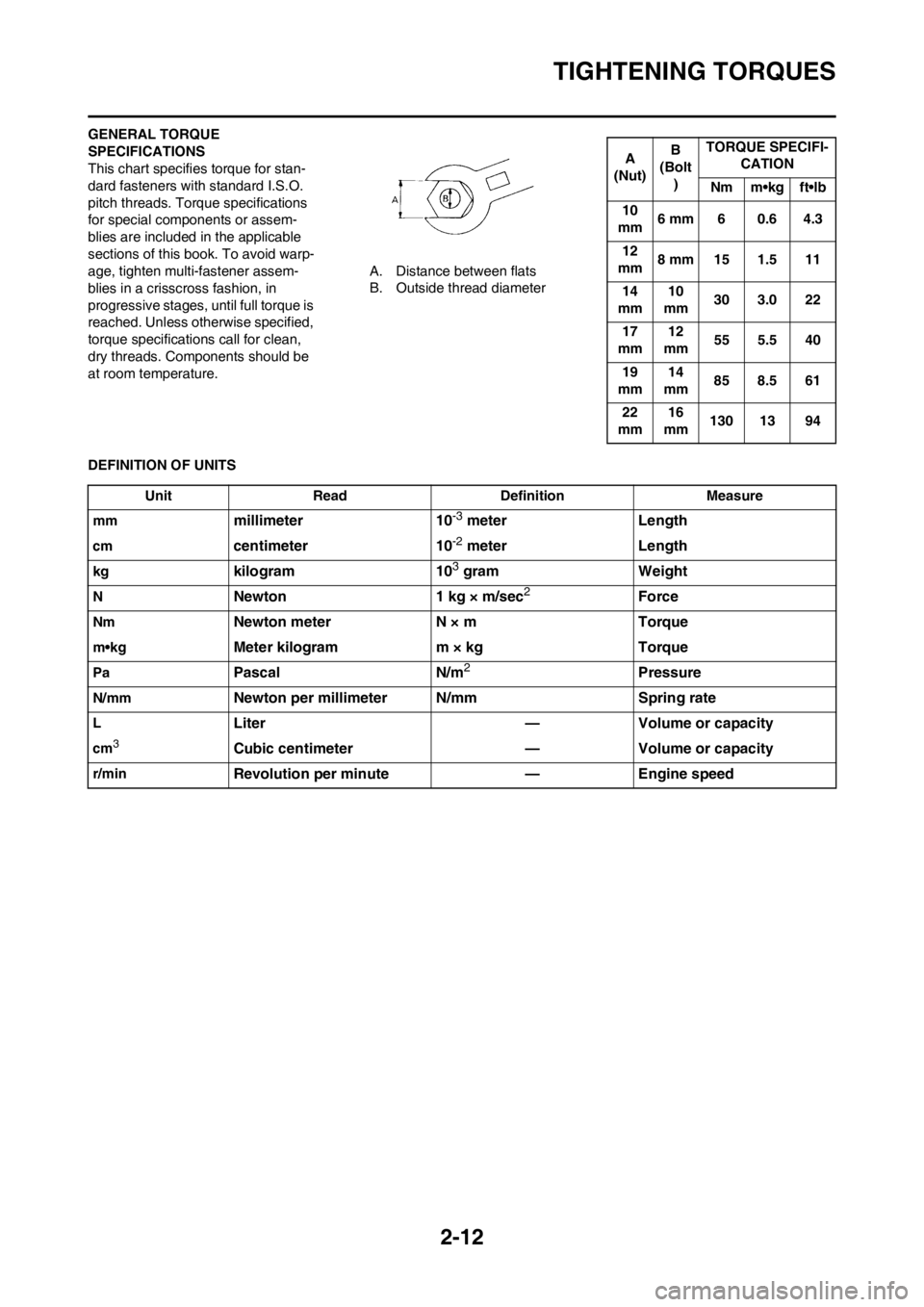
GENERAL TORQUE
SPECIFICATIONS
This chart specifies torque for stan-
dard fasteners with standard I.S.O.
pitch threads. Torque specifications
for special components or assem-
blies are included in the applicable
sections of this book. To avoid warp-
age, tighten multi-fastener assem-
blies in a crisscross fashion, in
progressive stages, until full torque is
reached. Unless otherwise specified,
torque specifications call for clean,
dry threads. Components should be
at room temperature.A. Distance between flats
B. Outside thread diameter
DEFINITION OF UNITS
A
(Nut)B
(Bolt
)TORQUE SPECIFI-
CATION
Nm m•kg ft•lb
10
mm6 mm 6 0.6 4.3
12
mm8 mm 15 1.5 11
14
mm10
mm30 3.0 22
17
mm12
mm55 5.5 40
19
mm14
mm85 8.5 61
22
mm16
mm130 13 94
Unit Read Definition Measure
mm
millimeter 10-3 meter Length
cmcentimeter 10-2 meter Length
kgkilogram 103 gram Weight
NNewton 1 kg × m/sec2Force
NmNewton meter N × m Torque
m•kgMeter kilogram m × kg Torque
PaPascal N/m2Pressure
N/mmNewton per millimeter N/mm Spring rate
LLiter — Volume or capacity
cm3Cubic centimeter — Volume or capacity
r/minRevolution per minute — Engine speed
Page 38 of 168
2-13
CABLE ROUTING DIAGRAM
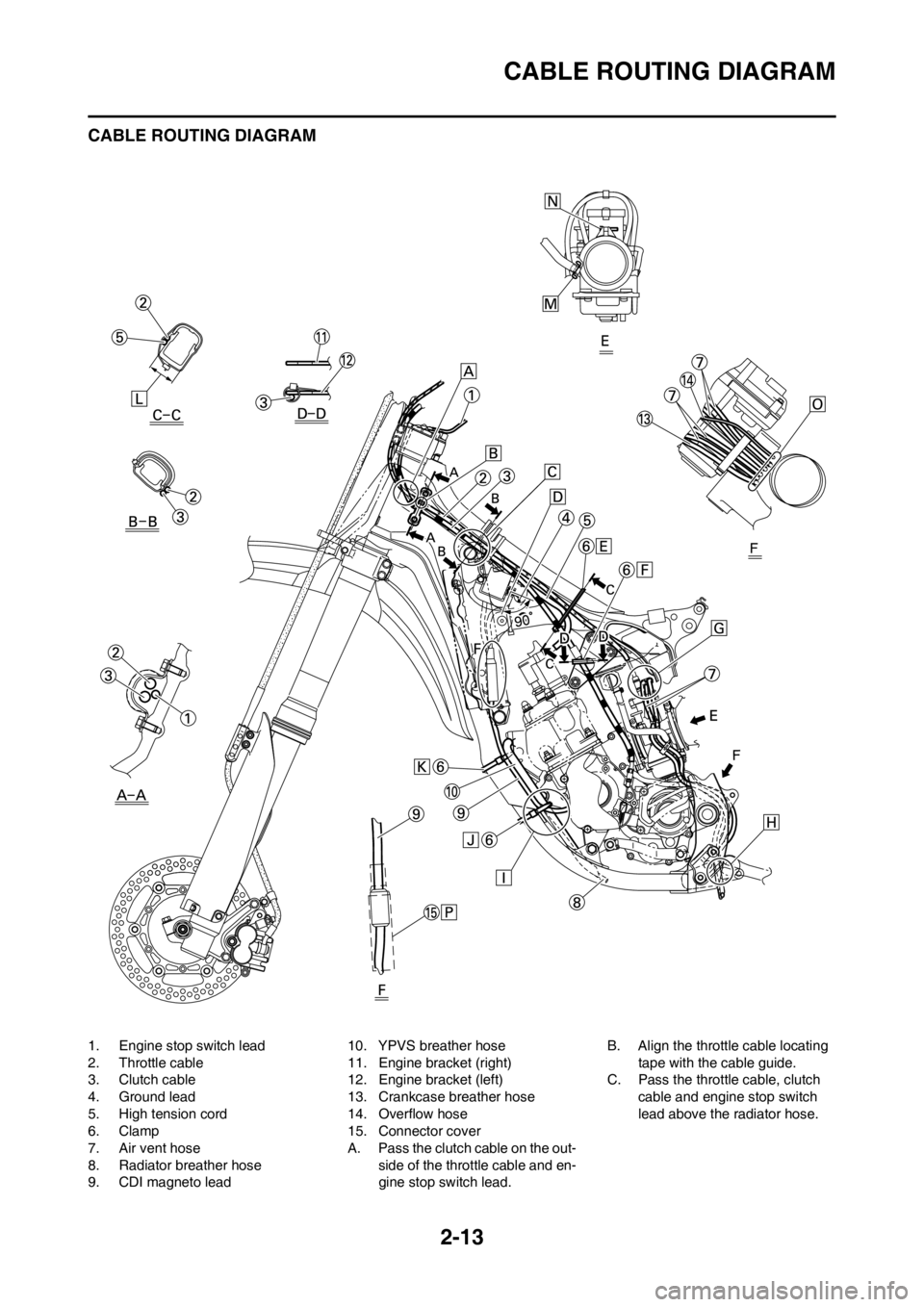
CABLE ROUTING DIAGRAM
1. Engine stop switch lead
2. Throttle cable
3. Clutch cable
4. Ground lead
5. High tension cord
6. Clamp
7. Air vent hose
8. Radiator breather hose
9. CDI magneto lead10. YPVS breather hose
11. Engine bracket (right)
12. Engine bracket (left)
13. Crankcase breather hose
14. Overflow hose
15. Connector cover
A. Pass the clutch cable on the out-
side of the throttle cable and en-
gine stop switch lead.B. Align the throttle cable locating
tape with the cable guide.
C. Pass the throttle cable, clutch
cable and engine stop switch
lead above the radiator hose.
Page 39 of 168

2-14
CABLE ROUTING DIAGRAM
D. Install the ignition coil, side core
and ground lead together to the
frame. Take care to fasten the
ground lead so that its terminal
is within the indicated range.
E. Clamp the throttle cable and
high tension cord to the frame.
F. Clamp the clutch cable to the left
engine bracket. Clamp the
clutch cable below the position-
ing grommet.
G. Pass the air vent hose back of
the throttle cable.
H. Pass the air vent hose, overflow
hose and crankcase breather
hose between the frame and
connecting rod.
I. Pass the radiator breather hose
and YPVS breather hose out-
side the engine bracket and in-
side the down tube. Then pass
the radiator breather hose inside
the YPVS breather hose.
J. Clamp the CDI magneto lead,
radiator breather hose and
YPVS breather hose to the
frame.
K. Clamp to the frame the CDI
magneto lead and radiator
breather hose. Take care to
clamp them above the projection
on the frame.
L. Locate the clamp ends in the ar-
rowed range.
M. Direct the clip with its finger grip
facing forward.
N. Tighten the clamp with its bolt
head facing the left side of the
chassis (on both sides of the
carburetor joint and the air filter
joint).
O. Pass the air vent hose, overflow
hose and crankcase breather
hose so that they do not contact
the rear shock absorber.
P. Bring the connector cover into
contact with the coupler.
Page 40 of 168
2-15
CABLE ROUTING DIAGRAM
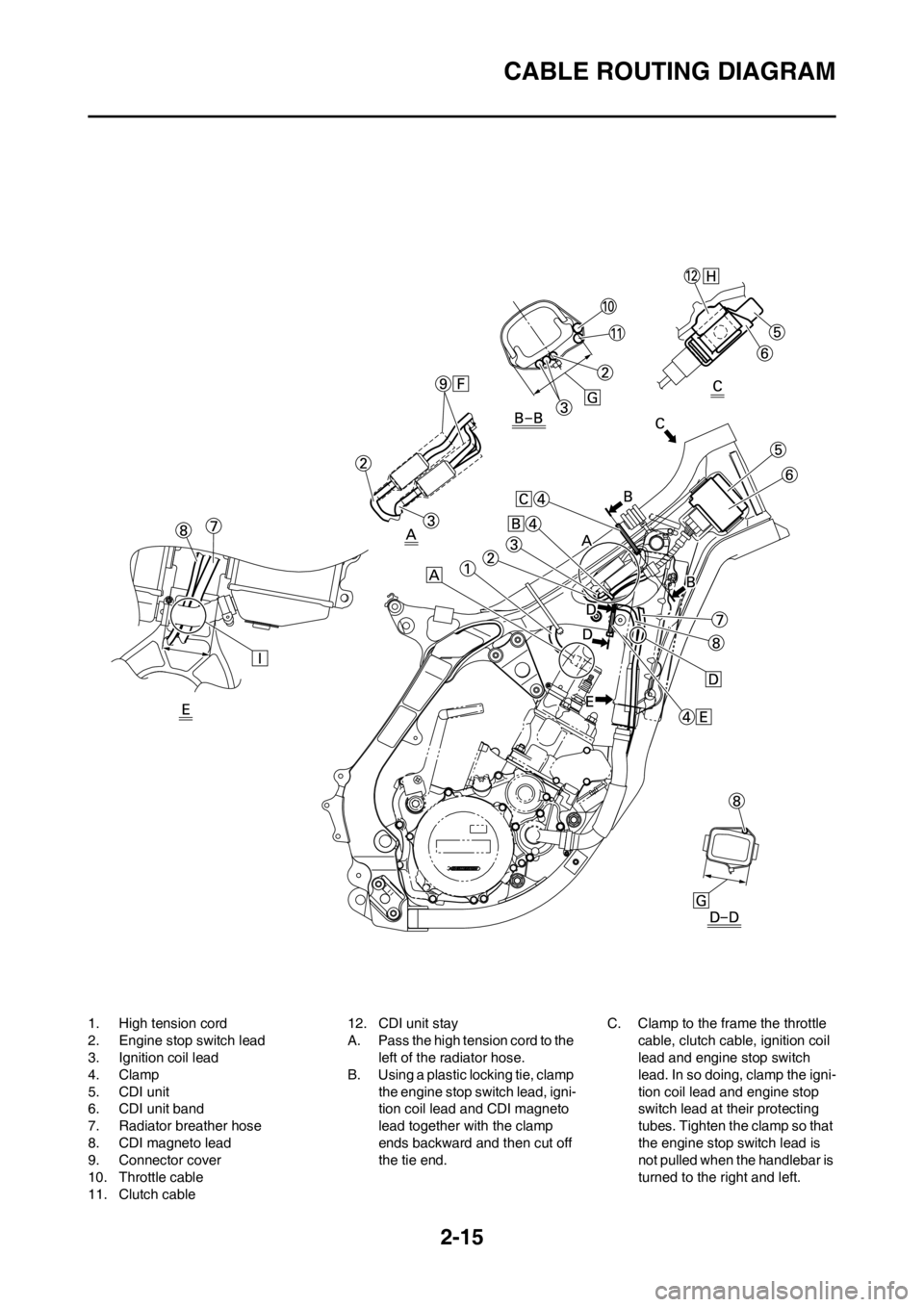
1. High tension cord
2. Engine stop switch lead
3. Ignition coil lead
4. Clamp
5. CDI unit
6. CDI unit band
7. Radiator breather hose
8. CDI magneto lead
9. Connector cover
10. Throttle cable
11. Clutch cable12. CDI unit stay
A. Pass the high tension cord to the
left of the radiator hose.
B. Using a plastic locking tie, clamp
the engine stop switch lead, igni-
tion coil lead and CDI magneto
lead together with the clamp
ends backward and then cut off
the tie end.C. Clamp to the frame the throttle
cable, clutch cable, ignition coil
lead and engine stop switch
lead. In so doing, clamp the igni-
tion coil lead and engine stop
switch lead at their protecting
tubes. Tighten the clamp so that
the engine stop switch lead is
not pulled when the handlebar is
turned to the right and left.
Page 43 of 168
2-18
CABLE ROUTING DIAGRAM
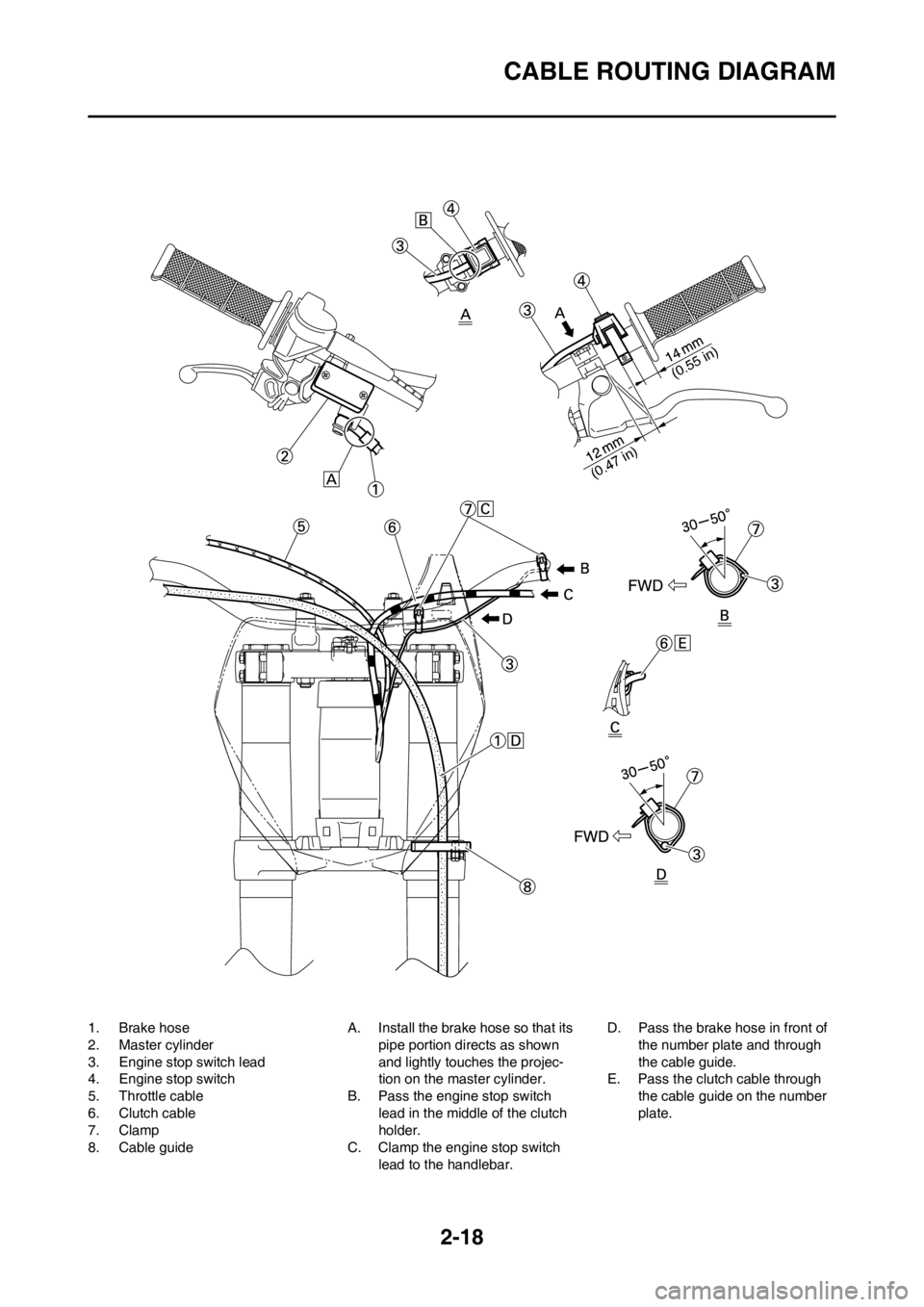
1. Brake hose
2. Master cylinder
3. Engine stop switch lead
4. Engine stop switch
5. Throttle cable
6. Clutch cable
7. Clamp
8. Cable guideA. Install the brake hose so that its
pipe portion directs as shown
and lightly touches the projec-
tion on the master cylinder.
B. Pass the engine stop switch
lead in the middle of the clutch
holder.
C. Clamp the engine stop switch
lead to the handlebar.D. Pass the brake hose in front of
the number plate and through
the cable guide.
E. Pass the clutch cable through
the cable guide on the number
plate.
(0.55 in)
(0.47 in)
Page 48 of 168

3-5
PRE-OPERATION INSPECTION AND MAINTENANCE
PRE-OPERATION INSPECTION AND MAINTENANCE
Before riding for break-in operation, practice or a race, make sure the machine is in good operating condition.
Before using this machine, check the following points.
GENERAL INSPECTION AND MAINTENANCE
Item Routine Page
CoolantCheck that coolant is filled up to the radiator cap. Check the cool-
ing system for leakage.P.3-6 – 7
FuelCheck that a fresh mixture of oil and gasoline is filled in the fuel
tank. Check the fuel line for leakage.P.1-12
Transmission oilCheck that the oil level is correct. Check the crankcase for leak-
age.P.3-8 – 9
Gear shifter and clutchCheck that gears can be shifted correctly in order and that the
clutch operates smoothly.P.3-7
Throttle grip/HousingCheck that the throttle grip operation and free play are correctly
adjusted. Lubricate the throttle grip and housing, if necessary.P.3-7 – 8
Brakes Check the play of front brake and effect of front and rear brake. P.3-9 – 12
Drive chainCheck drive chain slack and alignment. Check that the drive chain
is lubricated properly.P.3-12 – 13
WheelsCheck for excessive wear and tire pressure. Check for loose
spokes and have no excessive play.P.3-16 – 17
SteeringCheck that the handlebar can be turned smoothly and have no ex-
cessive play.P.3-17
Front forks and rear shock
absorberCheck that they operate smoothly and there is no oil leakage.
P.3-13 – 16
Cables (wires)Check that the clutch and throttle cables move smoothly. Check
that they are not caught when the handlebars are turned or when
the front forks travel up and down.—
Muffler Check that the muffler is tightly mounted and has no cracks. P.4-3 – 4
Rear wheel sprocket Check that the rear wheel sprocket tightening bolt is not loose. P.3-12
Lubrication Check for smooth operation. Lubricate if necessary. P.3-18
Bolts and nuts Check the chassis and engine for loose bolts and nuts. P.1-13
Lead connectorsCheck that the CDI magneto, CDI unit, and ignition coil are con-
nected tightly.P.1-7
SettingsIs the machine set suitably for the condition of the racing course
and weather or by taking into account the results of test runs be-
fore racing? Are inspection and maintenance completely done?P.7-1 – 11
Page 49 of 168

3-6
ENGINE
ENGINE
CHECKING THE COOLANT LEVEL
Do not remove the radiator cap
"1", drain bolt and hoses when the
engine and radiator are hot. Scald-
ing hot fluid and steam may be
blown out under pressure, which
could cause serious injury. When
the engine has cooled, place a
thick towel over the radiator cap,
slowly rotate the cap counter-
clockwise to the detent. This pro-
cedure allows any residual
pressure to escape. When the
hissing sound has stopped, press
down on the cap while turning
counterclockwise and remove it.
Hard water or salt water is harmful
to the engine parts. You may use
distilled water, if you can't get soft
water.
1. Place the machine on a level
place, and hold it in an upright po-
sition.
2. Remove:
• Radiator cap
3. Check:
• Coolant level "a"
Coolant level low →Add coolant.
1. Radiator
CHANGING THE COOLANT
Do not remove the radiator cap
when the engine is hot.
Take care so that coolant does not
splash on painted surfaces. If it
splashes, wash it away with water.
1. Place a container under the en-
gine.2. Remove:
• Coolant drain bolt "1"
3. Remove:
• Radiator cap
Drain the coolant completely.
4. Clean:
• Cooling system
Thoroughly flush the cooling sys-
tem with clean tap water.
5. Install:
• Copper washer
• Coolant drain bolt
6. Fill:
• Radiator
•Engine
To specified level.
• Do not mix more than one type of
ethylene glycol antifreeze con-
taining corrosion inhibitors for
aluminum engine.
• Do not use water containing im-
purities or oil.
Handling notes of coolant:
The coolant is harmful so it should be
handled with special care.
• When coolant splashes to your
eye.
Thoroughly wash your eye with
water and see your doctor.
• When coolant splashes to your
clothes.
Quickly wash it away with water
and then with soap.
• When coolant is swallowed.
Quickly make him vomit and take
him to a doctor.
7. Install:
• Radiator cap
Start the engine and warm it up
for a several minutes.
8. Check:
• Coolant level
Coolant level low→Add coolant.
CHECKING THE RADIATOR CAP
1. Inspect:
• Seal (radiator cap) "1"
• Valve and valve seat "2"
Crack/damage →Replace.
Exist fur deposits "3" →Clean or
replace.
CHECKING THE RADIATOR CAP
OPENING PRESSURE
1. Attach:
• Radiator cap tester "1" and adapt-
er "2"
Apply water on the radiator cap seal.
Coolant drain bolt:
10 Nm (1.0 m•kg, 7.2
ft•lb)
Recommended coolant:
High quality ethylene
glycol anti-freeze con-
taining anti-corrosion
for aluminum engine
Coolant "1" and water
(soft water) "2" mixing ra-
tio:
50%/50%
Coolant capacity:
0.9 L (0.79 Imp qt, 0.95
US qt)
Radiator cap tester:
YU-24460-01/90890-
01325
Radiator cap tester
adapter:
YU-33984/90890-01352
Page 50 of 168
3-7
ENGINE
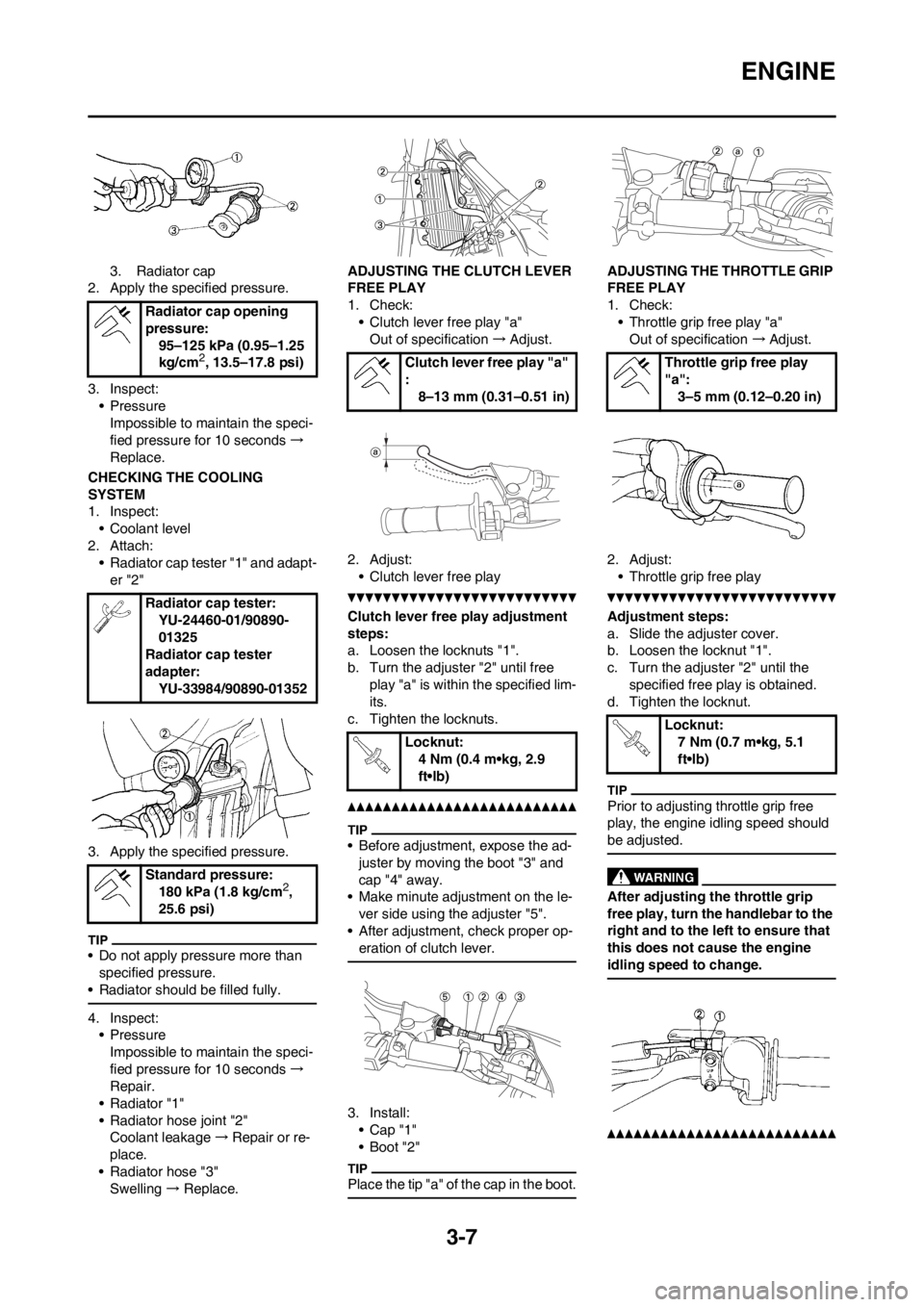
3. Radiator cap
2. Apply the specified pressure.
3. Inspect:
• Pressure
Impossible to maintain the speci-
fied pressure for 10 seconds →
Replace.
CHECKING THE COOLING
SYSTEM
1. Inspect:
• Coolant level
2. Attach:
• Radiator cap tester "1" and adapt-
er "2"
3. Apply the specified pressure.
• Do not apply pressure more than
specified pressure.
• Radiator should be filled fully.
4. Inspect:
• Pressure
Impossible to maintain the speci-
fied pressure for 10 seconds →
Repair.
•Radiator "1"
• Radiator hose joint "2"
Coolant leakage →Repair or re-
place.
• Radiator hose "3"
Swelling → Replace. ADJUSTING THE CLUTCH LEVER
FREE PLAY
1. Check:
• Clutch lever free play "a"
Out of specification →Adjust.
2. Adjust:
• Clutch lever free play
Clutch lever free play adjustment
steps:
a. Loosen the locknuts "1".
b. Turn the adjuster "2" until free
play "a" is within the specified lim-
its.
c. Tighten the locknuts.
• Before adjustment, expose the ad-
juster by moving the boot "3" and
cap "4" away.
• Make minute adjustment on the le-
ver side using the adjuster "5".
• After adjustment, check proper op-
eration of clutch lever.
3. Install:
• Cap "1"
•Boot "2"
Place the tip "a" of the cap in the boot.
ADJUSTING THE THROTTLE GRIP
FREE PLAY
1. Check:
• Throttle grip free play "a"
Out of specification →Adjust.
2. Adjust:
• Throttle grip free play
Adjustment steps:
a. Slide the adjuster cover.
b. Loosen the locknut "1".
c. Turn the adjuster "2" until the
specified free play is obtained.
d. Tighten the locknut.
Prior to adjusting throttle grip free
play, the engine idling speed should
be adjusted.
After adjusting the throttle grip
free play, turn the handlebar to the
right and to the left to ensure that
this does not cause the engine
idling speed to change.
Radiator cap opening
pressure:
95–125 kPa (0.95–1.25
kg/cm
2, 13.5–17.8 psi)
Radiator cap tester:
YU-24460-01/90890-
01325
Radiator cap tester
adapter:
YU-33984/90890-01352
Standard pressure:
180 kPa (1.8 kg/cm
2,
25.6 psi)
Clutch lever free play "a"
:
8–13 mm (0.31–0.51 in)
Locknut:
4 Nm (0.4 m•kg, 2.9
ft•lb)Throttle grip free play
"a":
3–5 mm (0.12–0.20 in)
Locknut:
7 Nm (0.7 m•kg, 5.1
ft•lb)