2013 YAMAHA SUPERJET engine
[x] Cancel search: enginePage 66 of 78
Maintenance
60
EJU34378Checking the spark plugs
WARNING
EWJ00350
Be careful not to damage the insulator
when removing or installing a spark plug.
A damaged insulator could allow sparks to
escape, which could result in a fire or ex-
plosion.
Remove and check the condition of the spark
plugs.
The condition of a spark plug can indicate
something about the condition of the engine.
For example, if the center electrode portion is
very white, this could indicate an intake air
leak or carburetion problem in that cylinder.
Do not attempt to diagnose any problems
yourself. Have a Yamaha dealer service the
watercraft.
To remove a spark plug:
(1) Remove the hood. (See page 24 for hoodremoval and installation procedures.)
(2) Remove the spark plug cap.
(3) Remove the spark plug, and then check the condition of the spark plug and the
spark plug gap. If the electrode portion is
significantly discolored, if electrode ero-
sion becomes excessive, if carbon and
other deposits are excessive, or if the
spark plug gap is not within the specified
range, replace the spark plug.
TIP:
When the engine is operating normally, the
color of the spark plug electrode portion will
be a medium-to-light tan.
To install a spark plug:
(1) Wipe off any dirt from the threads, insula-tor, and gasket surface of the spark plug.
(2) Install the spark plug, and then tighten it to the specified torque.
TIP:
If a torque wrench is not available when you
are installing a spark plug, a good estimate of
Nuts and bolts Check —
Item Operation
Initial Thereafter every
Page
10
hours 50 hours 100
hours 200
hours
6
months 12
months 12
months 24
months
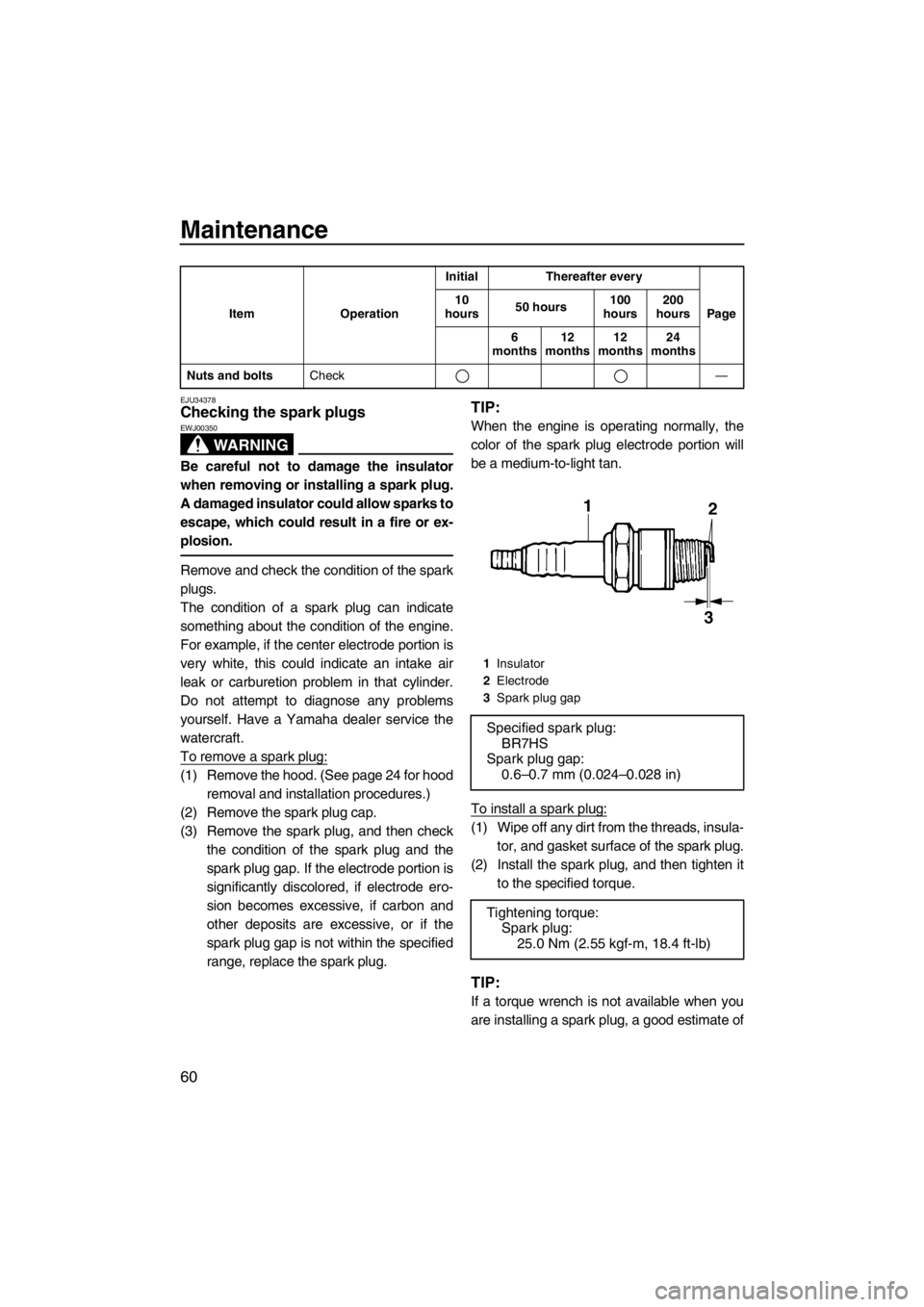
1 Insulator
2 Electrode
3 Spark plug gap
Specified spark plug:
BR7HS
Spark plug gap: 0.6–0.7 mm (0.024–0.028 in)
Tightening torque: Spark plug:
25.0 Nm (2.55 kgf-m, 18.4 ft-lb)
UF2F75E0.book Page 60 Thursday, July 5, 2012 8:50 AM
Page 68 of 78

Maintenance
62
EJU34463Adjusting the carburetor
NOTICE
ECJ00172
If the carburetor settings are disturbed by
someone who does not have the neces-
sary technical knowledge, poor engine
performance and damage may result.
The carburetor is a vital part of the engine and
requires very sophisticated adjustments.
Most adjustments should be left to a Yamaha
dealer who has the professional knowledge
and experience to make them.
However, the operator may adjust the engine
idling speed as part of the usual maintenance
routine.
EJU34471Adjusting the engine idling speed
(1) Place the watercraft in the water.
(2) Start the engine and warm it up for 1 to 2minutes.
(3) While using a diagnostic tachometer, turn the throttle stop screw to adjust the en-
gine idling speed to specification. Turn
the throttle stop screw clockwise to in-
crease the engine idling speed or coun-
terclockwise to decrease the engine
idling speed.
1Throttle stop screw
Engine idling speed:
1300 ±50 r/min
UF2F75E0.book Page 62 Thursday, July 5, 2012 8:50 AM
Page 69 of 78

Specifications
63
EJU34542
Specifications
Watercraft capacity:
Maximum people on board:1 person
Dimensions:
Length:2240 mm (88.2 in)
Width:
680 mm (26.8 in)
Height: 660 mm (26.0 in)
Dry weight: 139 kg (306 lb)
Performance:
Maximum output (according to ISO 8665/SAE
J1228):48.5 kW@6250 r/min
Maximum fuel consumption:
29.0 L/h (7.7 US gal/h, 6.4 Imp.gal/h)
Cruising range at full throttle: 0.62 hour
Trolling speed: 1300 ±50 r/min
Engine:
Engine type:
2-stroke
Number of cylinders: 2
Engine displacement:
701 cm³
Bore & stroke: 81.0 × 68.0 mm (3.19 × 2.68 in)
Compression ratio: 7.2 : 1
Lubrication system:
Pre-mixed fuel and oil
Cooling system: Water
Starting system: Electric
Ignition system:
C.D.I.
Spark plug: BR7HS
Spark plug gap: 0.6–0.7 mm (0.024–0.028 in)
Battery capacity:
12 V, 19 Ah Charging system:
Flywheel magneto
Drive unit:
Propulsion system:
Jet pump
Jet pump type: Axial flow, single stage
Impeller rotation: Counterclockwise
Jet thrust nozzle angle:
P1: 14.4+14.4°
P2: 17.3+17.3°
Fuel and oil:
Recommended fuel:Regular unleaded gasoline
Minimum octane rating (PON): 86
Minimum octane rating (RON): 90
Recommended engine oil:
YAMALUBE 2-W or TC-W3 outboard motor oil or equivalent
Fuel mixing ratio (fuel to oil):
50 :1
Fuel tank total capacity: 18 L (4.8 US gal, 4.0 Imp.gal)
Fuel tank reserve capacity: 5.5 L (1.5 US gal, 1.2 Imp.gal)
UF2F75E0.book Page 63 Thursday, July 5, 2012 8:50 AM
Page 70 of 78

Trouble recovery
64
EJU34561
Troubleshooting
If you have any trouble with your watercraft, use the troubleshooting chart to check for the pos-
sible cause.
If you cannot find the cause, consult a Yamaha dealer.
EJU34575Troubleshooting chart
TROUBLE POSSIBLE CAUSE REMEDYPAGE
Engine does not
start (Starter motor
does not turn over) Engine shut-
off switch
Clip not in place Install clip
19
Fuse Burned out Replace fuse and
check wiring 67
Battery Run down Recharge51
Poor terminal con-
nections Tighten as required
51
Terminal corroded Clean or replace 51
Starter motor Faulty Have serviced by
Yamaha dealer —
Engine does not
start (Starter motor
turns over) Fuel cock Turned to “OFF” Turn fuel cock knob to
“ON”21
Fuel Empty Refill as soon as pos-
sible 29
Stale or contaminat-
ed Have serviced by
Yamaha dealer
—
Fuel tank Water or dirt present Have serviced by Yamaha dealer—
Spark plug Fouled or defective Replace 60
Spark plug
cap Not connected or
loose Connect properly
60
Crankcase Filled with water Have serviced by Yamaha dealer68
Fuel filter Clogged or water pooled Have serviced by
Yamaha dealer
61
Choke Knob moves back on its own Tighten choke knob
adjusting nut
61
UF2F75E0.book Page 64 Thursday, July 5, 2012 8:50 AM
Page 71 of 78

Trouble recovery
65
Engine runs irregu-
larly or stallsFuel Empty Refill as soon as pos-
sible29
Stale or contaminat-
ed Have serviced by
Yamaha dealer
—
Too much oil in fuel
mixing ratio Correct fuel-to-oil ra-
tio to 50:1
28
Choke Knob is left pulled Push fully in 21
Fuel filter Clogged or water pooled Have serviced by
Yamaha dealer
61
Fuel tank Water or dirt present Have serviced by Yamaha dealer—
Spark plug Fouled or defective Replace 60 Incorrect heat range Replace 60
Gap incorrect Replace 60
Spark plug
cap Not connected or
loose Connect properly
60
Cracked, torn or dam-
aged Have serviced by
Yamaha dealer
—
Electrical wir-
ing Loose electrical con-
nections Have serviced by
Yamaha dealer
—
Carburetor Incorrect idle adjust- ment Have serviced by
Yamaha dealer
—
Clogged Have serviced by Yamaha dealer 62
Watercraft slow or
loses power Cavitation Jet intake clogged Clean 66
Impeller damaged or
worn Have serviced by
Yamaha dealer
66
Engine over-
heated Jet intake clogged Clean
66
Fuel filter Clogged Have serviced by Yamaha dealer61
Spark plug Fouled or defective Replace 60 Incorrect heat range Replace 60
Gap incorrect Replace 60
Spark plug
caps Not connected or
loose Connect properly
60
Fuel Stale or contaminat- ed Have serviced by
Yamaha dealer
—
TROUBLE POSSIBLE CAUSE REMEDY PAGE
UF2F75E0.book Page 65 Thursday, July 5, 2012 8:50 AM
Page 72 of 78
Trouble recovery
66
EJU34623
Emergency procedures EJU34634Cleaning the jet intake and impeller
WARNING
EWJ00782
Before attempting to remove weeds or de-
bris from the jet intake or impeller area,
shut the engine off and remove the clip
from the engine shut-off switch. Severe in-
jury or death could result from coming in
contact with the rotating parts of the jet
pump.
If weeds or debris gets caught in the jet intake
or impeller, cavitation can occur, causing jet
thrust to decrease even though engine speed
rises. If this condition is allowed to continue,
the engine will overheat and may seize.
NOTICE: If weeds or debris gets caught in
the jet intake, do not operate the watercraft
above trolling speed until they have been
removed.
[ECJ00653]
If there is any sign that the jet intake or impel-
ler is clogged with weeds or debris, return to
shore and check the intake and impeller. Al- ways stop the engine before beaching the wa-
tercraft.
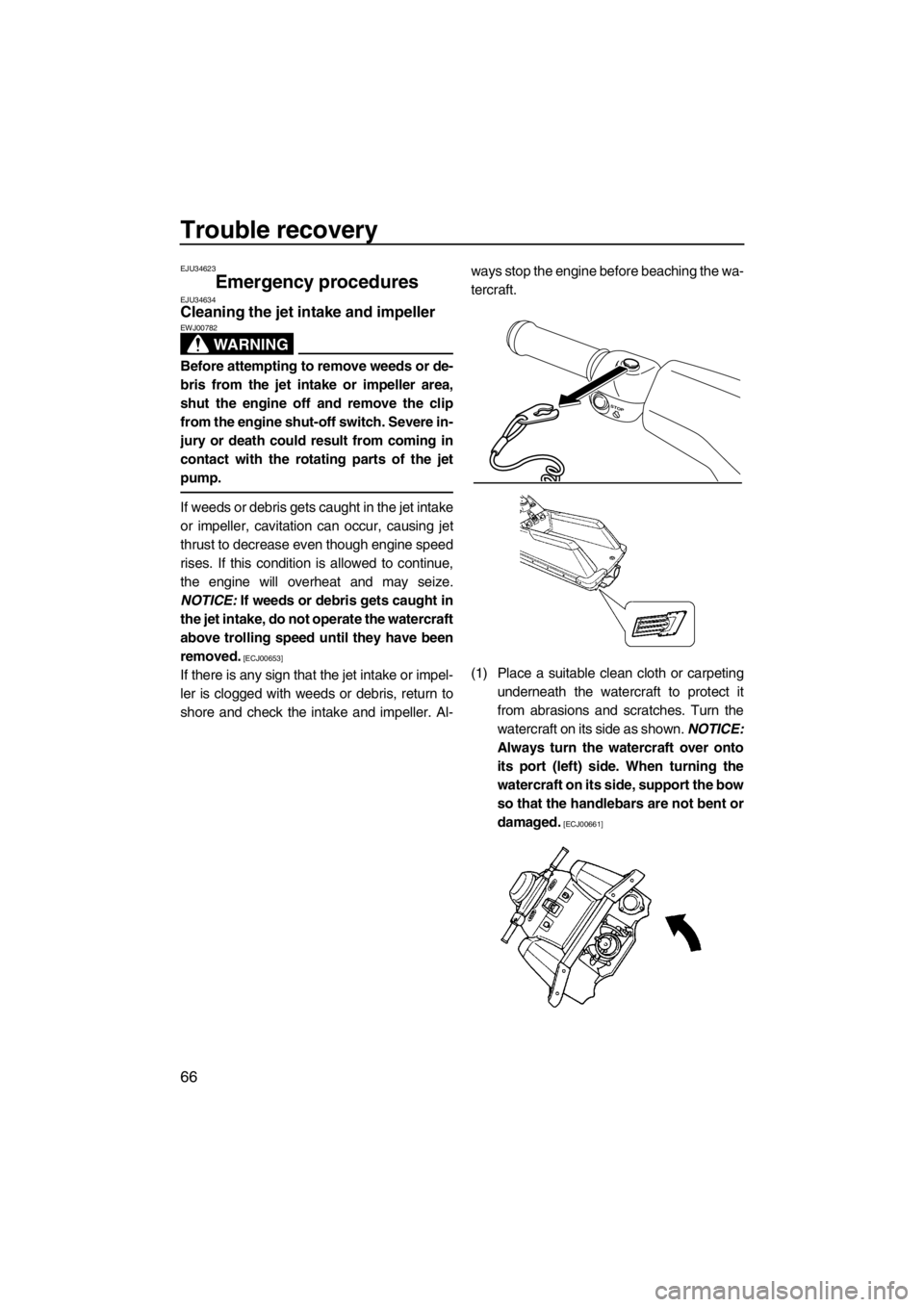
(1) Place a suitable clean cloth or carpeting
underneath the watercraft to protect it
from abrasions and scratches. Turn the
watercraft on its side as shown. NOTICE:
Always turn the watercraft over onto
its port (left) side. When turning the
watercraft on its side, support the bow
so that the handlebars are not bent or
damaged.
[ECJ00661]
STOP
UF2F75E0.book Page 66 Thursday, July 5, 2012 8:50 AM
Page 73 of 78

Trouble recovery
67
(2) Remove any weeds or debris fromaround the jet intake, drive shaft, impel-
ler, jet pump housing, and jet thrust noz-
zle.
If debris is difficult to remove, consult a
Yamaha dealer.
EJU34641Jumping the battery
If the watercraft battery has run down, the en-
gine can be started using a 12-volt booster
battery and jumper cables.
EJU34653Connecting the jumper cables
WARNING
EWJ01250
To avoid battery explosion and serious
damage to the electrical system:
●Do not reverse the polarity of the jumper
cables when connecting to the batteries.
●Do not connect the negative (–) jumper
cable to the negative (–) terminal of the
watercraft battery.
●Do not touch the positive (+) jumper ca-
ble to the negative (–) jumper cable.
(1) Connect the positive (+) jumper cable to the positive (+) battery terminals of both
batteries.
(2) Connect one end of the negative (–) jumper cable to the negative (–) battery
terminal of the booster battery. (3) Connect the other end of the negative (–)
jumper cable to an unpainted bolt on the
cylinder head.
(4) Start the engine, and then disconnect the jumper cables by reversing the steps
above. (See page 19 for information on
starting the engine.)
EJU34675Replacing the fuse
If the fuse is blown, replace it with the proper
fuse.
To replace the fuse:
(1) Remove the hood. (See page 24 for hoodremoval and installation procedures.)
(2) Loosen the cap and remove it.
(3) Pull out the red lead to pull out the fuse
holder from the electrical box.
1Positive (+) jumper cable
2 Booster battery
3 Negative (–) jumper cable
1 Good fuse
2 Blown fuse
2
1
UF2F75E0.book Page 67 Thursday, July 5, 2012 8:50 AM
Page 74 of 78

Trouble recovery
68
(4) Open the fuse holder and replace thefuse with one of the correct amperage.
WARNING! Do not use fuses of a dif- ferent amperage than recommended.
Substitution with a fuse that has an
improper rating can cause extensive
electrical system damage and possi-
ble fire.
[EWJ00802]
(5) Insert the fuse holder into the electrical box.
(6) Securely install the cap by tightening it until it stops.
(7) Securely install the hood in its original po- sition.
EJU34704Towing the watercraft
WARNING
EWJ00811
●The operator of the towing boat must
keep speed to a minimum and avoid traf-
fic or obstacles which could be a hazard
to the operator on the watercraft.
●The towline should be long enough so
that the watercraft will not collide with
the towing boat when slowing down.
If the watercraft becomes inoperative in the
water, it can be towed to shore.
To tow the watercraft:
Use a towline that is three times the combined
length of the towing boat and the watercraft.
(1) Securely attach the towline to the bowrope hole of the watercraft being towed.
(2) Ride the watercraft with your body weight supported on the riding tray. Hold on to
the handlebars in order to balance the
watercraft and keep the bow up out of the
water. NOTICE: The bow must be kept
up out of the water during towing, oth-
erwise water could flood the engine
compartment or water could flow back
into the engine, causing severe en-
gine damage.
[ECJ01330]
Tow the watercraft at 8 km/h (5 mph) or less.
NOTICE: Tow the watercraft at 8 km/h (5
mph) or less, otherwise water could flood
the engine compartment or water could
flow back into the engine, causing severe
engine damage.
[ECJ01321]
EJU34734
Submerged watercraft
If the watercraft is submerged or flooded with
water, drain the bilge water from the engine
1 Fuse holder
2 Electrical box
3 Fuse
4 Cap
Fuse amperage:
Battery fuse:10 A
1Bow rope hole
UF2F75E0.book Page 68 Thursday, July 5, 2012 8:50 AM