2013 YAMAHA FJR1300A key
[x] Cancel search: keyPage 47 of 118
INSTRUMENT AND CONTROL FUNCTIONS
3-32
3
EAU39495
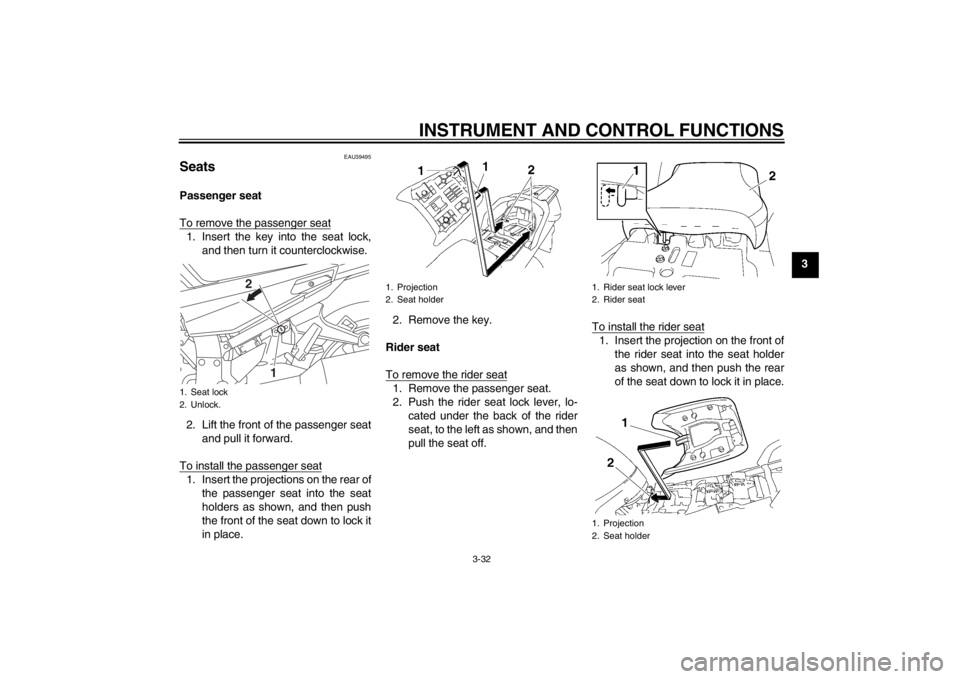
Seats Passenger seat
To remove the passenger seat1. Insert the key into the seat lock,and then turn it counterclockwise.
2. Lift the front of the passenger seat and pull it forward.
To install the passenger seat1. Insert the projections on the rear of the passenger seat into the seat
holders as shown, and then push
the front of the seat down to lock it
in place. 2. Remove the key.
Rider seat
To remove the rider seat
1. Remove the passenger seat.
2. Push the rider seat lock lever, lo- cated under the back of the rider
seat, to the left as shown, and then
pull the seat off. To install the rider seat
1. Insert the projection on the front of
the rider seat into the seat holder
as shown, and then push the rear
of the seat down to lock it in place.
1. Seat lock
2. Unlock.
1
2
1. Projection
2. Seat holder
1. Rider seat lock lever
2. Rider seat
1. Projection
2. Seat holder
U1MCE0E0.book Page 32 Thursday, July 19, 2012 6:59 PM
Page 51 of 118
INSTRUMENT AND CONTROL FUNCTIONS
3-36
3
WARNING
EWA14420
●
Do not exceed the load limit of 1
kg (2 lb) for storage compart-
ment A.
●
Do not exceed the load limit of 3
kg (7 lb) for storage compart-
ment B.
●
Do not exceed the maximum
load of 215 kg (474 lb) for the ve-
hicle.
EAU39480
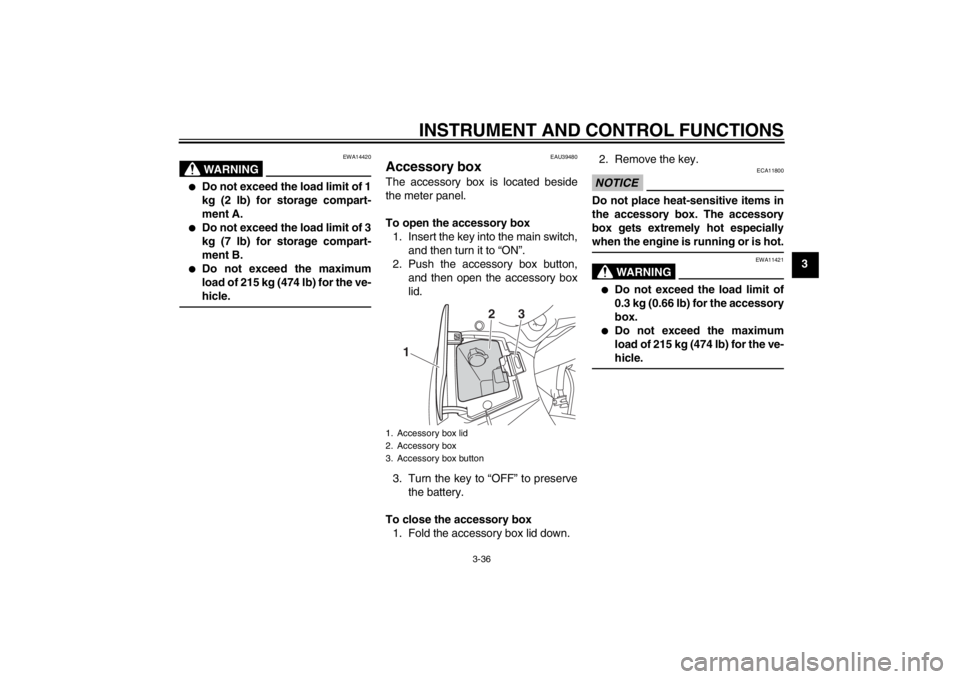
Accessory box The accessory box is located beside
the meter panel.
To open the accessory box1. Insert the key into the main switch, and then turn it to “ON”.
2. Push the accessory box button, and then open the accessory box
lid.
3. Turn the key to “OFF” to preserve the battery.
To close the accessory box 1. Fold the accessory box lid down. 2. Remove the key.
NOTICE
ECA11800
Do not place heat-sensitive items in
the accessory box. The accessory
box gets extremely hot especially
when the engine is running or is hot.
WARNING
EWA11421
●
Do not exceed the load limit of
0.3 kg (0.66 lb) for the accessory
box.
●
Do not exceed the maximum
load of 215 kg (474 lb) for the ve-
hicle.
1. Accessory box lid
2. Accessory box
3. Accessory box button
1
2
3
U1MCE0E0.book Page 36 Thursday, July 19, 2012 6:59 PM
Page 59 of 118

INSTRUMENT AND CONTROL FUNCTIONS
3-44
3
With the engine turned off:
1. Move the sidestand down.
2. Make sure that the start/engine stop switch is set to “ ”.
3. Turn the key on.
4. Shift the transmission into the neutral position.
5. Push the “ ” side of the start/engine stop switch.
Does the engine start?
With the engine still running:
6. Move the sidestand up.
7. Keep the clutch lever pulled.
8. Shift the transmission into gear.
9. Move the sidestand down.
Does the engine stall?
After the engine has stalled:
10. Move the sidestand up.
11. Keep the clutch lever pulled.
12. Push the “ ” side of the start/engine stop switch.
Does the engine start?
The system is OK. The motorcycle can be ridden.
YES NO YES NO YES NO
The neutral switch may not be working correctly.
The motorcycle should not be ridden until
checked by a Yamaha dealer.
The clutch switch may not be working correctly.
The motorcycle should not be ridden until
checked by a Yamaha dealer.The sidestand switch may not be working correctly.
The motorcycle should not be ridden until
checked by a Yamaha dealer. The vehicle must be placed on the center-
stand during this inspection.If a malfunction is noted, have a Yamaha
dealer check the system before riding.
WA R N I N G
U1MCE0E0.book Page 44 Thursday, July 19, 2012 6:59 PM
Page 60 of 118

INSTRUMENT AND CONTROL FUNCTIONS
3-45
3
EAU39655
Auxiliary DC jack
WARNING
EWA14360
To prevent electrical shock or short-
circuiting, make sure that the cap is
installed when the auxiliary DC jack
is not being used.NOTICE
ECA15431
The accessory connected to the
auxiliary DC jack should not be used
with the engine turned off, and the
load must never exceed 30 W (2.5 A),
otherwise the fuse may blow or the
battery may discharge.This vehicle is equipped with an auxilia-
ry DC jack in the accessory box.
A 12-V accessory connected to the
auxiliary jack can be used when the key
is in the “ON” position and should only
be used when the engine is running.
To use the auxiliary DC jack1. Open the accessory box lid. (See page 3-36.)
2. Turn the key to “OFF”.
3. Remove the auxiliary DC jack cap. 4. Turn the accessory off.
5. Insert the accessory plug into the
auxiliary DC jack.
6. Turn the key to “ON”, and then start the engine. (See page 5-1.)
7. Turn the accessory on.
1. Auxiliary DC jack cap
1. Auxiliary DC jack
11
U1MCE0E0.book Page 45 Thursday, July 19, 2012 6:59 PM
Page 64 of 118

OPERATION AND IMPORTANT RIDING POINTS
5-1
5
EAU15951
Read the Owner’s Manual carefully to
become familiar with all controls. If
there is a control or function you do not
understand, ask your Yamaha dealer.
WARNING
EWA10271
Failure to familiarize yourself with
the controls can lead to loss of con-
trol, which could cause an accident
or injury.
EAU47150
TIPThis model is equipped with:●
a lean angle sensor to stop the en-
gine in case of a turnover. In this
case, the multi-function meter unit
indicates error code 30, but this is
not a malfunction. Turn the key to
“OFF” and then to “ON” to clear the
error code. Failing to do so will pre-
vent the engine from starting even
though the engine will crank when
pushing the start switch.
●
an engine auto-stop system. The
engine stops automatically if left
idling for 20 minutes. In this case,
the multi-function meter unit indi-
cates error code 70, but this is not
a malfunction. Push the start
switch to clear the error code and
to restart the engine.
EAU54170
Starting the engine In order for the ignition circuit cut-off
system to enable starting, one of the
following conditions must be met:●
The transmission is in the neutral
position.
●
The transmission is in gear with
the clutch lever pulled and the
sidestand up.
See page 3-43 for more informa-
tion.
1. Turn the key to “ON” and make sure that the start/engine stop
switch is set to “ ”.
The following warning lights and
indicator lights should come on for
a few seconds, then go off.●
Oil level warning light
●
Engine trouble warning light
●
Traction control system indi-
cator/warning light
●
Cruise control indicator lights
●
Immobilizer system indicator
light
U1MCE0E0.book Page 1 Thursday, July 19, 2012 6:59 PM
Page 65 of 118
OPERATION AND IMPORTANT RIDING POINTS
5-2
5
NOTICE
ECA11833
If a warning or indicator light does
not come on initially when the key is
turned to “ON”, or if a warning or in-
dicator light remains on, see page
3-4 for the corresponding warning
and indicator light circuit check.
The ABS warning light should
come on when the key is turned to
“ON”, and then go off after travel-
ing at a speed of 10 km/h (6 mi/h)
or higher.
NOTICE
ECA17681
If the ABS warning light does not
come on and then go off as ex-
plained above, see page 3-4 for the
warning light circuit check.2. Shift the transmission into the neu-tral position. The neutral indicator
light should come on. If not, ask a
Yamaha dealer to check the elec- trical circuit.
3. Start the engine by pushing the “ ” side of the start/engine
stop switch. If the engine fails to start, release
the start/engine stop switch, wait a
few seconds, and then try again.
Each starting attempt should be as
short as possible to preserve the
battery. Do not crank the engine
more than 10 seconds on any one
attempt.
NOTICE
ECA11042
For maximum engine life, never ac-
celerate hard when the engine is
cold!
EAU16671
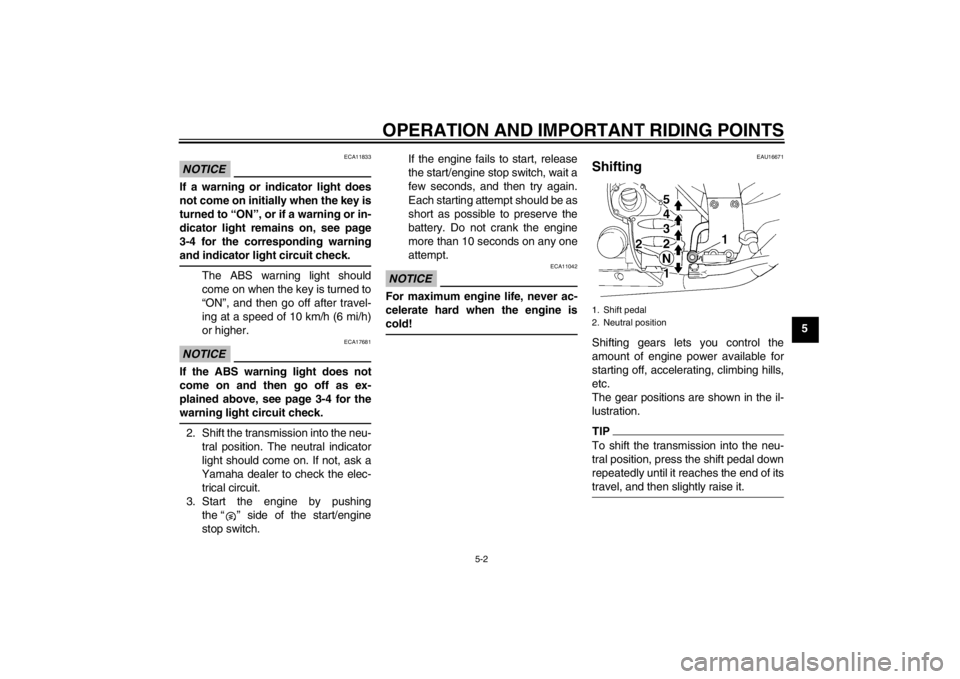
Shifting Shifting gears lets you control the
amount of engine power available for
starting off, accelerating, climbing hills,
etc.
The gear positions are shown in the il-
lustration.TIPTo shift the transmission into the neu-
tral position, press the shift pedal down
repeatedly until it reaches the end of its
travel, and then slightly raise it.1. Shift pedal
2. Neutral position
U1MCE0E0.book Page 2 Thursday, July 19, 2012 6:59 PM
Page 67 of 118

OPERATION AND IMPORTANT RIDING POINTS
5-4
5
1000–1600 km (600–1000 mi)
Avoid prolonged operation above 5400
r/min.
1600 km (1000 mi) and beyond
The vehicle can now be operated nor-
mally.
NOTICE
ECA10310
●
Keep the engine speed out of
the tachometer red zone.
●
If any engine trouble should oc-
cur during the engine break-in
period, immediately have a
Yamaha dealer check the vehi- cle.
EAU17213
Parking When parking, stop the engine, and
then remove the key from the main
switch.
WARNING
EWA10311
●
Since the engine and exhaust
system can become very hot,
park in a place where pedestri-
ans or children are not likely to
touch them and be burned.
●
Do not park on a slope or on soft
ground, otherwise the vehicle
may overturn, increasing the
risk of a fuel leak and fire.
●
Do not park near grass or other
flammable materials which
might catch fire.
U1MCE0E0.book Page 4 Thursday, July 19, 2012 6:59 PM
Page 98 of 118
PERIODIC MAINTENANCE AND ADJUSTMENT
6-31
6
EAU39525
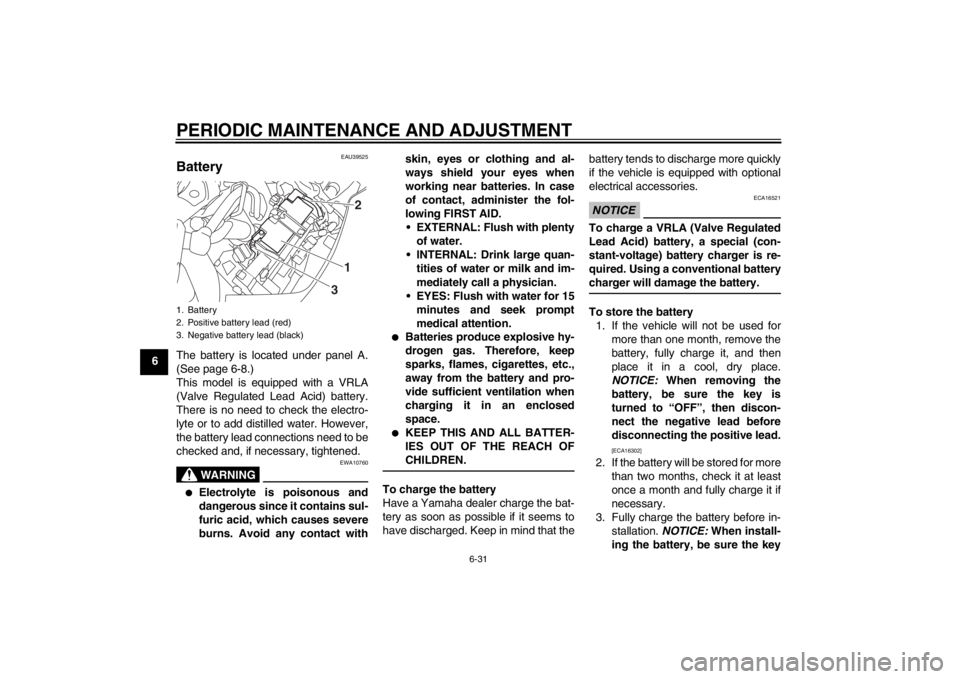
Battery The battery is located under panel A.
(See page 6-8.)
This model is equipped with a VRLA
(Valve Regulated Lead Acid) battery.
There is no need to check the electro-
lyte or to add distilled water. However,
the battery lead connections need to be
checked and, if necessary, tightened.
WARNING
EWA10760
●
Electrolyte is poisonous and
dangerous since it contains sul-
furic acid, which causes severe
burns. Avoid any contact withskin, eyes or clothing and al-
ways shield your eyes when
working near batteries. In case
of contact, administer the fol-
lowing FIRST AID.
EXTERNAL: Flush with plenty of water.
INTERNAL: Drink large quan- tities of water or milk and im-
mediately call a physician.
EYES: Flush with water for 15 minutes and seek prompt
medical attention.
●
Batteries produce explosive hy-
drogen gas. Therefore, keep
sparks, flames, cigarettes, etc.,
away from the battery and pro-
vide sufficient ventilation when
charging it in an enclosed
space.
●
KEEP THIS AND ALL BATTER-
IES OUT OF THE REACH OF
CHILDREN.
To charge the battery
Have a Yamaha dealer charge the bat-
tery as soon as possible if it seems to
have discharged. Keep in mind that the battery tends to discharge more quickly
if the vehicle is equipped with optional
electrical accessories.
NOTICE
ECA16521
To charge a VRLA (Valve Regulated
Lead Acid) battery, a special (con-
stant-voltage) battery charger is re-
quired. Using a conventional battery
charger will damage the battery.To store the battery
1. If the vehicle will not be used for more than one month, remove the
battery, fully charge it, and then
place it in a cool, dry place.
NOTICE: When removing the
battery, be sure the key is
turned to “OFF”, then discon-
nect the negative lead before
disconnecting the positive lead.
[ECA16302]
2. If the battery will be stored for more than two months, check it at least
once a month and fully charge it if
necessary.
3. Fully charge the battery before in- stallation. NOTICE: When install-
ing the battery, be sure the key
1. Battery
2. Positive battery lead (red)
3. Negative battery lead (black)
1 2
3
U1MCE0E0.book Page 31 Thursday, July 19, 2012 6:59 PM