2013 VOLVO V60 key
[x] Cancel search: keyPage 62 of 422

02 Locks and alarm
Locking/unlocking
02
60* Option/accessory, for more information, see Introduction.
Unlocking with the remote control key
The alarm for the tailgate can be disarmed* and
the tailgate unlocked on its own by using the
remote control key's
button.
The lock indicator on the instrument panel
stops flashing in order to show that not all of
the car is locked and the alarm's* level and
movement sensors and the sensors for open-
ing the tailgate are disconnected.
The doors remain locked and armed.
•The tailgate is unlocked, but remains
closed - press lightly on the rubberised
pressure plate under the outer handle and
lift the tailgate.
If the tailgate is not opened within 2 minutes
then it is relocked and the alarm is re-armed.
Unlocking the car from inside
To unlock the tailgate:
–Press the lighting panel button (1).
> The tailgate is unlocked and can be
opened within 2 minutes (if the car is
locked from the inside).
Locking with the remote control key–Press the remote control key's button for
locking,
, see page 45.
> The lock indicator on the instrument
panel starts flashing, which means that
the car is locked and the alarm* has
been activated.
Deadlocks*1
Deadlocks means that all door handles are
mechanically disengaged, which prevents
doors being opened from the inside.
The deadlocks are activated with the remote
control key and are set after an approximately
10 second delay after the doors have been
locked.
NOTE
If a door is opened within the delay time then
the sequence is interrupted and the alarm is
deactivated.
The car can only be unlocked from a deadlock
state with the remote control key. The front left
door can also be unlocked with the detachable
key blade.
WARNING
Do not allow anyone to remain in the car
without first deactivating the deadlocks in
order to avoid the risk of anyone being
locked in.
1Only in combination with alarm.
ProCarManuals.com
Page 64 of 422
02 Locks and alarm
Child safety locks
02
62* Option/accessory, for more information, see Introduction.
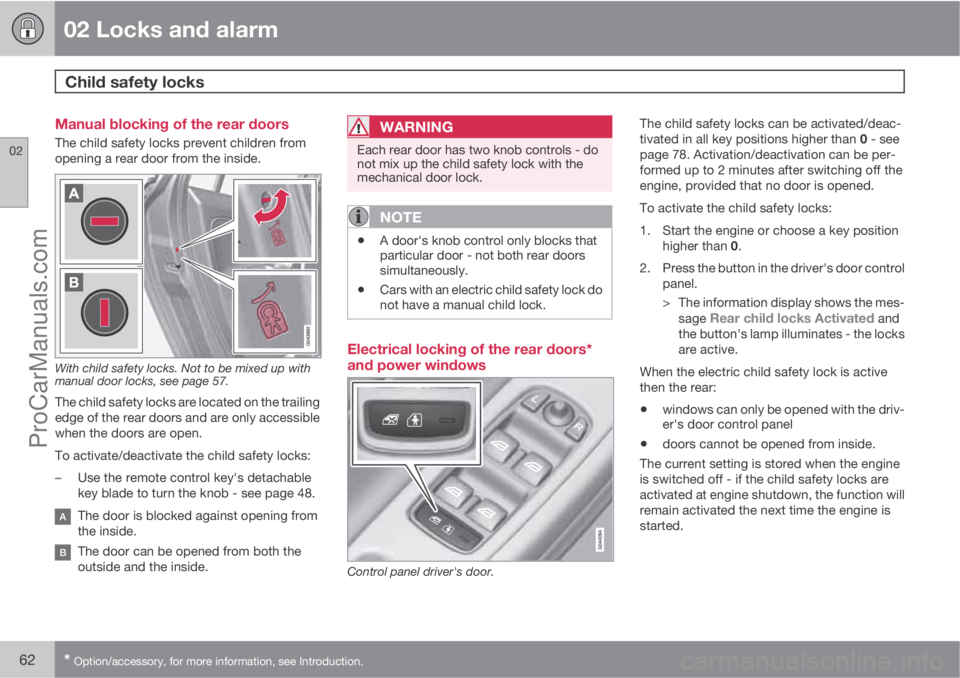
Manual blocking of the rear doors
The child safety locks prevent children from
opening a rear door from the inside.
With child safety locks. Not to be mixed up with
manual door locks, see page 57.
The child safety locks are located on the trailing
edge of the rear doors and are only accessible
when the doors are open.
To activate/deactivate the child safety locks:
–Use the remote control key's detachable
key blade to turn the knob - see page 48.
The door is blocked against opening from
the inside.
The door can be opened from both the
outside and the inside.
WARNING
Each rear door has two knob controls - do
not mix up the child safety lock with the
mechanical door lock.
NOTE
•A door's knob control only blocks that
particular door - not both rear doors
simultaneously.
•Cars with an electric child safety lock do
not have a manual child lock.
Electrical locking of the rear doors*
and power windows
Control panel driver's door.
The child safety locks can be activated/deac-
tivated in all key positions higher than 0 - see
page 78. Activation/deactivation can be per-
formed up to 2 minutes after switching off the
engine, provided that no door is opened.
To activate the child safety locks:
1. Start the engine or choose a key position
higher than 0.
2. Press the button in the driver's door control
panel.
> The information display shows the mes-
sage
Rear child locks Activated and
the button's lamp illuminates - the locks
are active.
When the electric child safety lock is active
then the rear:
•windows can only be opened with the driv-
er's door control panel
•doors cannot be opened from inside.
The current setting is stored when the engine
is switched off - if the child safety locks are
activated at engine shutdown, the function will
remain activated the next time the engine is
started.
ProCarManuals.com
Page 65 of 422

02 Locks and alarm
Alarm*
02
* Option/accessory, for more information, see Introduction.63 General
Activated alarm is triggered if:
•a door, the bonnet or the tailgate is opened
•a movement is detected in the passenger
compartment (if fitted with a movement
detector*)
•the car is raised or towed away (if fitted
with a tilt detector*)
•the battery's cable is disconnected
•the siren is disconnected.
If there is a fault in the alarm system, the infor-
mation display shows a message. In which
case, contact a workshop - an authorised
Volvo workshop is recommended.
NOTE
The movement sensors trigger an alarm in
the event of movement in the passenger
compartment - air currents are also regis-
tered. For this reason the alarm is triggered
if the car is left with a window or the sunroof
open or if the passenger compartment
heater is used.
To avoid this: Close the window/sunroof
when leaving the car. If the car's integrated
passenger compartment heater (or a porta-
ble electric heater) shall be used - direct the
airflow from the air vents so that they are not
pointing upwards in the passenger com-
partment.
NOTE
Do not attempt to repair or modify alarm
system components. All such attempts
could affect the terms of insurance.
Alarm indicator
Same LED as lock indicator, see page 45.
A red LED on the instrument panel indicates
the alarm system's status:
•LED not lit – Alarm not armed
•The LED flashes once every other second
– Alarm is armed
•The LED flashes rapidly after disarming the
alarm (and until the remote control key is
inserted in the ignition switch and key posi-
tion I is selected) – Alarm has been trig-
gered.
Arming the alarm–Press the remote control key lock button.
Deactivate the alarm–Press the remote control key unlock but-
ton.
ProCarManuals.com
Page 66 of 422
02 Locks and alarm
Alarm*
02
64* Option/accessory, for more information, see Introduction.
Deactivating a triggered alarm–Press the remote control key unlock button
or insert the remote control key in the igni-
tion switch.
Other alarm functions
Automatic re-arming of the alarmThis function prevents the car being left with
the alarm disarmed unintentionally.
If the car is unlocked with the remote control
key (and the alarm is disarmed) but none of the
doors or the tailgate is opened within 2
minutes, then the alarm is automatically re-
armed. The car is relocked at the same time.
Remote control key not workingIf the alarm cannot be deactivated with the
remote control key, e.g. if the key's battery is
discharged - the car can be unlocked, dis-
armed and the engine started as follows:
1. Open the driver's door with the detachable
key blade - see page 54.
> The alarm is triggered, the alarm indica-
tor flashes rapidly and the siren sounds.
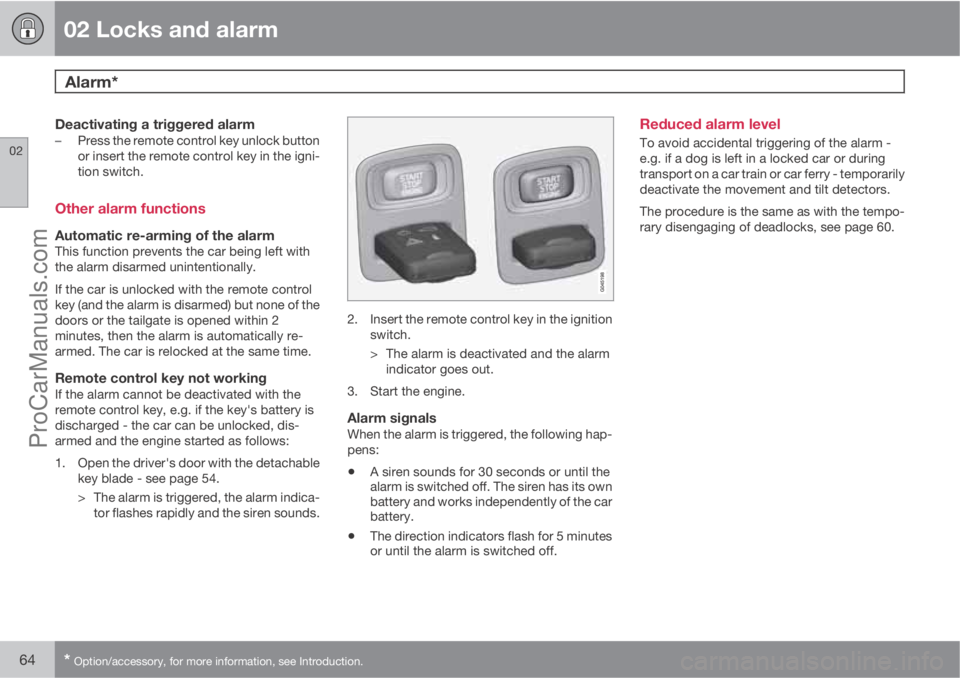
2. Insert the remote control key in the ignition
switch.
> The alarm is deactivated and the alarm
indicator goes out.
3. Start the engine.
Alarm signalsWhen the alarm is triggered, the following hap-
pens:
•A siren sounds for 30 seconds or until the
alarm is switched off. The siren has its own
battery and works independently of the car
battery.
•The direction indicators flash for 5 minutes
or until the alarm is switched off.
Reduced alarm level
To avoid accidental triggering of the alarm -
e.g. if a dog is left in a locked car or during
transport on a car train or car ferry - temporarily
deactivate the movement and tilt detectors.
The procedure is the same as with the tempo-
rary disengaging of deadlocks, see page 60.
ProCarManuals.com
Page 68 of 422

66* Option/accessory, for more information, see Introduction.
Instruments and controls........................................................................ 68
Volvo Sensus ......................................................................................... 77
Key positions.......................................................................................... 78
Seats....................................................................................................... 80
Steering wheel........................................................................................ 85
Lighting................................................................................................... 86
Wipers and washing................................................................................ 98
Windows, rearview and door mirrors....................................................101
Compass*.............................................................................................. 106
Power sunroof*..................................................................................... 107
Alcolock*............................................................................................... 109
Starting the engine................................................................................ 113
Starting the engine – Flexifuel............................................................... 118
Starting the engine – external battery................................................... 120
Gearboxes............................................................................................. 121
DRIVe Start/Stop*................................................................................. 127
All-wheel drive – AWD*.........................................................................134
Foot brake............................................................................................. 135
Parking brake........................................................................................ 137
HomeLink
Ÿ *.......................................................................................... 141
ProCarManuals.com
Page 74 of 422

03 Your driving environment
Instruments and controls
03
72* Option/accessory, for more information, see Introduction.
Meters
Meters in the combined instrument panel.
Speedometer
Fuel gauge. See also Trip computer, page
224, and Refuelling, page 287.
Tachometer. The meter indicates engine
speed in thousands of revolutions per
minute (rpm).
Indicator and warning symbols
Indicator and warning symbols.
Main beam and direction indicator symbol
warning symbols1
Symbol for DRIVe - Start/Stop*, see
page 127
Indicator symbols
Functionality checkAll indicator and warning symbols illuminate in
key position II or when the engine is started.
When the engine has started, all the symbols
should go out except the parking brake sym-
bol, which only goes out when the brake is dis-
engaged.If the engine does not start or if the functionality
check is carried out in key position II then all
symbols go out after 5 seconds except the
symbol for faults in the car's emissions system
and the symbol for low oil pressure.
Indicator symbols
SymbolSpecification
ABL fault
Emissions system
ABS fault
Rear fog lamp on
Stability system
Stability system, sport mode
Engine preheater (diesel)
Low level in fuel tank
Information, read display text
1For certain engine variants, the symbol for low oil pressure is not used. Warnings are made via display text. For information on checking the oil level, see page 329.
ProCarManuals.com
Page 79 of 422

03 Your driving environment
Volvo Sensus
03
* Option/accessory, for more information, see Introduction.77 General
Control panel in centre console
Navigation* - NAV, see separate owner's
manual (Road and Traffic Information Sys-
tem - RTI).
Infotainment (RADIO, MEDIA, TEL*), see
page 234.
Car settings - MY CAR, see page 202.
Park assist camera - CAM*, see
page 191.
Climate control, see page 210.
Volvo Sensus is the car's operating system, the
heart of your personal Volvo experience. Volvo
Sensus combines and presents many func-
tions in several of the car's systems on the
centre console TV screen. With Volvo Sensusthe car can be personalised by means of an
intuitive user interface. Settings can be made
in Car settings, Infotainment, Climate, etc.
With the centre console buttons and controls
or the steering wheel's right-hand keypad*
functions can be activated or deactivated and
many different settings can be made.
With a press on MY CAR all settings related to
the driving and control of the car are presented,
such as City Safety, Locks and alarm, setting
the clock, etc.
With a press on the respective function:
RADIO, MEDIA, TEL*, NAV* and CAM* other
sources, systems and functions can be acti-
vated, e.g. AM, FM1, CD, DVD*, TV*, Blue-
tooth*, navigation* and park assist camera*.
For more information on all functions/systems,
see the respective section in the owner's man-
ual.
ProCarManuals.com
Page 80 of 422

03 Your driving environment
Key positions
03
78* Option/accessory, for more information, see Introduction.
Insert and remove the remote control
key
Ignition switch with remote control key extracted/
inserted.
NOTE
For cars with the Keyless* function the key
does not need to be inserted into the ignition
switch but can be stored in e.g. a pocket.
For more information on Keyless functions -
see page 53.
Insert the key1. Hold the end of the remote control key with
the detachable key blade and insert the key
in the ignition switch.
2. Then press the key in the lock up to its end
position.
IMPORTANT
Foreign objects in the ignition switch may
jeopardise the function or destroy the lock.
Do not press the remote control key incor-
rectly turned - Hold the end with the detach-
able key blade, see page 48.
Withdraw the key
•Push the remote control key, allow it to
eject, then pull it out from the ignition
switch.
Functions at different levels
In order to enable the use of a limited number
of functions with the engine switched off, the
car's electrical system can be set in 3 different
levels (key positions) - 0, I and II - with the
remote control key. Throughout this owner's
manual these levels are described using the
denomination "key positions".
The following table shows the functions avail-
able in each key position/level.
LevelFunctions
0•Odometer, clock and tem-
perature gauge are illumi-
nated.
•Power seats can be adjusted.
•The audio system can be
used for a limited time - see
page 234.
I•Sunroof, power windows, 12
V socket in the passenger
compartment, RTI, phone,
ventilation fan and wind-
screen wipers can be used.
II•The headlamps come on.
•Warning/indicator lamps illu-
minate for 5 seconds.
•Several other systems are
activated. However, heating
in seat cushions and the rear
window can only be activated
after the engine has been
started.
This key position consumes a
lot of current from the starter
battery and should therefore be
avoided!
ProCarManuals.com