2013 VOLVO V60 ignition
[x] Cancel search: ignitionPage 258 of 422
06 Infotainment system
External audio source via AUX/USB* input
06
256* Option/accessory, for more information, see Introduction.
General
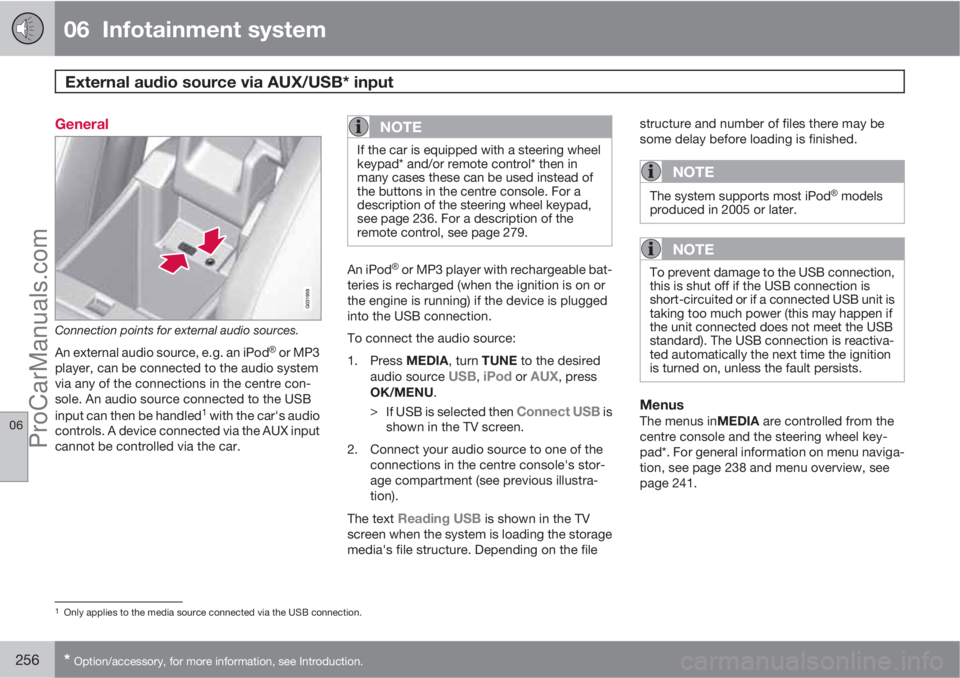
Connection points for external audio sources.
An external audio source, e.g. an iPodŸ or MP3
player, can be connected to the audio system
via any of the connections in the centre con-
sole. An audio source connected to the USB
input can then be handled
1 with the car's audio
controls. A device connected via the AUX input
cannot be controlled via the car.
NOTE
If the car is equipped with a steering wheel
keypad* and/or remote control* then in
many cases these can be used instead of
the buttons in the centre console. For a
description of the steering wheel keypad,
see page 236. For a description of the
remote control, see page 279.
An iPodŸ or MP3 player with rechargeable bat-
teries is recharged (when the ignition is on or
the engine is running) if the device is plugged
into the USB connection.
To connect the audio source:
1.
Press MEDIA, turn TUNE to the desired
audio source
USB, iPod or AUX, press
OK/MENU.
>
If USB is selected then
Connect USB is
shown in the TV screen.
2. Connect your audio source to one of the
connections in the centre console's stor-
age compartment (see previous illustra-
tion).
The text
Reading USB is shown in the TV
screen when the system is loading the storage
media's file structure. Depending on the filestructure and number of files there may be
some delay before loading is finished.
NOTE
The system supports most iPodŸ models
produced in 2005 or later.
NOTE
To prevent damage to the USB connection,
this is shut off if the USB connection is
short-circuited or if a connected USB unit is
taking too much power (this may happen if
the unit connected does not meet the USB
standard). The USB connection is reactiva-
ted automatically the next time the ignition
is turned on, unless the fault persists.
MenusThe menus inMEDIA are controlled from the
centre console and the steering wheel key-
pad*. For general information on menu naviga-
tion, see page 238 and menu overview, see
page 241.
1Only applies to the media source connected via the USB connection.
ProCarManuals.com
Page 291 of 422

07 During your journey
Fuel
07
289
IMPORTANT
•Always refuel with unleaded petrol so as
not to damage the catalytic converter.
•Do not use additives not recommended
by Volvo.
Bioethanol E85
Do not modify the fuel system or its compo-
nents, and do not replace components with
parts that are not specifically designed for use
with bioethanol.
WARNING
Methanol must not be used. A decal on the
inside of the fuel filler flap shows the correct
alternative fuel.
The use of components not designed for
bioethanol engines could cause fire, injury
or engine damage.
Reserve fuel canThe reserve fuel can should be filled with petrol,
see the NOTE box, page 118.
IMPORTANT
Make sure the reserve fuel can is securely
fastened and that its cap is sealed.
WARNING
Ethanol is sensitive to sparks, and explosive
gases could form in the reserve fuel can if it
is refuelled with ethanol.
Diesel
Only use diesel fuel from well-known produc-
ers. Never use diesel of dubious quality. Diesel
should fulfil the EN 590 or JIS K2204 stand-
ards. Diesel engines are sensitive to contami-
nants in the fuel, such as excessively high vol-
umes of sulphur particles for example.
At low temperatures (-6 °C to -40 °C), a paraffin
precipitate may form in the diesel fuel, which
may lead to ignition problems. Special diesel
fuel designed for low temperatures around
freezing point is available from the major oil
companies. This fuel is less viscous at low tem-
peratures and reduces the risk of paraffin pre-
cipitate.
The risk of condensation in the fuel tank is
reduced if the tank is kept well filled. Whenrefuelling, check that the area around the fuel
filler pipe is clean. Avoid spilling fuel onto the
paintwork. Wash off any spillage with deter-
gent and water.
IMPORTANT
Only ever use fuel that fulfils the European
diesel standard.
The sulphur content must be a maximum of
50 ppm.
IMPORTANT
Diesel type fuels that must not be used:
•Special additives
•Marine diesel fuel
•Heating oil
•FAME1 (Fatty Acid Methyl Ester) and
vegetable oil.
These fuels do not fulfil the requirements in
accordance with Volvo recommendations
and generate increased wear and engine
damage that is not covered by the Volvo
warranty.
Empty tankThe design of the fuel system in a diesel engine
means that if the vehicle runs out of fuel, the
1Diesel fuel may contain a certain amount of FAME, but further amounts must not be added.
ProCarManuals.com
Page 292 of 422

07 During your journey
Fuel
07
290* Option/accessory, for more information, see Introduction.
tank may need to be vented in the workshop in
order to restart the engine after fuelling.
Once the engine has stopped due to fuel star-
vation, the fuel system needs a few moments
to carry out a check. Do this before starting the
engine, once the fuel tank has been filled with
diesel:
1. Insert the remote control key in the ignition
switch and push it in to the end position
(see page 78).
2.
Press the START button without depress-
ing the brake and/or clutch pedal.
3. Wait approx. 1 minute.
4. To start the engine: Depress the brake and/
or clutch pedal and then press the
START button again.
NOTE
Before filling with fuel in the event of fuel
shortage:
•Stop the car on as flat/level ground as
possible - if the car is tilting there is a
risk of air pockets in the fuel supply.
Draining condensation from the fuel filterThe fuel filter separates condensation from the
fuel. Condensation can disrupt engine opera-
tion.The fuel filter must be drained at the intervals
specified in the Service and Warranty Booklet
or if you suspect that the car has been filled
with contaminated fuel.
IMPORTANT
Certain special additives remove the water
separation in the fuel filter.
Diesel particle filter (DPF)Diesel cars are equipped with a particle filter,
which results in more efficient emission con-
trol. The particles in the exhaust gases are col-
lected in the filter during normal driving. So-
called "regeneration" is started in order to burn
away the particles and empty the filter. This
requires the engine to have reached normal
operating temperature.
Regeneration of the filter is automatic and nor-
mally takes 10-20 minutes. It may take a little
longer at a low average speed. Fuel consump-
tion may increase slightly during regeneration.
Regeneration in cold weatherIf the car is frequently driven short distances in
cold weather then the engine does not reach
normal operating temperature. This means that
regeneration of the diesel particle filter does
not take place and the filter is not emptied.When the filter has become approximately
80% full of particles, a warning triangle on the
instrument panel illuminates, and the message
Soot filter full See manual is shown on the
instrument panel display.
Start regeneration of the filter by driving the car
until the engine reaches normal operating tem-
perature, preferably on a main road or motor-
way. The car should then be driven for approx-
imately 20 minutes more.
NOTE
A smaller reduction of engine power may be
noticed temporarily during regeneration.
When regeneration is complete the warning
text is cleared automatically.
Use the parking heater* in cold weather so that
the engine reaches normal operating tempera-
ture more quickly.
IMPORTANT
If the filter fills up with particles then it can
be difficult to start the engine and the filter
will be incapable of functioning. Then there
is a risk that the filter will have to be
replaced.
ProCarManuals.com
Page 295 of 422
07 During your journey
Loading
07
* Option/accessory, for more information, see Introduction.293 Lowering the rear seat backrest
To simplify loading in the cargo area, the rear
seat backrest can be folded down, see
page 82.
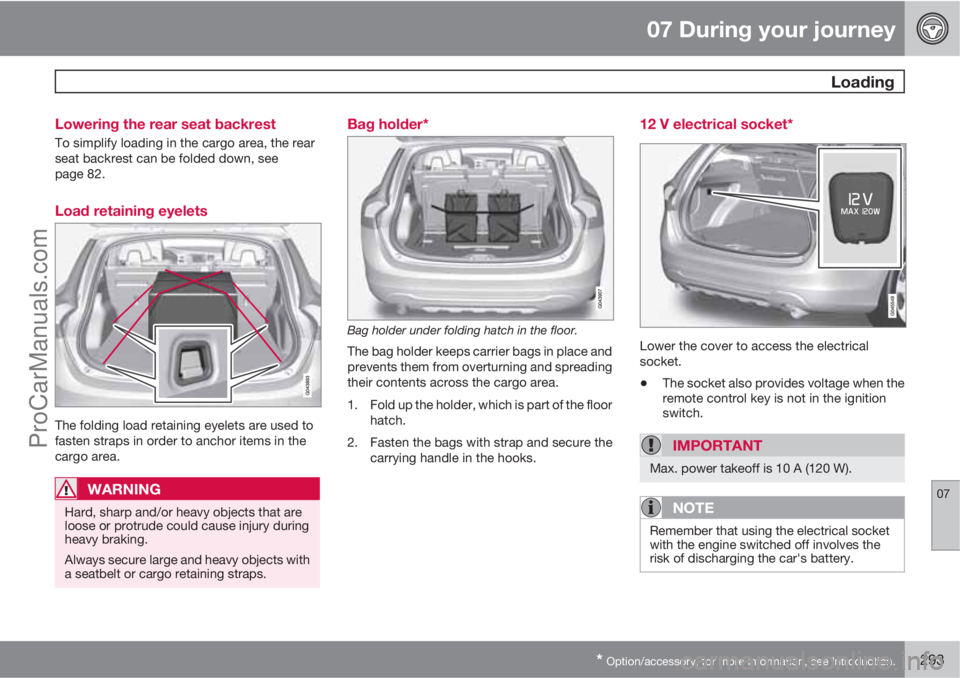
Load retaining eyelets
The folding load retaining eyelets are used to
fasten straps in order to anchor items in the
cargo area.
WARNING
Hard, sharp and/or heavy objects that are
loose or protrude could cause injury during
heavy braking.
Always secure large and heavy objects with
a seatbelt or cargo retaining straps.
Bag holder*
Bag holder under folding hatch in the floor.
The bag holder keeps carrier bags in place and
prevents them from overturning and spreading
their contents across the cargo area.
1. Fold up the holder, which is part of the floor
hatch.
2. Fasten the bags with strap and secure the
carrying handle in the hooks.
12 V electrical socket*
Lower the cover to access the electrical
socket.
•The socket also provides voltage when the
remote control key is not in the ignition
switch.
IMPORTANT
Max. power takeoff is 10 A (120 W).
NOTE
Remember that using the electrical socket
with the engine switched off involves the
risk of discharging the car's battery.
ProCarManuals.com
Page 306 of 422

07 During your journey
Towing and recovery
07
304
Towing
Find out the statutory maximum speed limit for
towing before towing begins.
1. Unlock the steering lock by inserting the
remote control key in the ignition switch
and giving a long press on the START/
STOP ENGINE button - key position II is
activated, see page 78 for more informa-
tion on key positions.
2. The remote control key must remain in the
ignition switch while the car is being towed.
3. Keep the towline taut when the towing
vehicle reduces speed by holding your foot
gently pressed on the brake pedal -
thereby avoiding unnecessary jerking.
4. Be prepared to brake to stop.
WARNING
•Check that the steering lock is unlocked
before towing.
•The remote control key must be in key
position II - in position I all airbags are
deactivated.
•Never remove the remote control key
from the ignition switch when the car is
being towed.
WARNING
The brake servo and power steering do not
work when the engine is switched off - the
brake pedal needs to be depressed
about 5 times more heavily and the steering
is considerably heavier than normal.
Manual gearboxPrior to towing:
–Move gear lever into neutral and release
the parking brake.
Automatic gearbox Geartronic
IMPORTANT
Note that the car must always be towed with
the wheels rolling forward.
•Cars with automatic gearbox must not
be towed at speeds above 80 km/h or
further than 80 km.
Prior to towing:
–
Move the gear selector to position N and
release the parking brake.
Automatic gearbox PowershiftThe model with Powershift transmission
should not be towed as it is dependent on the
engine running in order to receive sufficientlubrication. If towing still has to take place, the
route must be as short as possible and then
with very low speed.
In the event of uncertainty as to whether or not
the car is equipped with Powershift transmis-
sion, this can be verified by checking the des-
ignation on the transmission's label under the
bonnet - see page 370. The designa-
tion ”MPS6” means that it is Powershift – trans-
mission otherwise it is Geartronic automatic
transmission.
IMPORTANT
Avoid towing.
•However, the car can be towed for a
short distance at low speed to move it
from a dangerous position - not further
than 10 km and not faster than
10 km/h. Note that the car must always
be towed with the wheels rolling for-
ward.
•In the event of moving a longer distance
than 10 km, the car must be transported
with the drive wheels raised from the
road - professional recovery is recom-
mended.
Prior to towing:
–
Move the gear selector to position N and
release the parking brake.
ProCarManuals.com
Page 331 of 422

09 Maintenance and service
Engine compartment09
329
Turn the handle about 20-25 degrees
clockwise. You will hear when the catch
releases.
Move the catch to the left and open the
bonnet. (The catch hook is located
between the headlamp and grille, see illus-
tration.)
WARNING
Check that the bonnet locks properly when
closed.
Engine compartment, overview
The appearance of the engine compartment may
vary depending on engine variant.
Coolant expansion tank
Power steering fluid reservoir
Engine oil dipstick1
Radiator
Filling engine oil
Reservoir for brake and clutch fluid
(located on the driver's side)
Battery
Relay and fuse box
Filling washer fluid
Air filter
WARNING
The ignition system has very high voltage
and output. The voltage in the ignition sys-
tem is highly dangerous. The remote control
key must always be in 0 position when work
is being done in the engine compartment,
see page 78.
Do not touch the spark plugs or ignition coil
when the remote control key is in II position
or when the engine is hot.
Checking the engine oil
1Engines with electronic oil level sensor have no dipstick (5-cyl. diesel).
ProCarManuals.com
Page 338 of 422

09 Maintenance and service
Lamps 09
336
3. (Second illustration)
Detach the headlamp connector by
pressing down the clip with your thumb.
At the same time, guide out the con-
nector with your other hand.
4. Lift out the headlamp and place it on a soft
surface to avoid scratching the lens.
5. Replace the bulb in question.
Securing the headlamp
1. Plug in the connector, a clicking sound
should be heard.
2. Reinstall the headlamp and locking pins.
The short pin is fitted closest to the grille.
Check that they are correctly inserted.
3. Check the lighting.The headlamp must be mounted and the con-
nector correctly installed before the lighting is
switched on or the remote control key is
inserted into the ignition switch.
Removing the cover
Before starting to replace a bulb, see
page 335.
1. Unscrew the cover's four screws with the
tool (1) in the tool kit, see page 310. They
should not be detached completely.
(3 - 4 turns are sufficient.)
IMPORTANT
Use the tool in the toolkit to remove and
attach this correctly.
2. Slide the cover to one side.
3. Remove the cover.
Reinstall the cover in reverse order.
Dipped beam, halogen
1. Detach the headlamp, see page 335.
2. Remove the cover.
3. Unplug the connector from the bulb.
4. Detach the bulb by pulling it straight out.
5. The guide pin on the lamp should be
straight up when it is fitted and a clicking
sound should be heard when it clicks into
place.
Reinstall the parts in reverse order.
ProCarManuals.com
Page 343 of 422

09 Maintenance and service
Wiper blades and washer fluid09
341 Wiper blades
Service position
Wiper blades in service position.
In order to change, clean or lift the wiper blades
(for scraping off ice from the windscreen, for
example) they must be in service position.
IMPORTANT
Before placing the wiper blades in the serv-
ice position, make sure that they are not fro-
zen down.
1. Insert the remote control key in the ignition
switch1 and briefly press the START/
STOP ENGINE button to set the car's elec-trical system to key position I. (For detailed
information on key positions, see page 78.)
2.
Briefly press the START/STOP ENGINE
button again to set the car’s electrical sys-
tem in key position 0.
3. Within 3 seconds, move the right stalk
switch up and hold it in position for
approx. 1 second.
> The wipers then move to standing
straight up.
The wipers return to their starting position
when you briefly press the START/STOP
ENGINE button to set the car’s electrical sys-
tem to key position I (or when the car is
started).
IMPORTANT
If the wiper arms in service position have
been folded up from the windscreen, they
must be folded back down onto the wind-
screen before the wipers are allowed to
return to their starting position. This is to
avoid scraping the paint on the bonnet.
NOTE
Once the wiper arms have been in service
position, the wipers must be activated and
deactivated before service position can be
used again.
Replacing the wiper blades
1Not necessary in cars with Keyless function.
ProCarManuals.com