Page 562 of 740

562 4-3. Do-it-yourself maintenance
CAUTION
The engine compartment contains many mechanisms and fluids that may
move suddenly, become hot, or become electrically energized. To avoid death
or serious injury observe the following precautions.
■When working on the engine compartment
●Keep hands, clothing, and tools away from the moving fan and engine
drive belt.
● Be careful not to touch the engine, radiator, exhaust manifold, etc. right
after driving as they may be hot. Oil and other fluids may also be hot.
● Do not leave anything that may burn easily, such as paper or rags, in the
engine compartment.
● Do not smoke, cause sparks or expose an open flame to fuel or the bat-
tery. Fuel and battery fumes are flammable.
● Be extremely cautious when working on the battery. It contains poisonous
and corrosive sulfuric acid.
● Take care because brake fluid can harm your hands or eyes and damage
painted surfaces.
If fluid gets on your hands or in your eyes, flush the affected area with
clean water immediately.
If you still experience discomfort, see a doctor.
■ When working near the cooling fans or radiator grille
Be sure the engine switch is in the LOCK position.
With the engine switch on, the cooling fans may automatically start to run if
the air conditioning is on and/or the coolant temperature is high.
■ Safety glasses
Wear safety glasses to prevent flying or falling material, fluid spray, etc. from
getting in the eyes.
Page 564 of 740
564
4-3. Do-it-yourself maintenance
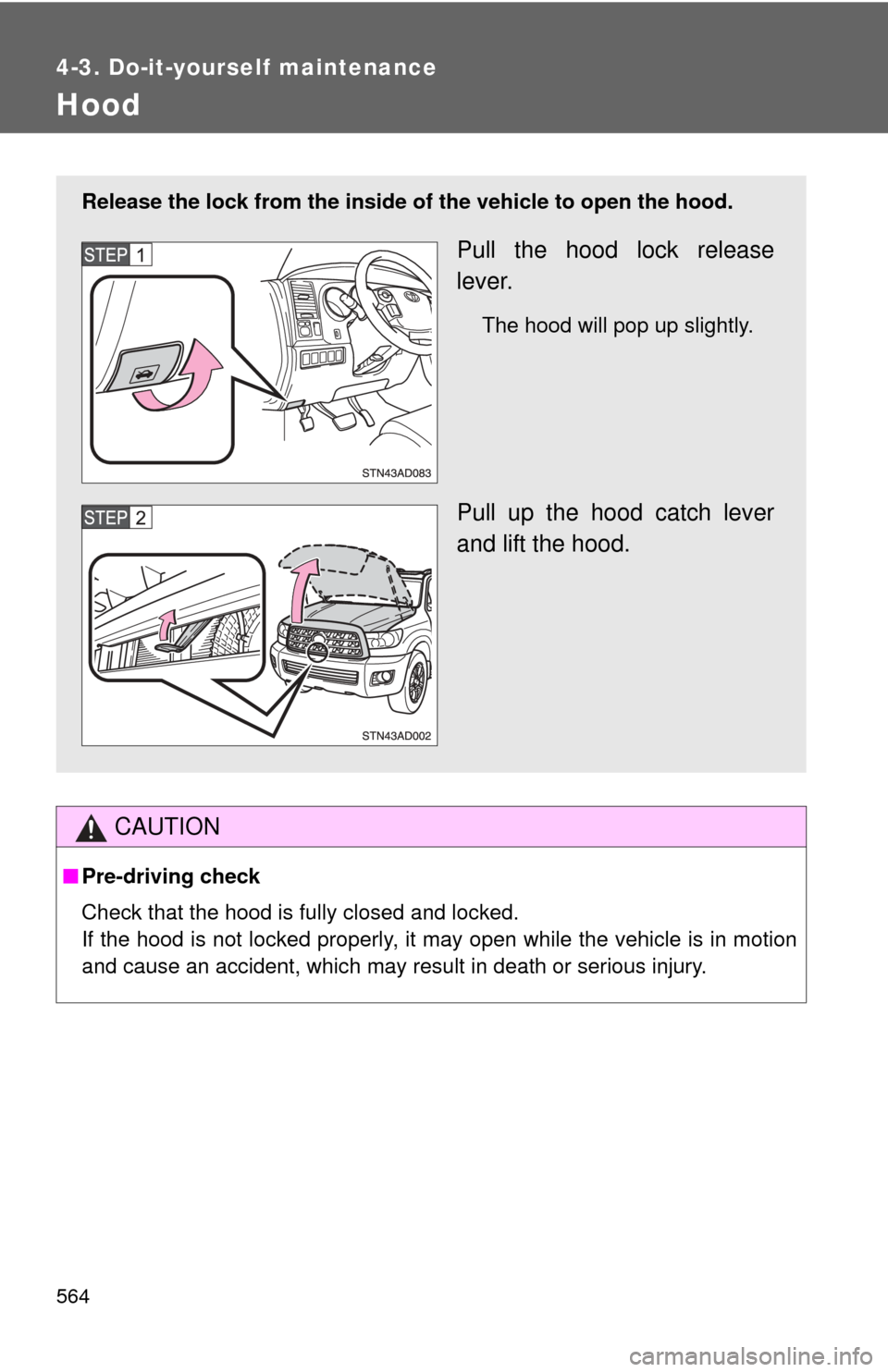
Hood
CAUTION
■Pre-driving check
Check that the hood is fully closed and locked.
If the hood is not locked properly, it may open while the vehicle is in motion
and cause an accident, which may result in death or serious injury.
Release the lock from the inside of the vehicle to open the hood.
Pull the hood lock release
lever.
The hood will pop up slightly.
Pull up the hood catch lever
and lift the hood.
Page 567 of 740
567
4-3. Do-it-yourself maintenance
4
Maintenance and care
■
Adding engine oil
If the oil level is below or near
the low level mark, add engine
oil of the same type as already in
the engine.
Make sure to check the oil type and prepare the items needed before
adding oil. Remove the oil filler cap, turning it counterclockwise.
Add engine oil slowly.
Checking the dipstick.
Reinstall the filler cap, turning it clockwise.
The approximate quantity of oil needed to raise the level between low and
full on the dipstick is indicated as follows:
1.6 qt. (1.5 L, 1.3 lmp. qt.)
Engine oil selection P. 680
ItemsClean funnel
Page 574 of 740
574 4-3. Do-it-yourself maintenance
Power steering fluid■ Fluid level
The fluid level should be within the appropriate range.
Full (when cold)
Add fluid (when cold)
Full (when hot)
Add fluid (when hot)
Hot: Vehicle has been driven around 50 mph (80 km/h) for 20 minutes, or slightly longer in frigid temperatures. (Fluid
temperature, 140°F - 175°F [60°C - 80°C])
Cold: Engine has not been run for about 5 hours. (Room tem- perature, 50°F - 85°F[10°C - 30°C])
■ Checking the fluid level
Make sure to check the fluid type and prepare the necessary items.
Clean all dirt off the reservoir.
Remove the cap by turning it counterclockwise.
Wipe the dipstick clean.
Reinstall and remove the reservoir cap again.
Check the fluid level.
Fluid type Automatic transmission fluid DEXRON® II or III
Items Rag or paper towel and funnel (only for adding fluid)
Page 582 of 740
582 4-3. Do-it-yourself maintenance
Push and hold the tire pressure
warning reset switch until the tire
pressure warning light blinks
slowly 3 times.
Wait for several minutes with the engine switch on, and then
turn the engine switch to the ACC or LOCK position.
Registering ID codes
The tire pressure warning valve and transmitter is equipped with a
unique ID code. When replacing a tire pressure warning valve and
transmitter, it is necessary to regi ster the ID code of tire pressure
warning valve and transmitter. Have the ID code registered by your
Toyota dealer.
■When to replace your vehicle’s tires
Tires should by replaced if:
●You have tire damage such as cuts, splits, cracks deep enough to
expose the fabric or bulges indicating internal damage
●A tire goes flat repeatedly or c annot be properly repaired due to the
size or location of a cut or other damage
If you are not sure, consult with your Toyota dealer.
Page 603 of 740

603
4-3. Do-it-yourself maintenance
4
Maintenance and care
13 POWER NO.4 25 A Power windows
14 FOG 15 A Front fog lights
15 STOP 15 A
Stop lights, high mounted stop-
light, vehicle stability control sys-
tem, anti-lock brake system, shift
lock system, multiport fuel injection
system/sequential multiport fuel
injection system, towing converter
16 TOW BRK 30 A Trailer brake controller
17 IMB 7.5 A Multiport fuel injection system/
sequential multiport fuel injection
system
18 AM2 7.5 A Starting system
19 TOWING 30 A Towing converter
20 AI-HTR 10 A Air injection pump heaters
21 ALT-S 5 A Charging system
22 TURN-HAZ 15 A Turn signal lights, emergency
flashers, towing converter
23 F/PMP 25 A Fuel pump
24 ETCS 10 A Multiport fuel injection system/
sequential multiport fuel injection
system, electric throttle control sys-
tem
25 MET-B 5 A Gauges and meters
26 AMP 30 A Audio system, rear view monitor,
navigation system, rear seat enter-
tainment system
27 RAD NO.1 15 A Audio system, rear view monitor,
navigation system, rear seat enter-
tainment system
FuseAmpereCircuit
Page 605 of 740

605
4-3. Do-it-yourself maintenance
4
Maintenance and care
39 AIR SUS NO.2 7.5 A
Electronically modulated air sus-
pension system
40 SPARE 5 A Spare fuse
41 SPARE 15 A Spare fuse
42 SPARE 30 A Spare fuse
43 AIR SUS 50 A Electronically modulated air sus-
pension system
44 PBD 30 A Power back door
45 RR HTR 40 A Air conditioning system
46 H-LP CLN 30 A Headlight cleaner
47 DEFOG 40 A Rear window defogger
48 SUB BATT 40 A Trailer towing
49 ABS1 50 A Anti-lock brake system, vehicle sta-
bility control system
50 ABS2 40 A Anti-lock brake system, vehicle sta-
bility control system
51 ST 30 A Starting system
52 HTR 50 A Air conditioning system
53 LH-J/B 150 A AM1, TAIL, PANEL, ACC, CIG, LH-
IG, 4WD, ECU-IG NO.1, BK/UP LP,
SEAT-HTR, A/C IG, ECU-IG NO.2,
WSH, WIPER, OBD, A/C, TI&TE,
FR P/SEAT RH, MIR, DR/LCK, FR
P/SEAT LH, CARGO LP, PWR
OUTLET, POWER NO.1 fuses
54 ALT 180 A
*LH-J/B, HTR, SUB BATT, TOW
BRK, STOP, FOG, TOW TAIL,
DEICER fuses
140 A
*
55 A/PUMP NO.1 50 A Multiport fuel injection system/
sequential multiport fuel injection
system
FuseAmpereCircuit
Page 607 of 740
607
4-3. Do-it-yourself maintenance
4
Maintenance and care
■
Under the instrument panel
FuseAmpereCircuit
1 INVERTER 15 A Power outlet (120 V)
2 FR P/SEAT LH 30 A Power front driver’s seat
3 DR/LCK 25 A Multiplex communication system
4 POWER No.5 30 A Power back door
5 OBD 7.5 A On-board diagnosis system
6 PWR OUTLET 15 A Power outlets
7 AM1 7.5 A Shift lock system, starting system,
seat heaters
8 A/C 7.5 A Air conditioning system
9 MIR 15 A Outside rear view mirror control,
outside rear view mirror heaters
10 POWER No.3 20 A Power windows 11 FR P/SEAT RH 30 A Power front passenger seat
12 TI&TE 15 A Power tilt and power telescopic
13 S/ROOF 25 A Electric moon roof
14 RR SEAT-HTR
RH 10 A Seat heaters