Page 253 of 684
253
2-5. Driving information
2
When driving
■
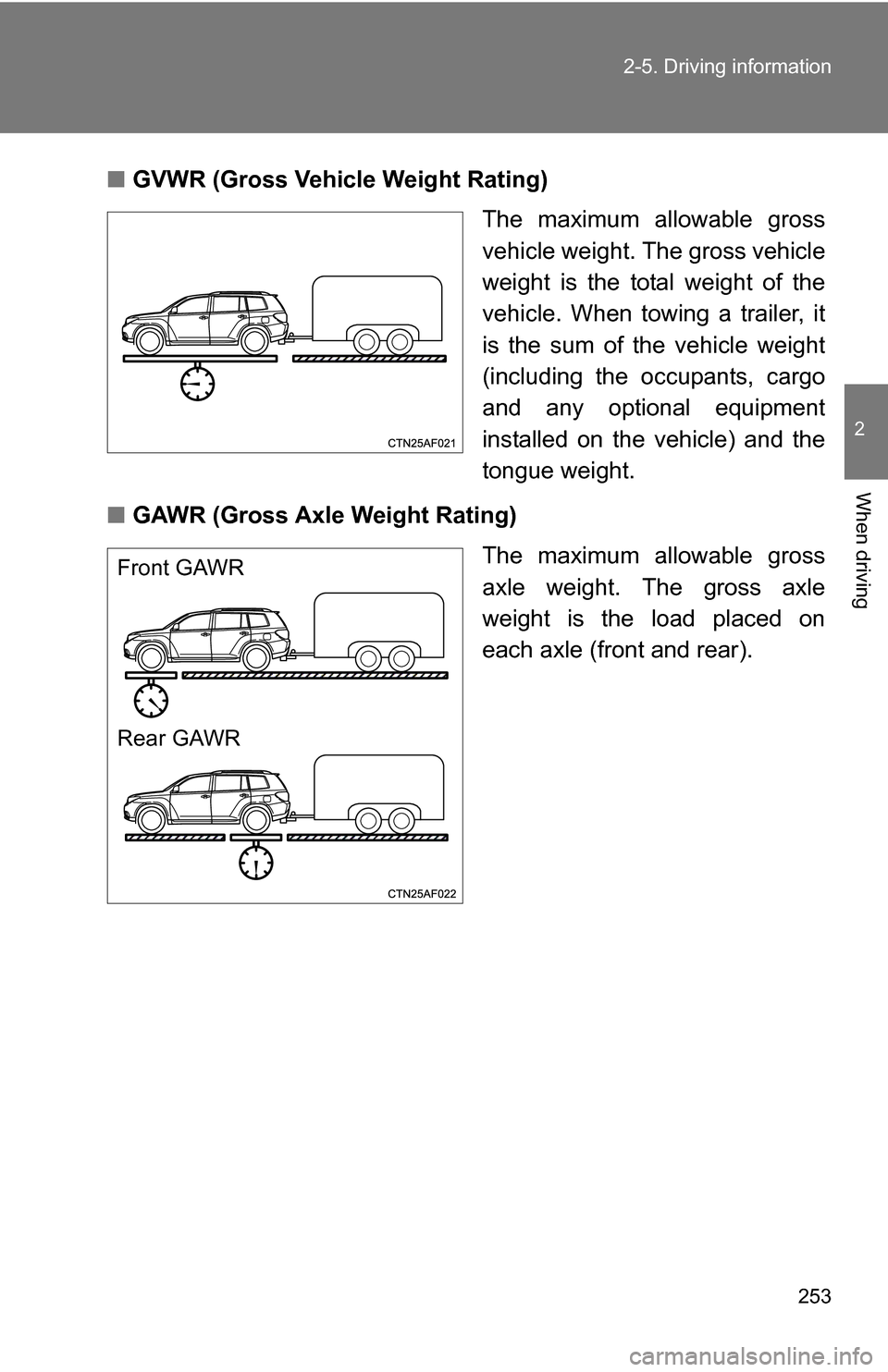
GVWR (Gross Vehicle Weight Rating)
The maximum allowable gross
vehicle weight. The gross vehicle
weight is the total weight of the
vehicle. When towing a trailer, it
is the sum of the vehicle weight
(including the occupants, cargo
and any optional equipment
installed on the vehicle) and the
tongue weight.
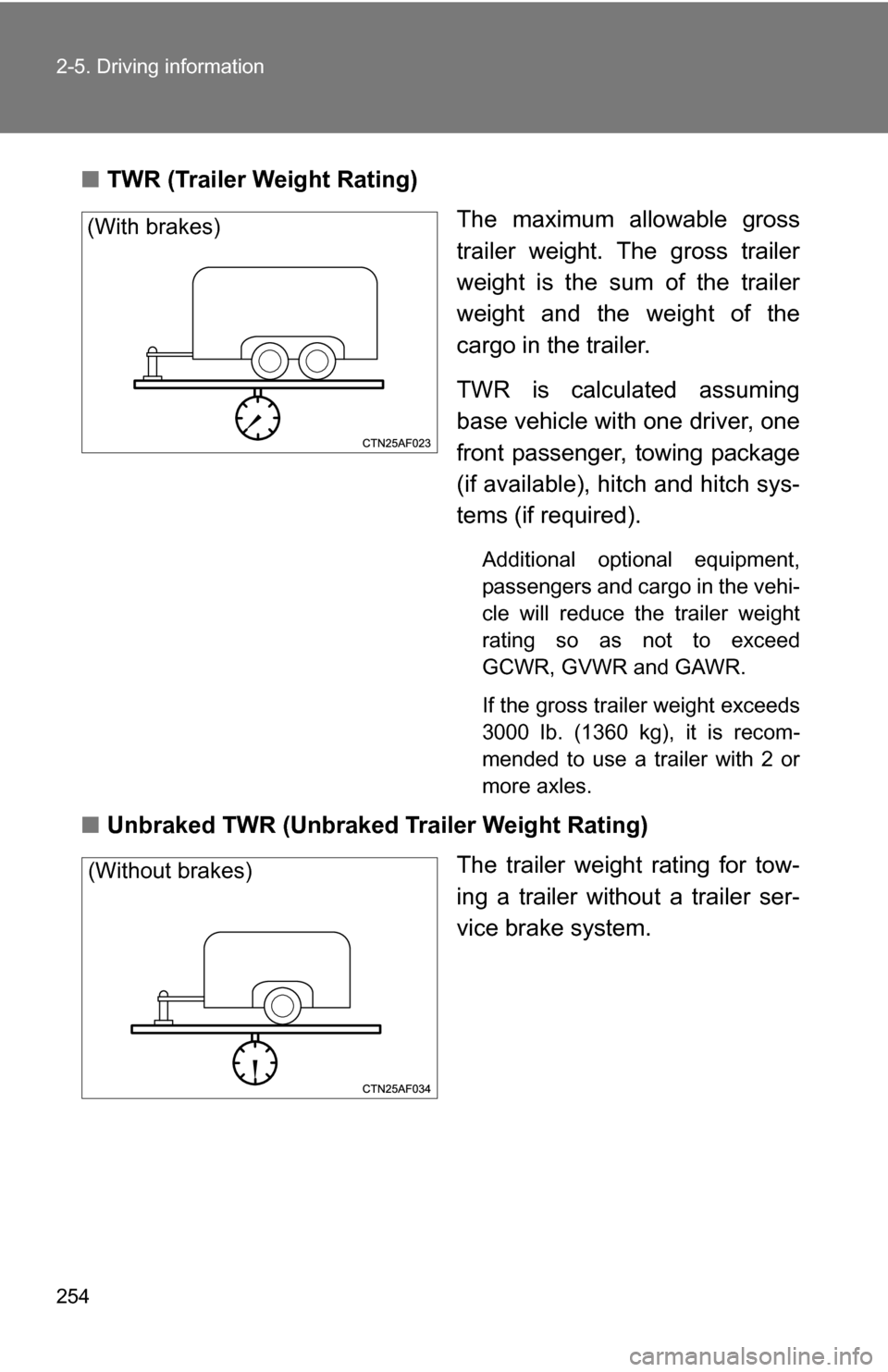
■ GAWR (Gross Axle Weight Rating)
The maximum allowable gross
axle weight. The gross axle
weight is the load placed on
each axle (front and rear).
Front GAWR
Rear GAWR
Page 254 of 684
254 2-5. Driving information
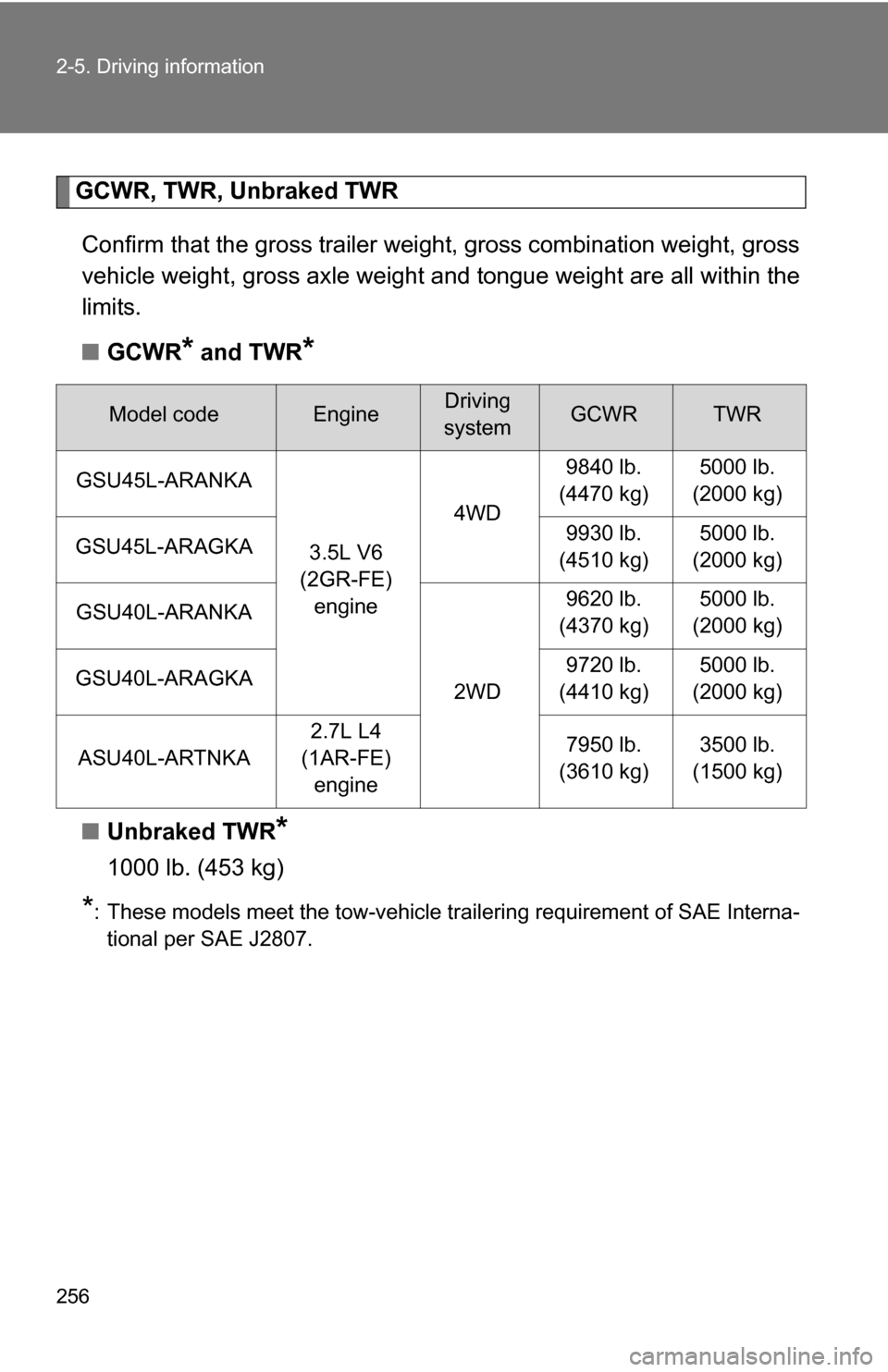
■TWR (Trailer Weight Rating)
The maximum allowable gross
trailer weight. The gross trailer
weight is the sum of the trailer
weight and the weight of the
cargo in the trailer.
TWR is calculated assuming
base vehicle with one driver, one
front passenger, towing package
(if available), hitch and hitch sys-
tems (if required).
Additional optional equipment,
passengers and cargo in the vehi-
cle will reduce the trailer weight
rating so as not to exceed
GCWR, GVWR and GAWR.
If the gross trailer weight exceeds
3000 lb. (1360 kg), it is recom-
mended to use a trailer with 2 or
more axles.
■Unbraked TWR (Unbraked Trailer Weight Rating)
The trailer weight rating for tow-
ing a trailer without a trailer ser-
vice brake system.
(With brakes)
(Without brakes)
Page 256 of 684
256 2-5. Driving information
GCWR, TWR, Unbraked TWRConfirm that the gross trailer weight, gross combination weight, gross
vehicle weight, gross axle weight and tongue weight are all within the
limits.
■ GCWR
* and TWR*
■Unbraked TWR*
1000 lb. (453 kg)
*: These models meet the tow-vehicle trailering requirement of SAE Interna-
tional per SAE J2807.
Model codeEngineDriving
systemGCWRTWR
GSU45L-ARANKA
3.5L V6
(2GR-FE) engine 4WD
9840 lb.
(4470 kg) 5000 lb.
(2000 kg)
GSU45L-ARAGKA 9930 lb.
(4510 kg) 5000 lb.
(2000 kg)
GSU40L-ARANKA
2WD9620 lb.
(4370 kg) 5000 lb.
(2000 kg)
GSU40L-ARAGKA 9720 lb.
(4410 kg) 5000 lb.
(2000 kg)
ASU40L-ARTNKA 2.7L L4
(1AR-FE) engine 7950 lb.
(3610 kg) 3500 lb.
(1500 kg)
Page 257 of 684
257
2-5. Driving information
2
When driving
Trailer Tongue Weight
● A recommended tongue weight varies in accordance with the types
of trailers or towing as described below.
● To ensure the recommended values shown below, the trailer must
be loaded by referring to the following instructions.
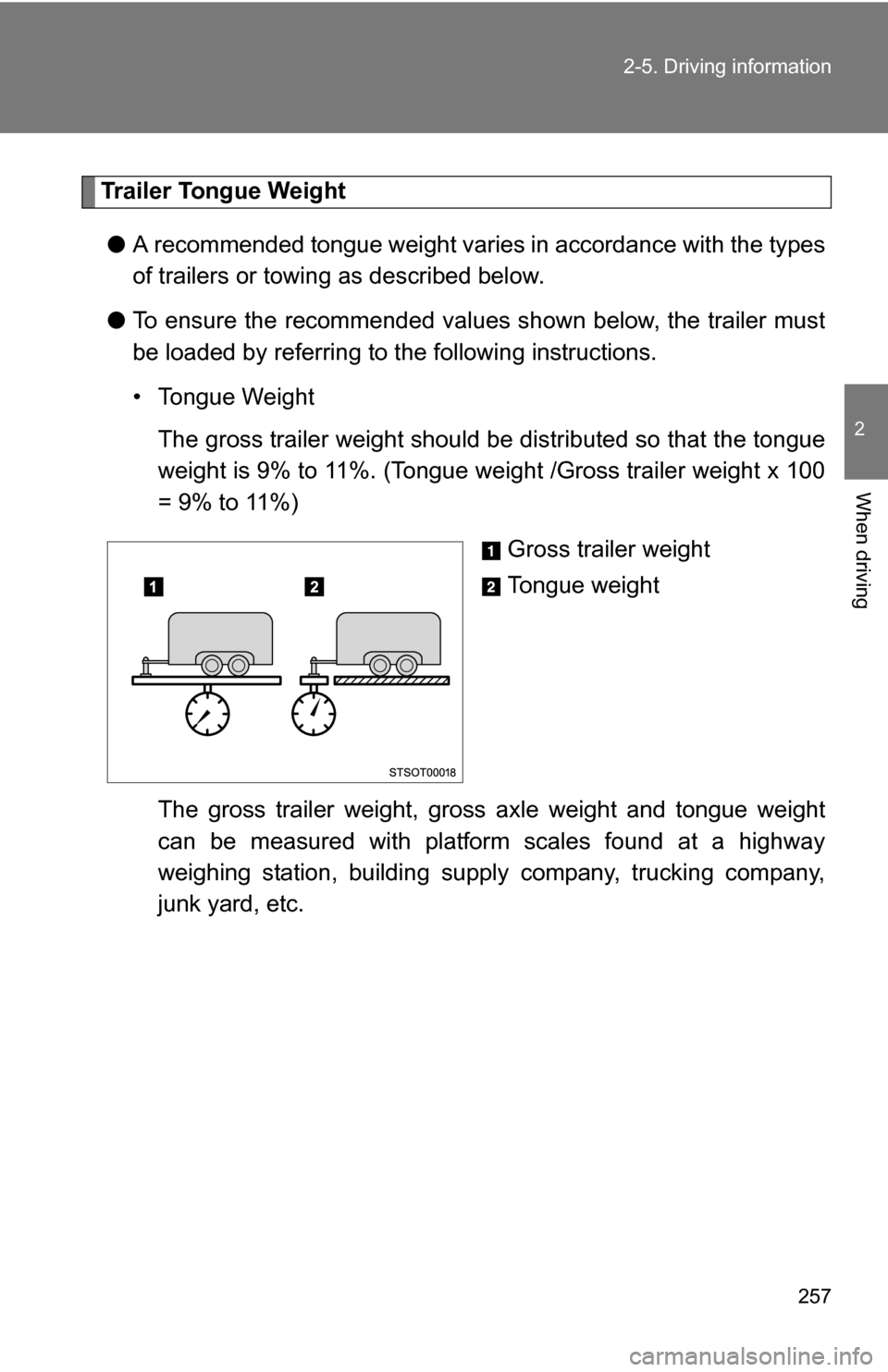
• Tongue Weight
The gross trailer weight should be distributed so that the tongue
weight is 9% to 11%. (Tongue weight /Gross trailer weight x 100
= 9% to 11%)
Gross trailer weight
Tongue weight
The gross trailer weight, gross axle weight and tongue weight
can be measured with platform scales found at a highway
weighing station, building supply company, trucking company,
junk yard, etc.
Page 258 of 684
258 2-5. Driving information
HitchTrailer hitch assemblies have different weight capacities. Toyota rec-
ommends the use of Toyota hitch/brac ket for your vehicle. For details,
contact your Toyota dealer.
● If you wish to install a trailer hitch, contact your Toyota dealer.
● Use only a hitch that c onforms to the gross trailer weight require-
ment of your vehicle.
● Follow the directions supplied by the hitch manufacturer.
● Lubricate the hitch ball with a light coating of grease.
● Remove the trailer hitch whenever you are not towing a trailer.
After removing the hitch, seal any mounting hole in the vehicle
body to prevent entry of any substances into the vehicle.
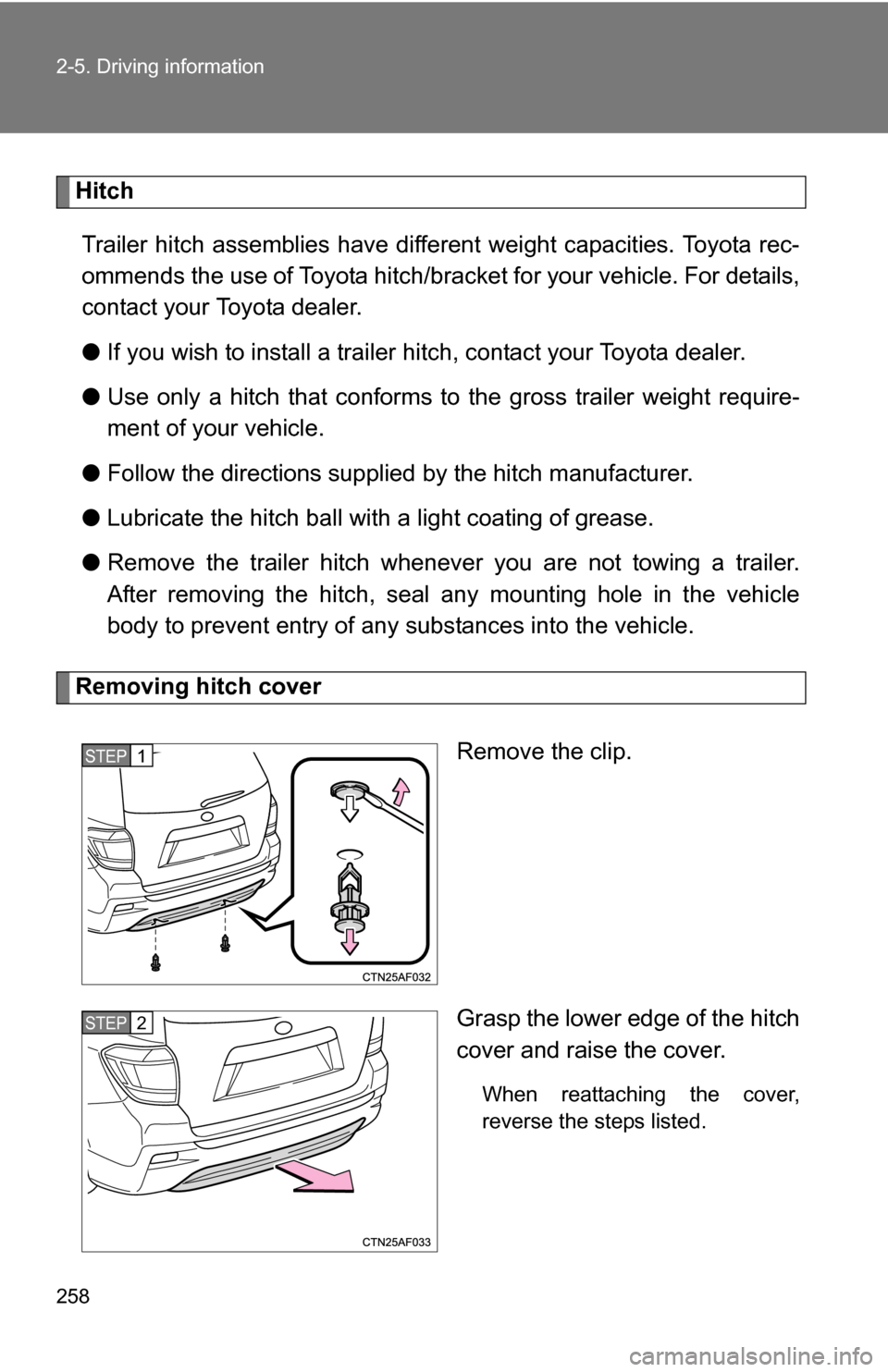
Removing hitch cover
Remove the clip.
Grasp the lower edge of the hitch
cover and raise the cover.
When reattaching the cover,
reverse the steps listed.
STEP1
STEP2
Page 260 of 684
260 2-5. Driving information
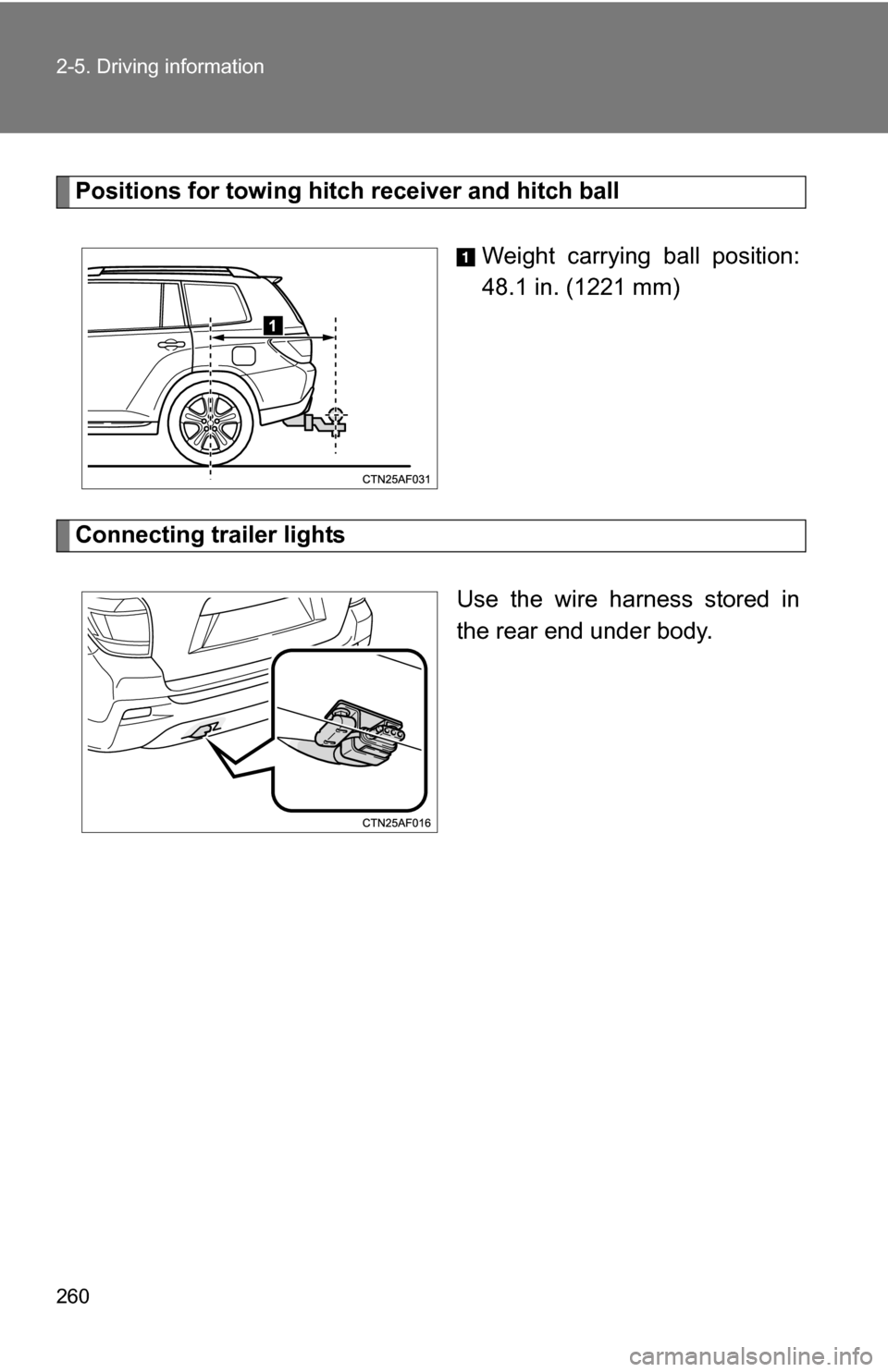
Positions for towing hitch receiver and hitch ballWeight carrying ball position:
48.1 in. (1221 mm)
Connecting trailer lightsUse the wire harness stored in
the rear end under body.
Page 261 of 684
261
2-5. Driving information
2
When driving
Trailer towing tips
Your vehicle will handle differently when towing a trailer. Help to avoid
an accident, death or serious injury, keep the following in mind when
towing:
● Speed limits for towing a trailer vary by state or province. Do not
exceed the posted towing speed limit.
● Toyota recommends that the vehicle-trailer speed limit is 65 mph
(104 km/h) on a flat, straight, dry road. Do not exceed this limit, the
posted towing speed limit or the speed limit for your trailer as set
forth in your trailer owner’s man ual, whichever is lowest. Instability
of the towing vehicle-trailer combin ation (trailer sway) increases as
speed increases. Exceeding speed limits may cause loss of con-
trol.
● Before starting out, check the trailer lights, tires and the vehicle-
trailer connections. Recheck after driving a short distance.
● Practice turning, stopping and reve rsing with the trailer attached in
an area away from traffic until you become accustomed to the feel
of the vehicle-trailer combination.
● Reversing with a trailer attached is difficult and requires practice.
Grip the bottom of the steering wheel and move your hand to the
left to move the trailer to the left. Move your hand to the right to
move the trailer to the right. (Thi s is generally opposite to reversing
without a trailer attached.) Avoid sharp or prolonged turning. Have
someone guide you when reversing to reduce the risk of an acci-
dent.
● As stopping distance is increased when towing a trailer, vehicle-to-
vehicle distance should be increased. For each 10 mph (16 km/h)
of speed, allow at least o ne vehicle and trailer length.
● Avoid sudden braking as you may skid, resulting in the trailer jack-
knifing and a loss of vehicle control. This is especially true on wet
or slippery surfaces.
Page 264 of 684
264 2-5. Driving information
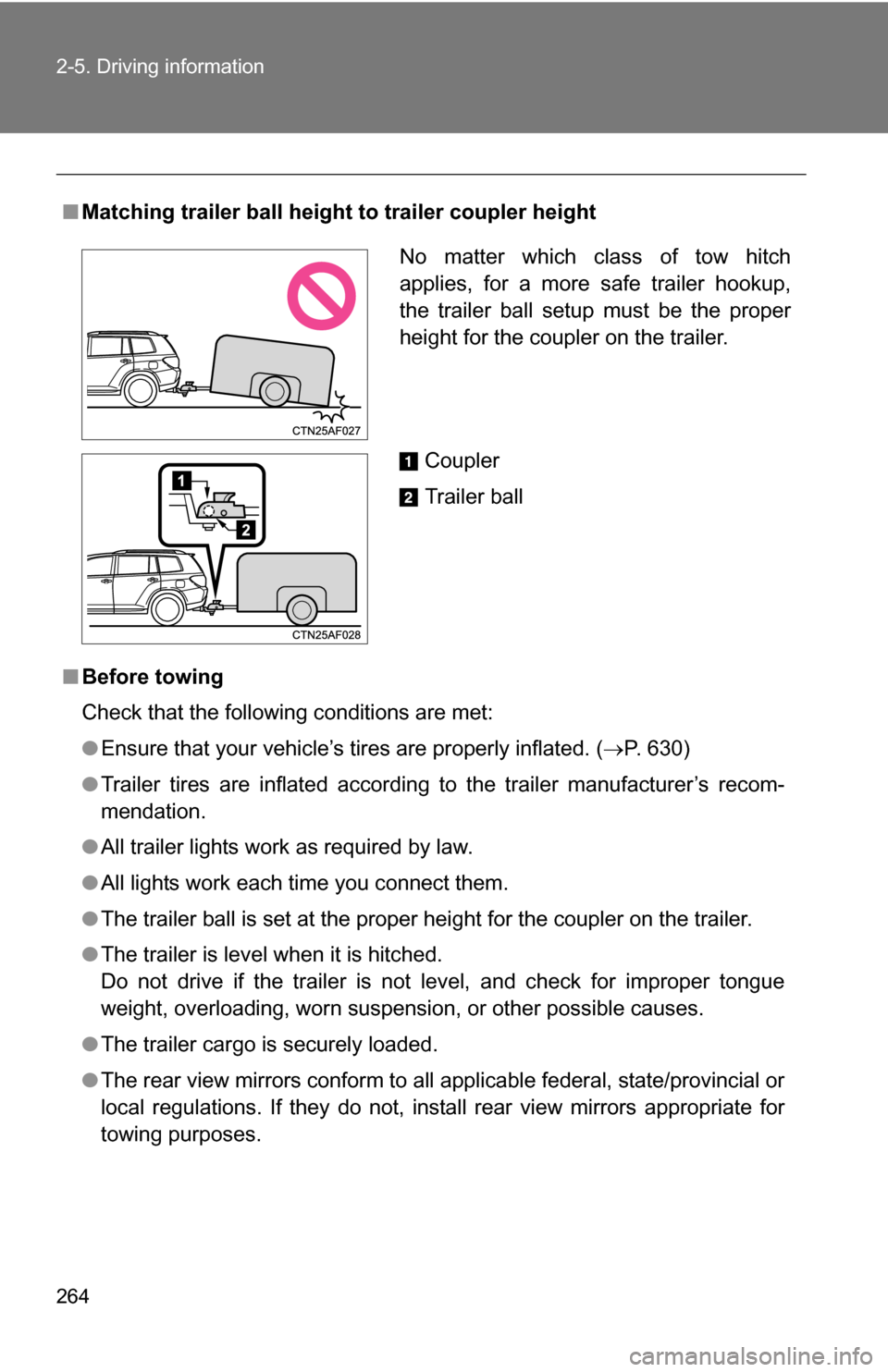
■Matching trailer ball height to trailer coupler height
■ Before towing
Check that the following conditions are met:
●Ensure that your vehicle’s tires are properly inflated. ( P. 630)
● Trailer tires are inflated according to the trailer manufacturer’s recom-
mendation.
● All trailer lights work as required by law.
● All lights work each time you connect them.
● The trailer ball is set at the proper height for the coupler on the trai\
ler.
● The trailer is level when it is hitched.
Do not drive if the trailer is not level, and check for improper tongue
weight, overloading, worn suspension, or other possible causes.
● The trailer cargo is securely loaded.
● The rear view mirrors conform to all applicable federal, state/provincial or
local regulations. If they do not, install rear view mirrors appropriate for
towing purposes.
No matter which class of tow hitch
applies, for a more safe trailer hookup,
the trailer ball setup must be the proper
height for the coupler on the trailer.
Coupler
Trailer ball