Page 132 of 207
Downloaded from www.Manualslib.com manuals search engine 5-37OTHER CONTROLS AND EQUIPMENT
60MK0-14E
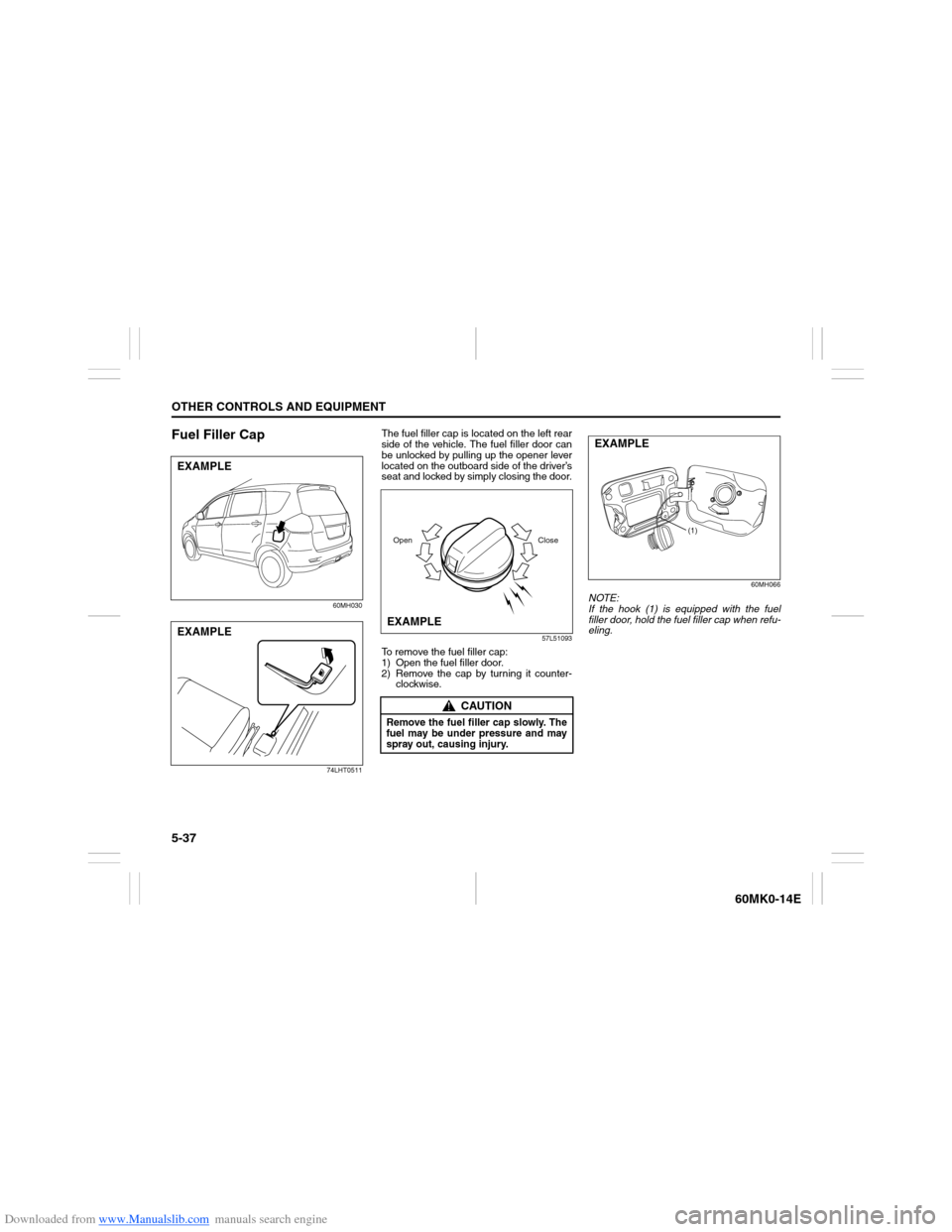
Fuel Filler Cap
60MH030
74LHT0511
The fuel filler cap is located on the left rear
side of the vehicle. The fuel filler door can
be unlocked by pulling up the opener lever
located on the outboard side of the driver’s
seat and locked by simply closing the door.
57L51093
To remove the fuel filler cap:
1) Open the fuel filler door.
2) Remove the cap by turning it counter-
clockwise.
EXAMPLEEXAMPLE
CAUTION
Remove the fuel filler cap slowly. The
fuel may be under pressure and may
spray out, causing injury.Open CloseEXAMPLE
60MH066
NOTE:
If the hook (1) is equipped with the fuel
filler door, hold the fuel filler cap when refu-
eling.
(1)
EXAMPLE
Page 138 of 207
Downloaded from www.Manualslib.com manuals search engine 5-43OTHER CONTROLS AND EQUIPMENT
60MK0-14E
Cup Holder and Storage AreaFront
74LHT0520
Passenger side
74LHT0529
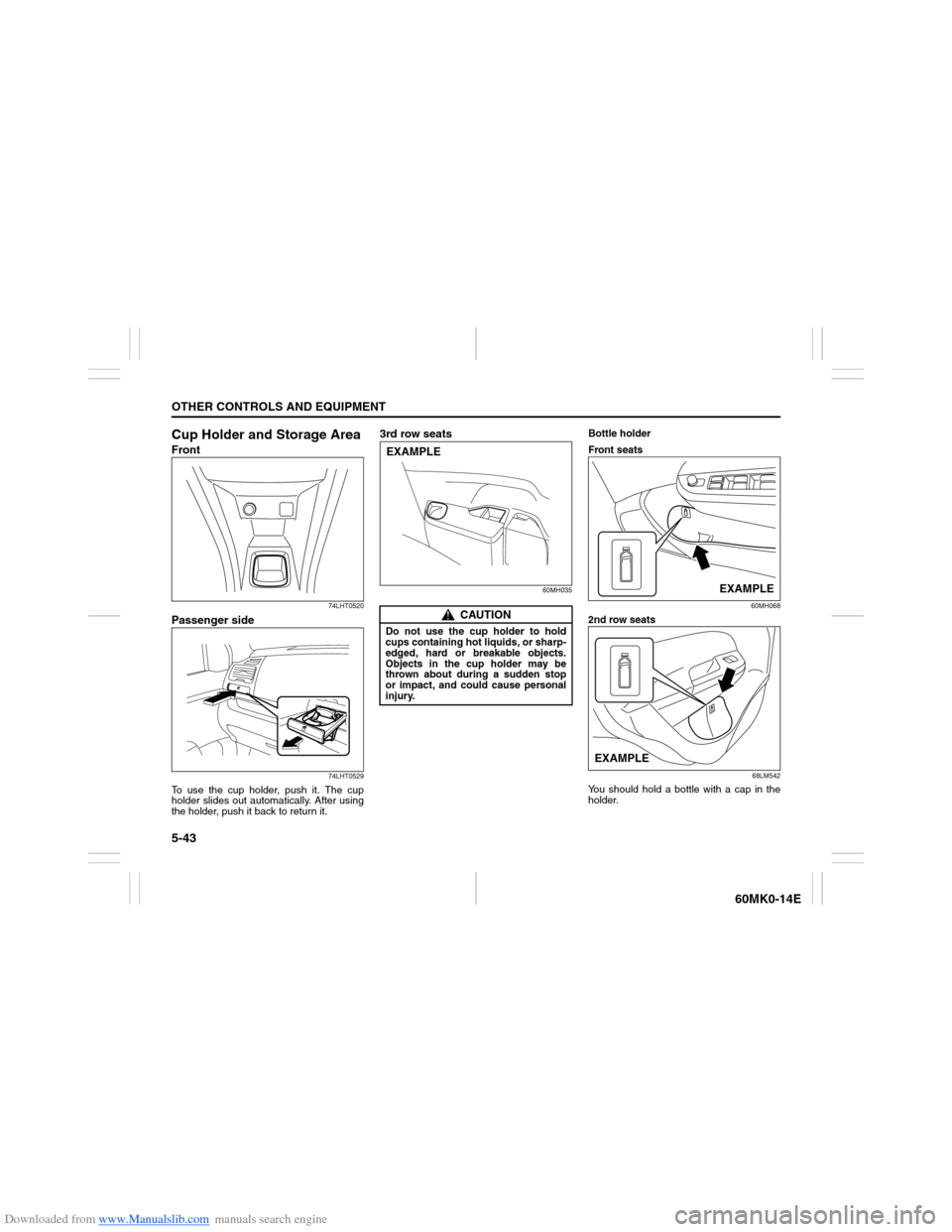
To use the cup holder, push it. The cup
holder slides out automatically. After using
the holder, push it back to return it.
3rd row seats
60MH035
Bottle holder
Front seats
60MH068
2nd row seats
68LM542
You should hold a bottle with a cap in the
holder.
CAUTION
Do not use the cup holder to hold
cups containing hot liquids, or sharp-
edged, hard or breakable objects.
Objects in the cup holder may be
thrown about during a sudden stop
or impact, and could cause personal
injury.EXAMPLE
EXAMPLE
EXAMPLE
Page 139 of 207
Downloaded from www.Manualslib.com manuals search engine 5-44
OTHER CONTROLS AND EQUIPMENT
60MK0-14E
Front Seat Back Pocket
(if equipped)
60MH078
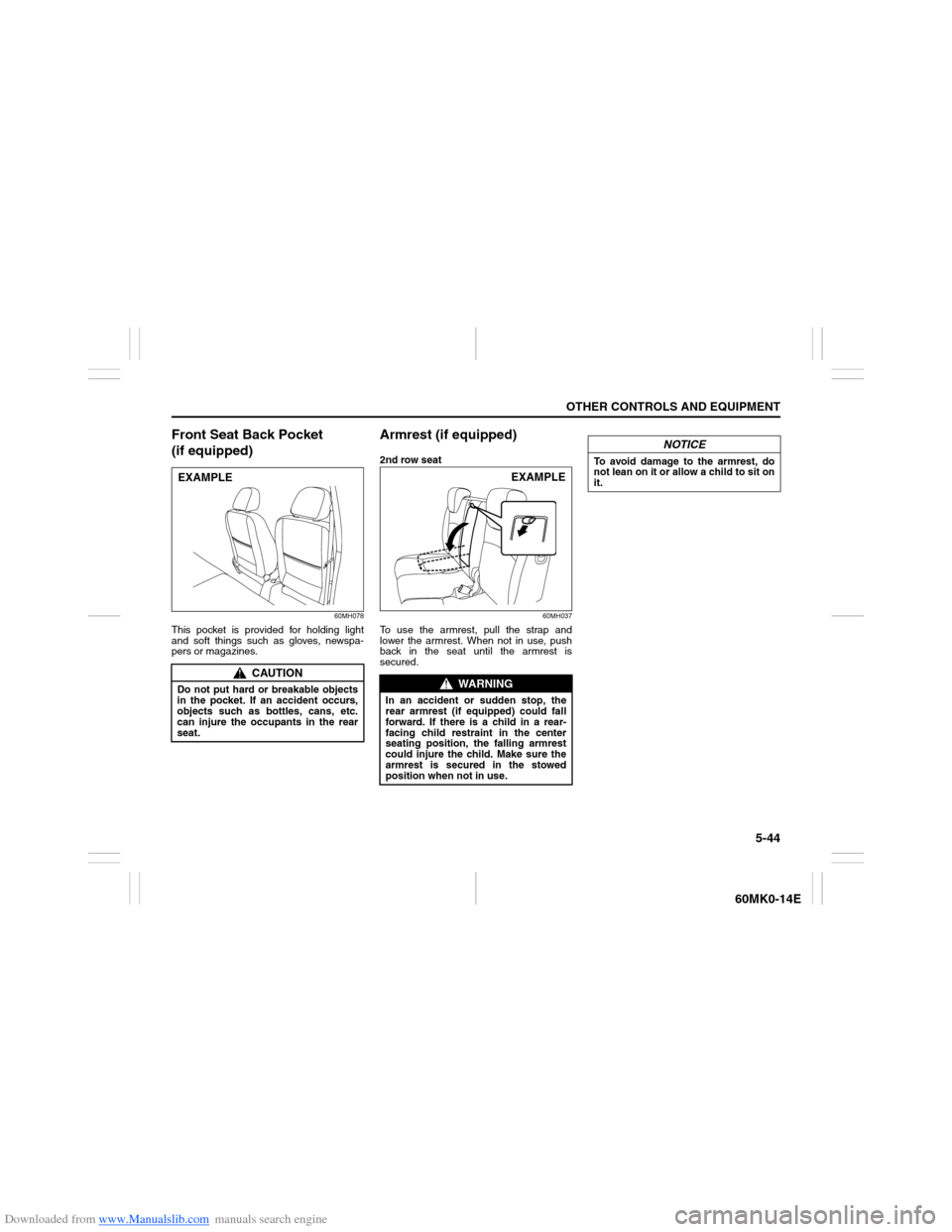
This pocket is provided for holding light
and soft things such as gloves, newspa-
pers or magazines.
Armrest (if equipped)2nd row seat
60MH037
To use the armrest, pull the strap and
lower the armrest. When not in use, push
back in the seat until the armrest is
secured.
CAUTION
Do not put hard or breakable objects
in the pocket. If an accident occurs,
objects such as bottles, cans, etc.
can injure the occupants in the rear
seat.EXAMPLE
WARNING
In an accident or sudden stop, the
rear armrest (if equipped) could fall
forward. If there is a child in a rear-
facing child restraint in the center
seating position, the falling armrest
could injure the child. Make sure the
armrest is secured in the stowed
position when not in use.
EXAMPLE
NOTICE
To avoid damage to the armrest, do
not lean on it or allow a child to sit on
it.
Page 144 of 207

Downloaded from www.Manualslib.com manuals search engine 6-1VEHICLE LOADING AND TOWING
60MK0-14E
Vehicle LoadingYour vehicle was designed for specific
weight capacities. The weight capacities of
your vehicle are indicated by the Gross
Vehicle Weight Rating (GVWR) and the
Gross Axle Weight Rating (GAWR, front
and rear). The GVWR and GAWR (front
and rear) are listed in the “SPECIFICA-
TIONS” section.
GVWR – Maximum permissible overall
weight of the fully loaded vehicle (including
all the occupants, accessories and cargo
plus the trailer nose weight if towing a
trailer).
GAWR – (Front and Rear) Maximum per-
missible weight on an individual axle.
Actual weight of the loaded vehicle and
actual loads at the front and rear axles can
only be determined by weighing the vehi-
cle. Compare these weights to the GVWR
and GAWR (front and rear). If the gross
vehicle weight or the load on either axle
exceeds these ratings, you must remove
enough weight to bring the load down to
the rated capacity.
Trailer TowingYour SUZUKI was originally designed to
carry people and a normal amount of
cargo, not to tow a trailer. SUZUKI does
not recommend you use your vehicle to
tow a trailer. Towing a trailer can adversely
affect handling, durability, and fuel econ-
omy.
WARNING
Never overload your vehicle. The
gross vehicle weight (sum of the
weights of the vehicle, all the occu-
pants, accessories, cargo plus trailer
nose weight if towing a trailer) must
never exceed the Gross Vehicle
Weight Rating (GVWR). In addition,
never distribute a load so that the
weight on either the front or rear axle
exceeds the Gross Axle Weight Rat-
ing (GAWR).
WARNING
Always distribute cargo evenly. To
avoid personal injury or damage to
your vehicle, always secure cargo to
prevent it from shifting if the vehicle
moves suddenly. Place heavier
objects on the floor and as far for-
ward in the cargo area as possible.
Never pile cargo higher than the top
of the seat backs.
Page 146 of 207
Downloaded from www.Manualslib.com manuals search engine 7-1INSPECTION AND MAINTENANCE
60MK0-14E
60B128S
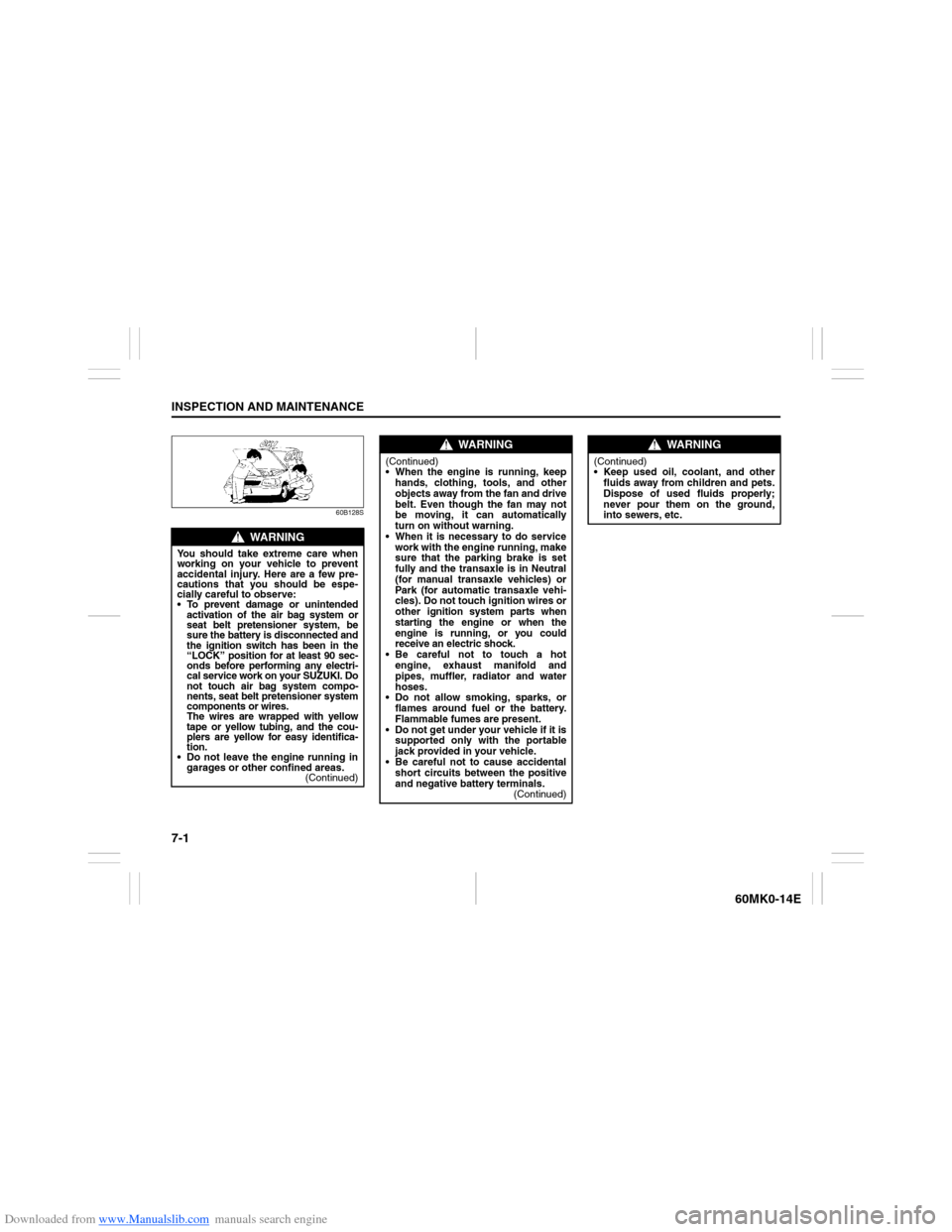
WARNING
You should take extreme care when
working on your vehicle to prevent
accidental injury. Here are a few pre-
cautions that you should be espe-
cially careful to observe:
To prevent damage or unintended
activation of the air bag system or
seat belt pretensioner system, be
sure the battery is disconnected and
the ignition switch has been in the
“LOCK” position for at least 90 sec-
onds before performing any electri-
cal service work on your SUZUKI. Do
not touch air bag system compo-
nents, seat belt pretensioner system
components or wires.
The wires are wrapped with yellow
tape or yellow tubing, and the cou-
plers are yellow for easy identifica-
tion.
Do not leave the engine running in
garages or other confined areas.
(Continued)
WARNING
(Continued)
When the engine is running, keep
hands, clothing, tools, and other
objects away from the fan and drive
belt. Even though the fan may not
be moving, it can automatically
turn on without warning.
When it is necessary to do service
work with the engine running, make
sure that the parking brake is set
fully and the transaxle is in Neutral
(for manual transaxle vehicles) or
Park (for automatic transaxle vehi-
cles). Do not touch ignition wires or
other ignition system parts when
starting the engine or when the
engine is running, or you could
receive an electric shock.
Be careful not to touch a hot
engine, exhaust manifold and
pipes, muffler, radiator and water
hoses.
Do not allow smoking, sparks, or
flames around fuel or the battery.
Flammable fumes are present.
Do not get under your vehicle if it is
supported only with the portable
jack provided in your vehicle.
Be careful not to cause accidental
short circuits between the positive
and negative battery terminals.
(Continued)
WARNING
(Continued)
Keep used oil, coolant, and other
fluids away from children and pets.
Dispose of used fluids properly;
never pour them on the ground,
into sewers, etc.
Page 155 of 207
Downloaded from www.Manualslib.com manuals search engine 7-10
INSPECTION AND MAINTENANCE
60MK0-14E
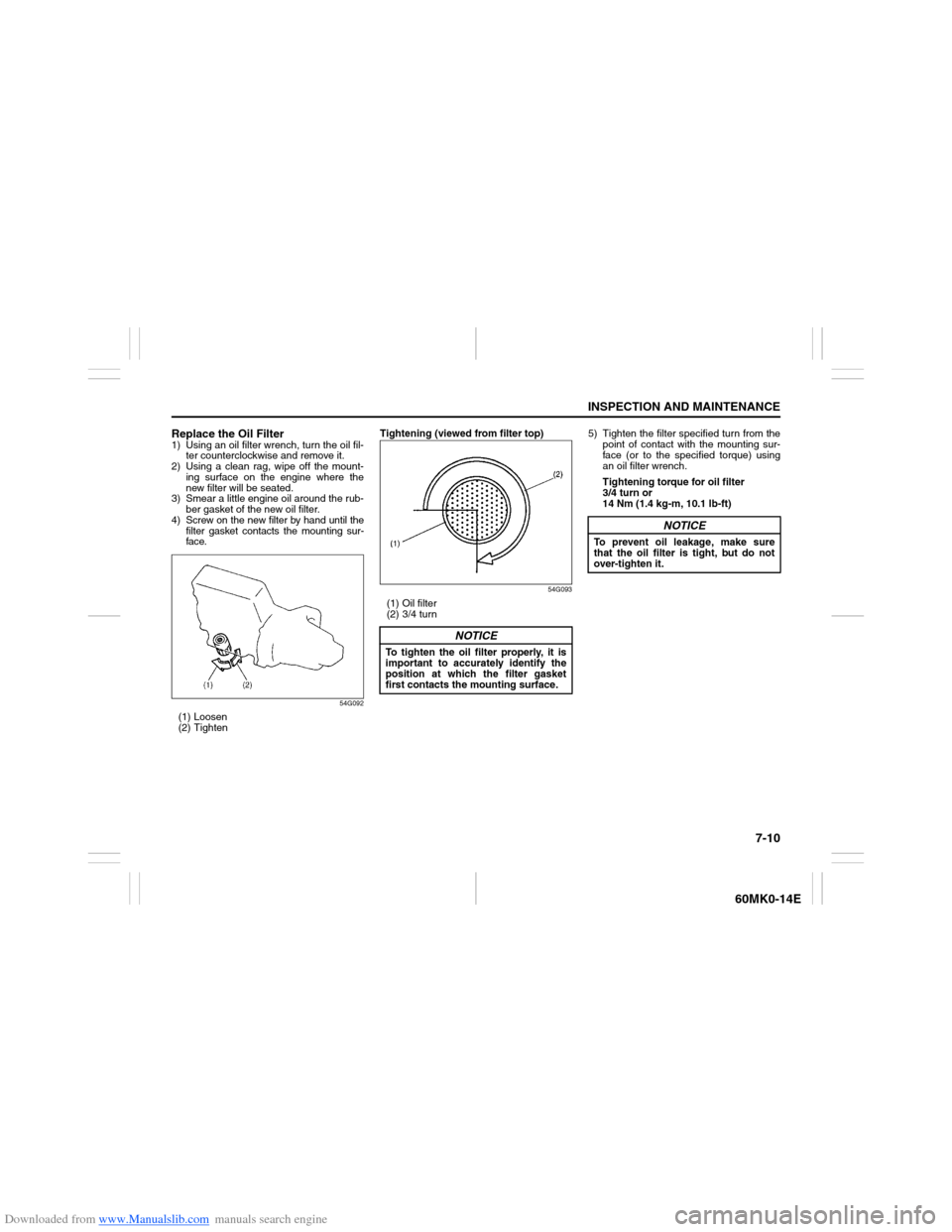
Replace the Oil Filter1) Using an oil filter wrench, turn the oil fil-
ter counterclockwise and remove it.
2) Using a clean rag, wipe off the mount-
ing surface on the engine where the
new filter will be seated.
3) Smear a little engine oil around the rub-
ber gasket of the new oil filter.
4) Screw on the new filter by hand until the
filter gasket contacts the mounting sur-
face.
54G092
(1) Loosen
(2) TightenTightening (viewed from filter top)
54G093
(1) Oil filter
(2) 3/4 turn5) Tighten the filter specified turn from the
point of contact with the mounting sur-
face (or to the specified torque) using
an oil filter wrench.
Tightening torque for oil filter
3/4 turn or
14 Nm (1.4 kg-m, 10.1 lb-ft)
NOTICE
To tighten the oil filter properly, it is
important to accurately identify the
position at which the filter gasket
first contacts the mounting surface.
NOTICE
To prevent oil leakage, make sure
that the oil filter is tight, but do not
over-tighten it.
Page 162 of 207
Downloaded from www.Manualslib.com manuals search engine 7-17INSPECTION AND MAINTENANCE
60MK0-14E
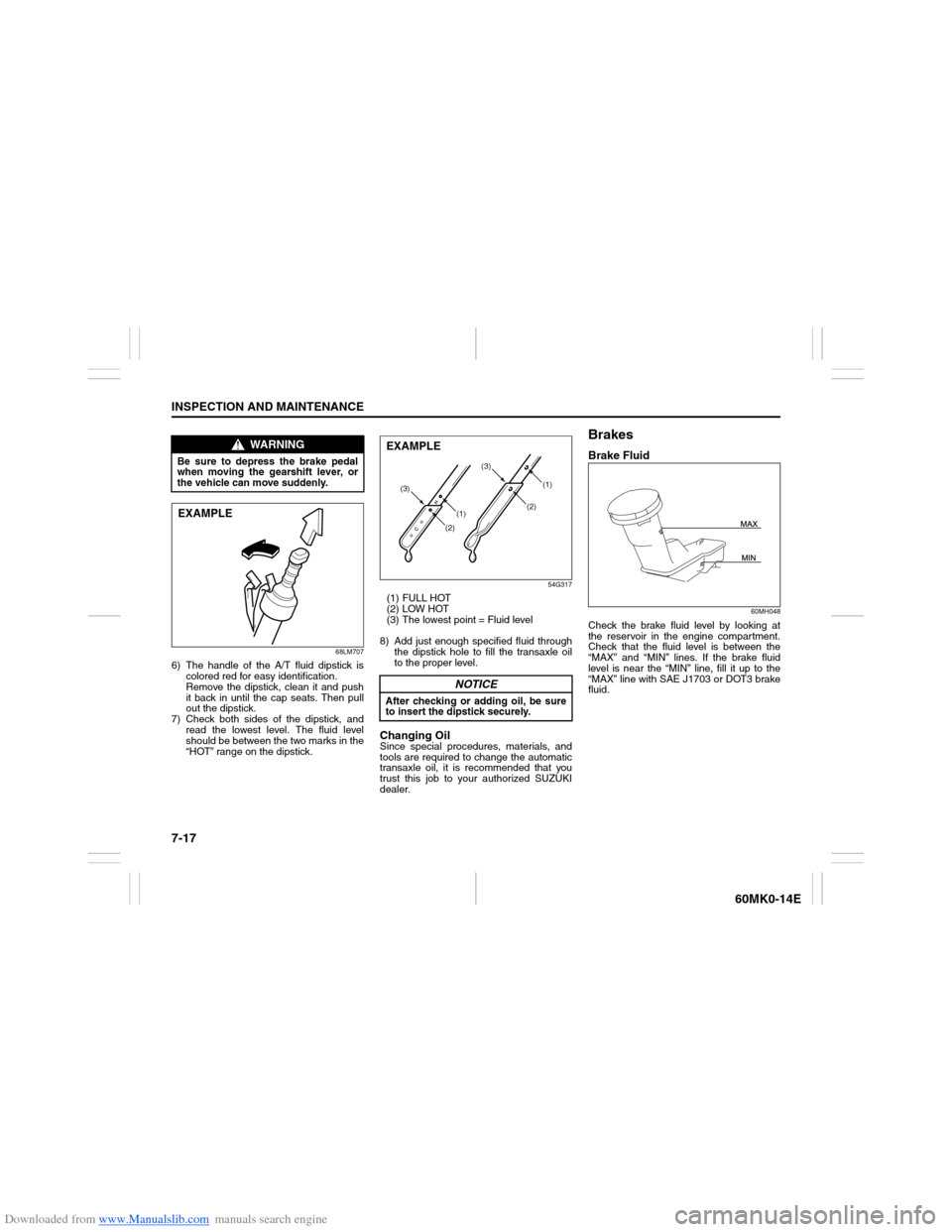
68LM707
6) The handle of the A/T fluid dipstick is
colored red for easy identification.
Remove the dipstick, clean it and push
it back in until the cap seats. Then pull
out the dipstick.
7) Check both sides of the dipstick, and
read the lowest level. The fluid level
should be between the two marks in the
“HOT” range on the dipstick.
54G317
(1) FULL HOT
(2) LOW HOT
(3) The lowest point = Fluid level
8) Add just enough specified fluid through
the dipstick hole to fill the transaxle oil
to the proper level.Changing OilSince special procedures, materials, and
tools are required to change the automatic
transaxle oil, it is recommended that you
trust this job to your authorized SUZUKI
dealer.
BrakesBrake Fluid
60MH048
Check the brake fluid level by looking at
the reservoir in the engine compartment.
Check that the fluid level is between the
“MAX” and “MIN” lines. If the brake fluid
level is near the “MIN” line, fill it up to the
“MAX” line with SAE J1703 or DOT3 brake
fluid.
WARNING
Be sure to depress the brake pedal
when moving the gearshift lever, or
the vehicle can move suddenly.EXAMPLE
NOTICE
After checking or adding oil, be sure
to insert the dipstick securely.
(1)(2) (3)(1)
(2)(3)
EXAMPLE
Page 186 of 207
Downloaded from www.Manualslib.com manuals search engine 8-5EMERGENCY SERVICE
60MK0-14E
Changing WheelsTo change a wheel, use the following pro-
cedure:
1) Remove the jack, tools and spare wheel
from the vehicle.
2) Loosen, but do not remove the wheel
nuts.
3) Jack up the vehicle (follow the jacking
instructions in this section).
4) Remove the wheel nuts and wheel.
5) Before installing the new wheel, clean
any mud or dirt off from the surface of
the wheel and hub with a clean cloth.
Clean the hub carefully; it may be hot
from driving.
6) Install the new wheel and replace the
wheel nuts with their cone shaped end
facing the wheel. Tighten each nuts
snugly by hand until the wheel is
securely seated on the hub.
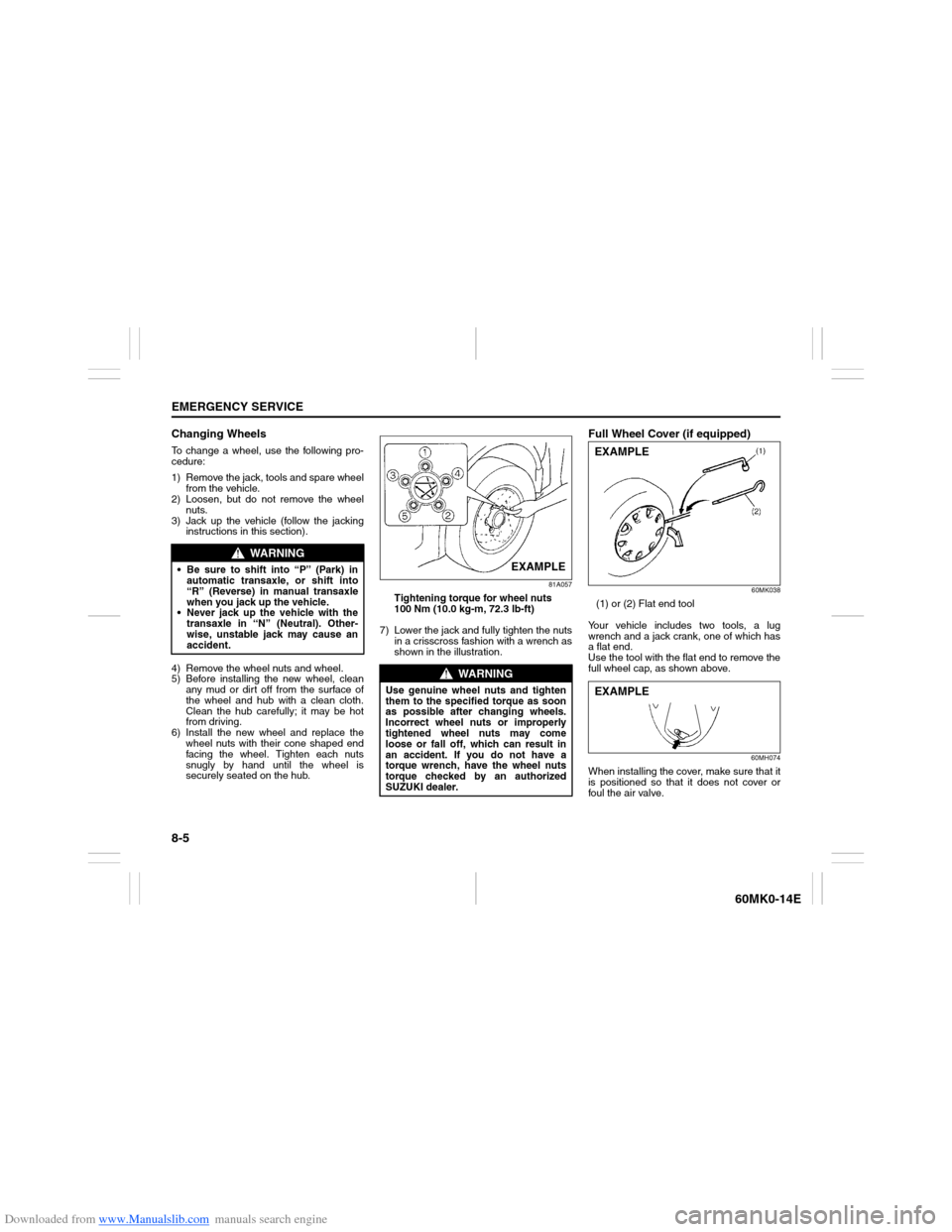
81A057
Tightening torque for wheel nuts
100 Nm (10.0 kg-m, 72.3 lb-ft)
7) Lower the jack and fully tighten the nuts
in a crisscross fashion with a wrench as
shown in the illustration.
Full Wheel Cover (if equipped)
60MK038
(1) or (2) Flat end tool
Your vehicle includes two tools, a lug
wrench and a jack crank, one of which has
a flat end.
Use the tool with the flat end to remove the
full wheel cap, as shown above.
60MH074
When installing the cover, make sure that it
is positioned so that it does not cover or
foul the air valve.
WARNING
Be sure to shift into “P” (Park) in
automatic transaxle, or shift into
“R” (Reverse) in manual transaxle
when you jack up the vehicle.
Never jack up the vehicle with the
transaxle in “N” (Neutral). Other-
wise, unstable jack may cause an
accident.
WARNING
Use genuine wheel nuts and tighten
them to the specified torque as soon
as possible after changing wheels.
Incorrect wheel nuts or improperly
tightened wheel nuts may come
loose or fall off, which can result in
an accident. If you do not have a
torque wrench, have the wheel nuts
torque checked by an authorized
SUZUKI dealer.
EXAMPLE
EXAMPLEEXAMPLE