2013 SKODA YETI ECU
[x] Cancel search: ECUPage 72 of 266

›Remove the head restraint from the rear middle seat
» page 67.›Push the outer rear seats towards the rear as far as they will go » page 68, Set-
ting theSetting the seats in the longitudinal direction .›
Pull the lever
A
» Fig. 49 on page 68 and fold the seat backrests of the outer
rear seats onto the seat cushion as far as the stop.
›
Fold the middle rear seat backrest forwards in the same way, then pull once more on the lever
A
» Fig. 49 on page 68 and press the seat backrest down-
wards until it is heard to lock into a lower position.
Folding seats fully forwards and locking them
›
If the outer rear seat is fully folded forward, push it towards the rear as far as it
can go.
›
Pull the lever
B
» Fig. 50 in the direction of the arrow
1
and push the seat
completely forward in the direction of arrow
2
.
›
Secure the folded forward seat with the aid of the fixing belt B to a guide rod of
the head restraint in the front seat » Fig. 51.
WARNING■
Immediately lock the folded forward seat to a guide rod on the front head
restraint using the fixing belt - risk of injury.■
The following guidelines must be observed » page 162, Correct seated posi-
tion for the driver .
CAUTION
■
Before folding the rear middle seat forward, make sure that the storage com-
partment, the ashtray and the cup holder in the rear part of the centre console
are closed - risk of damage.■
Only keep the seats in the folded forward position for as long as necessary to
transport cargo - there is a risk of damaging the front seat backrests. The seats must be folded back once the cargo has been transported.
■
If the outer seat is not in the rear end position when folding forward, damage
can occur to the locking bolts when unlocking the seat.
Unlocking and removing seatsFig. 52
Unlocking the folded forward
seat and carrying handles on the
seat surface
First read and observe the introductory information given on page 67.
›
Fold the seat forward » page 68, Fold downseat backrest and seat fold down
completely .
›
Unlock the folded seat by pressing seat locks
A
in the direction of ar-
row » Fig. 52 .
›
Remove the seat using the carrying handles
B
or
C
.
WARNINGThe following guidelines must be observed » page 162, Correct seated posi-
tion for the passengers in the rear seats .
Note
The outer seats are not mutually interchangeable. In the rear area the left seat is
marked with the letter L and the right seat with the letter R.
69Seats and useful equipment
Page 73 of 266

Adjusting seats in crosswise directionFig. 53
Locking seats
First read and observe the introductory information given on page 67.
›
Remove the middle seat » page 69, Unlocking and removing seats .
›
Fold the outer seat forward » page 68 and unlock » Fig. 52 on page 69.
›
Move the folded forward and unlocked seat on the guide towards the middle of
the vehicle up to the stop.
›
Lock the folded forward seat by pressing the seat locks
A
in the direction of
arrow » Fig. 53 .
Folding back into the starting position is accomplished in the reverse order.
Folding seats back into the initial position
Fig. 54
Folding the seat backrest back
into positionFirst read and observe the introductory information given on page 67.›
If the seat has been removed, first position it on the guide and lock it in place using seat locking
A
» Fig. 53 on page 70 . Pull the seat upwards to ensure that
the seat is locked correctly.
›
Fold the seat in the horizontal position until it can be heard to click. Check for yourself that the seat can no longer be lifted by pulling it up.
›
Press the lever in direction of arrow » Fig. 54 and fold back the seat. Check for
yourself that the seat backrest is engaged by pulling on it.
›
Remove the tongue of the lock from the safety position.
WARNING■ The belt locks must be in their original position after folding back the seat
cushions and backrests - they must be ready to use.■
The seat backrests must be securely engaged so that objects from the boot
cannot slip into the passenger compartment on sudden braking – risk of in- jury!
■
When folding the seat backrest always make sure that it has safely locked
into position, this is confirmed by the position and a visible marking on the cover of the lever.
Practical equipment
Introduction
This chapter contains information on the following subjects:
Car park ticket holder
71
Storage compartment on the dashboard
71
Storage compartments in the doors
72
Storage compartment in the front central console
72
Cupholders
73
Cigarette lighter
74
Ashtray
74
12-volt power outlet
75
Waste container
76
Storage compartment under the front armrest
76
Storage net in the front centre console
77
70Using the system
Page 80 of 266

Closing storage compartment›Open the cover to the stop, only then can it be folded downwards and againstthe direction of the arrow 1
» Fig. 44 on page 65.
Opening air inlet
›
Pull the handle in the direction of the arrow » Fig. 67.
Closing air inlet
›
Push the shutter against the arrow direction until it stops » Fig. 67.
When the air vent is opened, the air flows into the stowage compartment with a
temperature corresponding to the control dial settings on the A/C unit, depending on the outer climate conditions.
The air inlet in the storage compartment is connected to position
through ad-
justment of the control dial for air distribution. This setting causes the maximum
amount of air to flow into the storage compartment (depending on the rotary reg-
ulator position for the fan).
If you do not use the air inlet in the storage compartment, the inlet should al-
ways be kept closed.
Storage net in the front centre console
Fig. 68
Storage net
First read and observe the introductory information and safety warn-
ings on page 70.
Located on the center console on the passenger side, a storage net providing storage for cards, magazines, etc. is provided » Fig. 68 .
WARNINGOnly store soft objects with a total weight of 0.5 kg in the storage net. Heavy
objects are not secured sufficiently – risk of injury!
CAUTION
Do not place any sharp objects into the net – risk of net damage.
Compartment for glasses
Fig. 69
Opening the glasses storage box
First read and observe the introductory information and safety warn-
ings on page 70.
Opening
›
Press the button » Fig. 69 .
The box folds in the direction of the arrow.
Closing
›
Swivel » Fig. 69 the lid on the glasses storage box against the direction of the
arrow until it is heard to lock.
WARNING■ The compartment must only be opened when removing or inserting the
spectacles and otherwise must be kept closed!■
The box must be closed before leaving and locking the vehicle – risk of im-
pairment to the functions of the anti-theft alarm system! 77Seats and useful equipment
Page 84 of 266

Removable ski bagFig. 76
Securing the removable
through-loading bag
First read and observe the introductory information and safety warn-
ings on page 70.
The removable through-loading bag is solely used for transporting skis.
Loading
›
Open a rear side door of the vehicle.
›
Fold the middle seat backrest forward » page 67, Rear seats .
›
Place the empty removable through-loading bag in the gap between the front
and rear seats in such a way that the end of the bag with the zip lies in the
boot.
›
Open the boot lid.
›
Push the skis into the removable through-loading bag from the boot » .
›
Close the removable through-loading bag with the zip.
Securing
›
Pull the securing belt with both lock tongues out of the pocket of the remova- ble through-loading bag.
›
Insert the lock tongues
A
» Fig. 76 in the belt locks of the rear middle seat belt
C
, first on the one side and then on the other side.
›
Place the securing belt in the middle of the skis between the heel and the tip of
the bindings and pull the securing belt tight at the free end of the belt
B
.
WARNING■ After placing the skis into the through-loading bag, you must secure the
through-loading bag with the securing belt.■
The securing belt must hold the skis tight.WARNING (Continued)■ Ensure that the securing belt for skis grasps the middle between the tip and
the heel element of the binding (see also imprint on the removable through-
loading bag).■
The total weight of the skis which are transported must not exceed 10 kg.
Note
■ The removable through-loading bag is foreseen for two pairs of skis.■Place the skis and sticks in the removable through-loading bag with the tips
facing to the rear.■
If there are several pairs of skis in the removable through-loading bag, ensure
that the bindings are positioned at the same height.
■
The removable through-loading bag must never be folded together or stowed
when moist.
Luggage compartment
Introduction
This chapter contains information on the following subjects:
Fastening elements
82
Fixing nets
83
Foldable hook
83
Fastening bar with sliding hook
84
Flexible storage compartment
84
Floor covering on both sides
85
Luggage compartment cover
85
Net partition
86
Stortage compartments
86
Removable storage box
87
Removable light
87
Class N1 vehicles
88
Please observe the following for the purpose of maintaining good handling char-
acteristics of your vehicle:
›
Distribute loads as evenly as possible.
81Seats and useful equipment
Page 86 of 266

Fixing netsFig. 78
Fastening examples for nets
First read and observe the introductory information and safety warn-
ings
on page 81.
Examples for attaching the fixing nets » Fig. 78.
Horizontal pocket
Floor net
Vertical pocket
WARNINGDo not exceed the maximum permissible load of the fixing nets. Heavy objects are not secured sufficiently – risk of injury!
CAUTION
■ The maximum permissible load of the fixing nets is 1.5 kg.■Do not place any sharp objects in the nets – risk of net damage.
ABCFoldable hookFig. 79
Fold down hooks
First read and observe the introductory information and safety warn-
ings on page 81.
Folding hooks for attaching small items of luggage, such as bags etc., are provi-
ded on both sides of the luggage compartment.
›
Press on the lower portion of the hook
A
and then fold it in direction of the
arrow » Fig. 79 .
CAUTION
The maximum permissible load of the hook is 7.5 kg.
83Seats and useful equipment
Page 88 of 266

Floor covering on both sidesFirst read and observe the introductory information and safety warn-
ings
on page 81.
You can fit a double-sided floor covering in the luggage compartment.
One side of the double-sided floor covering is made of fabric, the other side is
washable (easy to maintain).
The washable side is used to transport wet or dirty items.
Note
For easier turning of the covering, use the loop attached.
Luggage compartment cover
Fig. 82
Secure luggage compartment cover
First read and observe the introductory information and safety warn- ings
on page 81.
The boot cover can be removed if you want to transport bulky goods.
Removing
›
Fold the seat backrests a little forward to make it easier to remove the luggage
compartment cover » page 68, Setting the tilt of the seat backrests .
›
Unhook the support straps
A
» Fig. 82 from the luggage compartment.
›
Place the cover in the horizontal position.
›
Pull the luggage compartment cover to the rear from the bolts
C
or pat on the
bottom of the cover in the area of the
C
bolts.
› Fold the slackened front part of the boot cover over the head restraints of the
rear seats.›
Slightly tilt the boot cover and remove it to the rear.
Installing
›
Place the cover on the contact surfaces of the side trim panel.
›
Position the mounts on the cover
B
» Fig. 82 onto the side trim panel via bolts
C
.
›
Interlock the cover by lightly knocking on the top side of the cover in the area
between the bolts.
›
Hook the support straps
A
onto the tailgate.
WARNINGNo objects should be placed on the boot cover, the vehicle occupants could be
endangered if there is sudden braking or the vehicle collides with something.
CAUTION
Please ensure that the heating elements for the rear window heater are not dam-
aged as a result of objects placed in this area.
Note
■ If the support straps A » Fig. 82 are attached to the boot, then the boot cover
will rise as well when the luggage compartment is opened.■
After removing the luggage compartment cover, store it in such a way that it
cannot be damaged or soiled.
85Seats and useful equipment
Page 91 of 266

Replace batteries » page 232.
Luggage compartment light
If the light is in the holder, it is automatically switched on when the boot lid is
opened.
If the lamp is in the holder, it is automatically switched off when the boot lid is
closed.
CAUTION
■ The removable lamp is not watertight and must therefore be protected against
moisture.■
If the lamp is not switched off and it is correctly inserted in the holder, the bulbs
in the front part
A
» Fig. 86 of the lamp are automatically switched off.
■
If the lamp is not correctly inserted into the holder, it does not light up when
the boot lid is opened and the rechargeable batteries are not charged.
Class N1 vehicles
First read and observe the introductory information and safety warn-
ings
on page 81.
On class N1 vehicles, which are not fitted with a protective grille, a lashing set which complies with the standard EN 12195 (1 - 4) must be used for fastening the
load.
Proper functioning of the electrical installation is essential for safe vehicle opera- tion. It is important to ensure that the electrical installation is not damaged dur-
ing the adjustment process or when the storage area is being loaded and unloa-
ded.
Variable loading floor in the luggage compartment
(Estate)
Introduction
This chapter contains information on the following subjects:
Removing and inserting the variable loading floor
88
Securing the loading floor in the raised position
89Removing and refitting carrier rails89Using the variable loading floor with a spare wheel90
The variable loading floor makes it easier to handle bulky goods and creates an even boot floor when the rear seat backrests are folded forward.
CAUTION
The maximum permissible load of the variable loading floor is 75 kg.
Note
The room under the variable loading floor can be used to stow objects.
Removing and inserting the variable loading floor
Fig. 87
Fold up variable loading floor/remove
First read and observe the introductory information and safety warn- ings
on page 88.
›
Fold the variable loading floor together using the handle
A
and fold in the di-
rection of
1
» Fig. 87 .
›
Fold up the variable loading floor in direction of arrow
2
.
›
Pull on both sides of the locking levers in direction of arrow
3
.
›
Remove the variable loading floor in direction of arrow
4
.
Insertion takes place in reverse order.
88Using the system
Page 92 of 266
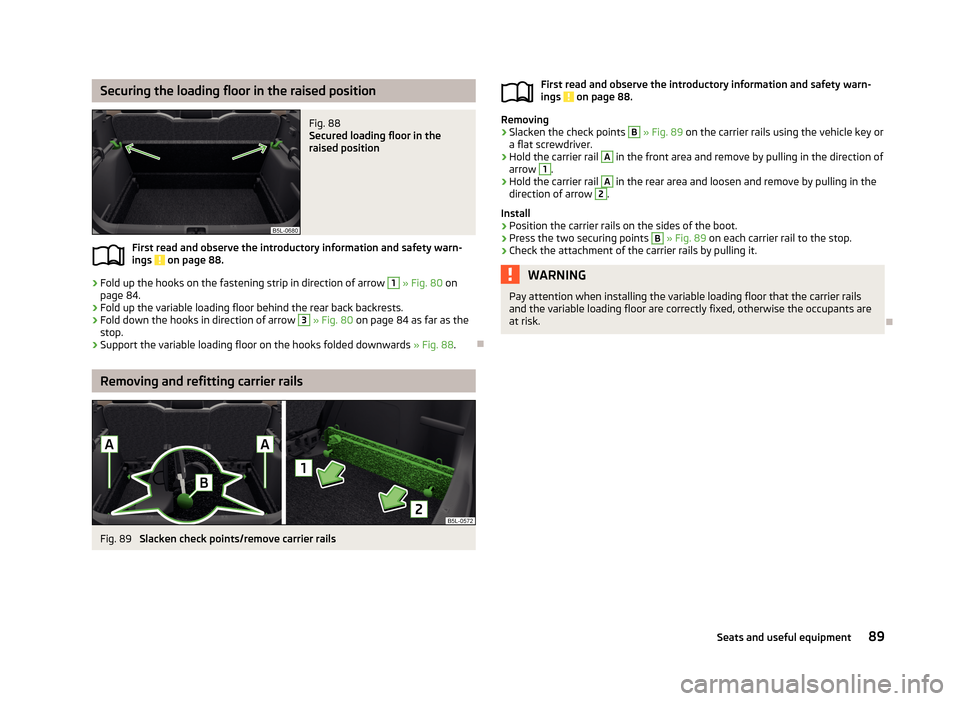
Securing the loading floor in the raised positionFig. 88
Secured loading floor in the
raised position
First read and observe the introductory information and safety warn-
ings on page 88.
›
Fold up the hooks on the fastening strip in direction of arrow
1
» Fig. 80 on
page 84.
›
Fold up the variable loading floor behind the rear back backrests.
›
Fold down the hooks in direction of arrow
3
» Fig. 80 on page 84 as far as the
stop.
›
Support the variable loading floor on the hooks folded downwards » Fig. 88.
Removing and refitting carrier rails
Fig. 89
Slacken check points/remove carrier rails
First read and observe the introductory information and safety warn-
ings on page 88.
Removing
›
Slacken the check points
B
» Fig. 89 on the carrier rails using the vehicle key or
a flat screwdriver.
›
Hold the carrier rail
A
in the front area and remove by pulling in the direction of
arrow
1
.
›
Hold the carrier rail
A
in the rear area and loosen and remove by pulling in the
direction of arrow
2
.
Install
›
Position the carrier rails on the sides of the boot.
›
Press the two securing points
B
» Fig. 89 on each carrier rail to the stop.
›
Check the attachment of the carrier rails by pulling it.
WARNINGPay attention when installing the variable loading floor that the carrier rails
and the variable loading floor are correctly fixed, otherwise the occupants are
at risk.
89Seats and useful equipment